
A wins-based scoring pool ranks participants by simply counting how many games their drafted teams win, nothing more. It's the right call for casual pools among friends or coworkers who want a transparent leaderboard without tracking stats all season. Skip it only if your group wants deeper strategy layered into scoring.
TL;DR:
- A wins-based scoring pool awards one point for each team win, making it ideal for casual groups prioritizing simplicity over detailed analysis.
- Setting clear rules before the draft, including entry method, deadlines, pick lock times, and payout procedures, prevents disputes later.
- Automated scoring platforms eliminate manual errors and ensure transparent, consistent results by directly importing game outcomes and applying pre-set tiebreaker hierarchies.
- In larger pools, drafting some underdog teams can improve expected standings since everyone tends to pick popular favorites, reducing relative advantage.
- The most common mistakes involve changing rules mid-season, neglecting to publish tie-breakers clearly, or inaccuracies from manual scorekeeping.
Table of Contents
- What Is a Wins-Based Scoring Pool?
- What Rules Should You Publish Before the Draft?
- Scoring Templates You Can Copy Today
- How Should You Draft Under Wins-Based Scoring?
- Commissioner Checklist and Mistakes to Avoid
- What Statistical Patterns Matter in Wins-Based Pools?
- Why Automated Scoring Makes Wins-Based Pools Easier
- Sources
- FAQ
What Is a Wins-Based Scoring Pool?
A wins-based scoring pool awards points strictly for team wins. Draft a set of teams, and every win they log adds to your total. No margin of victory, no bonus stats, no weighting by opponent strength unless you add it deliberately. It's the simplest scoring format available for team-draft pools, and that simplicity is the whole point.
Compare that to a points-based system, where participants earn credit for exact scores, margin thresholds, or multiple statistical categories. Prediction leagues often run on tiered systems, like one point for picking the correct winner and three points for nailing the exact score. That layered approach rewards precision but demands more setup and more explaining to your group.
Here's how wins-based scoring stacks up:
- Pros: Easy to explain in one sentence, transparent leaderboard anyone can audit, minimal setup time, and low weekly maintenance.
- Cons: Less granularity, so blowout wins and nail-biters count the same, and ties happen more often because outcomes are binary.
- Best fit: Small to mid-size groups, casual office or family pools, and commissioners with limited time for administration.
If your group cares more about "did my team win" than "by how much," this format matches the way people already talk about sports on Monday morning.
What Rules Should You Publish Before the Draft?
Publish your rules before a single pick happens. Groups that skip this step almost always end up arguing about something nobody thought to define, and by then it's too late to fix without hard feelings.
At minimum, your published rules need these four items:
- Entry method — how participants join (draft order, sign-up deadline, minimum group size).
- Deadlines — the date and time the draft closes and the date the season's scoring begins.
- Pick lock times — the exact cutoff after which rosters can't change.
- Payout method — how and when winnings move, and who's responsible for collecting them.
Tie-breakers deserve their own hierarchy, decided in advance rather than argued about after the fact. A workable default order, borrowed from common pool templates, runs like this:
- Number of weeks a participant had the most total wins
- Head-to-head result between tied participants, if your format tracks it
- Total win margin or aggregate point differential across the season
- Coin flip or random draw as the final fallback
For a deeper breakdown of how to structure this hierarchy, see how to set tiebreaker rules for a sports pool.
If real money is involved, collect entry fees up front through a peer payment app rather than promising to "settle up later." Casual pools should stay private, skip public advertising, and avoid taking a house cut, since state betting laws treat organized, publicly promoted pools very differently than a private group of coworkers splitting a pot. If your pool involves a workplace, check company policy first. HR departments have shut down office pools over less.
Scoring Templates You Can Copy Today
Three templates cover most wins-based pools, and each has a natural use case depending on how much nuance your group wants.
Template A: Pure wins. One point per team win, summed across every team you drafted. A commissioner running three teams that go 8 and 4, 6 and 6, and 10 and 2 posts a season total of 24 points. No math beyond addition.
Template B: Wins plus weekly bonus. Same base scoring, with a bonus point added for whoever posts the highest single-week win total, or a bigger bonus for a perfect week across all drafted teams. This keeps late-season interest alive when someone's overall total is already out of reach.
Template C: Weighted wins. Useful when teams play an uneven number of games, such as byes in a tournament format. Each win counts as a fraction, calculated against games played, so a team that wins 4 of 5 games scores comparably to one that wins 8 of 10.
Here's a worked tiebreaker example using Template A's default hierarchy:
- Participant A and Participant B both finish the season at 24 total wins.
- Check weeks with the most combined wins: both had two "best weeks," so it's still tied.
- Move to head-to-head, if your pool format tracks it directly. If there's no direct matchup, skip to the next tier.
- Compare total win margin across all games: Participant A's teams outscored opponents by a wider aggregate margin, so A takes the tiebreaker.
That's a full dispute resolved without a single argument, because the hierarchy was set before anyone drafted a team. For more on how scoring configuration works across different team-pool formats, see how scoring rules are configured for team pools.
How Should You Draft Under Wins-Based Scoring?
Draft strategy shifts once you know the format rewards raw win totals instead of point differentials. In small pools, favorites are usually the safer pick, since they maximize your expected win count over the season. But pool size changes the math.

Academic models on pool strategy show that as pool size grows, picking a few underdogs can raise your expected return even though favorites still maximize your raw expected score. The logic is simple: if everyone drafts the same popular teams, you're tied with the whole field when those teams win, and you gain nothing relative to your competition. Crowd avoidance means picking a team fewer people have, so a surprise run separates you from the pack instead of blending in with it.
A few practical guidelines:
- In pools under 10 people, stick mostly with proven winners.
- In pools of 30 or more, mix in one or two lower-profile teams with real upside.
- If you're allowed multiple entries, avoid drafting nearly identical rosters across all of them. Extreme overlap raises your variance without improving your odds, since one bad week sinks every entry at once.
Pro Tip: Draft one contrarian pick you'd be embarrassed to explain at the water cooler. If it's a team nobody else wants, that's exactly the point.
For a longer breakdown of pick strategy across pool sizes, read draft pick strategy for sports pools.
Commissioner Checklist and Mistakes to Avoid
Running a clean pool comes down to sequencing. Handle these in order and you'll avoid nearly every dispute that trips up first-time commissioners.
- Pre-draft: Publish rules, pick a scoring template, lock in tiebreakers, and collect entry fees if money's involved.
- During the season: Post leaderboard updates regularly, enforce pick lock times without exceptions, and communicate any clarification immediately, not after complaints start.
- Post-season: Publish final standings, distribute payouts promptly, and keep a copy of the rules and results in case next year's group asks how it worked.
The single most common mistake is changing rules mid-season. A commissioner who tweaks the tiebreaker order after a tie actually happens will lose the group's trust fast, even if the change seems fair. Ambiguous tiebreakers and manual scoring errors from spreadsheets round out the top three complaints commissioners hear.
Pro Tip: Screenshot your published rules and pin them somewhere the whole group can see, so nobody can claim they didn't know the tiebreaker order.
What Statistical Patterns Matter in Wins-Based Pools?
Wins-based scoring compresses a season's worth of performance into one number, and that compression has real statistical consequences worth understanding before you draft.
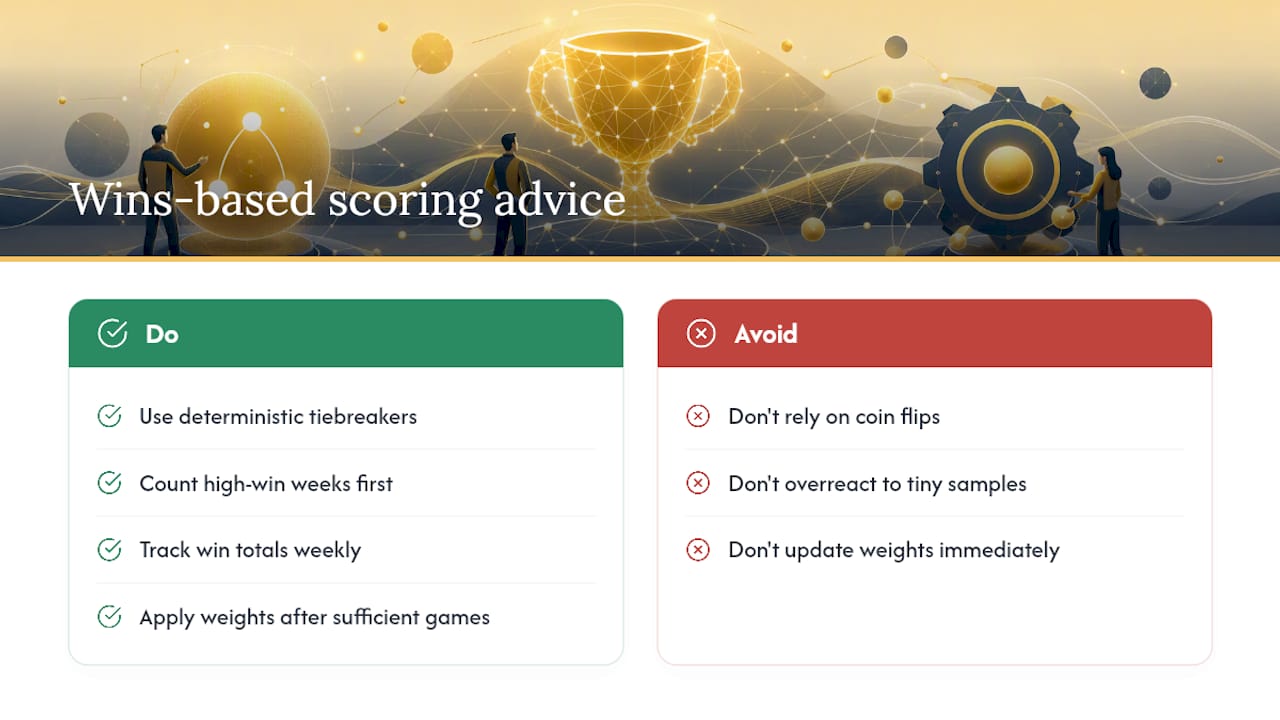
Binary outcomes produce more ties than granular scoring systems. Since a win counts the same whether it comes by 1 point or 40, two participants with wildly different underlying performance can land on identical totals. That's why a solid tiebreaker hierarchy isn't optional decoration, it's structural. Deterministic tiebreakers, like counting highest-win weeks before resorting to head-to-head or margin, preserve a sense of fairness better than jumping straight to a coin flip.
Sample size also matters more than most commissioners expect. A team that wins its first three games looks dominant, but three games is a small sample, and regression toward a team's true talent level is normal, not a sign that something's wrong with your draft. Commissioners who track win totals week over week, rather than only at season's end, tend to make sharper in-season judgments about which participants are genuinely ahead versus running hot.
Weighted templates introduce their own wrinkle: fractional win rates behave differently at the extremes. A team that goes 2 for 2 posts a perfect rate on a tiny sample, which can distort early standings if your template updates live. Waiting until a team has played a meaningful number of games before applying weighted comparisons keeps early-season noise from masquerading as a real lead. For more on how underlying data shapes these calculations, see the role of data in pool scoring.
Why Automated Scoring Makes Wins-Based Pools Easier
Manual spreadsheets are where most wins-based pools break down. Someone forgets to update a row, a formula gets overwritten, and suddenly the "official" standings are in dispute the week before payouts. Automated platforms fix this by pulling results directly and applying your published tiebreaker hierarchy the same way every time, with no room for a commissioner's thumb on the scale, intentional or not.
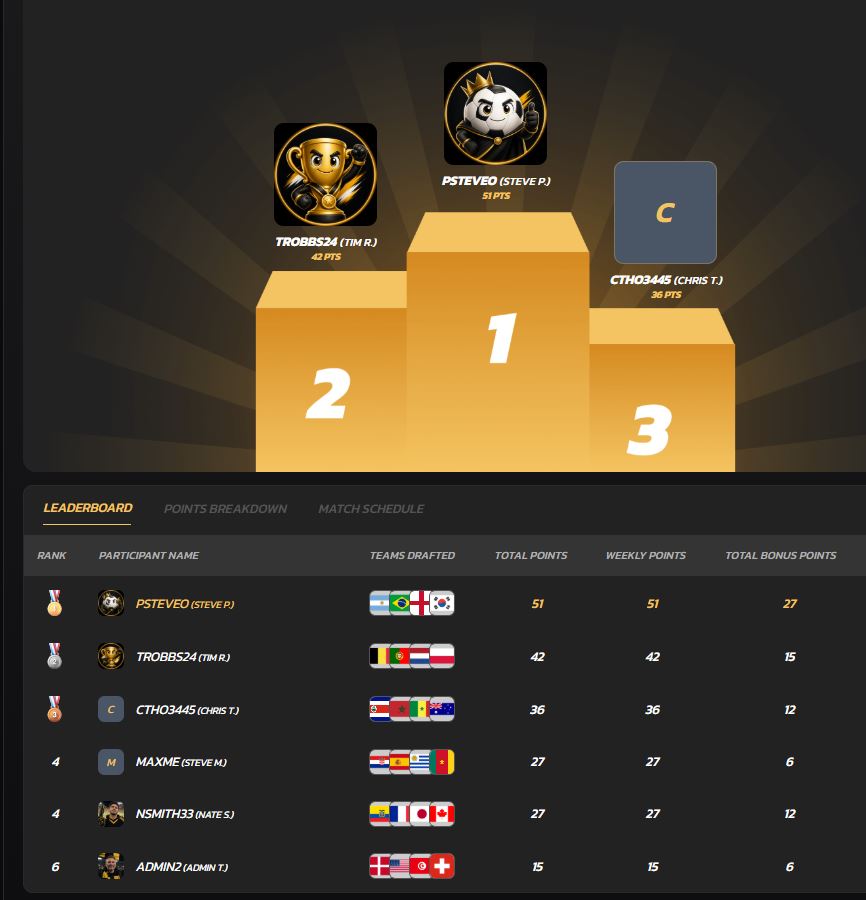
DraftWins was built around exactly this problem: private, team-draft pools where the draft itself, not individual player stats, drives the competition. Setting one up follows a short sequence. Create a private pool, configure the wins-based scoring template that matches your group (pure wins, weekly bonus, or weighted), run the draft, and let automated scoring and live leaderboards handle the rest. Lock times are enforced automatically, so nobody can sneak in a late roster change, and tiebreaker calculations run transparently instead of behind a spreadsheet formula only the commissioner can see.
Commissioners pay a one-time hosting fee to create their pool; participants join for free. There's no entry fee collection, no prize pool held by the platform, and no wagering involved, just a clean, automated way to run the pool you'd otherwise be tracking by hand. Check current pool options to see which format fits your group's season.
Sources
FAQ
What Is a Wins-Based Scoring Pool?
It's a scoring format that ranks participants by the total number of wins earned by the teams they drafted, with no credit for margin of victory or additional stats.
How Do Tiebreakers Work in a Wins-Based Pool?
A common default order checks the number of highest-win weeks first, then head-to-head results, then total win margin, and finally a random draw if everyone's still tied.
Is Wins-Based Scoring Better Than Points-Based Scoring?
Wins-based scoring is simpler and easier to explain to a casual group, while points-based systems offer more precision at the cost of extra setup and complexity.
Should I Draft Favorites or Underdogs in a Large Pool?
In small pools, favorites are usually safer, but larger pools reward a few contrarian underdog picks since everyone drafting the same favorites cancels out the advantage.
Can DraftWins Automate a Wins-Based Pool?
Yes. DraftWins lets commissioners configure a wins-based scoring template, run the team draft, and automatically track results on a live leaderboard without manual spreadsheet updates.