
Use this default chain and you'll settle almost any tie without an argument: (1) head-to-head result for a two-team tie, (2) point or goal differential, (3) total points scored, (4) fewest points allowed, (5) a coin flip or drawing of lots as the last resort. Publish it before anyone submits a pick.
Here's a copy-ready line you can paste straight into your rules page or pool settings today: "Ties are broken in this order: head-to-head, point differential, total points scored, points allowed, then a random draw."
The order matters more than the criteria themselves:
- Head-to-head (two teams only)
- Point/goal differential
- Total points or goals scored
- Fewest points/goals allowed
- Drawing of lots or a coin flip
Set tiebreaker rules for your sports pool before games start, not after a dispute forces your hand.
Key Takeaways
Setting a clear tiebreaker chain before competition starts, and applying it consistently through sub-group calculations for multi-team ties, prevents the disputes that ruin an otherwise fun pool.
| Point | Details |
|---|---|
| Publish before play begins | Post your tiebreaker chain on the registration page or rules sheet before the first game. |
| Use sub-groups for 3+ ties | Extract tied teams, apply sub-group head-to-head and differential before whole-pool metrics. |
| Match the criteria to the sport | Combat sports use classification points; soccer varies on head-to-head vs. goal difference; baseball often uses runs allowed. |
| Reserve playoffs for when logistics allow | Use a scheduled tiebreaker match when time permits; fall back to a transparent draw otherwise. |
| Lock rules in your platform | Draftwins lets commissioners configure and lock tiebreaker order directly in pool settings. |
Table of Contents
- What each tiebreaker criterion actually measures
- How do you resolve two-team versus multi-team ties?
- How do sport-specific tiebreaker rules differ?
- Copy-ready tiebreaker templates you can publish today
- Should you schedule a playoff or just draw lots?
- How do you publish and enforce tiebreaker rules?
- Automate Your Tiebreaker Rules With Draftwins
- Sources
- FAQ
What each tiebreaker criterion actually measures
Every tiebreaker option answers a slightly different question, and picking the wrong one for your format is how you end up with a fight in the group chat.
Head-to-head asks who won when the tied teams played each other. It's intuitive and fast, but it collapses the moment you get a three-way circular tie: Team A beat Team B, B beat C, and C beat A. Nobody "wins" that loop.
Win percentage measures wins divided by games played rather than raw win count, which matters when someone missed a game or the schedule wasn't perfectly even. Point (or goal) differential looks at scoring margin across every game and rewards teams that dominate, not just squeak by. Total points scored and least points allowed isolate offense and defense separately, useful in high-scoring sports like basketball or fantasy-style pools where margin alone doesn't tell the full story. Classification or quality-of-win points, common in combat sports, weight a win by how decisively it happened.
- Head-to-head: fast, intuitive, breaks down in circular ties
- Win percentage: fairer when match counts differ
- Point differential: rewards consistent dominance
- Least points allowed: isolates defensive performance
- Classification points: ranks the quality of a win, not just the result
Whichever ones you pick, decide up front whether you're computing them across the whole pool or only within the tied sub-group. That single choice avoids most disputes later.
Pro Tip: Decide how forfeits count before the season starts. A 1-0 forfeit win can quietly swing a point-differential tiebreaker in ways nobody intended.
How do you resolve two-team versus multi-team ties?
Two-team ties are the easy case. If the tied teams played each other, head-to-head usually decides it. If they never played, or the game ended in a draw, skip straight to point differential.
Multi-team ties need a different process:
- Pull the tied teams into their own sub-group, ignoring everyone else in the standings.
- Recalculate head-to-head results using only games played within that sub-group.
- If still tied, calculate point differential using only sub-group games.
- Still tied? Move to whole-pool metrics like total points scored, then least points allowed.
- Once one team is separated out, treat the remaining teams as a fresh tie and restart the check for that smaller group.
The circular tie problem (A beats B, B beats C, C beats A) is why step 2 uses sub-group point differential instead of trying to force a head-to-head winner that doesn't exist.
Quick example: Three teams tied at 2-1. Sub-group scores: A beat B 21-14, B beat C 17-10, C beat A 24-20. Sub-group point differential: A is minus-1, B is minus-4, C is plus-5. C ranks first, and A and B restart their own tiebreaker check for the remaining two spots.

How do sport-specific tiebreaker rules differ?
Default chains work fine for casual pools, but they can conflict with the actual rulebook the moment your event has real stakes or official sanctioning.
Combat sports like judo, wrestling, and taekwondo often skip point differential entirely in favor of classification points, sum-of-points systems, or "shortest accumulated time" among winners. Soccer is its own minefield: FIFA and UEFA competitions have historically disagreed on whether head-to-head or overall goal difference gets checked first, and that order has changed between tournament cycles. Baseball and softball pools frequently prioritize runs allowed over runs scored, though youth leagues sometimes flip that order to discourage running up the score.
Always confirm precedence against the governing rulebook for your sport before assuming a generic chain applies. A default that works for your office NFL pool can be flatly wrong for a sanctioned youth soccer bracket.
- Combat sports: classification points, sum-of-points, or shortest winning time
- Soccer/football: head-to-head vs. overall goal difference varies by competition
- Baseball/softball: runs allowed often outranks runs scored
- Always cross-check the official federation or league rulebook
Copy-ready tiebreaker templates you can publish today
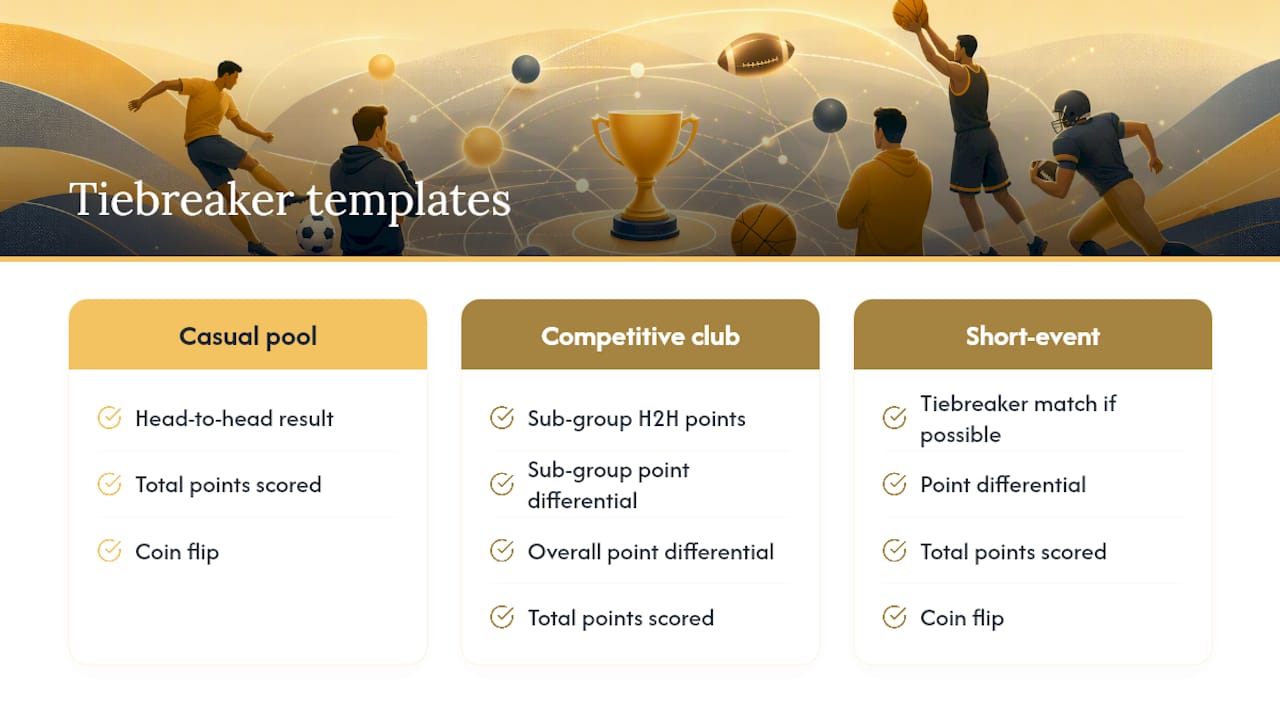
Three templates cover almost every use case. Pick the one matching your pool's stakes and paste it in as-is.
Casual/friendly pool (office pools, family brackets, low data tracking): "Ties are broken by: 1) head-to-head result, 2) total points scored, 3) coin flip."
Competitive club event (leagues that track full stats and run multi-week schedules): "Ties are broken in this order: 1) sub-group head-to-head points among tied teams, 2) sub-group point differential, 3) overall point differential, 4) total points scored, 5) points allowed, 6) drawing of lots. Classification points apply where relevant to the sport."
Short-event/championship (single-day tournaments where a decisive game is possible): "In the event of a tie, a scheduled tiebreaker match will be played if time and facilities allow. If a match cannot be scheduled, ties are broken by point differential, then total points scored, then a coin flip."
For software fields with tight character limits, use this compressed clause: "Tiebreakers: head-to-head, point differential, total points scored, points allowed, random draw."
Simple, well-defined scoring rules beat elaborate chains that nobody but the commissioner understands, especially for club and office pools where enforcement depends on everyone trusting the process.
Should you schedule a playoff or just draw lots?
A tiebreaker match is the most satisfying way to settle a tie because it lets teams decide it on the field rather than on paper. The catch is logistics: you need a time buffer, available space, and teams who agreed in advance to play if needed.
A draw makes more sense when there's no schedule room left, when metrics are truly equal down the line, or when it's simply the last resort after every other rule has run out.
- Playoff checklist: confirm time buffer, arrange warm-up, note any seeding effects
- Draw checklist: use a neutral witness, number the options, record the result publicly
Pro Tip: If you're offering a tiebreaker match, get written or emailed confirmation from both teams before the event starts. A team that didn't expect to play again can refuse, and then you're stuck defaulting to a draw anyway.
How do you publish and enforce tiebreaker rules?
Rules that exist only in your head don't count. Post them on the registration page, email them with the schedule, and link them from wherever the standings live.
Lock the settings once the pool starts, whether that's a physical rule sheet with a signature or a software configuration you screenshot with a timestamp. Locking prevents the "wait, I thought we said..." argument three weeks in.
Name a final arbiter up front, whether that's you as commissioner or a small committee, and describe what evidence they'll look at if a dispute comes up.
- Publish rules before the first pick or game
- Lock settings and record the version/date
- Name who has final say on disputed calls
- Send one clear notice: "Tiebreakers are posted at [link] and are final once published."
Getting your scoring rules locked in alongside your tiebreakers up front saves you from having to referee a debate mid-season.
Automate Your Tiebreaker Rules With Draftwins
Writing a tiebreaker chain is one thing. Enforcing it consistently across a full season, without doing manual math every week, is another problem entirely. Draftwins handles that gap.
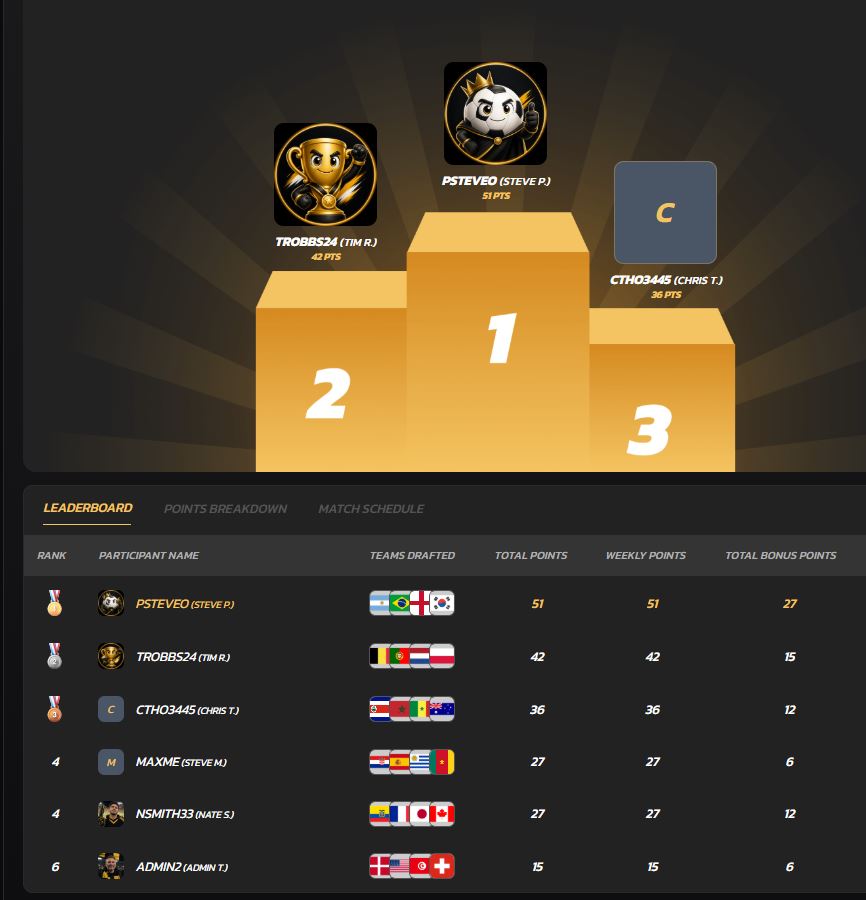
Draftwins lets commissioners configure tiebreaker order directly in the pool settings, whether that's head-to-head, point differential, or total points scored, and the platform applies it automatically to every live leaderboard. Because pools draft teams instead of individual players, there's no lineup management chaos on top of tiebreaker math. Once you lock your rules, they stay locked. No spreadsheet, no re-explaining the chain to a confused participant in week six.
If you're setting up a football pool this season, start with DraftWins for NFL pools and configure your tiebreaker chain during setup. For any other sport, the main pools page walks you through customizing scoring and tiebreaker rules before you send out invites.
Sources
- Tiebreaker Rules in Tournaments — How to Resolve Equal Points — SportsBracket
- How to Run a Pickleball Round Robin Tournament | LADR
- How to Run an Office Bracket Pool - Scoring, Rules
FAQ
What is the recommended default tiebreaker chain for a sports pool?
Head-to-head for two-team ties, then point differential, total points scored, points allowed, and finally a drawing of lots if everything else is even.
How do you handle a tie between three or more teams?
Extract the tied teams into a sub-group, apply head-to-head and point differential using only games played within that sub-group, then fall back to whole-pool metrics if needed.
Is a tiebreak scored to 7 points or 10?
Tiebreak scoring format depends entirely on the sport and event rules; tennis tiebreaks are played either to the sport's prescribed number of points depending on the format. Check your specific event's rulebook since various formats are in active use.
Does the final set always go to a tiebreak?
Not always. Many tournaments allow the deciding set to be played out normally without a tiebreak, while others apply a 10-point tiebreak specifically for the last set. This varies by governing body and event, so confirm the format before play starts.
How do you handle ties in individual player pools, like fantasy-style contests?
Apply the same logic used for teams: total points scored first, then a secondary stat like bench points or highest single scoring player, before resorting to a coin flip.
How should tiebreakers adjust for pools where teams played an unequal number of games?
Use win percentage or points-per-game instead of raw totals as your first criterion, since it corrects for missed games or uneven scheduling before you ever look at point differential.