
Game and player data is the source of truth behind every point, every rank, and every leaderboard shift in an automated sports pool. A deterministic scoring engine turns raw event logs into pool results the same way every time, given the same inputs. For commissioners, that means fewer disputes and no manual math. For participants, it means the leaderboard they check on their phone actually reflects what happened on the field.
Key Takeaways
Accurate pool scoring depends on treating raw game data as the permanent source of truth and keeping scoring rules separate from data ingestion.
| Point | Details |
|---|---|
| Data is the source of truth | Every score and leaderboard position traces back to timestamped, verified game events. |
| Separate ingestion from scoring | Keeping these layers apart allows a full re-score without re-fetching provider data. |
| Immutable event logs enable corrections | Storing raw events, not just totals, lets a platform recalculate scores after official corrections. |
| Event-driven beats polling | Pushing verified events to clients delivers faster, more reliable leaderboard updates than polling. |
| DraftWins applies these principles | Draftwins uses configurable scoring rules and automated updates so commissioners don't manage the data pipeline manually. |
Table of Contents
- The Role of Data in Pool Scoring
- Which Data Inputs Actually Matter for Scoring?
- Why Does Scoring Architecture Determine Accuracy?
- What Should Commissioners Check Before Launching a Pool?
- DIY Spreadsheets or an Automated Platform?
- Built Around These Data Principles: DraftWins
- Sources
- FAQ
The Role of Data in Pool Scoring
Here's the mechanical version of what happens between a touchdown and a leaderboard refresh:
- A live match event occurs (a goal, a sack, a substitution) and gets logged by a sports data provider with a timestamp and player ID.
- The event lands in a queue, tagged with team and player identifiers that stay stable across the season.
- A normalization step cleans the raw feed, matching provider-specific codes to your platform's internal IDs.
- A scoring trigger fires, running that single event through the pool's configured rules.
- The updated total writes to a cache, and a push notification (not a page refresh) sends the new number to every connected client.
The two details that matter most to a commissioner are timestamping and player ID consistency. If a provider swaps player ID formats mid-season or drops a timestamp, downstream scoring breaks silently, and you won't notice until someone complains their score is wrong.
Event-driven delivery, where verified events get pushed to clients the moment they're processed, has replaced polling in most modern leaderboard systems. Polling means your browser asks "anything new?" every few seconds; event-driven means the server tells you the instant something changes.
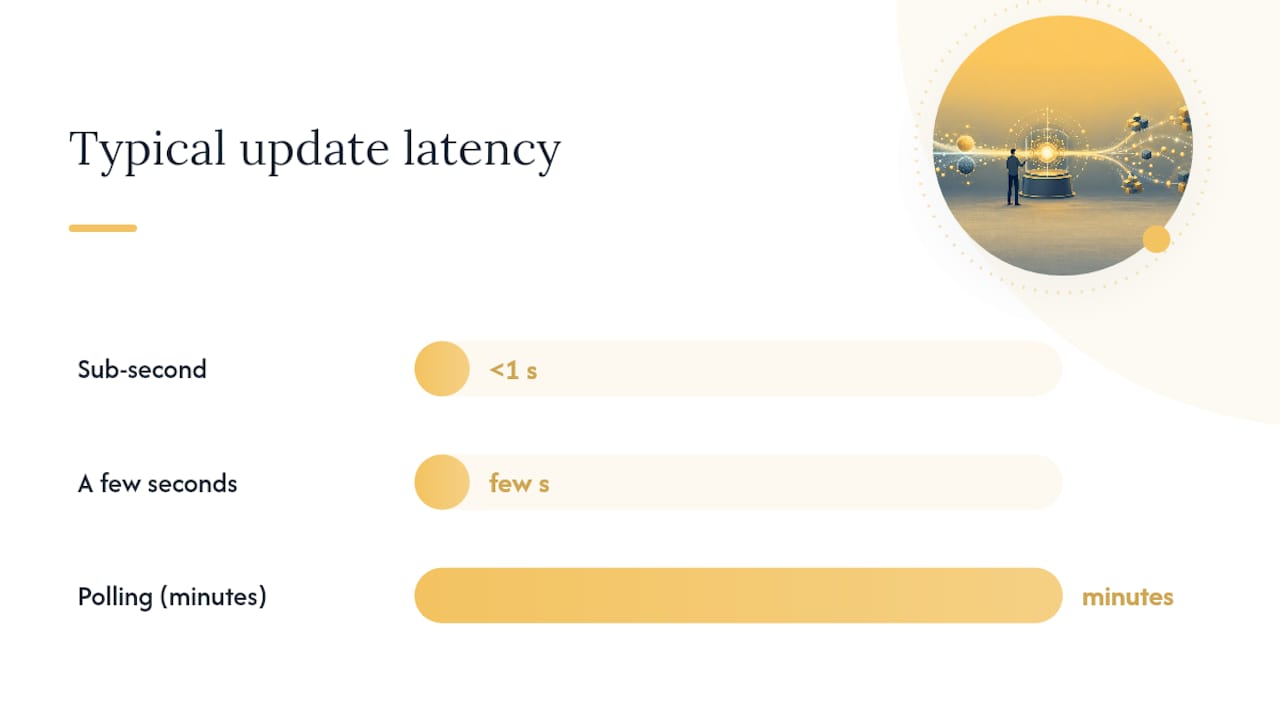
Pro Tip: Ask any platform you're evaluating what their typical update latency is, from event to visible leaderboard change. Sub-second to a few seconds is realistic for a well-built event-driven system; anything measured in minutes suggests they're still polling.
Which Data Inputs Actually Matter for Scoring?
Not all data is equal. A scoring engine that only tracks final stat lines can calculate today's score, but it can't explain itself or fix a mistake next week. The datasets that matter are the ones that let a system reconstruct exactly how a point was earned.
At minimum, a reliable platform needs:
- Live event logs, timestamped down to the play or minute
- Player and team IDs that stay consistent across a full season, not just a single game
- Lineups and substitutions, since scoring rules often change based on who's actually on the field
- Injury reports, which affect both real-time scoring and pool participation decisions
- Historical stats, used for tie-breakers, projections, and season-long context
A well-built raw event record looks something like this:
That last field, source ID, is what makes provenance possible. When a provider issues a correction, the platform needs to know exactly which raw event to revise. Keeping this durable, unedited event log is what makes re-scoring after an official correction possible instead of a manual scramble through old box scores.
Why Does Scoring Architecture Determine Accuracy?
The difference between a pool that handles a Monday-morning stat correction gracefully and one that dissolves into a group chat argument almost always comes down to architecture decisions made long before kickoff.
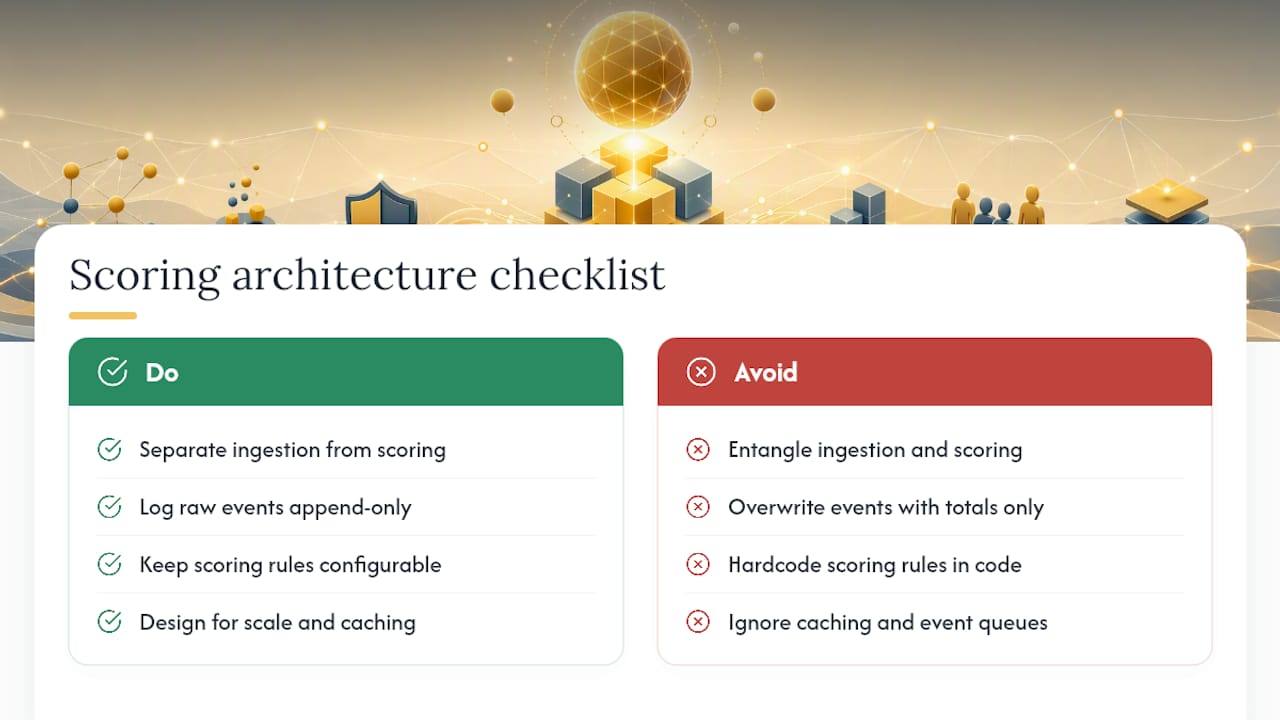
Separate ingestion from scoring. The layer that pulls in raw data should never also apply point values. When those two jobs get tangled together, a platform loses the ability to re-score a completed gameweek without re-pulling the entire feed from the provider. Keep them separate, and a correction becomes a quick replay of stored events instead of a full re-fetch.
Keep raw events immutable. Rather than storing only a final point total, a well-designed system logs the underlying facts as an append-only record. If a stat gets revised days later, the platform reconstructs the score from scratch instead of patching a number and hoping nobody asks why it changed.
Store scoring rules as configuration, not code. Rules like "3 points per touchdown" or "custom bonus for a shutout" should live in a database as editable data, not buried in the application's source code. This is what lets a commissioner adjust settings through a dashboard instead of filing a support ticket and waiting on a developer.
Design for scale. Handling thousands of concurrent participants checking a leaderboard during a live game usually means an event queue for incoming data, a caching layer (commonly Redis) for fast leaderboard reads, and time-series storage for high-frequency events, paired with WebSocket or server-sent-event delivery so updates reach everyone's screen at the same moment.
Pro Tip: When you're comparing platforms, ask two direct questions: "How long does a full re-score take after an official correction?" and "Can I see the audit trail for a specific point I'm questioning?" A platform that hesitates on either answer probably built scoring and ingestion as one tangled system.
What Should Commissioners Check Before Launching a Pool?
Running a pool that people trust for an entire season means catching problems before week one, not during a tense group chat in week three. Work through this before you open registration:
- Confirm which data provider feeds your scoring engine, and whether that provider issues corrections after games.
- Review the scoring configuration yourself; if you can't see the rules in plain language, participants can't either.
- Test the rescore flow on a past game to confirm point totals update correctly after a simulated correction.
- Verify time zone handling, especially for pools spanning international matches or late-night games.
- Settle disputes rules in writing before the season starts, not after the first disagreement.
Once the season is live, keep watching a smaller set of things:
- Leaderboard update latency during peak traffic (kickoff Sunday is not the time to discover lag)
- Whether you or participants can access an audit log for a disputed point
- How corrections get communicated (a silent number change breeds more complaints than an explained one)
Before your first live contest, ask platform support two questions that reveal how seriously they take data integrity: "How do you handle official stat corrections?" and "Can I see the raw event that produced this specific point?" A platform with a real answer to both has almost certainly separated ingestion from scoring the right way.
Pro Tip: Run a staged dry-run using a past week's real game data, and publish two or three worked scoring examples to your participants before the season starts. It takes twenty minutes and eliminates most "wait, how did that count?" messages during your first live week.
DIY Spreadsheets or an Automated Platform?
A one-off pool among five coworkers with simple rules can survive on a spreadsheet. A season-long pool with dozens of participants, live scoring expectations, and any chance of a stat correction usually can't.
Spreadsheets work using import functions and lookup formulas pulling from public stat sources, but they demand manual cleanup and formula patchwork every time a data format shifts, and they have no real audit trail when someone questions a score. A self-hosted scoring engine gives more control but requires someone to actually maintain the ingestion pipeline and rule logic. A hosted automated platform, built by people whose job is exactly this, handles ingestion, scoring, and corrections without commissioner intervention.
| Category | Accuracy & Corrections | Time Cost | Scale |
|---|---|---|---|
| DIY spreadsheets | Manual, error-prone, no audit trail | High, ongoing upkeep | Fine for small, single pools |
| Self-hosted engine | Accurate if built well, requires maintenance | High upfront, lower ongoing | Scales with technical effort |
| Hosted automated platform | Built-in re-scoring and audit logs | Minimal after setup | Handles concurrent, multi-league pools |
Use a hosted platform when your pool has real stakes, more than a handful of participants, or overlaps with other leagues you're running. Reach for a spreadsheet only when the pool is small, casual, and unlikely to need a correction mid-season.
Built Around These Data Principles: DraftWins
Draftwins runs on the same architecture principles covered above: a deterministic scoring engine, scoring rules stored as configuration rather than hardcoded logic, and event logs that support re-scoring when official stats change. Commissioners set up rules through the platform's interface, not a spreadsheet formula or a support ticket.
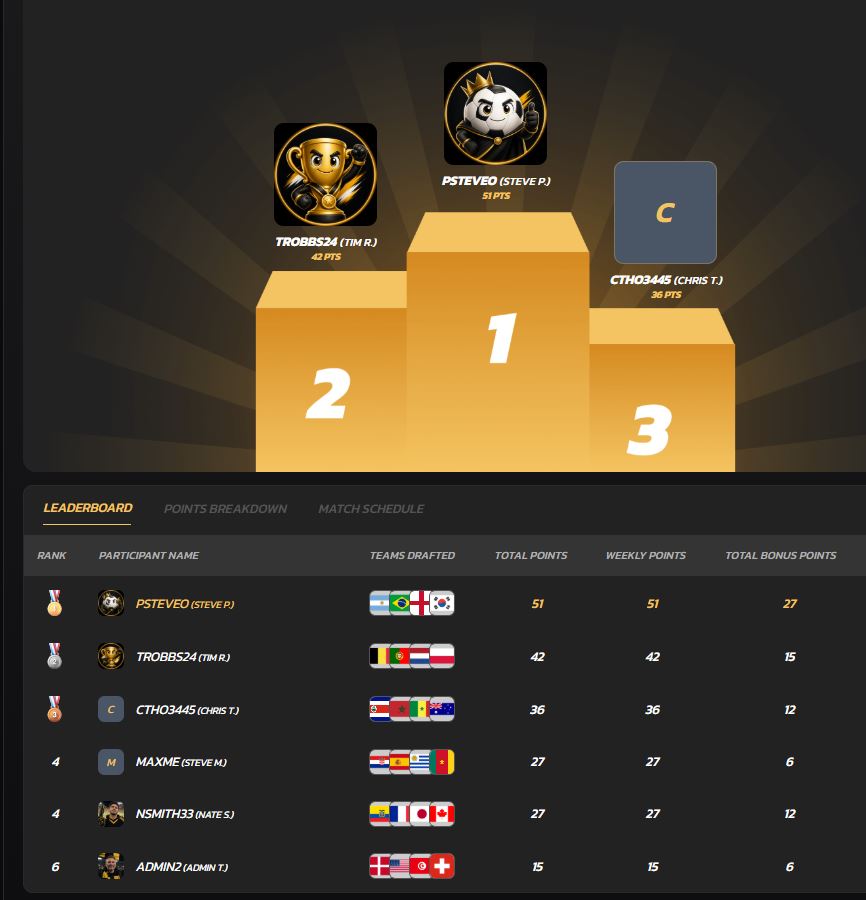
Because team-draft pools score entire teams instead of tracking individual player lineups, the data pipeline stays leaner while still giving commissioners full visibility into how a leaderboard was calculated. That's a meaningful difference from a raw spreadsheet setup or a self-hosted script: you get automated updates and a configurable rules engine without maintaining the pipeline yourself. Live leaderboards update automatically as game data comes in, and corrections apply without a manual recalculation on your end.
If you're setting up a pool for the coming NFL season, start your NFL pool on DraftWins and configure scoring rules before your first kickoff. For other formats, browse DraftWins pool options to see which setup fits your group.
Sources
- Fantasy scoring engines architecture and edge cases - SportMonks
- Building a live sports scoreboard with streaming SQL | RisingWave
FAQ
What role does data play in pool scoring?
Game and player data feeds a scoring engine that applies fixed rules to produce point totals and leaderboard positions, without manual calculation.
How does a platform handle a stat correction after a game ends?
A well-built platform re-processes the stored raw event log against its scoring rules, which is why immutable event logs matter more than storing final totals alone.
Why do leaderboards update faster on some platforms than others?
Platforms using event-driven delivery push verified updates to your screen the moment they're processed, while polling-based systems wait for a scheduled check.
Should a small pool use a spreadsheet instead of an automated platform?
A spreadsheet can work for a casual, low-stakes pool with few participants, but it lacks audit trails and struggles with corrections mid-season.
Does DraftWins handle scoring corrections automatically?
Draftwins applies the same separation between data ingestion and scoring rules described throughout this guide, letting corrections flow through without commissioner intervention.