
Scoring rule configuration is the process of defining how points are assigned, weighted, and ranked across a team competition. Get it wrong and your pool ends in disputes. Get it right and every participant knows exactly where they stand after every round. Platforms like Draftwins are built around this principle, giving commissioners the tools to set up match points, board points, and tie-break sequences before a single game is played. This guide explains how scoring rules are configured from the ground up, so you can run a fair, engaging contest every time.
How scoring rules are configured: the core components
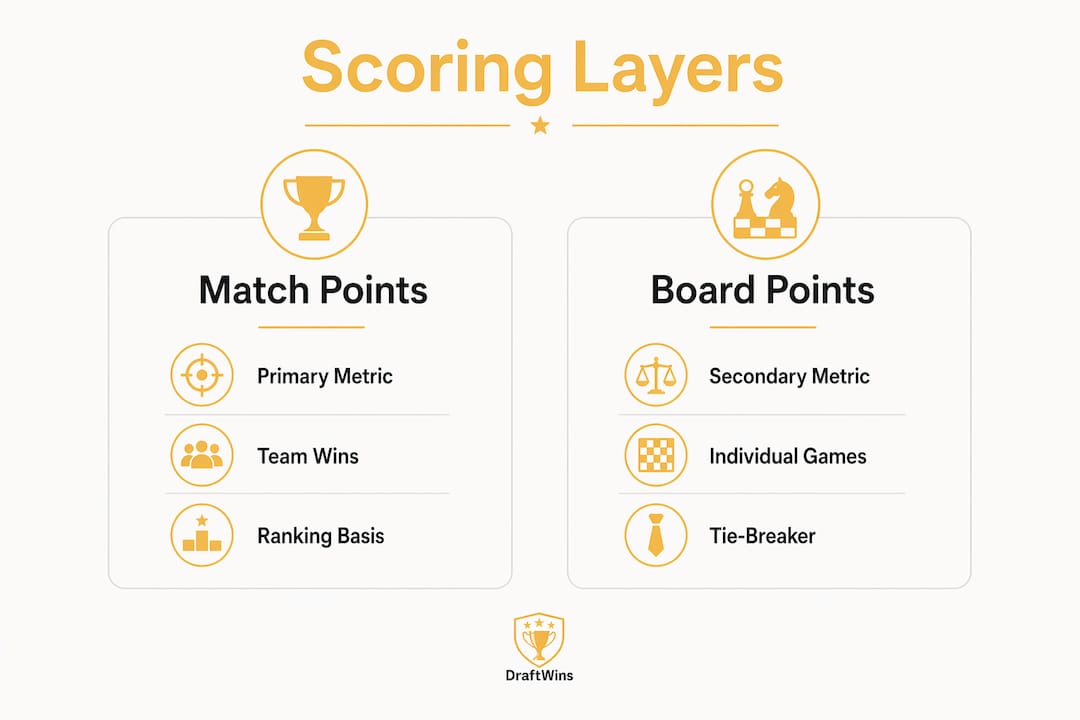
Every scoring system for team competitions rests on two parallel layers working at the same time. The first layer is match points, which measure whether a team won, drew, or lost a round. The second layer is board points, which measure how individual players or picks within that team performed.
Team competitions use two parallel scoring layers: match points as the primary ranking metric and board points as the tiebreaker. A team wins a match when it earns more than half the available board points. In a four-board setup, that means 2.5 or more points out of 4. Match points rank teams at the top level, while board points resolve ties between teams with equal match point totals.

This two-layer structure matters because it captures different dimensions of performance. Match points show whether a team succeeded overall. Board points reveal how dominant or narrow that success was. A team that wins every match by a single point looks identical to one that wins by a landslide in match points alone. Board points separate them.
Here is what a basic score configuration looks like in practice:
- Win: 2 match points
- Draw: 1 match point for each team
- Loss: 0 match points
- Board point value: 1 point per individual win, 0.5 per draw, 0 per loss
These values are not universal. Commissioners can adjust them based on competition format. Some pools award 3 points for a win to reward aggressive play. Others keep it at 2 to keep the math simple.
Pro Tip: Set your match point and board point values before you open registration. Changing them mid-competition, even for good reasons, creates distrust among participants.
Why tie-break rules are critical and how to configure them
Ties happen in every competition. Without a declared tie-break sequence, a tied final standing becomes a coin flip. That is not a competition. That is luck.
Tie-break sequences must be announced before the competition starts. The default sequence used in US Chess events is Modified Median, then Solkoff, then Cumulative, then Cumulative of Opposition. Each method calculates a different aspect of a team's performance history, and they are applied in order until the tie is broken.
Here is how the three most common tie-break methods work:
- Modified Median: Adds up the scores of a team's opponents, dropping the highest and lowest. This rewards teams that beat strong opponents consistently, not just weak ones.
- Solkoff: Adds up all opponent scores without dropping any. It is simpler than Modified Median and slightly more forgiving of one bad result.
- Cumulative: Adds up a team's own running score round by round. A team that builds its score early ranks higher than one that finishes strong but started slow.
One detail most organizers miss: unplayed games count as 0.5 points in Modified Median and Solkoff calculations. A forfeit or bye is not ignored. It is treated as a half-point result and folded into the tie-break math. This keeps rankings consistent and prevents teams from gaming the system by avoiding certain matchups.
Publishing your tie-break sequence before round one is not just good practice. It is the difference between a smooth competition and a post-final argument that poisons the whole experience.
Announcing scoring rules and tie-break orders before competition day avoids confusion and gives every team equal knowledge of how rankings are determined. FIDE applies this principle to all team events, and it translates directly to sports pools and fantasy contests.
How to set up scoring parameters in a pool platform
The score configuration process follows a clear sequence regardless of the platform you use. Define your criteria first, then assign point values, then set any weights or conditions.
The scoring configuration process includes defining conditions, assigning points, and setting frequency and time frame filters. Complex conditions are supported, meaning you can layer multiple criteria on top of each other. For a sports pool, this translates to setting different point values for different outcomes, then deciding whether those points stack or cap out.
Scores can be weighted and grouped to reflect different importance levels. In a pool context, a group stage win might carry less weight than a knockout round win. Score groups can have maximum limits so that one dominant performance does not overwhelm the entire standings.
A practical setup for a team draft pool looks like this:
- Step 1: Define the scoring criteria. What events earn points? Wins, draws, clean sheets, goals scored, or a combination.
- Step 2: Assign point values to each criterion. Be specific. "A win earns 3 points" is clear. "Good performance earns points" is not.
- Step 3: Set weights for different rounds or stages. Knockout wins can carry a multiplier.
- Step 4: Define your tie-break sequence and write it down in the pool rules.
- Step 5: Test the configuration with a sample round before the competition goes live.
For NFL draft pools, scoring and tie-break structures follow a similar layered approach. Primary points come from team wins, and secondary metrics like total points scored break ties between pool participants with identical records.
Pro Tip: Run a dry simulation with fake results before your competition opens. If the leaderboard produces a result that feels wrong, your configuration has an error you can still fix.
Match points vs. board points: which setup fits your competition?
The choice between a match-point-heavy system and a board-point-heavy system changes how participants play and how fair the final standings feel.
| Feature | Match-point-based | Board-point-based |
|---|---|---|
| Primary ranking metric | Team win/loss record | Individual game results |
| Tie-break method | Board points, then tie-break sequence | Match points, then tie-break sequence |
| Encourages | Team-level strategy | Individual performance |
| Best for | Short competitions, pools | Long tournaments, leagues |
| Risk | Ties are common at the top | Outlier performances skew standings |
Layered scoring creates a more nuanced picture of team performance, helping avoid misleading rankings based on a single metric. A team that wins three matches by a single board point each time looks equal to one that swept every board. Board points expose that difference.
In NFL draft pools, the equivalent tension is between picking teams that win games versus teams that win by large margins. A pool that only rewards wins produces conservative drafting. A pool that also rewards margin of victory pushes participants to take risks on high-scoring teams. Neither approach is wrong. The right choice depends on what kind of competition you want to run.
Team draft contest structures that combine both metrics consistently produce higher engagement. Participants who understand exactly why they are ranked where they are stay more invested through the final round.
Tie-break complexity is the main tradeoff. A simple match-point system with a single tie-break rule is easy to explain. A multi-layer system with Modified Median, Solkoff, and Cumulative in sequence is more accurate but harder to communicate. The solution is not to simplify the math. The solution is to publish the full sequence before the competition starts and let the platform handle the calculation automatically.
Draftwins makes scoring configuration straightforward
Draftwins is built for commissioners who want a fair, customizable scoring setup without spending hours on spreadsheets.
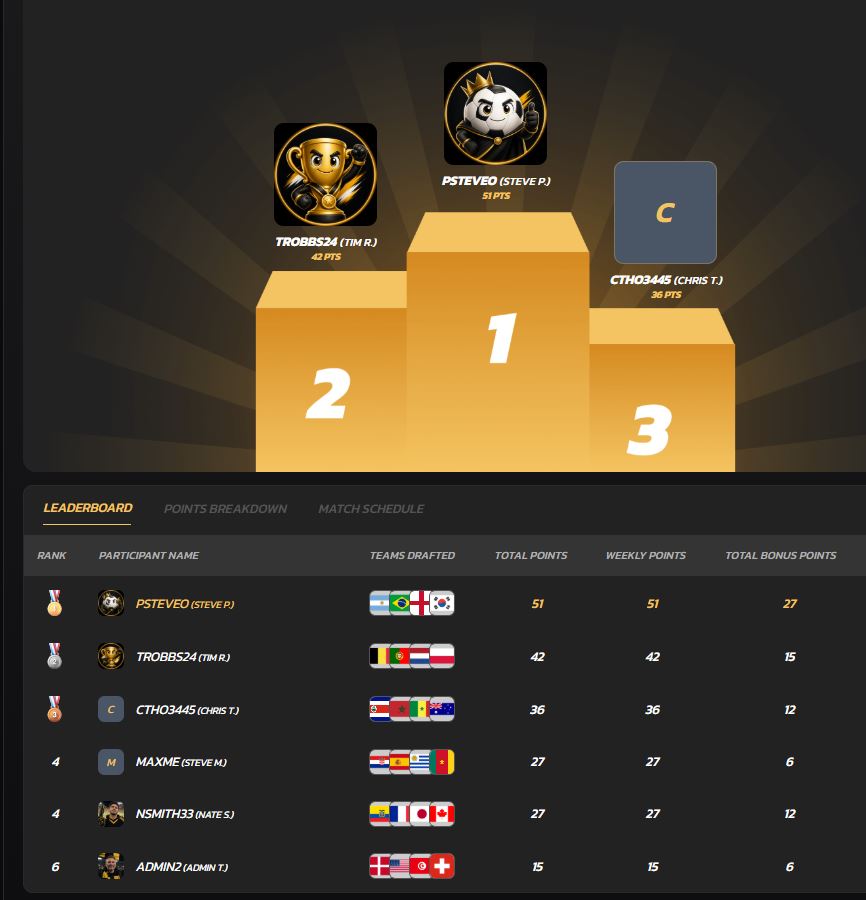
The platform lets you configure scoring rules for team-based pools with point assignments, weighted rounds, and tie-break sequences handled automatically. Live leaderboards update in real time so every participant sees exactly how the standings are calculated. Draftwins launches with World Cup pools and expands to NFL and College Football pools, giving you a flexible setup for the competitions you care about most. Commissioners set the rules. Draftwins runs the math. Learn more about fair scoring setups and see how the platform handles the configuration work for you.
Key takeaways
Scoring rules in team competitions require two parallel metrics, a declared tie-break sequence, and a published rule set before round one begins.
| Point | Details |
|---|---|
| Use two scoring layers | Match points rank teams; board points break ties between equal records. |
| Declare tie-breaks upfront | Announce Modified Median, Solkoff, and Cumulative sequences before competition starts. |
| Assign specific point values | Define exact points for wins, draws, and losses at both match and board level. |
| Weight rounds appropriately | Apply multipliers to knockout stages so later rounds carry more impact. |
| Test before going live | Run a sample simulation to catch configuration errors before participants join. |
FAQ
What does "configuring scoring rules" mean for a pool?
Configuring scoring rules means defining the exact point values, ranking criteria, and tie-break sequences that determine standings in your competition. Every rule must be set and published before the contest begins.
What is the difference between match points and board points?
Match points measure whether a team won or lost a round overall. Board points measure individual game results within that round and are used as the primary tie-break metric.
How should tie-break rules be set up?
Tie-break rules should be declared as an ordered sequence before the competition starts. The standard US Chess sequence is Modified Median, Solkoff, Cumulative, then Cumulative of Opposition, applied in that order until the tie resolves.
Do unplayed games affect tie-break calculations?
Yes. In Modified Median and Solkoff systems, unplayed or forfeited games count as 0.5 points to keep rankings consistent across all participants.
Can I use weighted scoring in a team pool?
Yes. Score groups and weights let you assign higher point values to later rounds or more significant outcomes, giving knockout stage results more impact than group stage results.