
The best friend group contest formats for private sports pools include snake/serpentine, tiered, auction-style team draft, keeper/seasonal, random/bracket draft, and salary-cap, each suited to different group sizes and commitment levels. Each format runs cleanly on Draftwins, which handles automated scoring, live leaderboards, and private pool controls so the commissioner isn't stuck doing math all season.
Quick format picks by group type:
- Snake/serpentine: small groups suited for live draft nights
- Tiered draft: casual setups for moderate group sizes
- Auction-style team draft: engages mid-sized groups with strategic play
- Keeper/seasonal: best for committed groups over multiple seasons
- Random/bracket draft: suitable for any group size and casual participation
- Salary-cap: requires longer setup, good for competitive groups
Table of Contents
- How are team-draft pools different from player-based fantasy?
- Six ready-to-run team-draft format examples
- How do you choose the right format for your group?
- Commissioner checklist: from pool creation to first leaderboard
- Sample scoring templates and why rewarding extremes keeps players engaged
- Key Takeaways
- Draftwins makes it easy to launch any of these formats
- Useful sources for deeper setup
- FAQ
How are team-draft pools different from player-based fantasy?
Team-draft pools work exactly as the name suggests: each participant drafts entire sports teams, not individual players. No weekly lineup swaps, no waiver wire, no injury-report anxiety on Thursday night. You draft once, lock your roster, and follow your teams through the season or tournament.
That single difference changes the whole experience. Player-based fantasy demands weekly attention from every participant. Team-draft pools demand attention once, at the draft, and then let automated scoring handle the rest. Live leaderboards update after each game, so participants stay engaged without logging in to manage anything.
Draft flows come in three types. A live snake draft runs in real time, everyone in the same room or video call. An async (slow) draft gives each participant a pick window of 12–24 hours, with auto-notify when it's their turn. A sealed/auto-draft assigns teams automatically based on pre-submitted rankings. For most friend groups, live snake drafts create the best social experience. Async drafts are the practical fallback.
Pro Tip: When your group can't coordinate schedules, run an async draft with 12-hour pick timers and auto-notify turned on. Participation stays high because nobody has to clear an entire evening.
Six ready-to-run team-draft format examples
These team-draft contest structures are built to copy and launch. Each includes a scoring snippet and a one-line checklist.

Snake/serpentine draft
How it works: Pick order reverses each round (1→8, then 8→1). The first-pick advantage in round 1 is offset by picking last in round 2. This is the industry standard for fairness in friend groups.
- Group size: 6–12
- Rounds/picks: 4–8 rounds depending on roster size
- Sample scoring: Win = 3 pts, Tie = 1 pt, Loss = 0 pts
- Setup time: ~30 minutes
- Launch checklist: Set pick order, configure round count, enable auto-scoring, lock rosters post-draft
Tiered draft
How it works: Teams are pre-sorted into tiers by strength. Each participant picks one team per tier, guaranteeing nobody loads up on favorites.
- Group size: 4–20
- Rounds/picks: One pick per tier (typically 4–6 tiers)
- Sample scoring: Win = 2 pts, Upset win (lower seed beats higher) = 4 pts
- Setup time: ~15 minutes
- Launch checklist: Build tier list, assign picks per tier, set upset bonus, invite players
Auction-style team draft
How it works: Each participant gets a budget (e.g., $100 in auction credits). Teams go up for bid; participants spend credits to win them. Budget management becomes part of the strategy.
- Group size: 8–16
- Rounds/picks: Continuous until all teams are claimed
- Sample scoring: Win = 3 pts, Playoff round win = +2 pts per round
- Setup time: 60–90 minutes
- Launch checklist: Set credit budgets, list all available teams, run live auction, record final rosters, lock
Keeper/seasonal draft
How it works: Participants keep a portion of their drafted teams from the previous season and draft new ones to fill open slots. Rewards long-term strategy and loyalty.
- Group size: 6–12
- Rounds/picks: Full draft in year 1; partial drafts in subsequent years
- Sample scoring: Win = 3 pts, Championship win = 10 pts bonus
- Setup time: Moderate (requires keeper rules documented before draft)
- Launch checklist: Define keeper slots, document carryover rules, run partial draft, lock rosters
Random/bracket draft
How it works: Teams are assigned randomly or drawn from a hat. No strategy, pure luck. Works brilliantly for World Cup pools or March Madness-style events where everyone wants in regardless of sports knowledge.
- Group size: Any
- Rounds/picks: Single assignment round
- Sample scoring: Round win = escalating points (e.g., Round of 16 = 1 pt, Quarterfinal = 2 pts, Final = 4 pts, Champion = 8 pts)
- Setup time: Under 10 minutes
- Launch checklist: List all teams, randomize assignments, publish leaderboard, done
Salary-cap team draft
How it works: Every team carries a salary value based on ranking or odds. Participants build a roster that fits under a cap. Similar to auction-style but with pre-set values instead of live bidding.
- Group size: 8–20
- Rounds/picks: Participants submit rosters independently within the cap
- Sample scoring: Win = 3 pts, Low-seed upset win = 5 pts
- Setup time: 60+ minutes (requires pre-set salary values)
- Launch checklist: Assign salary values, set cap limit, collect rosters, validate totals, lock
Format comparison at a glance
| Format | Complexity | Setup time | Social experience | Best group size |
|---|---|---|---|---|
| Snake/serpentine | Low | ~30 min | High (live draft night) | 6–12 |
| Tiered | Very low | ~15 min | Medium | 4–20 |
| Auction-style | High | 60–90 min | Very high | 8–16 |
| Keeper/seasonal | Medium | Moderate | Medium | 6–12 |
| Random/bracket | None | Under 10 min | High (party vibe) | Any |
| Salary-cap | High | 60+ min | Medium | 8–20 |
How do you choose the right format for your group?
Prioritize group size and schedule availability first. Everything else follows from those two constraints.
A group of 10 that can meet on a Tuesday night for two hours should run a snake or auction-style draft. A group of 20 coworkers who can't coordinate a shared evening should run tiered or random. The format has to fit the people, not the other way around.
Decision criteria, in order:
- Time availability: Can 8–10 people meet for a live draft? If yes, snake or auction. If no, tiered or async snake.
- Strategy depth: Do participants want to research and compete hard, or just have fun? Salary-cap and auction for competitors; tiered and random for casual groups.
- Commissioner bandwidth: How much manual work can you handle? Tiered and random are nearly self-running. Auction and salary-cap require more prep.
- Season length: One-off tournament (World Cup, March Madness)? Random or tiered. Full NFL season? Snake or keeper.
- Prize structure: Bigger prize pools reward more complex formats. A $10-per-person office pool runs fine on tiered. A $50-per-person competitive pool deserves auction or salary-cap.
Red flags to watch for:
- Fewer than 6 participants in a snake draft means too few rounds to feel competitive
- Auction-style with participants who've never done it before requires a practice round
- Keeper formats need documented rules before year 1, or disputes follow in year 2
- Salary-cap values that aren't updated before the draft create obvious exploits
Ask your group two questions before committing: "Do participants want a season-long commitment or a one-off event?" and "How much does everyone care about winning versus just participating?" The answers point directly to a format in the table above. For more on matching draft styles to schedules, the 2026 draft competition styles guide covers live vs. async timing in detail.
Commissioner checklist: from pool creation to first leaderboard
Six steps, in order. Do them in this sequence and you won't miss anything.
- Create the pool (Week 1): Choose your platform, select a team-draft template, set pool name and privacy settings.
- Set the rules (Week 1): Define format, roster size, scoring system, tiebreakers, and prize structure. Write them down and share with participants before the draft.
- Prepare the team catalog (Week 1–2): Confirm which teams are eligible, assign tiers or salary values if needed, and finalize the draft order.
- Test scoring (Week 2): Run a sample entry through the scoring system. Verify that wins, upsets, and milestone bonuses calculate correctly. Check edge cases: ties, forfeits, and canceled games.
- Schedule the draft (Week 2): Set date, time, and format (live or async). Send calendar invites. For async drafts, configure pick timers and auto-notify.
- Invite and launch (Draft day): Send pool invitations, confirm all participants have joined, run the draft, then lock rosters immediately after the last pick.
Pro Tip: Lock rosters the moment the draft ends. Leaving them open invites endless "can I swap this team?" requests that undermine the whole point of a team-draft format.
Pro Tip: Before inviting the full group, pilot your scoring template with two or three sample entries. Leaderboard math errors discovered after week 3 are much harder to fix than errors caught before launch.
Sample scoring templates and why rewarding extremes keeps players engaged
Use a base scoring model plus milestone bonuses. That combination keeps the group competitive from week 1 through the final, because a team sitting in last place can still climb with a single upset run.
PoolGenius recommends scoring systems that reward big upside, noting that escalators and seed-based bonuses change how participants value picks and sustain engagement across the full event. The behavioral logic is straightforward: if the leader is untouchable by week 4, half the group stops checking the leaderboard.
Scoring template examples
| Format | Base points | Milestone bonus | Seed/handicap adjustment |
|---|---|---|---|
| Snake/serpentine | Win = 3, Tie = 1, Loss = 0 | Championship win = +10 | None |
| Tiered | Win = 2, Tie = 1, Loss = 0 | Upset win (lower seed) = +2 | Lower seed gets +1 per win |
| Auction-style | Win = 3, Tie = 1, Loss = 0 | Each playoff round = +2 | Budget efficiency bonus optional |
| Random/bracket | Round of 16 win = 1 | Final win = 8, Semifinal = 4 | Seed multiplier: (seed ÷ 4) × round pts |
| Salary-cap | Win = 3, Tie = 1, Loss = 0 | Low-seed upset = +5 | Cap efficiency bonus optional |
Worked example 1 (Random/bracket): A participant draws the 12th seed. That team wins the Round of 16 (1 pt), the Quarterfinal (2 pts), and the Semifinal (4 pts). Seed multiplier: (12 ÷ 4) = 3. Total = (1 + 2 + 4) × 3 = 21 points. A 1-seed winning the same rounds scores (1 + 2 + 4) × (1 ÷ 4) = roughly 1.75 points per round, far less.
Worked example 2 (Tiered): A participant's Tier 3 team wins three straight games including two upsets. Base: 3 wins × 2 pts = 6 pts. Upset bonus: 2 × 2 pts = 4 pts. Handicap: 3 wins × 1 pt = 3 pts. Total: 13 points from a team most participants ignored.
Before launch, validate these steps:
- Confirm auto-scoring fires after each game result is entered
- Check that milestone bonuses apply only once per qualifying event
- Test a tie scenario to confirm tiebreaker rules display correctly on the leaderboard
- Verify that a last-place team can still reach the top 3 mathematically by week 3
Key Takeaways
The fastest path to a successful friend-group pool is matching your format to group size and schedule, then adding milestone bonuses to keep everyone engaged through the final round.
| Point | Details |
|---|---|
| Format by group size | Snake fits 6–12 for live draft nights; tiered or random works for 4–20 with no scheduling window. |
| Best scoring tweak | Add milestone bonuses (upset wins, round escalators) so last-place teams stay in contention. |
| Commissioner's first three actions | Create pool, write and share rules, then pilot scoring with sample entries before inviting everyone. |
| Lock rosters immediately | Locking rosters right after the draft keeps the contest focused on team performance, not daily edits. |
| Draftwins for automation | Draftwins supports all six formats with automated scoring, live leaderboards, and private pool controls. |
Draftwins makes it easy to launch any of these formats
Running a private team-draft pool without the right platform means the commissioner spends the whole season manually updating scores and answering "who's in first?" texts. Draftwins eliminates that entirely.
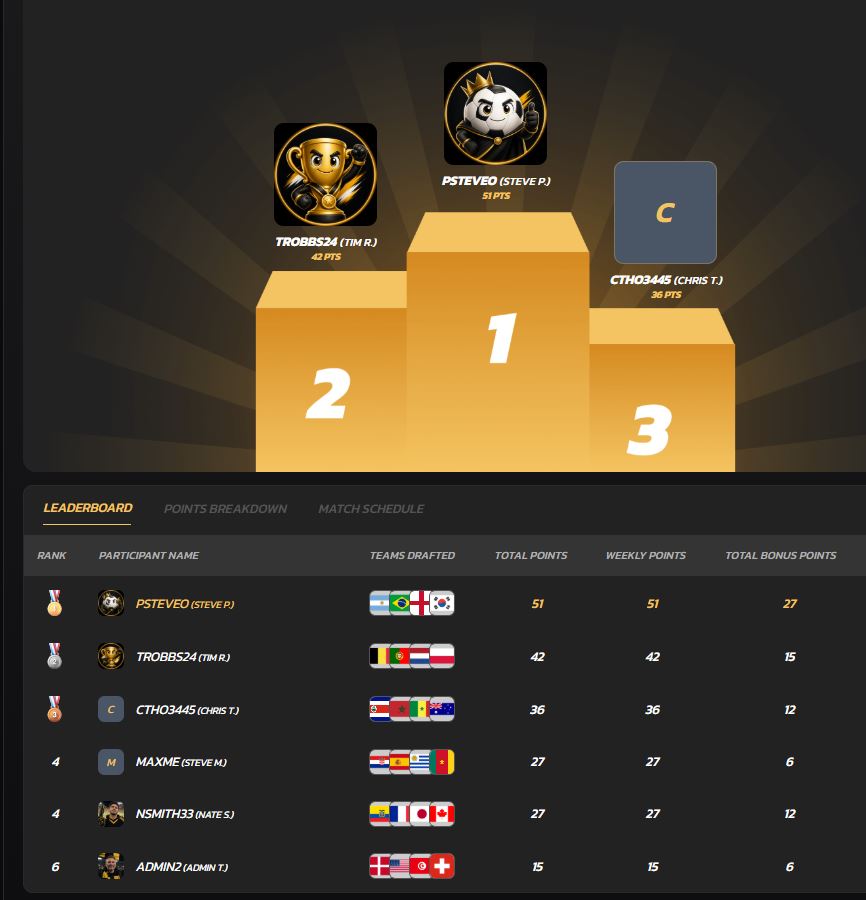
Draftwins supports all six formats covered here, with automated scoring that updates after every game, live leaderboards your group can check anytime, and private pool controls so only invited participants can join. Commissioners pay a one-time hosting fee to create the pool; every participant joins free. No entry fees collected, no prize pools held, no wagers. Just a clean, private contest your group controls.
Setup takes minutes: go to Draftwins Pools, choose a team-draft template, configure your scoring (the templates in this article map directly to the platform's options), schedule your draft as live or async, and send invitations. The platform handles roster locking, leaderboard math, and scoring validation automatically. World Cup pools are live now, with NFL and College Football pools coming next.
Useful sources for deeper setup
- Team Draft Contest Structures: 7 Examples That Work — Copy-ready rule sets and one-line launch checklists for each format covered here.
- Team Pool Formats for Sports Fans: 2026 Guide — Broader format overview with quick-start rules and commissioner tips.
- How Team Selection Pools Differ: A Format Guide — Explains the mechanics of team-draft vs. player-based fantasy for commissioners explaining the format to newcomers.
- Snake Draft vs Straight Draft Pools: Which Fits Your League? — Detailed fairness tradeoffs and recommended group sizes for draft order types.
FAQ
What is a team-draft pool format?
A team-draft pool is a private contest where participants draft entire sports teams instead of individual players, then score points based on those teams' real-game results. No weekly lineup management is required.
Which format works best for a small friend group of 6–8 people?
Snake/serpentine draft is the best fit for 6–8 people. It runs as a live draft night, takes about 30 minutes to set up, and the reversing pick order keeps it fair for everyone.
How does automated scoring work in team-draft pools?
Automated scoring pulls game results and applies your pre-configured point rules (wins, upsets, milestone bonuses) without manual entry. Draftwins updates the live leaderboard after each game automatically.
How do milestone bonuses keep low-ranked teams engaged?
Milestone bonuses (upset wins, round escalators, seed multipliers) give lower-seeded or underdog teams a higher point ceiling. A last-place participant can still climb the leaderboard with one strong upset run, which keeps everyone checking scores through the final.
Does the commissioner need technical experience to set up a pool on Draftwins?
No technical experience is needed. Draftwins provides team-draft templates with pre-built scoring options. Commissioners create a pool, configure rules from a menu, schedule the draft, and send invitations, all from a web browser with no app required.