
Team selection pools are defined groups of teams arranged to compete against each other in the early stages of a tournament, and the format you choose determines everything from fairness to scheduling efficiency. Understanding how team selection pools differ is the first step to running a contest that feels competitive and rewarding for every participant. The structure of a pool, including its size, seeding method, and scoring rules, shapes the entire player experience. Whether you are organizing a World Cup watch party pool or a weekend sports tournament, the format you pick has real consequences.
How team selection pools differ by format and size
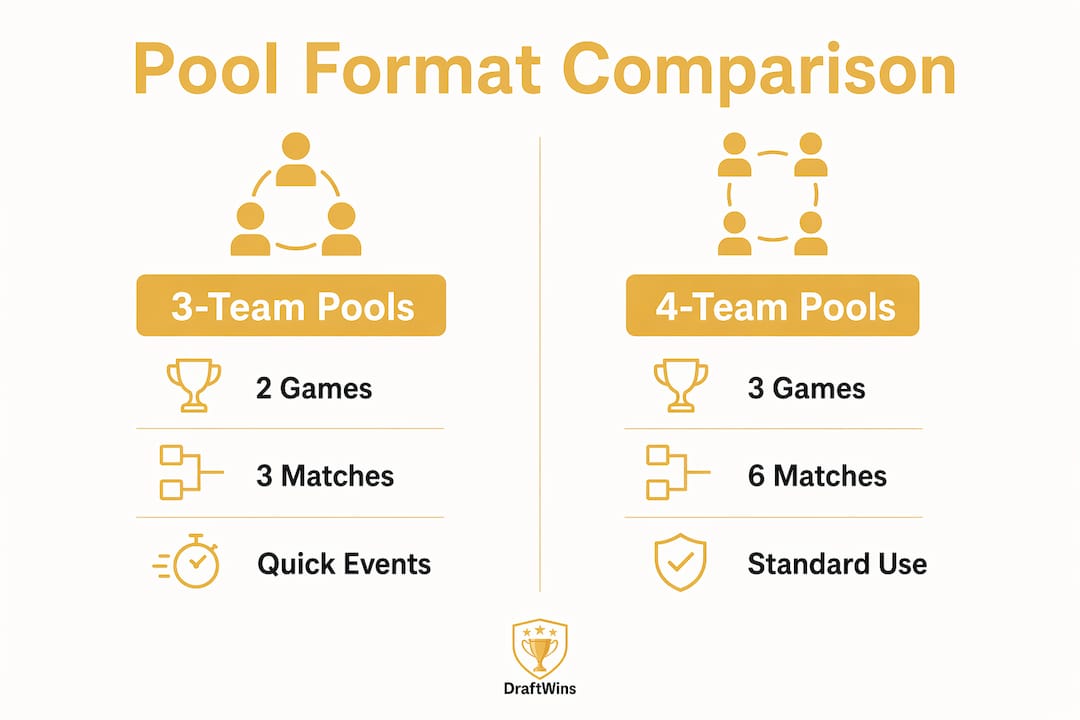
The most fundamental difference between pool formats is the number of teams assigned to each group. Pool sizes typically range from 3 to 6 teams, and each size creates a different competitive environment. A 3-team pool produces only 2 games per team, which suits tight schedules but limits exposure. A 5-team pool delivers 4 games per team, which tests stamina and gives organizers more data to rank participants accurately.
The 4-team pool is the most widely used format in organized sports tournaments. Most youth sports tournaments treat the 4-team pool as the sweet spot because it guarantees each team 3 matches and fits cleanly into tournament sizes of 8, 12, 16, or 20 teams. Three matches per team is enough to separate the strong from the weak without exhausting players or stretching a single-day event past its limits.

| Pool size | Games per team | Total pool matches | Best use case |
|---|---|---|---|
| 3 teams | 2 | 3 | Quick events, limited courts |
| 4 teams | 3 | 6 | Standard tournaments, most event sizes |
| 5 teams | 4 | 10 | Full-day events, high participant counts |
| 6 teams | 5 | 15 | Large invitationals, multi-day formats |
Six-team pools generate 15 total matches per group, which creates scheduling pressure and player fatigue. Organizers who run 6-team pools typically spread them across two days or use multiple courts running simultaneously. The right pool size is not about preference. It is about matching the format to your available time, courts, and participant count.
Pro Tip: If your event has an odd number of teams, build 4-team pools first and use one 3-team or 5-team pool to absorb the remainder rather than creating multiple uneven groups.
How does seeding and team distribution work across pools?
Seeding is the process of ranking teams before the tournament and then distributing those rankings across pools to create balanced competition. Poor seeding produces pools where one group contains all the top teams while another group is entirely weak, which makes the tournament feel unfair before a single game is played.
Serpentine seeding is the industry standard method for distributing teams across pools. The pattern works like this: Seed 1 goes to Pool A, Seed 2 to Pool B, Seed 3 to Pool C, then Seed 4 goes back to Pool C, Seed 5 to Pool B, and Seed 6 to Pool A. The snake pattern reverses direction at the end of each row, which spreads talent evenly across every group. Tournament commissioners widely agree that random draws frequently produce uneven groups, while serpentine seeding consistently delivers competitive balance.
The practical benefits of serpentine seeding include:
- Every pool contains at least one top-ranked team, preventing dominant groups
- Mid-ranked teams face a mix of strong and weak opponents, giving them meaningful games
- Bottom-ranked teams are not all clustered together, which keeps their pool competitive
- Advancement from each pool reflects actual performance rather than luck of the draw
Pro Tip: Publish your seeding criteria before the tournament starts. When participants understand how rankings were determined, they accept the pool assignments as fair even if the matchups feel tough.
Seeding also matters in team-based sports pool contests, where organizers assign drafted teams to groups for leaderboard competition. The same principle applies: distribute the strongest picks across groups so no single pool becomes a runaway. Understanding draft strategy in team pools helps both organizers and participants make smarter decisions before competition begins.
What scheduling challenges come with different pool formats?
Scheduling is where most organizers underestimate the complexity of pool play. Pool play requires multi-court coordination and built-in rest windows, while bracket play faces a different problem: one overtime game cascades into every subsequent round, leaving courts idle and schedules broken. Pool play is more forgiving because games run simultaneously across courts, and a delay in one pool does not automatically stall another.
The core scheduling challenges by pool format are:
- 3-team pools finish quickly but create awkward gaps when other pools are still playing their third game
- 4-team pools run predictably and allow organizers to stagger start times across courts with minimal idle time
- 5-team pools require careful rotation so no team plays back-to-back games while opponents rest
- 6-team pools demand the most planning, often requiring dedicated scheduling software to manage court assignments
Rotation patterns must account for rest windows and prior matchups. A team that just played a physical 40-minute game should not immediately face its next opponent while a rested team waits. Ignoring rest windows creates a fairness problem that no seeding method can fix.
Experienced organizers build cushion time into every pool round and use scheduling tools with live adjustment capabilities. In hybrid pool and bracket events, that cushion prevents idle courts and keeps the day running on time.
The best approach for large events is to schedule all pool games within a fixed time block, regardless of when individual games finish. If Pool A finishes early, teams rest. If Pool B runs slightly long, the next round still starts on time because the block absorbs the variance. This is how professional tournament directors handle group sports contest formats at scale.
How do scoring and advancement rules differ between pool formats?
Scoring rules are where pool formats diverge most sharply in their effect on competitive pressure. Pool play scoring typically uses a combination of wins, point differentials, and tiebreakers to rank teams within each group. The exact weight given to each factor changes the incentives for every team in the pool.
A win-only scoring system rewards teams for securing victories but gives no credit for dominant performances. A points-based system, where the margin of victory contributes to standings, pushes teams to compete hard even in games they are already winning. That distinction matters for player engagement. When every point counts, teams stay focused through the final minute of every match.
Advancement rules also vary by pool size and tournament structure. The most common rule is that the top 2 teams from each pool advance to a playoff bracket, sometimes with wild card spots for the best third-place finishers across all pools. Typical advancement rules include wild card slots that reward strong performances even from teams that did not finish first in their group. Wild cards add a layer of strategy because teams on the bubble must track results from other pools in real time.
Tiebreakers are the most contentious part of any pool format. Common tiebreaker sequences include:
- Head-to-head record between tied teams
- Point differential in all pool games
- Points scored against common opponents
- Coin flip or draw as a last resort
The tiebreaker sequence you choose should be published before the tournament begins. Changing tiebreaker rules mid-event destroys credibility. Pools reward cumulative performance and longer leaderboard engagement, which makes them better suited for enthusiasts who want ongoing competition rather than a single-elimination gamble. That sustained engagement is exactly why the team-based sports pool format has grown in popularity for group contests beyond traditional bracket play. Reviewing how scoring rules are configured for team pools before you finalize your format saves significant confusion later.
Draftwins makes team pool formats easy to run
Running a fair, well-structured team pool contest takes planning, and Draftwins is built to handle the details that trip up most organizers.
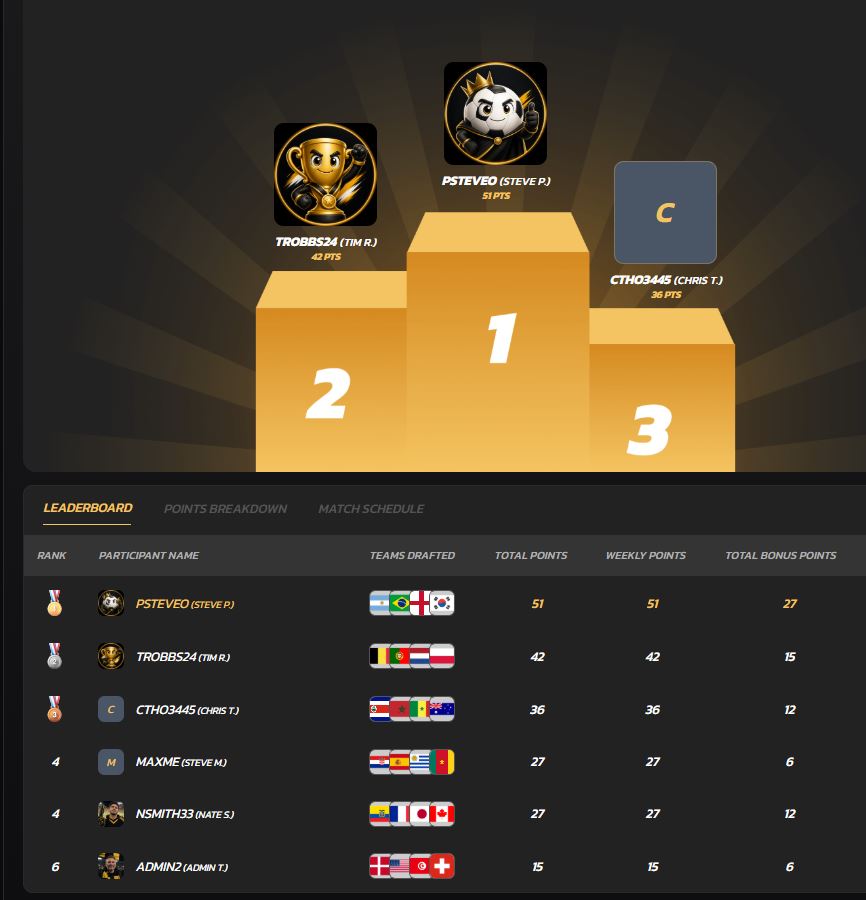
Draftwins lets commissioners create private pools where participants draft entire teams instead of individual players, which removes the lineup management headaches that come with traditional fantasy formats. The platform handles automated scoring and live leaderboards, so organizers spend their time enjoying the competition rather than tracking spreadsheets. Draftwins launches with World Cup pools, with NFL and College Football pools to follow. If you are ready to run a group contest that is fair, fun, and easy to manage, visit Draftwins and set up your pool today.
Key takeaways
Team selection pools differ most significantly in size, seeding method, scoring rules, and advancement criteria, and matching the right format to your event size is the single most important decision an organizer makes.
| Point | Details |
|---|---|
| Pool size drives game count | A 4-team pool gives each team 3 matches, the most practical balance for most events. |
| Serpentine seeding ensures fairness | Distributing seeds in a snake pattern prevents any single pool from becoming top-heavy. |
| Scheduling needs built-in cushion | Fixed time blocks per round absorb delays and keep multi-court events on schedule. |
| Scoring rules shape engagement | Points-based systems keep teams competing hard through every minute of every game. |
| Advancement rules must be set in advance | Publishing tiebreaker sequences before play begins prevents disputes and builds trust. |
FAQ
What is a team selection pool in a sports tournament?
A team selection pool is a group of teams assigned to compete against each other in the early rounds of a tournament before advancing to a playoff bracket. Pool play guarantees each team multiple games regardless of early losses.
What pool size works best for most tournaments?
The 4-team pool is the most widely used format because it gives each team 3 guaranteed matches and fits cleanly into tournament sizes of 8, 12, 16, or 20 teams.
What is serpentine seeding and why does it matter?
Serpentine seeding distributes ranked teams across pools in a snake pattern so that each pool contains a mix of strong and weak teams. It is the standard method for preventing lopsided groups in competitive tournaments.
How are tiebreakers handled in pool play?
Most tournaments resolve ties using head-to-head record first, then point differential, then points scored against common opponents. The tiebreaker sequence should be published before the tournament starts.
How does a team-based sports pool differ from a bracket contest?
A team-based sports pool rewards cumulative performance across multiple rounds, while a bracket contest eliminates teams after a single loss. Pool formats create longer leaderboard engagement and suit group contests where sustained competition matters.