
Snake draft and straight draft pools are the two primary formats for organizing player selection in fantasy and competitive sports leagues, and the format you choose shapes every pick, every strategy, and every competitive outcome. In a snake draft, the pick order reverses each round. In a straight draft, also called a linear draft, the same order repeats every round. The difference sounds simple, but the strategic and fairness implications run deep. This guide breaks down how each format works, what it means for your league's competitive balance, and how to pick the right one for your group.
How does the draft order differ in snake vs straight draft pools?
The pick sequence is the defining structural difference between these two formats. In a snake draft, round one runs from pick 1 to pick 10 (in a 10-team league), and round two reverses to run from pick 10 back to pick 1. This "serpentine" pattern continues, alternating direction every round. In a straight draft, the order is identical every single round: pick 1 always goes first, pick 10 always goes last.

That structural difference creates very different experiences at the draft table. The straight draft, or linear draft format, is most common in rookie drafts within dynasty leagues, where rewarding lower-ranked teams with consistent early picks is the entire point. The snake format is the default for most redraft fantasy leagues because it attempts to balance the advantage of picking first.
The table below shows how pick sequences compare across the first three rounds in a 10-team league.
| Round | Snake draft pick order | Straight draft pick order |
|---|---|---|
| Round 1 | 1, 2, 3, 4, 5, 6, 7, 8, 9, 10 | 1, 2, 3, 4, 5, 6, 7, 8, 9, 10 |
| Round 2 | 10, 9, 8, 7, 6, 5, 4, 3, 2, 1 | 1, 2, 3, 4, 5, 6, 7, 8, 9, 10 |
| Round 3 | 1, 2, 3, 4, 5, 6, 7, 8, 9, 10 | 1, 2, 3, 4, 5, 6, 7, 8, 9, 10 |
One underappreciated detail about snake draft mechanics is the "turn" advantage. In a 12-team league, pick slots 5 through 8 receive back-to-back selections at the turn of rounds, compressing their wait time and letting them grab two strong players in quick succession. That is a real strategic edge, even if it is not obvious at first glance.
What are the fairness and strategic implications of each format?
Snake drafts are widely perceived as the fairer format, but the data tells a more complicated story. Early picks hold a measurable edge over later picks due to player value drop-off, with top-3 picks carrying up to a 10% advantage. That gap matters because the best players at the top of a draft are significantly more valuable than those available in later rounds.
Statistical analysis confirms that early draft picks in snake formats show diminishing returns as rounds progress. The snake reversal helps, but it does not fully neutralize the first-pick advantage. Snake drafts create what analysts call a "first-half advantage," where picks 1 through 6 in a 12-team league consistently outperform picks 7 through 12 over a full season.
Straight drafts do not pretend to be equal. Linear drafts are intentionally unfair by design, built to reward poor-performing teams with better picks and promote parity over time. That is the correct tool for dynasty leagues, where a struggling team needs a structural advantage to rebuild.
Here is what each format rewards strategically:
- Snake draft: Rewards positional awareness, knowing when to reach for a player versus waiting for value at the turn.
- Straight draft: Rewards roster construction depth, since early picks dominate every round and late picks must find value in overlooked players.
- Snake draft (middle slots): Rewards patience and back-to-back pick planning at the turn of each round.
- Straight draft (late slots): Rewards scouting depth, since late-round picks must consistently outperform their draft position.
Pro Tip: If you hold a middle pick slot in a snake draft, map out your back-to-back picks at the turn before the draft starts. Knowing which two players you want at picks 6 and 7 (or 7 and 8) is more valuable than knowing your first-round pick.
How do league goals shape the choice between formats?
Choosing the right draft format depends directly on what your league is trying to accomplish. A casual group of friends running a one-season pool wants simplicity and entertainment. A competitive dynasty league wants a format that rewards skill and promotes long-term parity. These are different goals, and they point to different formats.
Commissioners should align format complexity with their league's scoring system and competition goals before setting draft rules. A simple scoring league benefits from a straightforward draft process. A league with deep scoring categories and multi-year rosters benefits from a format that rewards strategic depth.
The table below summarizes the key trade-offs between the two formats.
| Category | Snake draft | Straight draft |
|---|---|---|
| Pick order | Reverses each round | Same every round |
| Fairness goal | Approximate equality | Intentional imbalance |
| Best for | Redraft and casual leagues | Rookie and dynasty leagues |
| Strategic depth | Medium to high | High for early picks |
| Complexity | Moderate | Low |
| Engagement style | Broad participation | Rewards research and scouting |
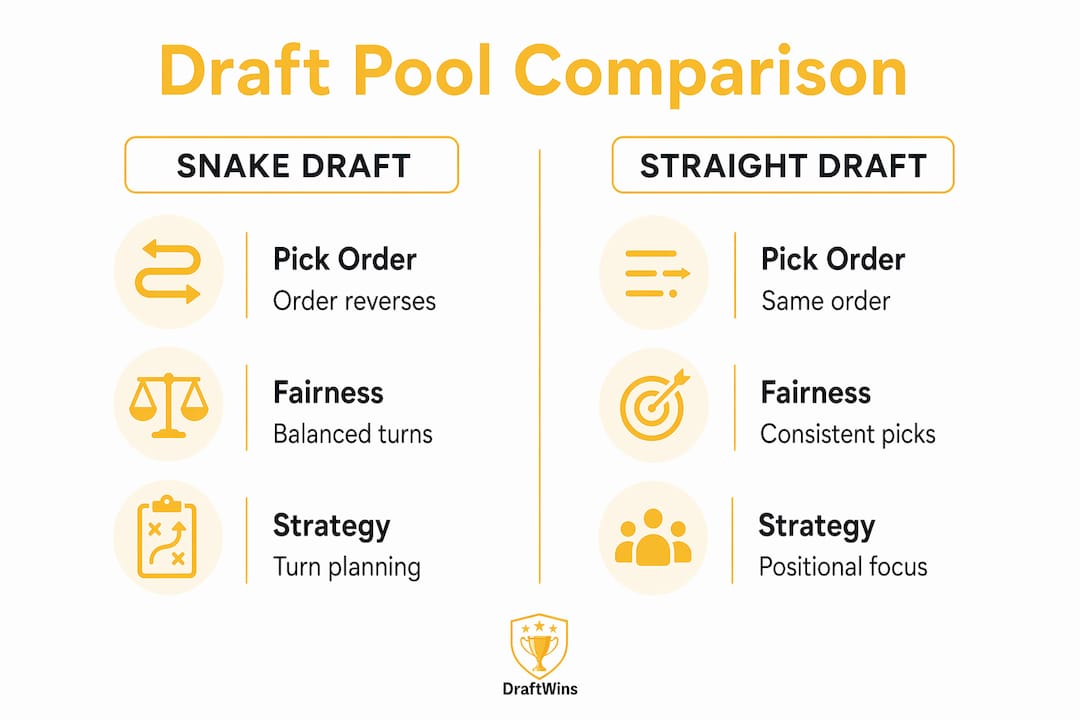
The entertainment factor also differs. Snake drafts create more dramatic moments because the order shifts constantly, and participants feel the tension of watching players fall or disappear before their pick arrives. Straight drafts are more predictable, which some leagues find less exciting but others find easier to manage and explain to new participants.
Understanding how draft formats affect engagement helps commissioners make a more informed choice before the season starts.
What practical steps does a commissioner need to set up each format?
Organizing a draft pool well requires more than picking a format. The setup process determines whether your draft runs smoothly or collapses into confusion.
- Define your draft order method. Decide whether you will use a random lottery, a performance-based assignment, or allow managers to choose slots after random assignment. Allowing managers to choose slots after random assignment improves both balance and participant engagement.
- Set the number of rounds. Linear drafts typically span 3–4 rounds depending on league rules. Snake drafts in redraft leagues often run 15 or more rounds. Confirm this before draft day.
- Communicate the rules in writing. Send every participant the draft format, pick order, time limits per pick, and tiebreaker rules at least one week before the draft.
- Schedule a draft time that works for all participants. Missed picks and auto-draft selections are the most common source of post-draft complaints. Confirm attendance before locking the date.
- Test your scoring and tracking system. Whether you use a platform or a spreadsheet, verify that it correctly handles the pick sequence for your chosen format before the draft begins.
A common mistake in snake drafts is ignoring player value drop-off between rounds. Many participants focus only on their first-round pick and arrive unprepared for rounds 3 through 6, where the real competitive separation happens. Preparing a tiered player list by position before the draft prevents this.
Pro Tip: For straight drafts, prepare a "positional scarcity" chart before the draft. Knowing exactly how many elite players exist at each position tells you when to prioritize a position over best-available value.
Reviewing draft order strategy tips before your league's draft day gives commissioners a concrete framework for setting up competitive pools.
What challenges come up in each format and how do you fix them?
Every draft format creates predictable problems. Knowing them in advance lets you address them before they damage your league's experience.
Common challenges and their solutions:
- Perceived unfairness in snake drafts: Participants with late picks often feel disadvantaged after the draft. Fix this by randomizing draft order each season and explaining the turn advantage to all participants before the draft.
- Long waits in large snake draft leagues: In a 14-team league, the last pick waits through 13 selections before their turn. Set a strict pick timer (60–90 seconds is standard) to keep the draft moving.
- Predictable outcomes in straight drafts: When the same manager picks first every round, outcomes feel predetermined. Rotate the draft order each season or use a performance-based assignment to keep it competitive.
- Rule confusion for new participants: First-time participants often misunderstand how the snake reversal works. A short written explainer with a visual pick-order chart eliminates most confusion before it starts.
"Variance in snake drafts increases as league size grows, affecting fairness perception and draft outcomes. Point disparity between first and last pick in optimized snake drafts increases with the number of teams."
When neither format satisfies your league, auction drafts remove draft order bias entirely. Every manager bids on players using a fixed budget, replacing pick sequencing with budget management. Auction drafts require more preparation but deliver the most equal starting conditions of any format. They work best in experienced leagues where participants are comfortable with the added complexity.
Exploring different draft competition styles gives commissioners a broader view of what formats are available beyond the two standard options.
Key Takeaways
Snake drafts approximate fairness through order reversal, but straight drafts are the correct choice when intentional competitive imbalance serves your league's long-term goals.
| Point | Details |
|---|---|
| Snake draft fairness | Order reversal helps but does not eliminate the early-pick advantage. |
| Straight draft purpose | Linear drafts are built for dynasty and rookie leagues that reward poor-performing teams. |
| Middle-slot strategy | Picks 5–8 in a snake draft benefit from back-to-back selections at the turn of each round. |
| Format selection | Match the draft format to your league's scoring complexity and competition goals. |
| Setup priority | Communicate rules in writing and confirm draft order assignment before draft day. |
Draftwins makes draft pool competition easier to run
Running a competitive draft pool takes real organization. Draftwins is a sports pool platform built for groups who want the excitement of drafting teams without the complexity of managing individual player lineups.
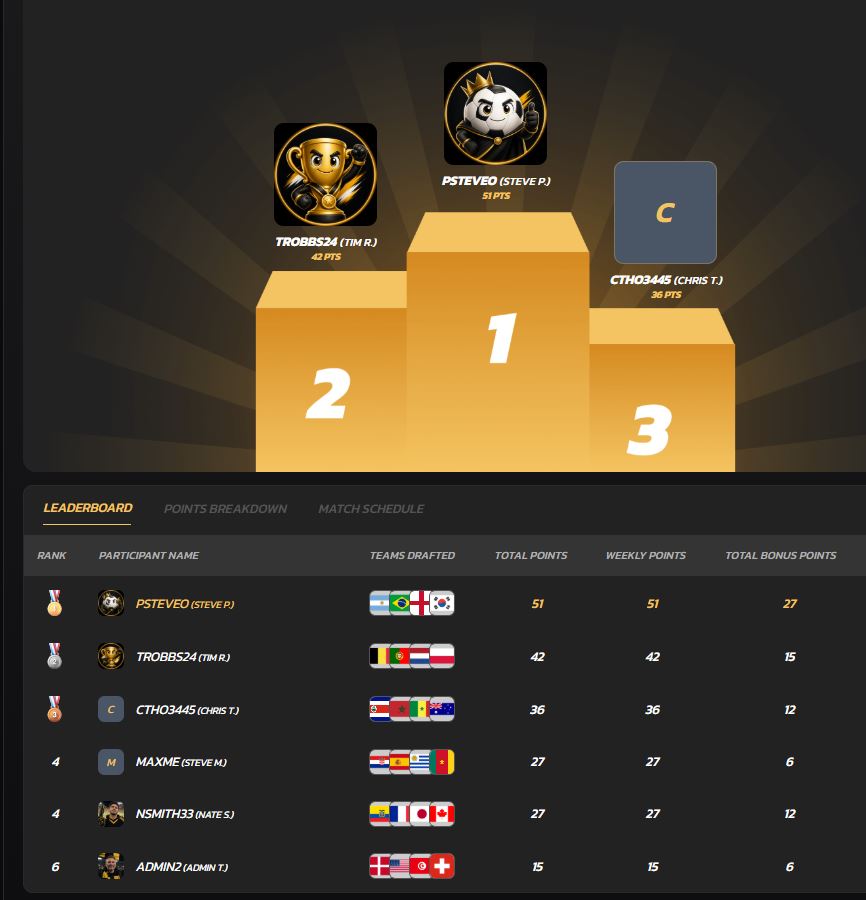
Draftwins handles automated scoring and live leaderboards, so commissioners spend less time tracking results and more time competing. Private pools let you set your own rules and scoring preferences, whether your group prefers a snake-style selection or a straight draft format. Draftwins launches with World Cup pools, with NFL and College Football pools to follow. If your group is ready to run a cleaner, more engaging draft pool, visit Draftwins and set up your league today.
FAQ
What is the main difference between snake and straight draft pools?
A snake draft reverses the pick order every round, while a straight draft keeps the same order every round. Snake drafts are standard in redraft fantasy leagues; straight drafts are common in dynasty and rookie leagues.
How do snake drafts work in pools with many teams?
In a snake draft, round one runs from pick 1 to the last pick, and round two reverses direction. In larger leagues, variance increases with league size, making the gap between first and last pick more pronounced as the draft progresses.
Which draft format is fairer for all participants?
Snake drafts are closer to equal, but top-3 picks still hold a measurable advantage due to player value drop-off. Auction drafts are the most equal format because they remove pick order entirely.
When should a league use a straight draft instead of a snake draft?
Straight drafts work best in dynasty or rookie leagues where rewarding lower-ranked teams with consistent early picks promotes long-term competitive balance across multiple seasons.
Can you switch draft formats between seasons?
Yes. Many dynasty leagues use a straight draft for the rookie portion and a snake draft for veteran free agent pickups. Commissioners should announce any format change in writing well before the draft to give all participants time to adjust their preparation.