
Team draft contest structures are organized frameworks that determine how participants select teams, score predictions, and compete across a group event. The best examples combine snake draft formats with tiered scoring or multiplier mechanics because these systems balance fairness with genuine strategic depth. Whether you are organizing a World Cup pool for 12 friends or a 200-person NFL office bracket, the structure you choose shapes every moment of the experience. This article breaks down seven proven draft contest structure examples so you can pick the right format for your group.
1. Examples of team draft contest structures: the snake draft
The snake draft is the most widely used format in group team contests, and for good reason. Snake drafts used in 100% of analyzed small-group team drafts typically run four to five rounds. That near-universal adoption reflects how well the alternating pick order solves the fairness problem that plagues simpler formats.
Here is how it works in practice. In round one, participants pick in order from position 1 to position 12. In round two, the order reverses, so position 12 picks first. The Cincinnati Soccer Talk 2026 World Cup Draft used exactly this structure across four rounds, letting each participant build a balanced squad of national teams without any single drafter holding a permanent advantage.
The snake format suits casual groups because the rules take about 30 seconds to explain. It also suits competitive organizers because the reversal mechanic creates genuine mid-draft strategy. Do you take the safe pick now or gamble on a stronger option in the next round?
- Randomize the initial draft order with a free tool like Wheel of Names or a simple dice roll to remove any perception of bias.
- Set a pick timer of 60 to 90 seconds to keep the draft moving and prevent analysis paralysis.
- Record every pick in a shared Google Sheet so all participants can track the board in real time.
Pro Tip: Publish the randomized draft order at least 24 hours before the event so participants can prepare their shortlists. Preparation increases engagement and reduces no-shows.
2. Tiered scoring systems and why they change competition
A flat scoring model, where every correct pick earns the same points, rewards luck as much as skill. Tiered scoring fixes that by assigning different point values based on prediction accuracy. The PFF 2026 Draft Pick Challenge awards 10 points for exact player-team matches and 5 points for correct slot placement, plus additional bonuses. That gap between exact and near-correct predictions creates a meaningful skill gap across a full contest.
Here is a tiered model you can adapt directly for your group:
- Exact match (correct team drafted in the correct round): 10 points
- Round match (correct team drafted but in the wrong round): 5 points
- Partial match (team drafted that advances further than predicted): 3 points
- Bonus category (a designated high-value pick, sometimes called a Captain's Pick): 2x multiplier on base points
The Captain's Pick mechanic deserves special attention. Multipliers increase competition excitement without requiring perfect predictions, which means a participant sitting in fifth place can still win if their Captain's Pick lands. That possibility keeps the entire group engaged through the final round rather than checking out once the leader pulls ahead.
"The best scoring systems reward the participant who was most right, not just the one who got lucky on the biggest pick." This principle, drawn from community draft design, separates a memorable contest from a forgettable one.
Pro Tip: Match your scoring tiers to your audience's familiarity with the sport. A casual World Cup pool works well with two tiers. A competitive NFL draft contest can support four or five tiers without confusing participants.
3. Bonus picks and contingency mechanisms for unpredictable events
Real sports are unpredictable. Trades happen. Players get injured before a draft. A team moves up or down the board at the last minute. Bonus pick systems and contingency mechanisms are the structural answer to that unpredictability.
The Commanders Draft Pick 3 contest on Hogs Haven is one of the clearest examples of this approach. Entrants nominate three players per pick plus bonus rounds, and the scoring adapts to trade outcomes. If the team trades out of a pick entirely, the bonus round absorbs the disruption rather than voiding a participant's entry. That design keeps the contest fair and continuous regardless of what happens on draft day.
Here is how to implement a basic contingency system in your own group contest:
- For each contested pick, allow participants to nominate a primary selection and one backup selection.
- Define in advance which real-world events trigger the backup pick. Trades and injury withdrawals are the two most common triggers.
- Award full points for a correct primary pick and 60% of points for a correct backup pick. This rewards confidence while protecting participants from events outside their control.
- Announce the contingency rules in writing before the contest opens. Disputes about rules after the fact kill group morale faster than any bad pick.
Contingency pick mechanisms allow draft contests to adapt to real-life position changes, maintaining fairness in prediction games. For organizers running high-stakes pools, this structure is not optional. It is the difference between a contest that survives draft day chaos and one that falls apart.
4. High-stakes prize structures and their effect on participation
Prize structure is itself a form of contest architecture. The Draft Pro's Perfect Draft Challenge offers a $1,000,000 prize for a perfect first-round NFL draft prediction. That number is designed to generate attention, not to be won. The real function of a headline prize is to drive initial sign-ups and social sharing.
For most organizers, the lesson is not to offer a million dollars. It is to understand that prize architecture shapes behavior. A single large prize creates a winner-take-all dynamic that discourages participants once the leader pulls ahead. A tiered prize structure, where the top three or five finishers earn recognition or rewards, keeps more participants invested through the final rounds.
Budget-friendly groups can use non-cash prizes effectively. The person who finishes last buys dinner. The winner picks the venue for the next group watch party. Social stakes often drive more engagement than cash because they create stories the group retells for years.
5. Narrative-driven community drafts
Not every draft contest is about points. Community-driven mock drafts emphasize narrative creation over pure stats, and that emphasis measurably increases fan engagement and participation. When participants write a short explanation of each pick, the contest becomes a conversation rather than a scoreboard.
The Pride of Detroit community mock draft format pairs participants with specific NFL franchises and asks them to draft with that team's needs in mind. Participants submit write-ups explaining their picks, and the community votes on which selections best fit the franchise's direction. The winner is not always the person with the most accurate prediction. Sometimes the winner is the person who told the most compelling story about why a pick made sense.
Organizers can apply this structure to any sport:
- Assign each participant a team or national squad to represent in the draft.
- Require a two to three sentence write-up for each pick explaining the strategic rationale.
- Add a community vote category worth 10 to 20% of the final score to reward narrative quality alongside prediction accuracy.
- Share write-ups in a group chat or private forum so participants read each other's reasoning before the real event unfolds.
Narrative synthesis increases engagement more than score-only formats. For casual fans who may not track every roster move, the narrative layer gives them a way to participate meaningfully even without deep statistical knowledge.
6. Managing draft momentum and preventing ghosting
Ghosting is the single biggest operational threat to a community draft contest. A participant goes silent, misses their pick window, and the entire draft stalls. Standby participants step in immediately if a drafter drops out, ensuring pace. Every organizer running a draft with more than eight participants should maintain a standby list.
The standby system works best when you set clear expectations upfront. Tell every participant at registration that a standby pool exists and that missing a pick window without notice results in substitution. That transparency removes ambiguity and gives the organizer authority to act without conflict.
Beyond standbys, two structural choices reduce ghosting risk. First, use asynchronous draft formats for groups spread across time zones. Participants get a 12 to 24 hour window per pick rather than a live clock. Second, send automated reminders 30 minutes before a pick window closes. Most ghosting is accidental, not intentional.
7. Comparing draft contest structures for different group types
The right structure depends on your group's size, sports knowledge, and how seriously they take competition. The table below maps each format to its best use case.
| Structure | Best for | Key advantage | Main limitation |
|---|---|---|---|
| Snake draft | Groups of 8 to 16, any sport | Simple, fair, universally understood | No scoring nuance beyond pick order |
| Tiered scoring | Competitive groups, NFL or World Cup | Rewards skill and strategy | Requires clear rules documentation |
| Bonus/contingency picks | High-stakes or trade-heavy sports | Survives real-world disruptions | Adds setup complexity for organizers |
| Narrative-driven format | Casual fans, community leagues | Builds engagement and social connection | Harder to score objectively |
| High-stakes prize structure | Large public contests | Drives sign-ups and social sharing | Winner-take-all can reduce late engagement |
For a first-time organizer running a World Cup pool with friends, the snake draft with two-tier scoring is the right starting point. For a seasoned organizer running a 50-person NFL contest, layering in contingency picks and a Captain's Pick multiplier adds the depth that experienced participants expect.
Key takeaways
The most effective team draft contest structures combine a snake draft format with tiered scoring and at least one contingency mechanism, because fairness and adaptability together determine whether a group stays engaged from the first pick to the final whistle.
| Point | Details |
|---|---|
| Snake draft is the baseline | Use alternating pick order across 4 to 5 rounds for any group size or sport. |
| Tiered scoring rewards skill | Award 10 points for exact matches and 5 for near-correct picks to separate skill from luck. |
| Contingency picks protect fairness | Allow backup nominations per pick so trades and injuries do not void participant entries. |
| Narrative layers drive casual engagement | Require short pick write-ups to keep fans invested beyond the scoreboard. |
| Standby pools prevent stalls | Maintain a substitute list and set clear pick windows to stop ghosting before it starts. |
Run your next draft contest on Draftwins
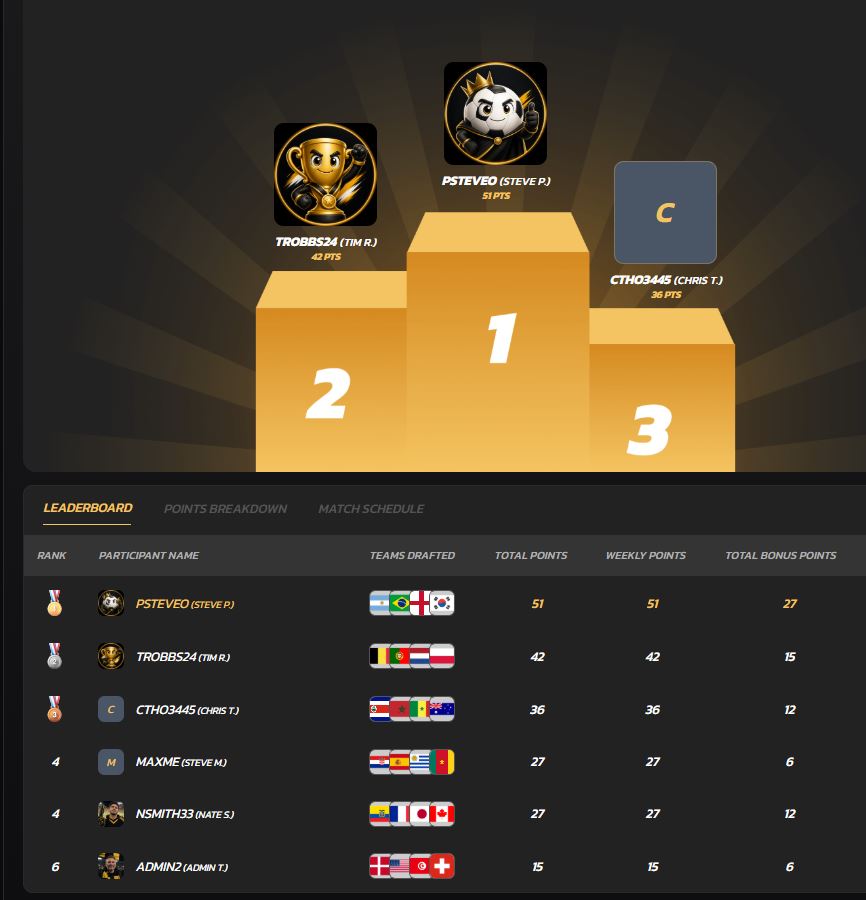
Draftwins is built for exactly the kind of group contests described in this article. The platform lets commissioners create private pools where participants draft teams instead of individual players, removing the lineup management headaches that make traditional fantasy leagues feel like a second job. Automated scoring and live leaderboards handle the tracking so you can focus on the competition itself. Draftwins launches with World Cup pools, with NFL and College Football pools to follow. If you are ready to run a contest your group will actually finish, start your pool on Draftwins today.
FAQ
What is the most common team draft contest structure?
The snake draft format is the most common structure, used in virtually all small-group team drafts. It runs four to five rounds with alternating pick order to keep selection balanced across all participants.
How does tiered scoring work in a draft contest?
Tiered scoring assigns different point values based on prediction accuracy. The PFF 2026 Draft Pick Challenge awards 10 points for exact matches and 5 points for correct slot placement, with optional multipliers like a Captain's Pick to add strategic depth.
What is a contingency pick and when should I use it?
A contingency pick is a backup nomination that activates if a trade or injury disrupts the original pick slot. Use this structure any time your contest involves a sport where roster moves or trades are likely before or during the draft event.
How do I stop participants from ghosting during a draft?
Keep a standby pool of substitute participants and set a defined pick window with automated reminders. Communicating the standby policy at registration gives organizers the authority to substitute without conflict.
Can casual fans compete fairly against experienced drafters?
Yes. Narrative-driven formats and Captain's Pick multipliers level the playing field by rewarding strategic reasoning and bold predictions rather than pure statistical knowledge. These mechanics let casual fans stay competitive even without deep roster expertise.