
Drafting NFL teams instead of individual players is the fastest way to enjoy a football pool without tracking injuries, waiver wires, or weekly lineups. This format, often called a "wins pool" or "team draft pool," lets you claim entire NFL franchises at the start of the season and root for their collective performance. The team-based draft format is built for casual fans who want real competition without the complexity of managing individual rosters. This guide covers everything you need: setup, draft order, scoring, and the pitfalls to avoid.
What does a "draft NFL teams not players" guide actually cover?
A team draft pool is defined as a group competition where each participant selects several NFL franchises before the season begins and earns points based on how those teams perform. No weekly lineup decisions. No waiver pickups. No injury panic. You draft your teams once, then watch the season unfold.
The core difference from traditional fantasy football is the absence of player management. In a standard fantasy league, you set a lineup every week, monitor injuries, and make constant roster moves. In a team draft pool, your picks are locked in on draft night. That single change removes the biggest barrier for casual fans who love football but do not want a part-time job managing it.

Focusing on NFL teams eliminates the "lineup stress" caused by injury tracking and waiver wire competition that is common in player-based fantasy formats. That stress is exactly why many casual fans quit traditional leagues by week four. Team drafts keep everyone engaged through January.
What do you need before drafting NFL teams?
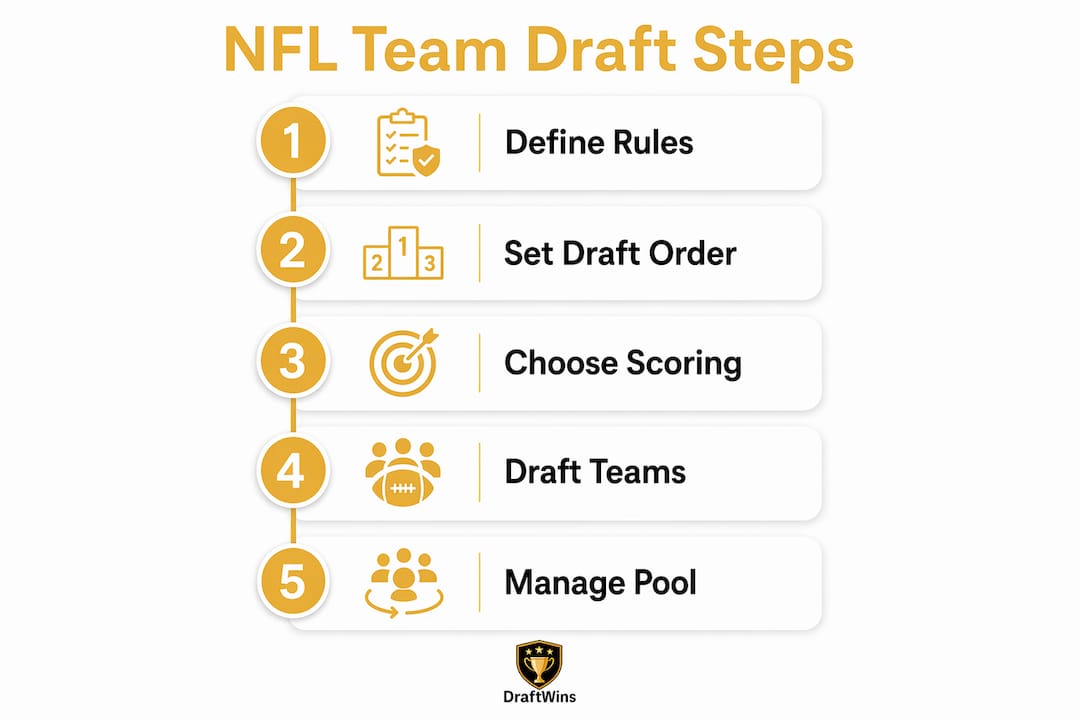
A team draft competition requires four things finalized before the season: a defined format, clear rules including tie-breakers, a payout structure, and a set draft order. Skip any one of these and disputes will follow.
Choosing your scoring format
The most common format is total season wins. Each team you draft earns one point per regular-season win. At the end of the season, the participant with the most combined wins from their drafted teams wins the pool. Some pools add playoff rounds as bonus scoring, which keeps late-season interest high even for participants whose teams missed the playoffs.
Setting your payout structure
The most common payout split is 60% to first place, 30% to second, and 10% to third. That structure rewards the winner clearly while giving second and third place a reason to stay engaged all season. You do not need large stakes to make it work. Low entry fees and social stakes often improve engagement and long-term sustainability better than high buy-ins.
Pro Tip: Keep entry fees modest, especially for a first-year pool. A $20 entry with 10 participants creates a $200 prize pool that feels meaningful without pricing anyone out.
Tools: automated software vs. manual tracking
Automated league software is the simplest way for casual groups to manage scoring and leaderboard updates. 1 in 5 DIY spreadsheets contain scoring errors. That number matters because a single miscalculation in week 12 can destroy trust in the whole pool. Automated platforms update scores in real time and remove the commissioner from the role of manual scorekeeper.
| Tool type | Best for | Main risk |
|---|---|---|
| Automated platform | Groups of 6 or more | Platform learning curve |
| Shared spreadsheet | Very small groups | Manual errors, disputes |
| Paper tracking | One-time casual events | No real-time updates |
How do you set up a fair draft order for NFL team pools?
Draft order is the single biggest fairness variable in a team pool. The participant who picks first gets the best team available. Without a fair system, the pool feels rigged before it starts.
The snake draft method
A snake draft ensures fairness by reversing the pick order each round. In an 8-person pool, the participant who picks first in round one picks last in round two. This balances the advantage of early picks across the full draft. Snake drafts are the standard for a reason: they are simple to explain, easy to run, and widely accepted as fair.
Here is how to run a snake draft for an 8-person NFL team pool:
- Randomly assign draft positions 1 through 8 (use a random number generator or draw names from a hat).
- Round 1 picks go from position 1 to position 8.
- Round 2 picks reverse: position 8 picks first, position 1 picks last.
- Continue alternating direction each round until all teams are drafted.
- Each participant ends up with 4 teams in a 32-team, 8-person pool.
The balanced draft order method
Advanced pools go one step further with a balanced draft order built on projected team win totals. The goal is to assign picks so that every participant's expected total wins clusters around the same average. A well-designed balanced order targets roughly 24.5 projected wins per participant in an 8-person pool.
The math behind this is compelling. A balanced draft order can reduce the standard deviation of projected wins from 0.8 wins down to 0.04 wins across all participants. That means the difference between the "best" and "worst" draft position shrinks to almost nothing. The pool becomes genuinely competitive from day one.
Pro Tip: Before draft night, pull the Vegas win totals for all 32 NFL teams. Sort them from highest to lowest. Use that list to build your balanced order so no single participant accidentally lands all the projected contenders.
A snake draft is the right call for most casual groups. A balanced order is worth the extra setup time for competitive pools where participants care deeply about fairness.
How does scoring work in team-based NFL drafts?
Scoring in a team draft pool is straightforward by design. The most common method counts each regular-season win as one point for the participant who drafted that team. Some pools add half a point per tie, which is rare but worth defining upfront.
Common scoring variations include:
- Regular-season wins only. Clean and simple. The season ends in January and scores are final.
- Wins plus playoff rounds. Each playoff win earns a bonus point. This keeps participants invested through the Super Bowl.
- Weighted wins. Division games or prime-time wins earn extra points. This adds strategy but also complexity.
For a first-year pool, regular-season wins only is the right choice. Everyone understands it immediately, and there is no room for scoring disputes.
Handling tie-breakers
Ties happen. Two participants can finish the season with identical win totals. Most pools use a prime-time game's combined score as the tie-breaker. Before the season starts, each participant submits a guess for the total combined score of a designated game, often the Super Bowl or the season opener. The participant whose guess is closest wins the tiebreak.
Defining tie-breakers before the season starts is non-negotiable. A tie-breaker decided after the fact will always feel unfair to the person who loses it. Lock in the rules in writing before anyone drafts a single team. Clear pool scoring rules prevent 90% of end-of-season arguments.
Tips for managing your NFL team pool and avoiding common mistakes
Running a team draft pool is easier than running a fantasy league, but it still requires active management from the commissioner. The biggest mistakes are organizational, not strategic.
"The commissioner's job is not to pick winners. It is to create a fair environment where everyone trusts the process. Clear rules, communicated early and often, do that job better than any scoring tweak."
Common pitfalls and how to avoid them:
- Ignoring bye weeks and strength of schedule. Pre-draft research should highlight each team's bye week and schedule difficulty. A team with a brutal early schedule may underperform their win total projection. Share this information with all participants before the draft.
- Unclear rules at draft time. Send a one-page rules summary to every participant at least 48 hours before draft night. Cover format, scoring, tie-breakers, and payout. Do not assume everyone read the group chat.
- No real-time leaderboard. Without a live standings update, participants lose interest by week six. Automated platforms solve this by updating scores automatically after each game.
- Skipping a draft night structure. Set a time limit per pick (60–90 seconds works well) and enforce it. A draft that drags past two hours loses energy fast.
Pro Tip: Send a weekly leaderboard update to the group chat every Monday morning. It takes two minutes and keeps everyone talking about the pool all week.
The draft night preparation process matters as much as the draft itself. A well-run draft night sets the tone for the entire season.
Draftwins makes team pool setup simple
Draftwins is built for exactly this format. The platform lets commissioners create private NFL team draft pools with automated scoring, live leaderboards, and clear rule enforcement, all without collecting entry fees or managing prize money.
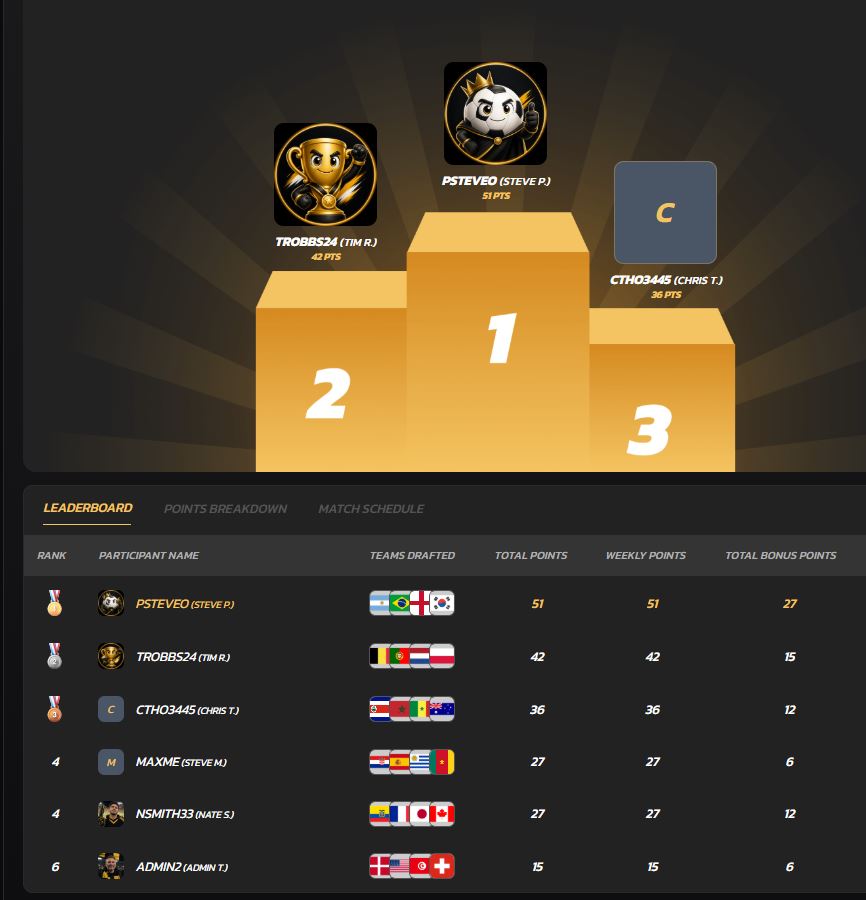
Setting up a pool on Draftwins takes minutes. You choose your scoring format, set your draft order, and invite participants. The platform handles score updates automatically as NFL results come in, so you spend Sunday watching football instead of updating a spreadsheet. Draftwins charges a platform hosting fee and does not hold prize pools or accept wagers. It is the right tool for groups who want a real competition without the administrative headache of running it manually.
Key Takeaways
Drafting NFL teams instead of players is the most accessible format for casual fans who want a real football competition without weekly roster management.
| Point | Details |
|---|---|
| Define rules before the draft | Lock in format, tie-breakers, and payout structure before anyone picks a team. |
| Use a snake or balanced draft order | Snake drafts are simple and fair; balanced orders reduce projected win variance to near zero. |
| Set your tie-breaker upfront | Use a prime-time game's combined score as the tie-breaker to avoid end-of-season disputes. |
| Automate your scoring | Automated platforms eliminate manual errors and keep participants engaged with live standings. |
| Keep stakes accessible | Low entry fees improve long-term participation and keep the pool fun for everyone. |
FAQ
What is a team draft pool in the NFL context?
A team draft pool is a group competition where participants draft entire NFL franchises before the season and earn points based on those teams' wins. No weekly lineups or player moves are required.
How many NFL teams should each participant draft?
In an 8-person pool using all 32 NFL teams, each participant drafts 4 teams. Adjust the number based on your pool size to distribute all 32 teams evenly.
What is the fairest draft order method for NFL team pools?
A snake draft order is the standard for fairness, reversing pick direction each round. A balanced order built on projected win totals is even more precise for competitive groups.
How do you handle a tie at the end of the season?
Most pools use a pre-submitted guess for the combined score of a designated prime-time game. The participant closest to the actual score wins the tiebreak. Define this rule before the season starts.
Do you need special software to run an NFL team draft pool?
You do not need software, but automated platforms reduce errors and keep participants engaged with real-time updates. Manual spreadsheets work for very small groups but carry a higher risk of scoring mistakes.