
NFL draft pools are scored by assigning point values to each player based on where they are actually selected in the official NFL draft, with the participant holding the lowest total score typically declared the winner. Understanding how NFL draft pools are scored separates casual participants from players who approach the contest with real strategy. The scoring system sounds simple on the surface, but the rules vary more than most people expect. This guide covers the most common point systems, trade value charts, operator-specific rules, and practical strategies so you can compete with confidence.
How NFL draft pools are scored: the core system
The most widely used NFL draft pool scoring system assigns a point value equal to the draft slot number of each player you selected. If you picked a player who goes first overall, you earn 1 point. If your player goes 32nd, you earn 32 points. At the end of the draft, your total points are added up, and the participant with the fewest points wins. This "low score wins" format mirrors golf scoring and rewards participants who correctly predict early-round picks.
Many casual NFL draft pools assign points equal to the draft slot number, with undrafted players scoring the maximum pick number plus one. That last rule matters more than people realize. If a player you selected goes undrafted entirely, you receive the worst possible score, which is the total number of picks in the draft plus one. Choosing a player who never hears his name called is the fastest way to lose a pool.

NFL draft picks are determined primarily by reverse order of finish from the previous season, with non-playoff teams picking 1 through 20 based on worst to best record. This context matters for pool participants because it tells you which positions in the draft are most predictable and therefore most valuable to target.
What point systems do most draft pools use?
The scoring methods across NFL draft pools fall into a few distinct categories, and knowing which one your pool uses changes your entire approach.
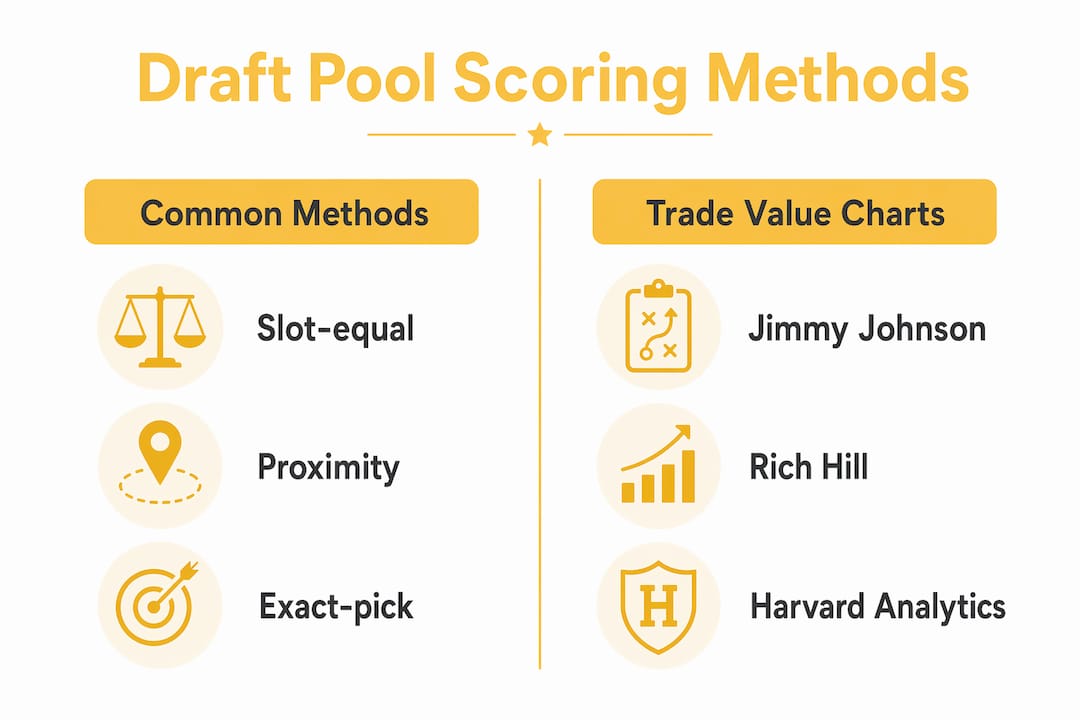
The slot-equal method is the most common format. Your score equals the exact pick number where your player was selected. First pick equals 1 point, 100th pick equals 100 points. Low total wins.
The proximity method rewards accuracy rather than just predicting early picks. Common schemes include 10 points for an exact pick prediction, 5 points for landing within one slot, and 2 points for landing within two slots. This format flips the scoring so that high totals win, and it rewards participants who nail specific picks rather than just guessing top-five players.
The exact-pick method awards points only for perfect predictions. You either called the exact slot or you score zero. This format is rare in casual office pools but appears in more competitive contest formats.
The penalty method adds a fixed penalty score for every player who goes undrafted. This is a variation of the slot-equal method and is designed to punish risky picks on players with uncertain draft status.
Here is a quick breakdown of the most common formats:
- Slot-equal scoring: Points equal draft slot number. Fewest total points wins. Best for casual groups.
- Proximity scoring: Points awarded for closeness to actual pick. Highest total wins. Rewards research and precision.
- Exact-pick scoring: Full points only for perfect predictions. Zero for misses. Best for competitive pools.
- Penalty scoring: Slot-equal base with added penalty for undrafted players. Discourages long-shot picks.
Pro Tip: Before joining any pool, confirm whether low score or high score wins. Mixing up the format is the single most common mistake new participants make, and it affects every pick decision you make.
How do trade value charts affect draft pool scoring?
Some pools move beyond simple slot numbers and use official NFL draft pick trade value charts as their scoring foundation. Draft pools often assign a numerical point value to every draft pick to allow comparison across picks and trades, with values running from the first overall pick through the final compensatory selection.
The most referenced trade chart is the Jimmy Johnson chart, which assigns 3,000 points to the first overall pick and drops steeply from there. The Rich Hill chart and the Harvard Analytics model take different mathematical approaches. The first overall pick can be valued from 494.6 points under the Harvard model to 3,000 points under the Jimmy Johnson chart. That is a sixfold difference for the exact same pick slot, which means two pools using different charts produce completely incomparable scores.
The table below shows how three major trade charts value key draft slots:
| Draft slot | Jimmy Johnson chart | Rich Hill chart | Harvard Analytics model |
|---|---|---|---|
| Pick 1 (overall) | 3,000 points | ~2,600 points | 494.6 points |
| Pick 10 | 1,300 points | ~900 points | ~200 points |
| Pick 32 (end of Round 1) | 590 points | ~400 points | ~80 points |
| Pick 64 (end of Round 2) | 260 points | ~180 points | ~35 points |
The steep, non-linear value curve in these charts creates a consistent baseline for scoring draft picks in pools, but it also means that early-round picks carry dramatically more weight than late-round selections. A pool using the Jimmy Johnson chart effectively makes your Round 1 picks worth ten times more than your Round 3 picks. That changes strategy entirely.
Pro Tip: If your pool uses a trade value chart for scoring, focus the majority of your research on the first two rounds. Late-round picks contribute so little to your total score under most chart models that agonizing over them is rarely worth the effort.
Variations and operator-specific rules you need to know
No single universal scoring method exists across all NFL draft pools, so participants must carefully review the scoring rules for each pool they join. This is the most overlooked piece of advice in draft pool participation.
Operator-run contests add another layer of complexity. DraftKings uses NFL official rules and its own posted scoring to determine pool winners, which differs from the informal rules most office pools follow. Reading the operator's specific rules before submitting picks is not optional. It is the only way to know what you are actually competing for.
Common rule variations you will encounter across different pools include:
- Round weighting: Some pools assign bonus multipliers to Round 1 picks, making them worth two or three times the base slot value.
- Position bonuses: Certain pools award extra points for correctly predicting a quarterback or edge rusher in the top ten, reflecting the premium those positions carry in real drafts.
- Tiebreaker rules: Most pools use a tiebreaker pick, often the exact slot of the first overall selection, to separate participants with identical scores.
- Trade pick rules: Pools that allow participants to select traded picks must define how compensatory picks are scored, since those picks are assigned after the standard rounds.
- Multi-day scoring: Some pools score each day of the draft separately, with a combined total determining the overall winner.
The fairness of any pool depends entirely on whether every participant understands the same rules before the draft begins. Disputes almost always trace back to ambiguous scoring language that the commissioner never clarified upfront.
Practical tips for calculating and maximizing your score
Applying scoring knowledge during the actual draft requires a clear system. Here is how to approach it effectively.
-
Write down your scoring format before the draft starts. Confirm whether you are playing slot-equal, proximity, or trade-chart scoring. Print the rules or save them to your phone so you can reference them during the draft.
-
Track your running total in real time. As each of your players is selected, add their point value immediately. Knowing your score after Round 1 tells you how much ground you need to make up or protect in Rounds 2 and 3.
-
Account for undrafted players before you finalize picks. Research each player's draft projection from sources like The Athletic or NFL.com mock drafts. If a player is projected as a late-round pick or undrafted free agent, the penalty points will almost certainly cost you the pool.
-
Use the scoring system to guide your picks, not just your football knowledge. In a slot-equal pool, picking a player projected to go 15th overall is more valuable than picking a player projected to go 45th, even if you personally believe the 45th player is the better prospect.
-
Understand how ties are broken in your specific pool. Many participants ignore tiebreaker rules until they are in one. Knowing the tiebreaker in advance lets you make a more informed final pick.
Pro Tip: In proximity-scoring pools, targeting players with a tight draft range projection (for example, projected anywhere from picks 8 to 12) gives you a better chance of landing within the scoring window than targeting players with wide projection ranges.
Key takeaways
NFL draft pool scoring rewards participants who understand the specific point system their pool uses and apply that knowledge to every pick decision.
| Point | Details |
|---|---|
| Slot-equal scoring is most common | Points equal the draft slot number; fewest total points wins in most casual pools. |
| Undrafted players carry the worst penalty | Players who go undrafted receive the maximum pick number plus one, making them pool-killers. |
| Trade charts vary dramatically | The Jimmy Johnson chart values pick one at 3,000 points; the Harvard model values it at 494.6 points. |
| No universal scoring standard exists | Every pool uses its own rules, so reading the specific scoring format before submitting picks is required. |
| Scoring format shapes strategy | Proximity pools reward precision; slot-equal pools reward predicting early picks correctly. |
Why scoring transparency is the real competitive edge
I have participated in and observed dozens of NFL draft pools over the years, and the pools that fall apart almost never fail because of bad picks. They fail because the scoring rules were never communicated clearly before the draft started. Someone assumed "low score wins" when the pool was actually running proximity scoring. Someone picked a player projected to go undrafted because they liked him as a prospect, not realizing the penalty would sink their entire entry.
The pools I have seen run well share one trait: the commissioner sent a one-page scoring summary to every participant at least 48 hours before the draft. That single habit eliminates 90% of the disputes I have witnessed. It also forces participants to actually engage with the scoring system rather than just submitting names and hoping for the best.
My honest opinion is that slot-equal scoring is the best format for groups that include casual fans. It is intuitive, requires no explanation beyond "low score wins," and keeps everyone engaged through the first two rounds when the most predictable picks happen. Proximity scoring is more fun for groups of serious fans who want to reward research and precision, but it creates confusion when new participants do not understand why picking a player who went exactly where projected scores zero points.
The trade chart formats are genuinely fascinating from a strategy perspective. The non-linear value curves mean that a single correct Round 1 prediction can be worth more than all of your Round 3 picks combined. But they require participants to understand the chart before the draft, and most casual groups are not willing to do that homework.
Whatever format your pool uses, the scoring system is the game. Treat it that way.
— Steve
Score your NFL draft pool the easy way with Draftwins
Running a draft pool with a group of friends should be fun, not a spreadsheet project. Draftwins is built for exactly this situation.
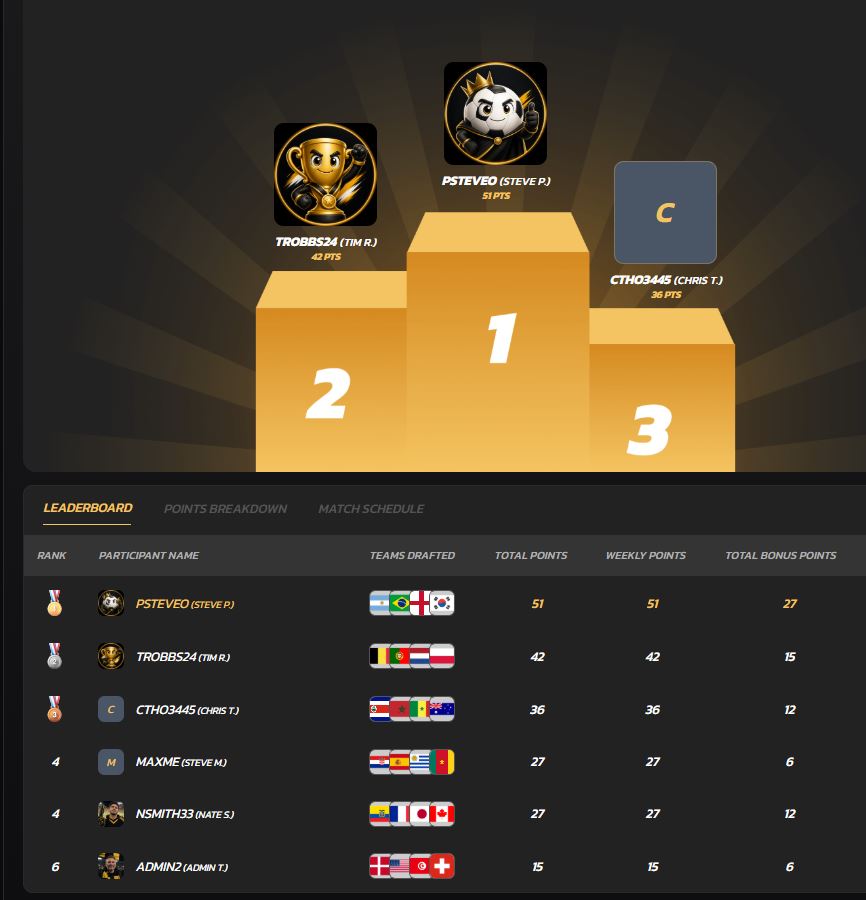
Draftwins handles automated scoring and live leaderboards so you never have to manually calculate point totals or chase down tiebreaker rules mid-draft. Commissioners can set up private pools with their preferred scoring format, share the rules with participants before the draft, and let the platform do the rest. NFL and College Football pools are coming to Draftwins following the platform's World Cup launch, making it the right time to get your group set up. Visit Draftwins and see how much easier your next draft pool can be.
FAQ
How are points assigned in a standard NFL draft pool?
Points are typically assigned equal to the draft slot number where your selected player is picked, so a player taken first overall scores 1 point and a player taken 32nd scores 32 points. The participant with the lowest total at the end of the draft wins.
What happens if a player I picked goes undrafted?
In most pools, an undrafted player receives a score equal to the total number of picks in the draft plus one, which is the worst possible score. This penalty is designed to discourage participants from selecting players with uncertain draft status.
What is the difference between slot-equal and proximity scoring?
Slot-equal scoring assigns points based on the actual draft slot number, with low totals winning. Proximity scoring awards points for how close your prediction was to the actual pick, with common schemes giving 10 points for an exact pick and 5 points for landing within one slot.
Do all NFL draft pools use the same scoring system?
No. There is no universal scoring standard across NFL draft pools. Operator-run contests like those on DraftKings use their own posted rules, while office pools and private groups set their own formats. Always read the specific scoring rules before submitting your picks.
What is a draft pick trade value chart and how does it affect pool scoring?
A trade value chart assigns numeric point values to each draft slot, with the first overall pick valued at 3,000 points on the Jimmy Johnson chart and 494.6 points on the Harvard Analytics model. Some pools use these charts instead of raw slot numbers, which dramatically increases the weight of early-round picks in your total score.