
Drafting teams instead of players is defined as selecting whole sports franchises as your fantasy assets rather than picking individual athletes, and it is the simplest way to compete in a sports pool without managing a weekly roster. Traditional fantasy leagues demand hours of waiver wire research, injury tracking, and lineup decisions every single week. The team-based format cuts all of that out. Platforms like DraftKings have already proven the appeal of low-maintenance formats, and purpose-built tools like Draftwins are now making team drafting accessible to anyone who wants the thrill of competition without the spreadsheet headache. If you have ever dropped out of a fantasy league because it got too complicated, this format was built for you.
What is drafting teams instead of players?
Drafting teams instead of players means your fantasy roster is made up of full sports franchises, not individual quarterbacks or strikers. You pick the Kansas City Chiefs, not Patrick Mahomes. You pick Brazil, not Vinícius Jr. Your score is tied to how that franchise performs across the competition, not to whether one athlete stays healthy on a Tuesday.
The industry term for the closest mainstream equivalent is "best ball" fantasy, where automatic lineups eliminate manual weekly decisions by starting your highest-scoring assets each week. Team drafting takes that logic one step further: instead of drafting 20 individual players and letting the algorithm sort them, you draft the teams themselves. The result is a format where your draft-day decisions are the competition.

This approach has a specific appeal for casual groups. Office pools, friend groups, and family leagues all suffer from the same problem: half the participants lose interest by week four because managing a traditional roster feels like a part-time job. Team-based drafts solve that by front-loading all the fun into a single draft event and then letting the season play out.
What do you need to get started with team-based drafting?
Getting into a team draft requires less setup than a traditional fantasy league, but a few prerequisites will make the experience much smoother.
What you need to know before your first draft:
- The field of teams. Know which franchises are in the competition. For a World Cup pool, that means the 32 national teams. For an NFL pool, that means the 32 NFL franchises. Understanding relative strength before you draft is the single biggest advantage you can have.
- The scoring format. Points can be awarded for wins, goals, touchdowns, or a combination. Confirm the scoring rules before draft day so you know whether you are chasing high-scoring offenses or consistent winners.
- The draft order format. Most team drafts use a snake format, where the order reverses each round. Some groups adapt auction mechanics, where budget allocation and bidding strategy determine who lands the top teams. Snake drafts are faster and easier for beginners.
- Trade rules. Decide upfront whether trades are allowed after the draft. Many casual pools skip trades entirely to keep things simple.
- The number of teams each participant drafts. In a 10-person pool with 32 available teams, each person drafts three teams with two teams going undrafted. That math shapes your strategy significantly.
Tools that help:
Platforms like NFL.com include live draft client features such as chat, queue management, and auto-pick for missed selections, which translate directly to team draft setups. Draftwins handles this natively for team-based pools, including automated scoring and live leaderboards so you never have to calculate points manually.
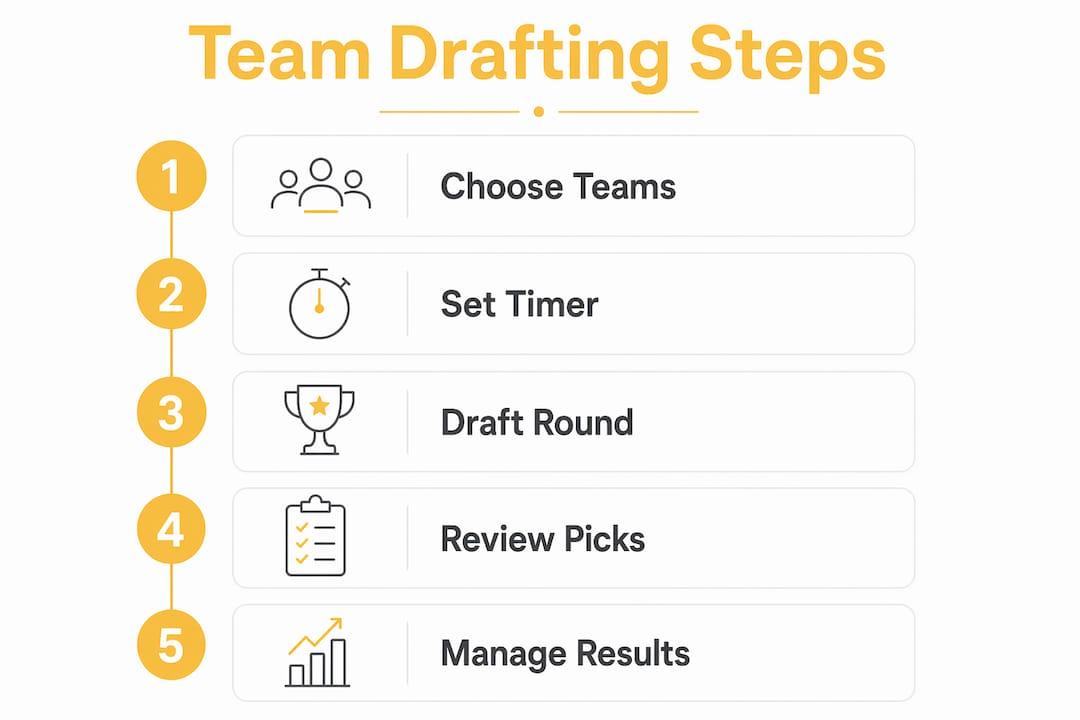
Pro Tip: Set a draft timer of 60 to 90 seconds per pick. It keeps the energy high and prevents anyone from over-analyzing a decision that should feel fun.
How do you run a team draft step by step?
Running a team draft is straightforward once you understand the mechanics. Here is the process from setup to final pick.
- Set the pool. Decide the sport, the competition (World Cup, NFL regular season, NFL playoffs), and the number of participants. Confirm everyone knows the scoring rules before the draft starts.
- Establish draft order. Use a random draw or a seeded order based on previous season results. In a snake draft, the person who picks last in round one picks first in round two.
- Rank the teams. Before the draft, each participant should have a rough ranking of the available franchises by projected performance. Recent form, strength of schedule, and historical performance all factor in.
- Execute the draft. Each participant selects one team per round until all roster spots are filled. In a 10-person pool with three picks each, the draft runs three rounds.
- Confirm the roster. Once the draft closes, rosters are locked. In a no-trade format, your draft-day decisions are final. In a trade-enabled format, a trade window opens immediately after the draft.
- Track scores automatically. Platforms like Draftwins handle scoring without manual input. Points accumulate based on your teams' real-world results throughout the competition.
- Monitor the leaderboard. Check standings after each game week. The live leaderboard is where the competition lives once the draft is done.
The key mechanical difference from player drafting is that you are not managing individual positions. There is no "I need a running back in round three" logic. You are evaluating franchise-level value, which is a much more intuitive judgment for most sports fans.
Pro Tip: In a World Cup pool, do not sleep on dark horse teams from strong confederations. A team like Morocco or Japan can outscore a group-stage exit from a top seed.
| Draft format | Best for | Trade complexity | Management after draft |
|---|---|---|---|
| Snake (team-based) | Casual groups, beginners | Low to none | None |
| Auction (team-based) | Competitive groups | Medium | None to low |
| Best Ball (player-based) | Experienced fantasy players | None | None |
| Traditional fantasy | Dedicated players | High | Weekly |
What are the top strategies for winning a team-based draft?
Team drafting strategy differs from player drafting in one fundamental way: you cannot replace a bad pick with a waiver wire add. Your draft is your season. That shifts the entire strategic weight onto a single event.
Prioritize consistency over ceiling. The temptation in any draft is to chase the highest upside. In team drafts, balanced rosters outperform concentrated bets on a few elite franchises. A team that exits in the quarterfinals scores zero points for the rest of the tournament. Spread your picks across teams with different paths through the bracket.
Understand the scoring structure before you draft. If your pool awards points for every goal scored, prioritize high-scoring offenses. If it awards points purely for wins and advances, prioritize defensively sound teams with easier draw paths. These are different drafts with different optimal strategies.
Use stacking deliberately. Stacking means drafting multiple teams from the same group or conference, betting that the group is collectively strong. This works in World Cup pools where a strong group (say, Group A with two historically dominant nations) means both teams are likely to advance. It backfires when a "strong" group produces early upsets.
Target undervalued teams in the middle rounds. The top three or four teams in any competition are obvious. Everyone knows who the favorites are. The draft is won or lost in rounds two and three, where the difference between a team that reaches the semifinals and one that exits in the round of 16 is not always obvious on draft day.
Diversify by schedule strength. In NFL team drafts, a team with a soft early schedule can rack up points fast even if their overall talent level is average. Roster depth at key positions matters in player formats for the same reason: sustained performance beats one great week.
What mistakes should you avoid in team draft leagues?
Most problems in team draft leagues come from poor setup decisions, not bad picks. Fix these before the draft starts.
- Over-concentrating on favorites. Drafting three of the top four teams feels safe but leaves you exposed if one exits early. One upset can collapse your entire roster.
- Ignoring bracket or schedule structure. In tournament formats, a team's path matters as much as their talent. A strong team in a brutal bracket may score fewer points than a weaker team with an easier road to the final.
- Skipping the rules conversation. Disputes about scoring, trades, and tiebreakers almost always trace back to rules that were never written down. Send a one-page rules summary to every participant before draft day.
- No plan for no-shows. If a participant misses the draft, auto-pick fills their roster randomly. That is fine for one person, but two or three auto-drafted rosters distort the pool. Set a clear policy: either hold the draft only when everyone is present, or assign a proxy drafter.
- Misreading the automatic scoring feature. In formats where scoring is automated, some participants assume they need to do something each week. They do not. Automatic lineup settings handle everything. Clarify this before the competition starts so no one thinks they are losing because they forgot to log in.
The best team draft leagues are the ones where the rules are so clear that nobody argues about them. Spend 10 minutes on setup and you save hours of frustration later.
Key takeaways
Drafting teams instead of players is the most accessible fantasy format available because it concentrates all strategy into a single draft event and removes weekly management entirely.
| Point | Details |
|---|---|
| Team drafting defined | You select full franchises as fantasy assets, not individual athletes, making the format intuitive for any sports fan. |
| Draft-day strategy is everything | With no waiver wire or weekly moves, your picks on draft day determine your entire season outcome. |
| Balance beats concentration | Spreading picks across multiple competitive teams outperforms loading up on a few heavy favorites. |
| Setup determines enjoyment | Clear rules on scoring, trades, and no-shows prevent disputes and keep the competition fun. |
| Automated scoring removes friction | Platforms like Draftwins handle point tracking automatically, so the competition runs itself after the draft. |
Why team drafting converted me for good
I ran traditional fantasy football leagues for eight years. I loved the strategy, but I watched the same thing happen every season: half the league checked out by October because managing a roster felt like homework. The people who stayed engaged were the ones who had time to obsess over it. Everyone else was just going through the motions.
The first time I ran a team-based pool for a World Cup, something shifted. Everyone showed up for the draft. Everyone stayed engaged through the group stage. People who had never touched a fantasy app were texting the group chat after every match. The format did not dumb the competition down. It focused the competition on the part that everyone actually enjoys: picking your teams and watching them perform.
The strategic depth is real, too. Knowing that Morocco's path through the bracket is softer than France's, or that a particular NFL team has four home games in the first six weeks, is genuine analysis. It just does not require you to check injury reports at 11 PM on a Thursday.
My advice for first-time team drafters: resist the urge to over-engineer the rules. Start with a snake draft, automated scoring, and no trades. Run one season that way. You will find out quickly which rules your group actually wants to add, and which ones just create noise. The simplest version of this format is also the most fun version, at least until your group is ready for more.
— Steve
Try team drafting with Draftwins
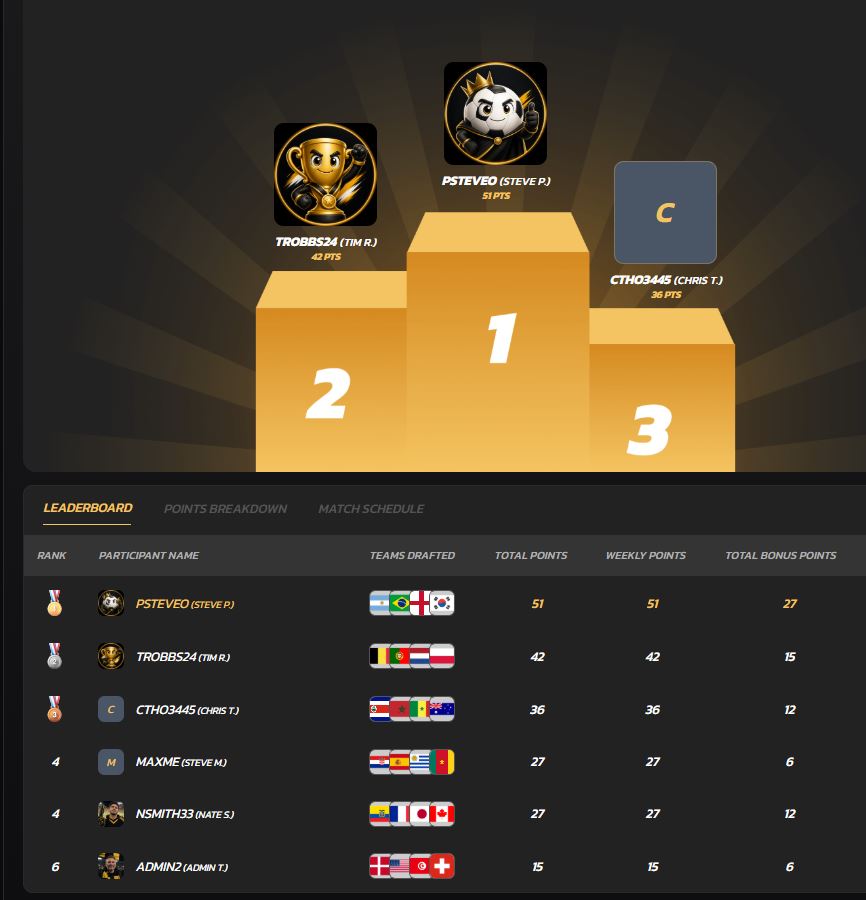
Draftwins is built specifically for the team drafting format described in this article. You draft entire teams, not individual players, and the platform handles scoring and leaderboards automatically from that point forward. Commissioners set up private pools in minutes, customize scoring rules, and invite their group with a single link. Draftwins launches with World Cup pools, with NFL and College Football pools to follow. There are no entry fees collected and no prize pools managed by the platform. It is a clean, focused experience designed for groups who want real competition without the complexity of traditional fantasy leagues. Start your pool and see how much easier draft day can be.
FAQ
What does drafting teams instead of players mean?
Drafting teams instead of players means selecting full sports franchises as your fantasy assets rather than individual athletes. Your score is based on how those franchises perform throughout the competition, not on individual player statistics.
Is team-based drafting good for beginners?
Team-based drafting is the best format for beginners because it requires no weekly lineup management. You make your picks on draft day, and automated scoring handles everything after that.
How many teams should each person draft?
The number depends on your pool size and the total teams available. In a 10-person World Cup pool with 32 teams, each participant drafts three teams, leaving two undrafted. Adjust the math to fit your group size.
What is the best team drafting strategy for casual players?
The most effective approach is to balance your picks across teams with different bracket paths rather than concentrating on the top favorites. Balanced team selection produces more consistent results than betting everything on one or two elite franchises.
Do you need to manage your roster after the draft in a team pool?
No. In most team draft formats, including those on Draftwins, your roster is set after the draft and scoring runs automatically. There are no weekly lineup decisions, waiver pickups, or trades required unless your league rules specifically allow them.