
For most groups, a short pick-em contest or a single-event bracket draft is the fastest way to launch, and a season-long team-draft league wins on engagement if your group is committed. DraftWins is one option built specifically for private, web-based team-draft pools, and the setup steps, scoring templates, and rule language below are ready to be copied into your own invite.
TL;DR:
- Short-format pick-em contests are ideal for casual or first-time groups, requiring minimal setup and encouraging quick participation.
- Bracket pools with round multipliers or confidence points effectively reward late-round accuracy and adjust for varying skill levels.
- Automating scoring and standings through platforms like DraftWins minimizes errors and saves time, especially for larger pools.
- Clear, published rules, including lock times and tiebreaker criteria, prevent disputes and ensure transparent gameplay.
- Engaging eliminated players with small prizes, leaderboards, or surprise awards maintains momentum beyond initial eliminations.
Table of Contents
- Bar Sports Contest Ideas: The Formats That Actually Work
- How to Set Up a Bar Sports Contest Without Chaos
- Scoring Systems and Tiebreakers You Can Copy Directly
- Keeping Players Engaged After They're Eliminated
- Rule Templates You Can Paste Into Your Invite
- Matching the Format to Your Group
- Theme Nights That Get More People to Sign Up
- Keeping the Pool Fair and Drama-Free
- Getting the Word Out and Filling Your Roster Spots
- How DraftWins Helps You Run Private Team-Draft Pools Faster
- Sources
- FAQ
Bar Sports Contest Ideas: The Formats That Actually Work
Every contest format trades commitment for engagement. A five-minute pick-em keeps casual friends involved without homework, while a full season-long draft demands more setup but pays back with weeks of chat activity. Here is how the main bar sports contest ideas stack up for private, web-based team-draft pools.
-
Short-format pick-em or daily match picks. Participants pick winners for a handful of upcoming matches, no draft required. This works best for casual groups, one-off weekends, or anyone testing a new group's appetite for a pool before committing to something bigger.
-
Bracket or knockout pools for tournaments. March Madness, the World Cup, and similar single-elimination events lend themselves to bracket pools scored with round multipliers, where each correct pick is worth more as the tournament advances. This format rewards people who correctly call upsets in later rounds instead of just picking favorites in round one.
-
Single-event team draft. Commissioners run one draft for one tournament, participants draft whole teams instead of individual players, and the pool runs its course over a few weeks. Lower ongoing commitment than a season league, but still gives everyone a rooting interest tied to a specific squad rather than a bracket line.
-
Season-long team-draft league. Weekly scoring, a full season of standings, and the highest sustained engagement of any format on this list. This suits coworkers or friend groups who already talk sports regularly and want a reason to check in every week, not just during a tournament window.
-
Hybrid mini-seasons. A shortened, recurring format, think four to six weeks tied to a stretch of the calendar, gives repeat groups structured engagement without asking for a full-season commitment. Good for groups that run a pool every quarter and don't want draft fatigue.
Group size and appetite decide which of these bar sports pool ideas fits. A tight friend group of six will get more out of a single bracket draft than a 12-week league; a 40-person office pool needs the structure a season-long format provides just to keep everyone oriented.
How to Set Up a Bar Sports Contest Without Chaos
Commissioners who skip a written timeline are the ones fielding "wait, when's the draft?" messages three days before kickoff. Run through these steps in order.
- Pick your format and cap your participant count. Decide on a hard deadline for signups before you send a single invite.
- Publish rules and prize structure first. Announce scoring, entry terms, and tiebreakers in writing before you collect a single pick. Clear rules published upfront reduce disputes far more than fixing a disagreement after the fact.
- Choose your draft type and test it. Snake draft, auction, or a timed live draft, each changes strategy. Draft rooms typically support snake, auction, freeze-tag, and czar formats, so pick one and run a private mock draft to confirm timer length and autopick behavior before the real thing.
- Set a hard lock time. For large groups or anyone spanning time zones, lock entries at least 24 hours before the first game so nobody scrambles at kickoff. Turn on auto-lock if your platform offers it.
- Confirm everyone can actually join. Verify participant emails and send account invites before you open the draft room, then decide where standings get posted, group email, Slack, or Discord, and how often.
Pro Tip: Run a five-minute mock draft with just yourself and one other person the night before. It catches timer glitches and autopick settings that would otherwise derail your actual draft.
Scoring Systems and Tiebreakers You Can Copy Directly
Scoring disputes kill more pools than bad picks do. Publish your method before entries open, not after someone loses by a technicality.
- Round-multiplier bracket scoring: points double each round, 1-2-4-8-16-32 for a six-round tournament. This is the standard approach for bracket pools because it keeps late rounds meaningful instead of letting an early lucky guess decide everything.
- Confidence points: participants rank picks by certainty each round, assigning higher point values to their most confident calls. Rewards conviction over volume.
- Upset bonus: add flat bonus points any time a lower seed advances, which nudges strategy away from chalk picks.
- Cumulative accumulator scoring: for season-long team drafts, award points weekly based on your drafted team's actual performance, tallied across the whole schedule rather than reset each round.
For tiebreakers, use a fallback order rather than a coin flip on the first tie: predict the championship total first, then most correct picks in a key round, then head-to-head record between the tied entries, and only then a coin flip. Publishing that order in advance means nobody argues about which rule applies when the pool actually ends in a tie.
Keeping Players Engaged After They're Eliminated
Elimination kills momentum fast unless you build in reasons to keep checking the standings. Weekly mini-prizes for the best single-round performance give people something to chase even after their main pick is out. A wooden-spoon award for last place, a small joke prize, keeps eliminated players engaged instead of ghosting the group chat. A surprise bonus for the best upset call rewards the people who took a risk and got it right.
- Post a pinned leaderboard snapshot after each round closes.
- Drop a short round-end announcement with a GIF or meme tied to the biggest surprise.
- Offer non-cash prizes, gift cards, a paid lunch, a trophy that travels to next season's winner.
Pro Tip: For workplace pools specifically, stick to non-cash prizes and check with HR before running anything that resembles a buy-in. It keeps the fun without the paperwork.
Rule Templates You Can Paste Into Your Invite
Copy these directly into your pool page or invite email and adjust the specifics for your group.
Single-event bracket template:
- Entry: one bracket per participant, submitted before lock time.
- Scoring: round multiplier, 1-2-4-8-16-32.
- Tiebreaker: predicted total points in championship game, then most correct Final Four picks.
- Lock: 24 hours before the first scheduled game.
Season-long team-draft template:
- Roster: each participant drafts one team per weekly slot draft, no player-level adds.
- Scoring: cumulative weekly points based on real team performance.
- Trades: allowed through week 4 only, commissioner approval required.
Commissioner authority: the commissioner has final say on disputed scoring and can pause or reset a draft in progress if a technical issue occurs. Workplace note: avoid cash buy-ins; confirm HR or IT policy before running any group pool through company channels.
Matching the Format to Your Group
The right bar sports pool idea depends less on the sport and more on how many people you are wrangling and how often they will actually check in.
- 5 to 12 people: a short bracket or single-event draft is plenty. Anything bigger adds overhead nobody in a small group needs.
- 13 to 30 people: a bracket with round multipliers, or a mini-season draft, gives you more sustained engagement without turning into a full-time job.
- 30 or more people, or a public-facing pool: lean on an automated tool with embedded leaderboards, and post updates at round-end rather than after every single match to avoid burying people in notifications.
- Remote-first groups: favor pick-em contests or short drafts, and announce everything in the channel your group already uses daily, Slack, Discord, or a shared email thread, rather than a separate app nobody opens.
Theme Nights That Get More People to Sign Up
A generic "join our pool" invite gets ignored. A themed one gets forwarded. Tying your contest to a specific stretch of the calendar, rivalry week, conference championship weekend, opening round of a global tournament, gives people a reason to act before the deadline instead of putting it off.
Try running a "underdog only" side contest alongside your main pool, where bonus points go exclusively to correctly calling lower seeds. It's a low-effort add that gives risk-takers something to brag about even if their main bracket falls apart early. A "rival office" format works well for coworker groups: split the office into two departments and track combined standings alongside individual ones, so even people who are losing individually still care about their team's total.
For recurring groups, rotate a "commissioner's curse" bit where last season's winner has to set this season's punishment for the wooden-spoon finisher. It costs nothing to run and gives every new season a built-in storyline before a single pick gets made. Seasonal tie-ins, kickoff weekend for football, opening weekend for March Madness, work because they create a natural deadline that themed invites can build urgency around without feeling forced.
None of this requires a big budget. A theme is just a hook that makes your invite text more interesting than "week 3 picks are due Friday." The hook is what gets forwarded to the person who was on the fence about joining.
Keeping the Pool Fair and Drama-Free
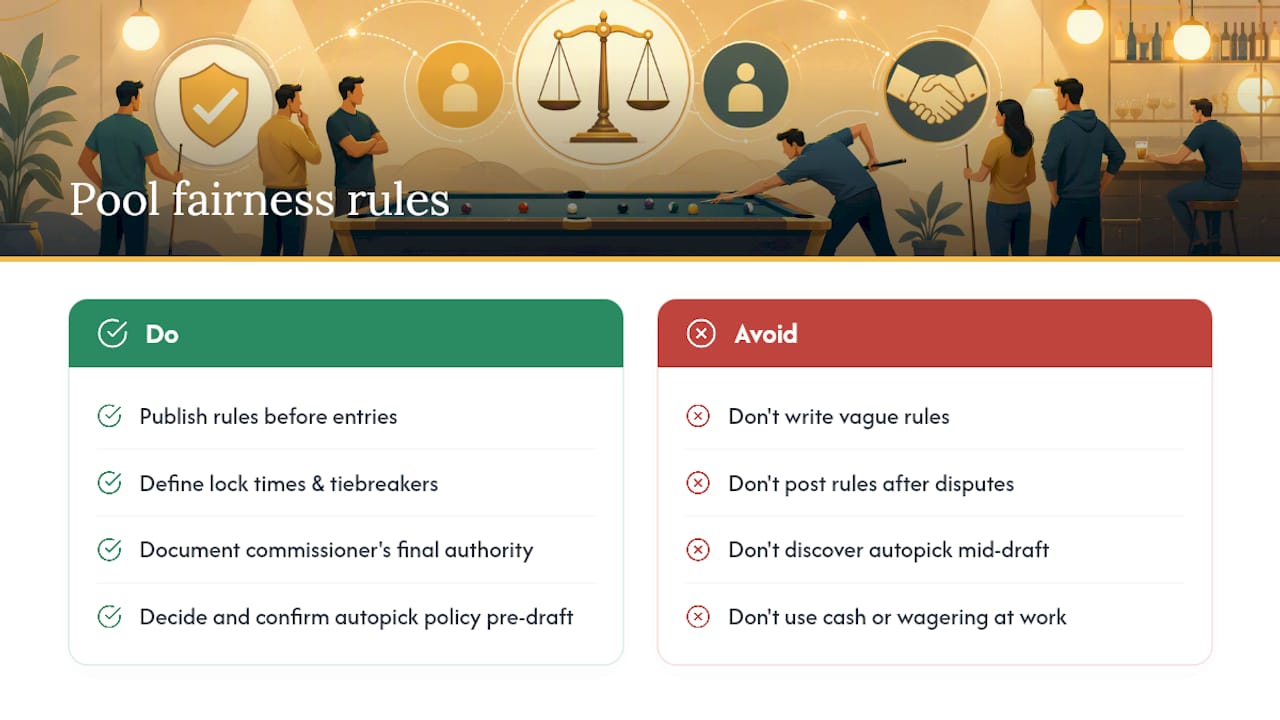
Most disputes in private pools come from ambiguity, not bad faith. Rules that are vague about lock times, scoring edge cases, or what counts as a valid pick create arguments that a clearly written policy would have prevented entirely.
Publish your rules before a single entry comes in, not after the first disagreement. That includes exactly when picks lock, how ties get broken, and what happens if a participant misses the deadline, does their previous week's picks carry over, or are they simply zeroed out. Give the commissioner explicit authority to make final calls on judgment scoring questions, and put that authority in writing so nobody feels like a decision was made arbitrarily after the fact.
Set a policy for no-shows in draft-based formats before draft day, not during it. Decide in advance whether an absent participant gets autopicked, and confirm your draft platform's autopick settings ahead of time rather than discovering how they work mid-draft. For workplace pools, treat safety broadly: no cash buy-ins, no wagering language in your invite, and a quick check with HR or IT if the pool runs through company email or chat tools. It's a five-minute conversation that avoids a much longer one later.
Getting the Word Out and Filling Your Roster Spots
The best format in the world doesn't matter if only four people sign up. Send your first invite at least a week before your draft, and lead with the deadline, not the rules. People respond to urgency ("draft is Thursday, lock your spot") faster than they respond to a wall of scoring details they can read later.
Use the channel your group already checks daily. A pool announced only by email to a group that lives in Slack will underperform one posted where people are already paying attention. Follow up once, two or three days before the deadline, with a simple headcount: "we've got 14 of 20 spots filled, draft is Thursday at 7." Visible momentum pulls in the fence-sitters.
For recurring pools, use last season's leaderboard as your recruiting pitch. Screenshot the final standings, tag last season's wooden-spoon finisher, and let the group's own history do the marketing. Spectator interest matters too, even non-participants will follow a pool if the standings are easy to see, so keep a leaderboard link pinned somewhere public in your group's main channel rather than buried in a spreadsheet only the commissioner can open.
How DraftWins Helps You Run Private Team-Draft Pools Faster
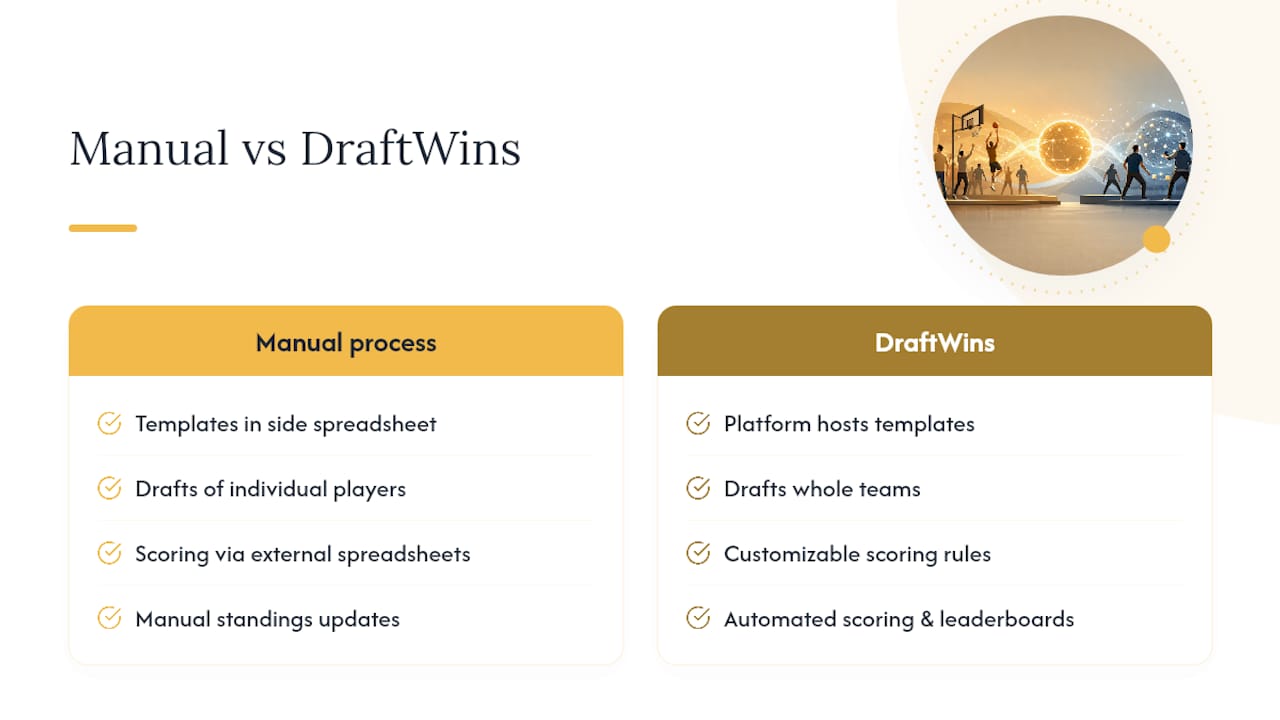
Every format and template above still needs somewhere to live, and that's the gap DraftWins is built to close. It's a platform for private, web-based team-draft pools, meaning participants draft whole teams instead of individual players, which sidesteps the injury-report anxiety and lineup micromanagement that traditional fantasy formats create.
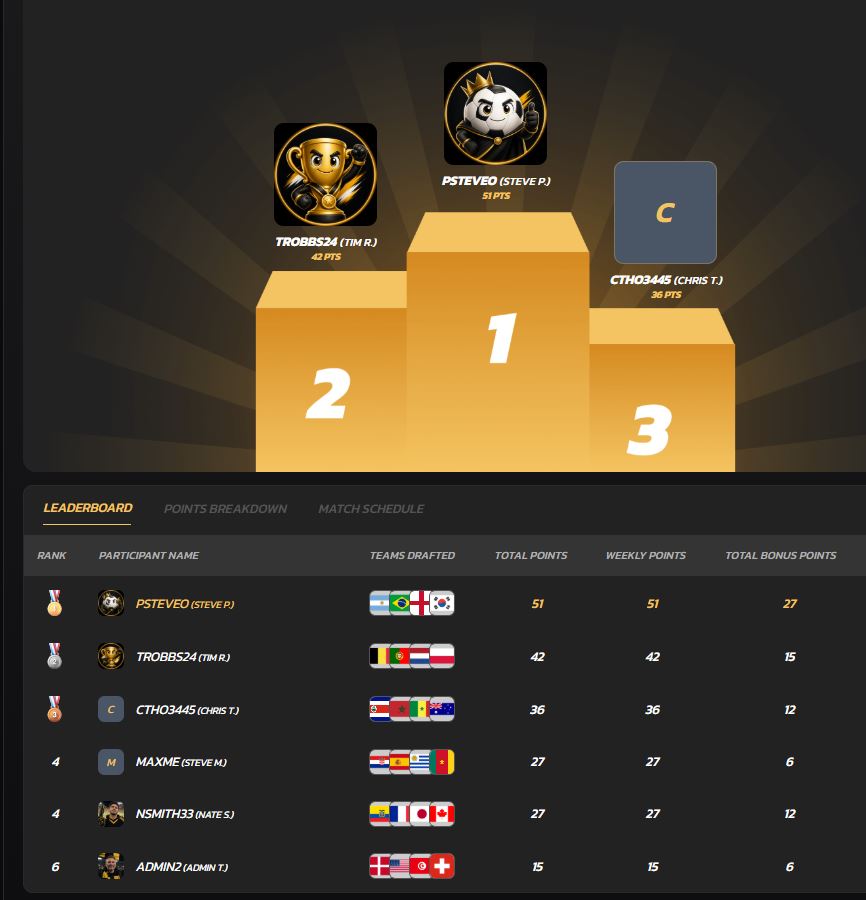
Commissioners set customizable scoring rules, so the round-multiplier or confidence-points systems above can go straight into your pool's settings rather than living in a side spreadsheet. Automated scoring and live leaderboards mean you're not manually updating standings after every match, and dedicated bracket or draft tools reduce the errors that manual spreadsheet scoring tends to produce once a pool grows past a handful of people. Some platforms charge a hosting fee to the commissioner to create and run private pools, while participants join free with no wagering involved.
If you're ready to move past the invite-and-spreadsheet routine, create a private pool on DraftWins, paste in your rule template, and share the live leaderboard link wherever your group already talks.
Sources
For deeper templates and format comparisons: see draft-based contest styles, why drafts drive engagement, team-picking guidance, ranked format comparisons, and tiebreaker rule examples.
- How to Run an Office Bracket Pool - Scoring, Rules
- How to Run a FIFA World Cup Bracket Pool (2026 Guide)
- Draft Room Manual
- How do I setup and use the online draftroom?
FAQ
What's the easiest bar sports contest idea for a first-time commissioner?
A short pick-em contest or single-event bracket draft requires the least setup and works well for testing whether your group wants a bigger, season-long pool later.
How far in advance should I lock entries?
Lock entries at least 24 hours before the first game to account for time zones and stragglers, a standard recommendation for World Cup and tournament bracket pools.
What scoring system avoids disputes in bracket pools?
A round-multiplier system, 1-2-4-8-16-32, is the most common default for bracket pools because it rewards correct late-round picks without needing custom math.
Can I run a team-draft pool without a dedicated platform?
Yes, but manual spreadsheet scoring tends to break down once a pool grows past a small group; an online sports pool platform automates scoring and leaderboards to reduce manual updates by commissioners.
What should workplace pools avoid?
Skip cash buy-ins and any wagering language, and confirm your pool complies with HR or IT policy before running it through company email or chat tools.
How do I keep eliminated participants engaged?
Offer a wooden-spoon prize for last place, post round-end leaderboard snapshots, and add a bonus for the best upset pick to keep people checking in after their main pick is out.