
Round-robin is the gold standard of group sports contest formats ranked by fairness, but it is rarely the right choice on its own. The best competitive sports formats balance three forces: how accurately they rank participants, how many matches they require, and how much excitement they generate for players and spectators alike. Major 2026 tournaments including the FIFA World Cup and the Volleyball Nations League each use different structural answers to that same problem. Whether you are organizing a weekend recreational league or managing a 48-team bracket, the format you choose determines everything from scheduling logistics to how fairly the final standings reflect actual performance.
1. Group sports contest formats ranked: why round-robin leads on fairness
Round-robin is the format against which all others are measured. Every participant plays every other participant exactly once, which means standings reflect all matches played rather than a single bad day. Teams earn three points for a win and one for a draw, with tiebreakers resolving ties through goal difference, goals scored, and head-to-head results.
The math behind round-robin is both its strength and its limitation. A group of four teams requires six matches. A group of eight requires 28. The formula is N×(N−1)/2, and match volume grows fast enough that round-robin becomes impractical for large participant pools without pairing it with a knockout phase. That is why most major leagues use it only for group stages.
Why round-robin ranks first:
- Every team faces the same schedule, removing luck-of-the-draw complaints
- Ranking accuracy is higher than any other single-stage format
- Tiebreakers are well-understood and widely accepted
- Works best for groups of four to eight participants
Pro Tip: Pair round-robin group stages with a knockout bracket for tournaments above 16 teams. The group stage produces accurate seedings; the knockout stage produces a clear champion.
2. Hybrid group stage plus knockout: the format most major tournaments actually use
The hybrid format combines mini round-robins in a group stage with a knockout elimination bracket. It is the structure behind the 2026 FIFA World Cup, which expanded to 48 teams across 12 groups of four. The top two teams from each group plus the eight best third-placed teams advance to a 32-team knockout bracket. That structure allows a massive participant pool while preserving the fairness of round-robin competition during the group phase.
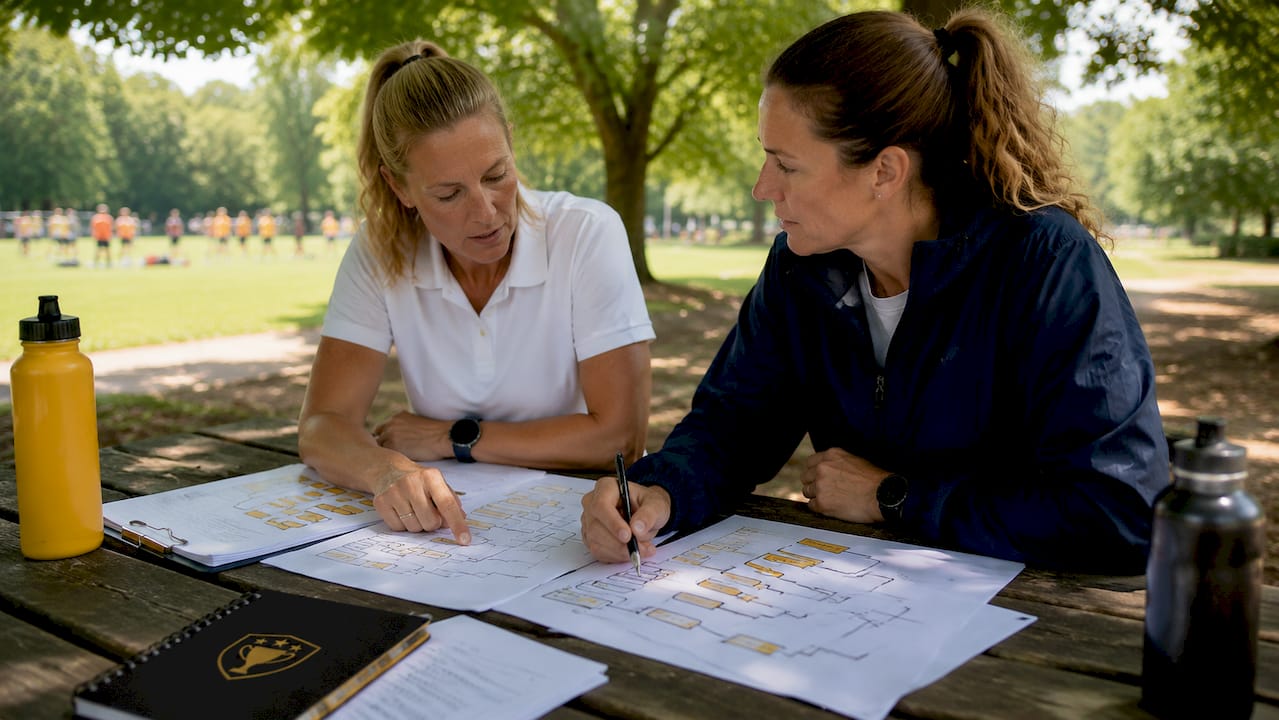
The Volleyball Nations League 2026 takes a similar approach. Eighteen teams per gender compete across a group stage before the top eight advance to a Final 8 elimination bracket, with cross-position quarterfinal matchups designed to balance competitiveness and reduce the chance of a top seed meeting another top seed in the first round.
Seeding is what separates a well-run hybrid from a chaotic one. Cross-seeding in knockout rounds, where the first-place finisher in one group faces the second-place finisher in another, reduces "unlucky bracket" complaints and improves average match quality throughout the elimination phase.
| Format element | Advantage | Drawback |
|---|---|---|
| Group stage (round-robin) | Fair ranking, everyone plays multiple matches | Time-consuming, requires scheduling discipline |
| Knockout bracket | High drama, clear winner | One loss ends the run, ranking below top four is unclear |
| Cross-seeded knockout | Reduces bracket luck, rewards group performance | More complex to explain to casual participants |
Pro Tip: Publish your tiebreaker criteria before the tournament starts. FIFA's tiebreaker sequence covers goal difference, goals scored, head-to-head results, fair play points, and drawing of lots. Participants who know the rules in advance accept outcomes far more readily.
3. Swiss-system format: the best option for large fields with limited time
The Swiss system is the most underused format in recreational and amateur sports organizing. Participants are paired each round based on their current results, so strong performers play other strong performers and weaker participants face comparable competition. Nobody is eliminated. Everyone plays every round. The format keeps participants active longer than full round-robin while requiring far fewer total matches.
Chess and Go have used Swiss-system formats for over a century, and the structure translates well to team sports. A 32-team Swiss tournament with six rounds produces a credible ranking for every participant. A full round-robin with 32 teams would require 496 matches. That comparison alone explains why Swiss is the right call for local tournaments with many participants but limited courts, fields, or time.
The format does carry real complexity. Bye rounds, where a participant has no opponent in a given round, must be assigned fairly and consistently. Tiebreakers at the end of a Swiss event require careful pre-set rules because small rule changes in tiebreaks can reorder final standings significantly. FIDE, the international chess federation, updated its Swiss rules in February 2026 specifically to address bye handling and tiebreak clarity.
Swiss-system strengths and limitations:
- Scales to 64 or more participants without exploding match counts
- Produces credible rankings across the full participant pool, not just the top finishers
- Keeps every team engaged through the final round
- Requires software or a dedicated organizer to manage pairings accurately
- Bye assignment and tiebreak rules must be published and enforced consistently
Pro Tip: For local recreational leagues with 20 or more teams and only one or two playing surfaces, Swiss is almost always the right call. It fills every time slot with meaningful matches and produces a final ranking that participants trust.
4. Single-elimination and double-elimination: ranked for speed, not fairness
Single-elimination is the simplest group competition style in existence. Lose once and you are out. The format produces a champion quickly and generates maximum drama in every match, but it ranks poorly on fairness. A top team that draws a difficult bracket in the first round can exit before most participants have played two matches. The ranking it produces beyond first and second place is essentially meaningless.
Double-elimination addresses that weakness directly. Every participant gets two losses before elimination, which means one bad match does not end a run. The format is common in softball, esports, and wrestling tournaments. It produces a more credible ranking than single-elimination and gives organizers a natural "winners bracket" and "losers bracket" narrative that participants find easy to follow.
The World Archery 2026 Hyundai World Cup uses a hybrid of qualification and seeded knockout that illustrates how to make elimination formats fairer. Qualification scores seed athletes for head-to-head elimination brackets, so the strongest performers from the qualification round face the weakest qualifiers in the first elimination round. That seeding step alone removes most of the "unlucky bracket" criticism that pure single-elimination attracts.
When to use elimination formats:
- Single-elimination: one-day events, final stages of larger tournaments, or situations where time is the binding constraint
- Double-elimination: weekend tournaments where fairness matters but a full round-robin is not feasible
- Always seed properly. Placing the top two teams in opposite halves of the bracket is the minimum standard
Pro Tip: In single-elimination, seed your top four teams into separate quadrants of the bracket. This prevents the two best teams from meeting before the final and gives the overall ranking more credibility.
5. Comparison of formats: when to use each one
No single format wins every situation. The right choice depends on your participant count, available time, number of playing surfaces, and whether your primary goal is accurate ranking, maximum excitement, or logistical simplicity.
| Format | Fairness | Match count | Complexity | Best for |
|---|---|---|---|---|
| Round-robin | Highest | High (N×(N−1)/2) | Low | Groups of 4 to 8, league play |
| Hybrid group plus knockout | High | Moderate | Medium | 16 to 48 teams, major tournaments |
| Swiss-system | High | Low to moderate | High | 20 or more teams, limited facilities |
| Double-elimination | Moderate | Moderate | Medium | Weekend events, 8 to 32 teams |
| Single-elimination | Low | Lowest | Lowest | Final stages, time-limited events |
The decision tree for most organizers runs like this. Under 10 teams with ample time: use round-robin. Between 16 and 48 teams in a structured event: use a hybrid group stage plus knockout. More than 20 teams with limited facilities or a tight schedule: use Swiss. Running a single-day event or a final stage: use single or double-elimination depending on how much fairness matters to your participants.
Budget also shapes format choice in ways organizers often underestimate. More matches mean more officials, more field time, and more administrative overhead. Swiss and single-elimination formats reduce those costs significantly compared to full round-robin. For recreational leagues where participant experience matters as much as ranking accuracy, hybrid formats offer the best return on that investment.
Key decisions before choosing a format:
- How many participants are registered?
- How many rounds or days are available?
- What is the primary goal: accurate ranking, excitement, or efficiency?
- Are tiebreak rules published and agreed upon before play begins?
Key takeaways
The most effective group sports contest format is the one that matches your participant count, time constraints, and ranking goals. Round-robin leads on fairness, hybrid formats lead on balance, and Swiss leads on scalability.
| Point | Details |
|---|---|
| Round-robin ranks highest for fairness | Every participant plays every other participant, producing the most accurate standings. |
| Hybrid formats dominate major tournaments | FIFA World Cup 2026 and Volleyball Nations League both use group stages feeding knockout brackets. |
| Swiss-system scales where round-robin cannot | Produces credible rankings for 20-plus teams without the match volume of full round-robin. |
| Seeding transforms elimination fairness | Cross-seeded knockout brackets reduce unlucky draws and reward group stage performance. |
| Publish tiebreak rules before play begins | Small tiebreak rule changes can reorder standings; early publication prevents disputes. |
Run your group sports competition with Draftwins
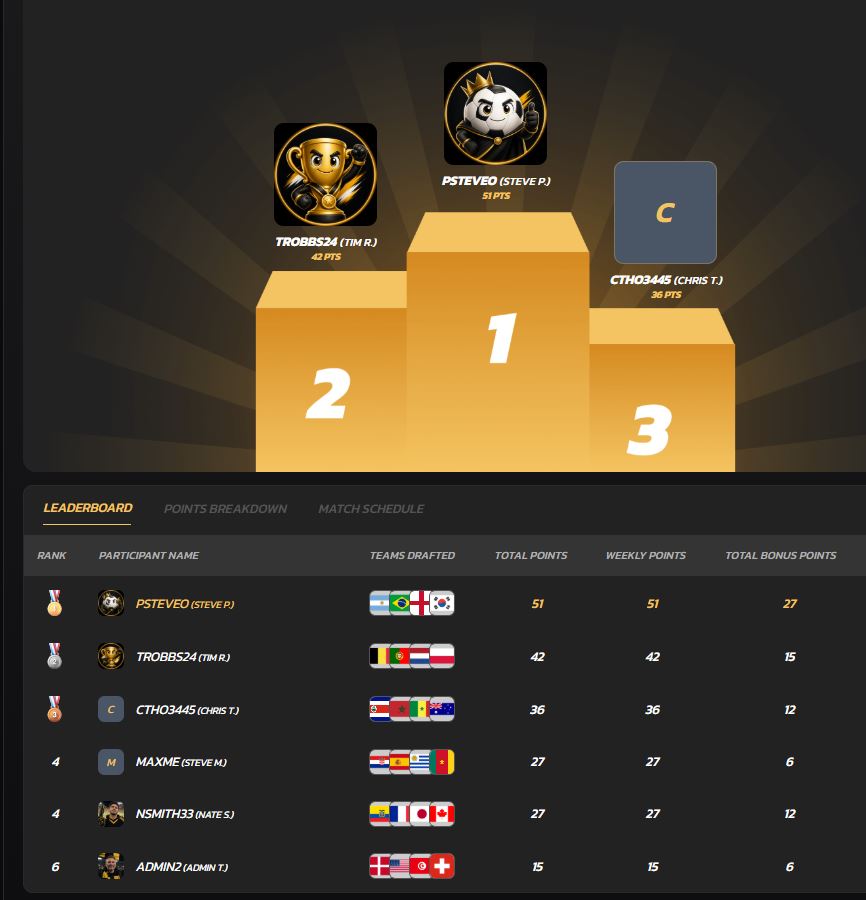
Choosing the right format is only half the work. Tracking results, updating standings, and keeping every participant engaged across multiple rounds is where most organizers lose time and momentum. Draftwins is built specifically for group sports competitions, letting commissioners create private pools, set custom scoring rules, and watch live leaderboards update automatically as results come in. Instead of managing spreadsheets and chasing scores, you focus on the competition itself. Draftwins launched with World Cup pools and is expanding to NFL and College Football. If you are organizing a group contest for the 2026 season, set up your pool on Draftwins and let the platform handle the scoring while you handle the fun.
FAQ
What is the fairest format for a group sports contest?
Round-robin is the fairest format because every participant plays every other participant, and standings reflect all matches played rather than a single result. It works best for groups of four to eight teams.
How does the 2026 FIFA World Cup group stage work?
The 2026 FIFA World Cup uses 12 groups of four teams, with each team playing three matches. The top two teams plus the best third-placed teams from all groups advance to a 32-team knockout bracket.
When should an organizer use a Swiss-system tournament?
Swiss-system works best when participant counts exceed 20 and facilities or time are limited. It keeps participants active through every round without the match volume that full round-robin requires.
What is the difference between single and double-elimination?
Single-elimination removes a participant after one loss; double-elimination requires two losses before elimination. Double-elimination produces a more credible ranking and is better suited to weekend tournaments where fairness matters alongside speed.
Why do tiebreaker rules matter so much in group contest formats?
Minor tiebreak rule changes can reorder final standings, which is why rules covering goal difference, head-to-head results, and fair play points must be published before competition begins.