
Team-based football pools are the better pick for players who want lower time commitment, simpler decisions, and scoring they can actually follow. You draft teams, not individual players, which cuts out the weekly grind of waiver claims, injury reports, and lineup swaps. The result: you spend a few minutes on picks instead of a few hours on roster management. This guide covers the head-to-head comparison, who each format actually suits, how to run or join a pool, and where platforms like Draftwins remove the remaining friction.
Table of Contents
- Why football pools beat fantasy leagues: the head-to-head breakdown
- Who should actually play team-based pools?
- How team-based football pools actually work
- Practical benefits you'll actually feel playing team-based pools
- How to create or join a team-based pool this week
- Legal and regulatory considerations for football pools
- Draftwins makes team-based pools effortless to run
- Key Takeaways
- Useful sources and next steps
- FAQ
Why football pools beat fantasy leagues: the head-to-head breakdown
The core difference is structural. Fantasy football is a management simulation built around cumulative season-long strategy. Team-based pools are prediction contests that resolve weekly or at season's end, with far less ongoing work.

| Dimension | Team-Based Football Pools | Traditional Fantasy Leagues |
|---|---|---|
| Complexity / time commitment | Low — picks take minutes per week | High — drafts, waivers, trades, lineup decisions |
| Skill vs luck balance | Prediction skill plus variance | Roster management skill plus injury luck |
| Injury / roster management | None required | Weekly, sometimes daily |
| Scoring transparency | Simple point totals or win/loss | Complex stat-based formulas |
| Social / party appeal | High — easy for casual groups | Moderate — best among committed players |
| Setup time | Under an hour | Several hours (draft day alone) |
| Platform automation | Automated scoring, live leaderboards | Varies; often requires active platform use |
| Best for | Casual fans, office pools, time-poor players | Stats enthusiasts, season-long competitors |
Team-based pool advantages:
- No roster to manage after draft day
- Scoring is transparent and easy to explain to newcomers
- Works well as a one-time or seasonal commitment
- Entry fees redistribute directly to winners, unlike sportsbooks that build in a margin
Fantasy league advantages:
- Deeper strategic engagement over a full season
- Stronger sense of ownership over individual player performance
- More data-driven decision-making for analytics fans
Team-based pool drawbacks: Less granular control; outcomes depend partly on team performance you cannot influence after picks are locked.
Fantasy league drawbacks: Fantasy platforms must handle sub-second synchronization during live events, and single marquee games can trigger traffic spikes that harm the user experience. That engineering complexity translates directly into player stress.
Scale check: Roughly 60 million fantasy football players participate in the United States annually. That scale drives platforms to build increasingly complex features, which raises the barrier for casual players who just want a fun weekly contest.
Who should actually play team-based pools?
Not every format fits every player. Here is a quick self-selection guide.
Play team-based pools if you are:
- A casual social player. You want to join the office pool, trash-talk on Sundays, and check a leaderboard without studying depth charts. Pools are built for you.
- A time-poor fan. A parent, a professional, or anyone who loves football but cannot commit to weekly pick management. Some pool formats take under a minute per week.
- A commissioner who wants low admin. Running a fantasy league means policing trades and handling waiver disputes. A pool with automated scoring runs itself.
Stick with fantasy leagues if you are:
- An analytics hobbyist. You enjoy building spreadsheets, tracking snap counts, and making data-driven roster moves. Fantasy rewards that investment.
- A season-long competitor. You want 17 weeks of strategic decisions, not a single draft and done.
Edge case worth noting: playing one team-based pool alongside a single fantasy league is a reasonable middle ground. The pool keeps you engaged with the broader schedule; the fantasy league satisfies the deeper competitive itch.
How team-based football pools actually work
The mechanics are genuinely simple. Here is how a standard pool runs:
- Commissioner sets up the pool. Define the format (pick'em, survivor, tiered team draft, or bracket), entry fee, payout split, and tiebreaker rules.
- Players draft or select teams. In a team-draft pool, each player claims a set of NFL or World Cup teams at the start of the season. In a pick'em, players choose winners each week.
- Weekly scoring runs automatically. Points accumulate based on team wins, point totals, or correct predictions, depending on the format.
- Live leaderboard updates. Players check standings without waiting for a commissioner to update a spreadsheet.
- Payout at season end (or weekly). The prize pot distributes to top finishers per the agreed split.
Common variants:
- Pick'em: Predict winners of each week's games. Most accessible format.
- Survivor pool: Pick one team to win each week; lose once and you're out.
- Tiered team draft: Draft NFL or World Cup teams in tiers; your teams' combined wins determine your score.
- Bracket-style: Single-elimination predictions, popular for playoff or tournament formats.
Sample rules block (copy-ready for commissioners):
- Entry: one entry per player, fee set by commissioner
- Scoring: 1 point per correct game winner; 2 points for correct upset picks
- Tiebreaker: total points scored in the final game of the week
- Payout: 70% first place, 20% second, 10% third
Pro Tip: Set tiebreaker rules before the first week, not after a tie happens. Retroactive tiebreakers kill group trust fast. Automated scoring platforms handle this without any commissioner input.
Practical benefits you'll actually feel playing team-based pools
Lower complexity is not just a feature list item. It changes how you experience the season.
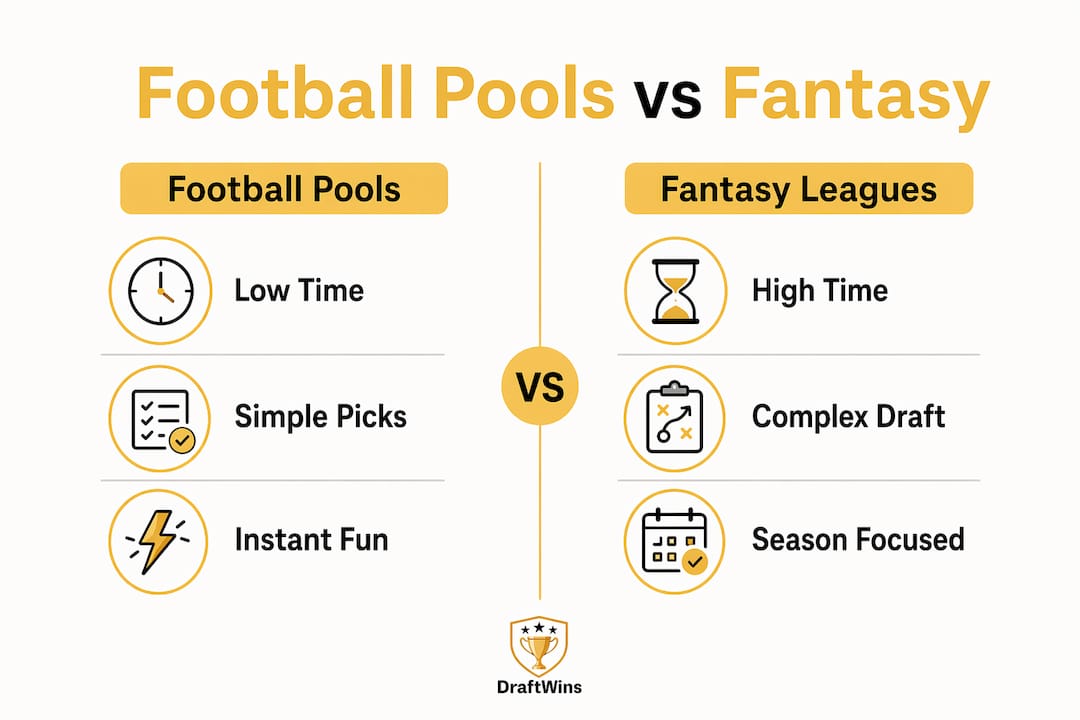
Fantasy platforms require real-time state synchronization, shared pool management, and strict draft timers. That combination creates genuine stress, especially during live drafts when a slow connection or a distracted moment costs you a key player. Team-based pools skip that entirely.
On the financial side, pool models often return most or all entry fees to winners. Sportsbooks subtract a bookmaker margin before any payout, which reduces expected value for every participant. In a pool, you are competing against other people, not a house edge.
| Benefit | Team-Based Pools | Notes |
|---|---|---|
| Weekly time per player | Minutes | Pick'em formats can take under 5 minutes |
| Roster management required | None | No waivers, trades, or injury checks |
| Payout structure | Entry fees to winners | No bookmaker margin deducted |
| Edge over casual opponents | Significantly higher finish rate | For disciplined players vs. average entrants |
That last figure is worth sitting with. Because most pool entrants pick on instinct rather than any consistent strategy, a player who applies even basic discipline, like avoiding popular picks and targeting undervalued teams, can finish in the money up to 5–10 times more often than the average entrant, as research shows.
Consider a working parent who spent three seasons in a 12-team fantasy league. Draft prep alone took four hours, and by Week 8 the waiver wire felt like a second job. Switching to a tiered team draft pool meant one selection day in September and a leaderboard check on Monday mornings. Same football, a fraction of the overhead.
How to create or join a team-based pool this week
Commissioner checklist
- Choose your format (pick'em, survivor, or team draft).
- Set the entry fee and payout split in writing before recruiting players.
- Define scoring rules and tiebreakers upfront.
- Pick a platform with automated scoring or prepare a shared spreadsheet.
- Recruit players, at least 8 for a meaningful prize pot.
- Run a draft or selection day (one session, under an hour for most formats).
- Let the platform handle weekly scoring and leaderboard updates.
Common admin traps: Missing payout policy documentation leads to disputes. Unclear tiebreakers cause more conflict than any other single issue. Platform fees vary, so confirm whether the platform charges players directly or bills the commissioner.
Player checklist
- Ask the commissioner for written rules before paying the entry fee.
- Budget 5–15 minutes per week for picks, depending on format.
- Use a simple draft pick strategy: avoid the most popular picks when the odds do not justify them, and target teams the group is undervaluing.
- Check the leaderboard weekly, not daily. Pools reward patience.
Legal and regulatory considerations for football pools
Football pools in the United States sit in a nuanced legal space. Most states permit private, social pools where the operator takes no rake and the prize comes entirely from player entry fees. The key legal distinction is between a game of skill or prediction (generally permissible) and gambling (regulated or restricted depending on state law).
Federal law, specifically the Unlawful Internet Gambling Enforcement Act (UIGEA), targets financial transactions related to unlawful gambling but does not define what is unlawful, leaving that to state law. Several states explicitly carve out social gambling exceptions for pools among friends or coworkers. Others are more restrictive.
Platforms that charge a hosting or platform fee rather than collecting entry fees or holding prize money occupy a different position than those that act as the house. Draftwins, for example, charges a platform fee and does not collect entry fees, hold prize pools, accept wagers, or pay out winnings. This structure is designed to keep the platform outside the definition of a gambling operator.
This article is general information, not legal advice. Confirm the rules in your state with a qualified attorney or your state's gaming commission before running a pool for money.
Draftwins makes team-based pools effortless to run
Running a pool manually means spreadsheets, group texts, and someone always forgetting to update the standings. Draftwins removes that entirely.
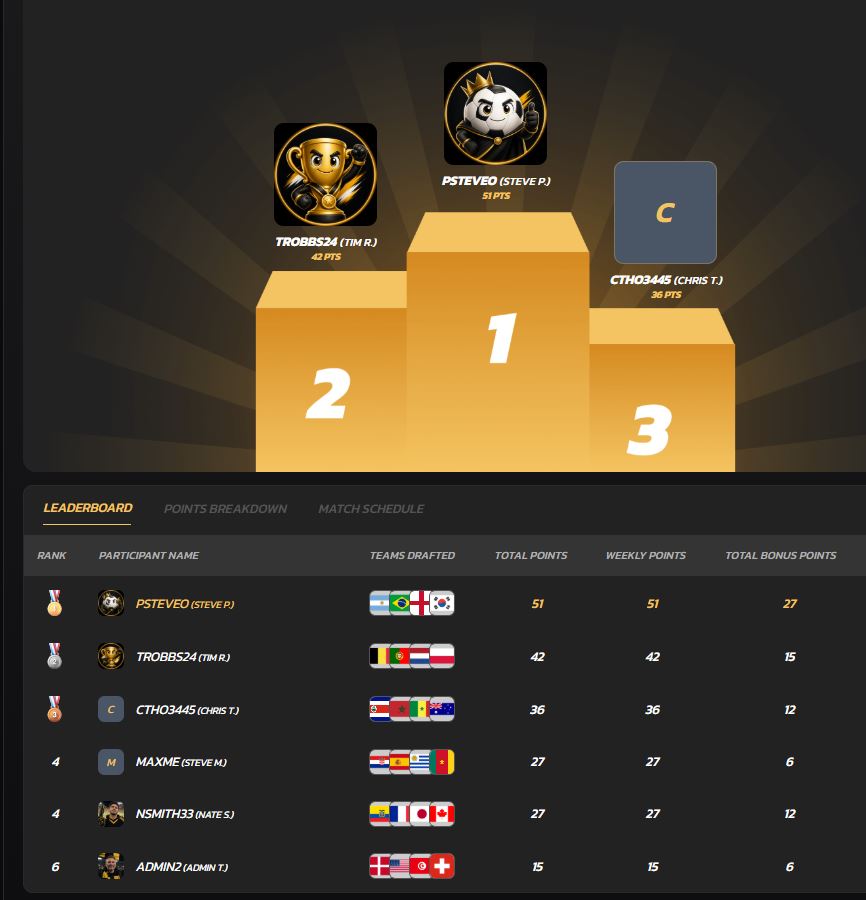
The platform is built specifically for team-based drafting, not individual player management. Commissioners create a private pool, set their scoring rules and payout structure, and the platform handles the rest: automated scoring after each game, live leaderboards that update without any admin input, and a clean interface that casual players can navigate without a tutorial. It launches with World Cup pools, with NFL and College Football pools following. No spreadsheets, no manual payouts, no chasing people for results.
Start your pool on Draftwins and have it live before the next kickoff.
Key Takeaways
Team-based football pools deliver a simpler, lower-effort experience than fantasy leagues because they remove roster management, clarify scoring, and return entry fees directly to winners.
| Point | Details |
|---|---|
| Time commitment | Pools take minutes per week; fantasy leagues require hours of active roster management. |
| No roster management | Once you draft teams, there are no waivers, trades, or injury decisions to make. |
| Payout structure | Pool entry fees go directly to winners, with no bookmaker margin reducing expected value. |
| Strategic edge | Disciplined players can achieve up to 5–10x higher chance to finish in the money versus average pool entrants. |
| Draftwins | Draftwins automates scoring and leaderboards for team-based pools, removing all commissioner admin work. |
Useful sources and next steps
- DraftWins platform — Create or join a team-based pool with automated scoring and live leaderboards.
- Team Pool Formats for Sports Fans: 2026 Guide — Overview of pool format types and how to choose the right one for your group.
- No Spreadsheet Sports Pool: Run Yours Effortlessly — Practical guide to automating commissioner work.
- Why Fantasy Football Gets Complicated for Beginners — Explains the specific friction points that drive casual players away from fantasy.
- PoolGenius: Why Football Pools Reward Smart Players — Research on strategic edges available in pool formats.
- Fantasy Football App Development: Lessons from 900K Users — Technical breakdown of why fantasy platforms are complex and stressful to use.
- Minute Football Pools Explained — Describes fast-play pool variants suited to time-poor players.
FAQ
What is the main difference between football pools and fantasy leagues?
Football pools ask you to predict team outcomes; fantasy leagues require you to draft and manage individual players all season. Pools resolve weekly or at season's end with minimal ongoing work.
Are team-based football pools legal in the United States?
Most states permit private social pools where entry fees go entirely to players and the operator takes no rake. State laws vary, so confirm the rules in your state before running a paid pool.
How much time do football pools take each week?
Pick'em and team-draft pools typically require just a few minutes per week for selections, compared to the hours of roster management that season-long fantasy leagues demand.
Can a casual player actually win a football pool?
Yes. Because many pool entrants pick on instinct, disciplined players who apply a consistent strategy can achieve up to 5–10x higher chance of finishing in the money versus the average entrant.
What does Draftwins do that a manual pool cannot?
Draftwins automates scoring and live leaderboards for team-based pools, so commissioners never touch a spreadsheet. Players draft teams, not individual players, and the platform tracks everything from kickoff to final standings.