
Following teams instead of individual rosters is usually better for casual group pools because it lowers time commitment, reduces injury risk exposure, and rewards matchup-level intuition over granular player knowledge. You spend less time tinkering with lineups and more time actually enjoying the competition. For friend and office pools, that trade-off almost always wins.
The practical effects are immediate:
- Less weekly maintenance — no daily lineup decisions or waiver-wire scrambles
- Lower injury sensitivity — one player going down rarely tanks your whole position
- Stronger social dynamics — everyone evaluates the same teams, so head-to-head rivalries feel personal and the benefits of following teams stay accessible to casual fans
Pool experts note that 10–20 participants is the sweet spot for friend and office contests, and team-based formats scale naturally to that range without overwhelming anyone with roster complexity.
Table of Contents
- How team-draft pools actually work differently from roster leagues
- Top reasons casual players prefer the team-following format
- When player-roster formats are still the better choice
- Practical strategies that work specifically in team-based pools
- How to join or run a team-based pool: a quick checklist
- How Draftwins simplifies running a team-draft pool
- Key Takeaways
- Draftwins makes team-draft pools easy to run
- FAQ
How team-draft pools actually work differently from roster leagues
In a player-roster league, you draft individual athletes, set a lineup each week, manage injuries, and scour the waiver wire. In a team-based pool, you draft or pick entire franchises. Your score comes from what that team does collectively — wins, goal differentials, or team-level point totals — not from whether a specific running back hit 80 rushing yards.

| Feature | Team-Draft Pool | Player-Roster League |
|---|---|---|
| Draft unit | Whole team | Individual players |
| Weekly decisions | Pick matchups or lock teams | Set lineup, manage waivers |
| Scoring basis | Team wins, differentials, points | Individual player stats |
| Injury impact | Spread across roster | Can eliminate a starting spot |
| Skill required | Matchup and schedule sense | Deep player-level knowledge |
| Commissioner options | Custom rules, automated scoring | Complex trade/waiver settings |
Scoring runs at the team level: a win might be worth 3 points, a shutout earns a bonus, and goal differential adds depth. Commissioners can customize those rules for private pools, set tiebreakers, and let automated systems handle the math.
The core shift: instead of asking "will Patrick Mahomes throw two touchdowns?" you ask "will Kansas City beat a struggling defense at home?" That's a question any engaged fan can answer confidently.
Top reasons casual players prefer the team-following format
1. Time commitment drops sharply. No daily lineup tinkering, no injury reports at midnight. You make your picks, lock them in, and watch the games.
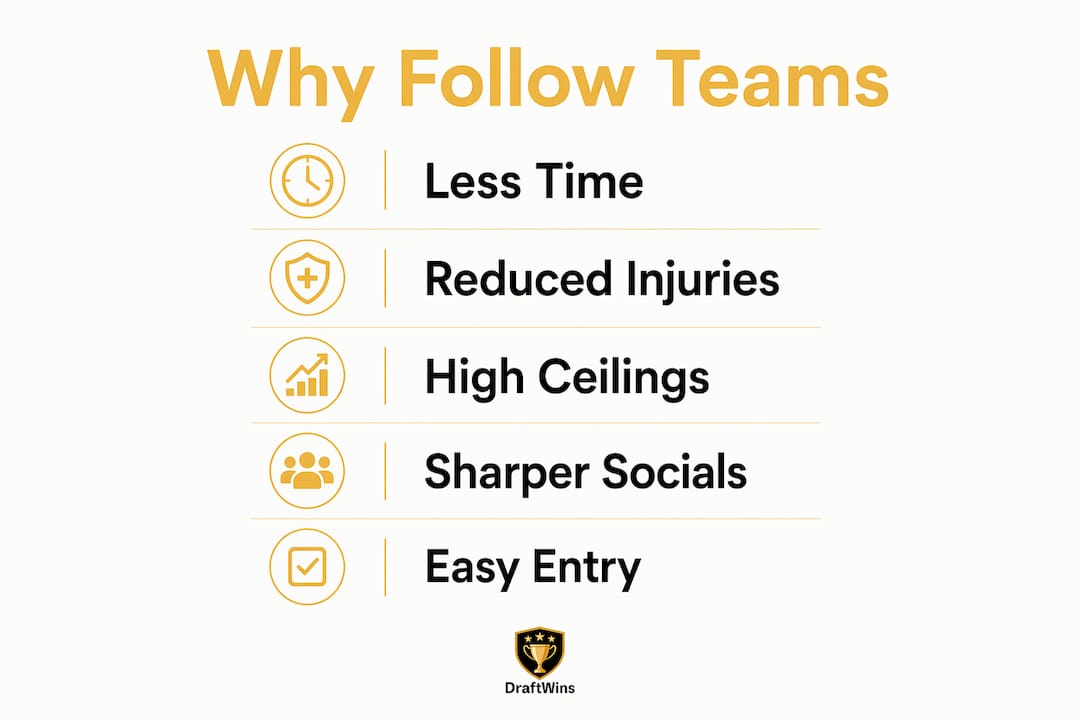
2. Injury noise fades. When a star receiver misses Sunday, a player-roster manager scrambles. In a team pool, the offense still runs — and your pick still has a shot. Team-level correlation smooths out single-player variance in a way individual rosters simply cannot.
3. High-ceiling outcomes stay in reach. When an entire offense clicks — think a high-powered attack in a favorable matchup — every contributor benefits at once. That correlated upside mirrors what DFS analysts call "stacking," but you get it without micro-managing a single player slot.
4. Social dynamics are sharper. Everyone evaluates the same set of teams, so debates are genuine and rivalries feel real. Private leaderboards and head-to-head pool features drive the kind of engagement that keeps a group coming back week after week. Research confirms that private contest modes significantly increase social motivation and retention among pool participants.
5. Lower barrier to entry. You don't need to know a third-string tight end's target share. You need to know which teams are hot, which matchups are favorable, and when to trust your gut.
Pro Tip: When following teams, prioritize schedule stretches and matchup context over isolated player metrics. A team facing three bottom-five defenses in a row is worth more than a team with one star player.
When player-roster formats are still the better choice
Team pools aren't for everyone. If you love the granular game, roster management is where your edge actually lives.
The honest trade-off: player-roster leagues reward deep analytical skill. If you can identify undervalued players before the market does, you want a format that pays for that edge — not one that averages it away at the team level.
The case for sticking with rosters:
- Granular control matters to you. Roster leagues let you express specific player-level conviction — a breakout running back, a receiver in a contract year.
- You're playing for consistency, not ceiling. In leagues that reward mid-table finishes or playoff appearances, lower variance strategies make more sense than swinging for correlated team outcomes.
- Winner-take-all prize structures change the math. When only first place pays, stacking correlated assets to reach a right-tail outcome is the correct play — and roster leagues give you more levers to do it.
- Keeper or dynasty formats. Long-season investment in young players is a roster-league concept that doesn't translate to team pools.
Rule variations also matter. Survivor pools that require two picks late in a season change when you should use strong teams, which adds a layer of strategic depth that appeals to more analytical players.
Practical strategies that work specifically in team-based pools
Team pools have their own game theory, and it's different from roster management.
Go contrarian when the pool is large. In pick'em and survivor formats, everyone evaluates the same teams — so consensus picks concentrate outcomes. If 80% of your pool takes the favorite and they lose, you gain massive ground by being on the other side. Winning often depends on knowing when to break from the crowd.
Stack at the matchup level. Identify games where one team has a structural edge — weak opposing defense, home field, short week for the opponent — and commit to that team across multiple scoring categories if your format allows it.
Adjust aggression to pool size:
- Small pools (6–10 players): favor consistency; variance hurts more
- Mid-size pools (10–20 players): balance contrarian picks with safe anchors
- Large pools (20+ players): lean contrarian; you need differentiation to win
Track opponent tendencies. In a friend group, you'll notice patterns fast. One person always takes the home favorite; another always fades primetime games. Use that information.
Pro Tip: In small office pools, the single best edge is knowing which teams your opponents will never pick — and picking them when the matchup actually supports it.
How to join or run a team-based pool: a quick checklist
Format first. Decide between pick'em (pick winners each week), survivor (one team per week, can't repeat), or confidence (rank your picks by certainty). Each format changes the optimal strategy.
Commissioner tip: automated scoring and live leaderboards remove the two biggest friction points in running a pool — manual tracking and disputes. Set them up before the first week, not after.
Setup checklist:
- Choose format and pool size (10–20 is the recommended range for engagement)
- Set tiebreaker rules before week one
- Define scoring: wins only, or add differentials and bonuses?
- Lock picks before kickoff, not after injury news breaks
- Create a group chat or communication channel for trash talk and recaps
Timeline for a season-based pool: open drafts or picks two weeks before the season starts, lock weekly picks 30 minutes before the first game, and run a mid-season recap to keep engagement high. For single-event pools like a World Cup, set picks before the group stage locks and update standings after each matchday.
How Draftwins simplifies running a team-draft pool
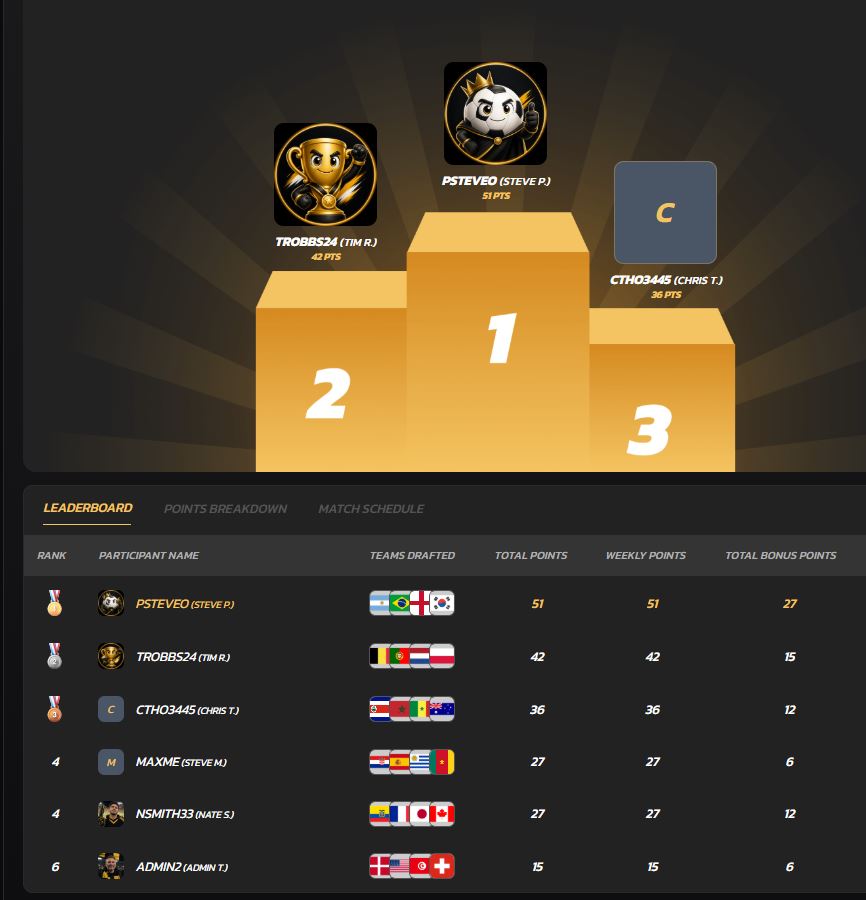
Draftwins is built around exactly this format. Instead of drafting players, you draft teams. Automated scoring handles the math, and live leaderboards update in real time so everyone in your group can see where they stand without anyone manually tracking results.
What sets it apart for casual pools: Draftwins charges a platform hosting fee and does not collect entry fees, hold prize pools, or pay out winnings. For friend and office groups that want competition without the legal complexity of prize pools, that model removes a real barrier.
Platform features that map directly to the benefits above:
- Automated scoring — no commissioner doing spreadsheet math on Monday morning
- Live leaderboards — social engagement stays high because standings are always visible
- Private pool controls — commissioners set custom rules, scoring, and tiebreakers
- Educational content — team-draft guides explain formats and strategy for first-timers
Draftwins is launching with World Cup pools, followed by NFL and College Football pools — covering the events where team-based formats make the most intuitive sense.
Key Takeaways
Team-based pools beat player-roster formats for casual group play because they lower maintenance, reduce injury sensitivity, and keep social dynamics strong without requiring deep player-level expertise.
| Point | Details |
|---|---|
| Lower time commitment | No weekly lineup tinkering or waiver-wire management required. |
| Injury risk spreads out | Team-level scoring absorbs single-player absences better than individual rosters. |
| Contrarian play wins pools | In shared-decision formats, picking against the crowd at the right moment is the core edge. |
| Pool size shapes strategy | Groups of moderate size hit the sweet spot for engagement and competitive balance. |
| Draftwins removes friction | Automated scoring, live leaderboards, and private pool controls make running a team-draft pool straightforward. |
Draftwins makes team-draft pools easy to run
If the format sounds right for your group, Draftwins is the simplest way to get one running. You skip the spreadsheet, the manual scoring, and the prize-pool headaches — the platform handles all of it so your group can focus on the competition.
What you get with Draftwins:
- Draft teams, not players — no lineup stress, no injury scrambles
- Automated scoring and live leaderboards — standings update in real time
- Private pools with custom rules — commissioners control format, scoring, and tiebreakers
- No entry fees or payouts — a clean, social experience with no regulatory complexity
Draftwins launches with World Cup pools and expands to NFL and College Football. Start your pool before your group defaults back to a format nobody actually enjoys managing.
FAQ
What is a team-draft pool?
A team-draft pool is a group contest where participants draft or pick entire sports teams rather than individual players, with scoring based on team-level outcomes like wins or point differentials.
Why follow teams instead of rosters in casual pools?
Team-based formats require less weekly maintenance, spread injury risk across a full roster, and keep social dynamics strong because everyone evaluates the same set of teams.
How big should a team-based pool be?
Pool experts recommend 10–20 participants for optimal engagement and management in friend and office contests.
When does a player-roster format make more sense?
Roster leagues are better when you want granular control, have deep player-level knowledge to exploit, or are playing in a keeper or dynasty format where long-term player investment matters.
Does Draftwins charge entry fees or pay out winnings?
No. Draftwins charges a platform hosting fee and does not collect entry fees, hold prize pools, or pay out winnings, making it well-suited for casual friend and office pools.