
A sports pool leaderboard is a live ranking system that tracks every participant's score in a group contest, updating standings as matches play out. Pool commissioners and casual competitors rely on these rankings to follow the action, settle friendly disputes, and keep everyone engaged from the first game to the last. Whether you are running a World Cup prediction pool or an NFL draft contest, the leaderboard is the heartbeat of the whole experience. Modern digital leaderboards update instantly after each match, replacing the old paper spreadsheet with something far more satisfying.
1. What makes a sports pool leaderboard effective?
The best leaderboards share a short list of non-negotiable features. Without them, participants lose interest fast.
Real-time score updates are the single most important feature. Automated digital scoreboards increase engagement by letting participants check standings the moment a final whistle blows. Waiting until the next day to see where you stand kills the excitement.

A clear, simple points system comes second. Participants should understand exactly why they moved up or down the standings without reading a manual. Complexity is the enemy of casual engagement.
Support for multiple pool formats matters more than most organizers realize. Prediction pools, draft-style team contests, and bracket formats each require slightly different leaderboard logic. A good platform handles all of them without forcing you to rebuild the scoring rules from scratch.
Mobile and web accessibility rounds out the must-have list. Participants check standings on their phones during halftime, not at a desktop. A leaderboard that works poorly on mobile loses half its audience before the tournament ends.
- Real-time automatic score updates after every match
- Point totals displayed clearly next to each participant's name
- Current rank shown alongside movement indicators (up, down, or steady)
- Streak tracking to highlight who is on a hot run
- Push notifications when standings change significantly
- Support for private pools with custom scoring rules
Pro Tip: Set your leaderboard to show rank movement arrows alongside point totals. Seeing that you jumped three spots overnight is far more motivating than seeing a raw number increase.
2. How scoring systems shape your pool standings
Scoring rules determine who wins, so they deserve serious attention before the first match kicks off.
Traditional football pools use a structured scoring model. The 49-match football pool system assigns 3 points for score draws, 2 points for no-score draws, and 1 point for correctly predicting a win. That weighting reflects the difficulty of predicting each outcome. Score draws are the hardest to call, so they pay the most.
Understanding that structure changes how you read the leaderboard. A participant sitting in third place with a cluster of score draw predictions still in play can leapfrog the leader in a single weekend. The standings are never truly settled until the final results are verified against official coupons.
| Scoring approach | Best for | Key trade-off |
|---|---|---|
| Simple win/loss points | Casual pools with new participants | Less differentiation at the top |
| Weighted outcome scoring | Traditional football pools | Requires clear explanation upfront |
| ROI and win rate metrics | Competitive sports betting leaderboards | Favors skill over luck |
| Normalized performance index | Mixed-volume pools | Balances casual and high-volume players |
Leaderboards in professional betting environments prioritize ROI and win percentage over total profit. That approach standardizes comparison across participants who make very different numbers of picks. For casual pools, a simpler weighted system works better because it rewards correct predictions without requiring participants to track percentages.
Pool commissioners should publish the full scoring rules before the pool opens. Participants who discover a scoring quirk mid-tournament feel cheated, even when the rules were always technically available.
Pro Tip: Post a one-paragraph scoring summary in your pool's group chat at the start of each round. Participants who understand the scoring watch the leaderboard more closely and stay engaged longer.
3. How technology powers modern pool standings
Digital platforms have changed what participants expect from contest rankings. A leaderboard that requires manual updates now feels broken by comparison.
Automated leaderboard platforms built for major tournaments like the 2026 World Cup update standings the moment official results are confirmed. That speed matters because it keeps participants checking back throughout the day rather than waiting for a weekly email. Engagement spikes immediately after each match, and a live leaderboard captures that attention.
Push notifications take engagement one step further. When a participant's rank changes, a notification pulls them back into the app. That touchpoint reinforces the competitive feeling that makes pools worth running in the first place.
Some platforms use proprietary scoring systems to level the playing field. The Teaser Betting Score™ normalizes performance so that a participant making ten picks per week competes fairly against someone making two. That kind of normalization matters in pools where participants have very different levels of involvement.
Daily-updated leaderboards also build trust. Participants who see their scores verified and refreshed every day are far less likely to dispute results. Transparency in the update process is what separates a pool people want to rejoin from one they abandon after one season.
- Instant post-match score updates without manual entry
- Rank history so participants can track their progress over time
- Visual streak indicators showing current hot runs
- Private pool creation with custom rules for commissioners
- Cross-device access so standings look right on any screen
Draftwins applies this same logic to team-based pools. Instead of tracking individual players, participants draft entire teams. That format removes the lineup management headache while keeping the leaderboard competition fully intact.
4. Best practices for pool organizers running a leaderboard
Running a fair, engaging pool takes more than picking a platform. The organizer's decisions before and during the tournament shape the entire experience.
1. Publish scoring rules before the pool opens. Participants should read and confirm the rules before making their first pick. Disputes about scoring are almost always caused by rules that were unclear at the start.
2. Set firm submission deadlines and communicate them clearly. Missed submissions result in zero scores for that round, which can knock a participant out of contention through no fault of the game. Automated reminders sent 24 hours and 1 hour before the cutoff prevent most of these errors.
3. Explain panel results before they happen. Panel results are scores assigned by experts when a match is abandoned or postponed. They differ from real match outcomes and can shift the leaderboard in unexpected ways. Participants who understand this in advance accept the result. Participants who learn about it after the fact feel the pool is rigged.
4. Verify scores against official results every round. Manual errors in score entry are rare on automated platforms but still possible. A quick verification pass after each round catches mistakes before they compound.
5. Use streak tracking to highlight momentum. Showing which participants are on a winning run creates secondary competition within the pool. Even someone sitting in fifth place stays engaged when they are on a four-round hot streak.
6. Track win percentage alongside total points. For longer pools, win rate gives a clearer picture of consistent skill than a raw point total. Participants who understand their own metrics compete more thoughtfully.
7. Keep the leaderboard visible and shareable. A standings link that participants can drop into a group chat drives organic engagement. When someone shares the leaderboard, they are inviting others to care about the result.
Key Takeaways
A sports pool leaderboard works best when it combines real-time score updates, transparent scoring rules, and clear communication from the pool organizer.
| Point | Details |
|---|---|
| Real-time updates are non-negotiable | Standings that refresh instantly after each match keep participants engaged throughout the event. |
| Scoring rules drive fairness | Publishing clear, weighted scoring rules before the pool opens prevents disputes and builds trust. |
| Panel results need explanation | Communicating how abandoned or postponed matches are scored prevents participant frustration. |
| Automated reminders prevent zero scores | Sending deadline alerts 24 hours and 1 hour before cutoff eliminates most missed-submission errors. |
| Team-based pools reduce complexity | Drafting teams instead of players removes lineup stress while keeping leaderboard competition fully alive. |
Draftwins makes team pool leaderboards easy to run
Running a group sports pool should feel fun, not like a second job. Draftwins is built for exactly that. Participants draft entire teams instead of managing individual player rosters, which removes the injury-tracking and lineup-swap headaches that drive casual competitors away from traditional fantasy formats.
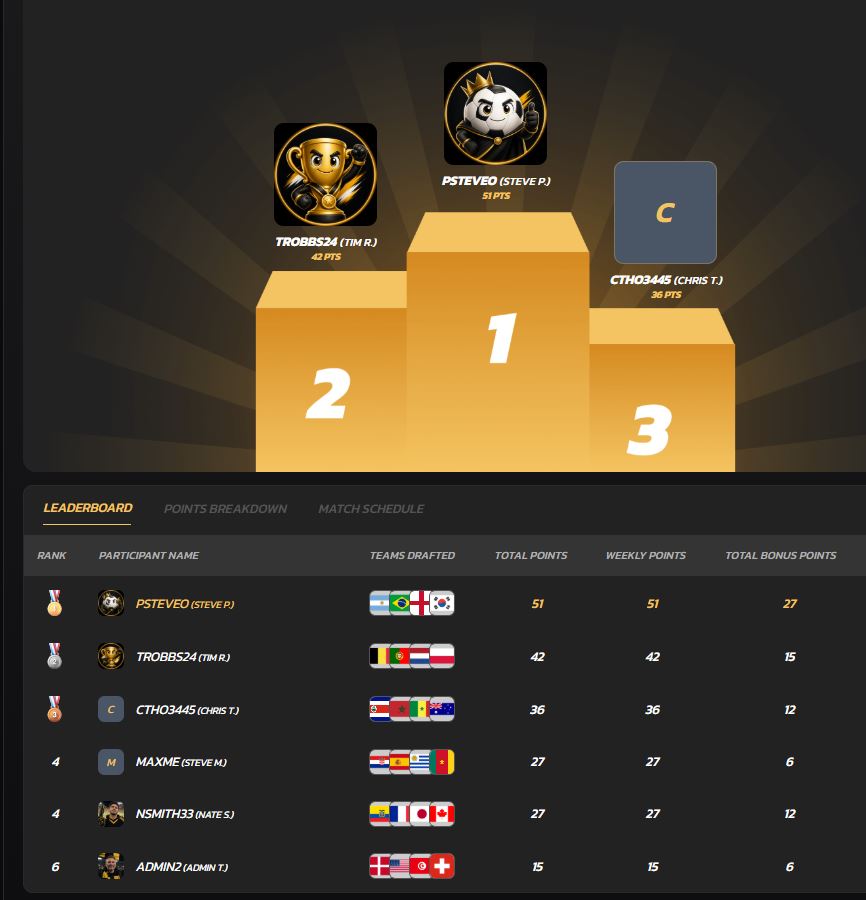
Draftwins handles automated scoring and live leaderboard updates so commissioners spend their time enjoying the competition, not maintaining a spreadsheet. Private pools are easy to set up with custom scoring rules, and the platform charges a hosting fee rather than collecting entry fees or holding prize money. Draftwins is live now for World Cup pools, with NFL and College Football pools coming next. Start your pool and see how straightforward a well-run leaderboard can be.
FAQ
What is a sports pool leaderboard?
A sports pool leaderboard is a live ranking system that displays each participant's score and current position in a group contest. It updates automatically as match results come in, keeping competition visible throughout the event.
How often should pool standings update?
Standings should update immediately after each match result is confirmed. Automated platforms make this possible without any manual work from the organizer.
What happens when a match is abandoned in a pool?
Abandoned or postponed matches may receive a panel result, which is a score assigned by experts rather than the actual match outcome. Pool organizers should explain this rule before the tournament starts to avoid confusion.
How do I prevent missed submissions from ruining my pool?
Send automated reminders 24 hours and 1 hour before each submission deadline. Strict cutoff enforcement combined with advance notice eliminates most missed-pick errors.
What scoring method works best for casual pools?
A simple weighted system, such as assigning more points for harder-to-predict outcomes like score draws, works best for casual competitors. It rewards correct predictions without requiring participants to track complex statistics.