
Group stage pool scoring is defined as the system that assigns points to participants based on how accurately they predict match outcomes during a tournament's group phase. The role of group stage pool scoring goes far beyond simple math. It shapes who stays engaged, who comes back daily, and how much fun your friend group actually has. The 3-1-0 scoring system is the most widely recommended format for friendly pools in 2026, awarding 3 points for an exact score, 1 point for a correct result, and 0 for a wrong pick. Get the scoring right, and your pool runs itself. Get it wrong, and people stop checking after the first week.
How does group stage pool scoring work?
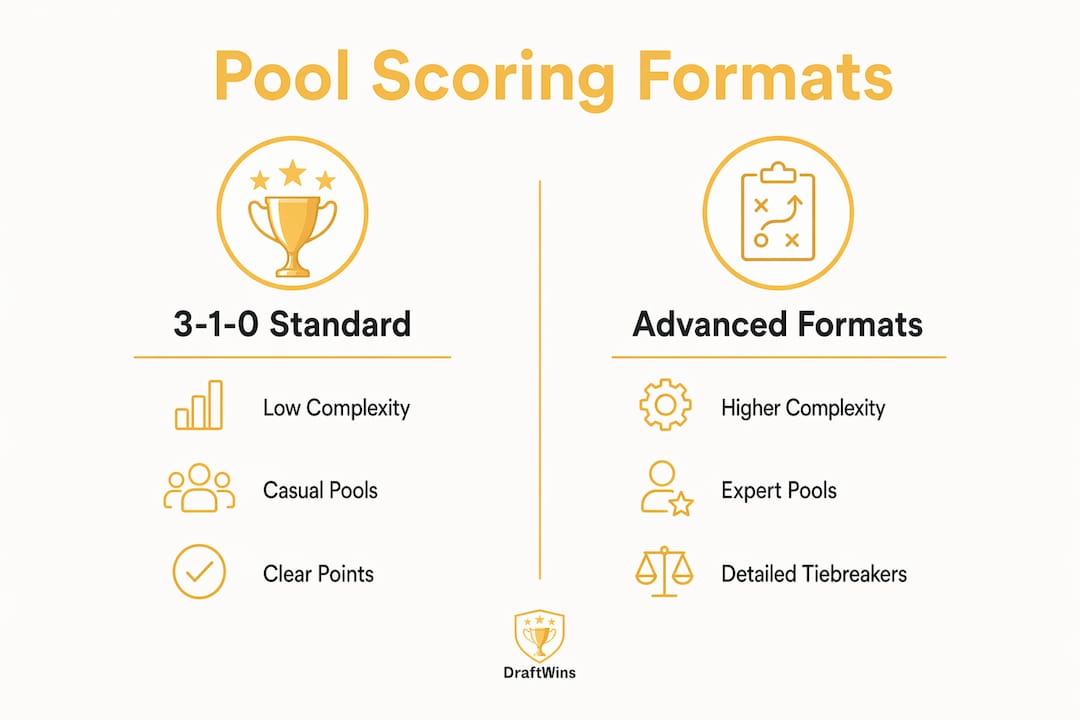
The standard scoring format used in most friendly pools is the 3-1-0 system. It gives 3 points for predicting the exact final score, 1 point for correctly calling the winning team or a draw, and 0 points for a wrong prediction. This format rewards both precision and basic knowledge. A casual participant who just picks winners can still compete, while the sports nerd who calls a 2-1 upset gets rewarded for the extra effort.
The 3-1-0 system works because the gap between 3 and 1 is wide enough to create real separation on the leaderboard, but not so punishing that casual players fall hopelessly behind. Alternative formats exist, such as systems that award bonus points for predicting goal scorers or halftime results. Those formats add complexity without adding much fun for most groups.
Match-specific scoring locks at kickoff time. That rule is non-negotiable for fairness. If a participant misses the deadline, they get zero for that match. No exceptions, no retroactive picks.
- 3 points for an exact score prediction (e.g., predicting a 2-1 win correctly)
- 1 point for a correct result (win, loss, or draw, regardless of the score)
- 0 points for an incorrect prediction
- Picks lock at kickoff to prevent retroactive entries
- Bonus point variants exist but add complexity most casual pools do not need
Pro Tip: Keep your scoring system to one paragraph of explanation. If a new participant needs more than 60 seconds to understand how points work, simplify the format before your pool launches.
How does scoring shape competition dynamics?
Scoring systems are the suspense engine of any pool. The 3-1-0 format creates a specific incentive structure: participants who play it safe by picking favorites can accumulate 1-point results, but anyone who correctly calls an upset earns 3 points and can leap up the leaderboard in a single match. That comeback potential keeps people checking standings even when they fall behind.

The 2026 FIFA World Cup introduced a rule change that affects how scoring dynamics play out in pools. The new format prioritizes head-to-head results over goal difference as a tiebreaker. Simulation models show a 5% increase in matches becoming "unimportant" because head-to-head results can freeze group standings before the final matchday. That matters for pool participants because fewer high-stakes matches means fewer opportunities for dramatic point swings.
The expanded 48-team format in 2026 also changes how teams play tactically. Early group matches reward conservative results, while later matches can turn chaotic as teams chase advancement. Pool participants who understand this dynamic can adjust their prediction strategies accordingly.
Here is how scoring rules influence participant behavior at each stage of the group phase:
- Early matches: Participants play conservatively, picking favorites to bank safe 1-point results.
- Mid-group stage: Leaderboard gaps emerge, pushing trailing participants to take riskier exact-score predictions.
- Final matchday: High-stakes matches create maximum suspense, with multiple participants capable of leapfrogging the leader.
- Tiebreaker scenarios: Head-to-head rules in 2026 can reduce late drama, making goal difference a more participant-friendly tiebreaker for casual pools.
- Comeback potential: The 3-point exact-score reward keeps every participant mathematically alive longer, sustaining engagement through the full group stage.
How does scoring drive social engagement and retention?
Social interaction driven by scoring is the real engine of long-term pool participation, not the math itself. Leaderboard banter, group chat trash talk, and the shared experience of watching a prediction unfold in real time are what bring people back match after match. Scoring systems serve as the facilitator of that social currency. Without clear, visible point totals, there is nothing to argue about.
Daily return mechanisms like score predictors and automated reminders improve retention by encouraging participants to engage repeatedly throughout the tournament. Participants who engage 20 or more times during a tournament show significantly higher retention than those who only spike on opening day. That finding has a direct implication for pool organizers: the goal is not a big launch day. The goal is consistent daily touchpoints.
Leaderboard transparency amplifies social momentum. When every participant can see exactly where they stand and why, the scoring system becomes a conversation starter. A well-structured leaderboard shows point totals, recent gains, and the gap to first place. That combination creates urgency and keeps casual participants from mentally checking out after a bad matchday.
- Automated reminders before each matchday deadline reduce missed picks and keep participants active
- Live leaderboard updates after each match create natural moments for group chat reactions
- Visible point breakdowns let participants see exactly why they gained or lost ground
- Consistent scoring transparency prevents disputes and builds trust in the pool organizer
Pro Tip: Send a leaderboard update to your group chat after every matchday, not just at the end of the group stage. That single habit generates more banter and return visits than any other tactic.
Common pitfalls and best practices in pool scoring
The most damaging mistake a pool organizer can make is changing the scoring rules after picks have locked. Pools that change scoring mid-tournament destroy participant trust immediately. Even a minor adjustment, like adding a bonus point category, signals that the rules are not final. Participants who feel the system is unfair stop engaging.
Keeping scoring rules concise means publishing them in under five lines before the first pick deadline. Pools that require a glossary or a lengthy FAQ lose casual participants before the tournament even starts. Publish the rules, lock them in, and do not touch them.
Pick fatigue is a real problem in large tournaments. The 2026 World Cup group stage features 48 teams across 12 groups, which means a high volume of matches to predict. Automated reminders and short side games, like a "match of the day" bonus prediction, re-engage participants between rounds without overwhelming them.
Head-to-head tiebreakers create confusion for casual participants, especially in three-way tie scenarios. Experienced pool organizers prefer goal difference as a tiebreaker because it is intuitive. A participant can look at the standings and immediately understand why one team ranks above another.
| Scoring format | Complexity | Best for | Key risk |
|---|---|---|---|
| 3-1-0 standard | Low | Casual and mixed groups | None significant |
| Bonus goal scorer | High | Hardcore sports fans | Alienates casual players |
| Result-only (1-0) | Very low | First-time pool participants | Reduces leaderboard separation |
| Weighted exact score | Medium | Competitive friend groups | Harder to calculate quickly |
Pro Tip: Publish your full scoring rules as a pinned message in your group chat before the first matchday. Participants who can reference the rules themselves ask fewer questions and trust the process more.
Draftwins makes group stage pool scoring simple
Running a World Cup pool should feel exciting, not like managing a spreadsheet. Draftwins is built specifically for that experience, giving commissioners a straightforward setup that defaults to clear, fair scoring configurations without requiring technical knowledge.
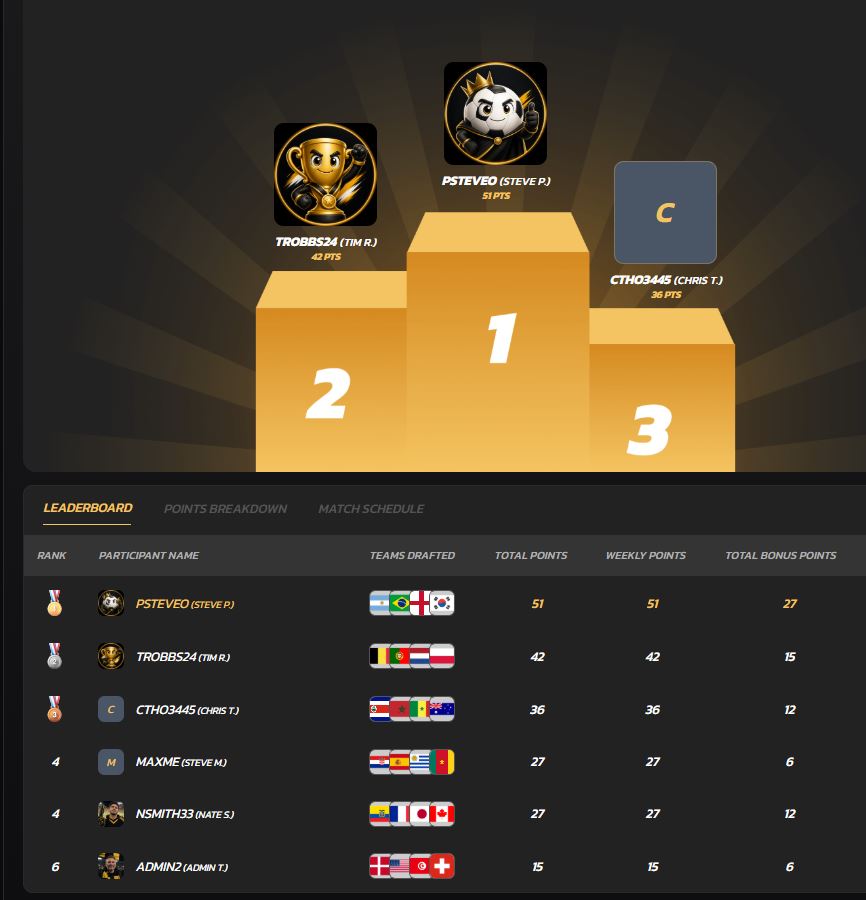
Draftwins automates scoring updates and sends reminders before pick deadlines, which directly addresses the pick fatigue problem that kills engagement in long tournaments. Live leaderboards update after every match, giving your group something to react to in real time. Commissioners can create private pools with custom rules, and the platform handles the math so you can focus on the competition. Draftwins charges a platform fee and does not collect entry fees or hold prize money. Start your World Cup pool on Draftwins and spend your energy on the banter, not the admin.
FAQ
What is the 3-1-0 scoring system in pools?
The 3-1-0 system awards 3 points for an exact score prediction, 1 point for a correct result, and 0 for a wrong pick. It is the most widely recommended format for friendly prediction pools because it balances simplicity with competitive depth.
How do 2026 World Cup rules affect pool scoring?
The 2026 FIFA World Cup prioritizes head-to-head results over goal difference as a tiebreaker, which can reduce the importance of some late group stage matches. Pool organizers running casual pools may prefer to use goal difference as their own tiebreaker to keep standings more intuitive.
Why do participants drop off during long tournaments?
Pick fatigue is the primary cause. Automated reminders and side games are the most effective tools for keeping participants engaged across a full group stage without overwhelming them with too many decisions at once.
Should I use goal difference or head-to-head as a tiebreaker?
Goal difference is the better choice for casual pools. Experienced organizers favor goal difference because it is immediately intuitive, while head-to-head scenarios, especially three-way ties, confuse casual participants and generate disputes.
How often should I update my pool leaderboard?
Update the leaderboard after every matchday, not just at the end of the group stage. Daily engagement touchpoints drive significantly higher retention than single-event spikes, and a fresh leaderboard gives your group a reason to keep the conversation going.
Key takeaways
Group stage pool scoring is the foundation of every successful friendly sports pool. Without clear, consistent point rules, engagement collapses before the group stage ends.
| Point | Details |
|---|---|
| Use the 3-1-0 format | Award 3 points for exact scores, 1 for correct results, and 0 for wrong picks to balance depth and simplicity. |
| Lock rules before picks open | Publishing scoring rules in under five lines before the first deadline prevents disputes and maintains trust. |
| Automate reminders to fight fatigue | Sending automated pick reminders and adding side games keeps participants engaged across a long tournament. |
| Choose goal difference over head-to-head | Goal difference tiebreakers are more intuitive for casual participants than complex head-to-head scenarios. |
| Leaderboard updates drive social engagement | Posting standings after every matchday generates banter and return visits that sustain pool participation. |