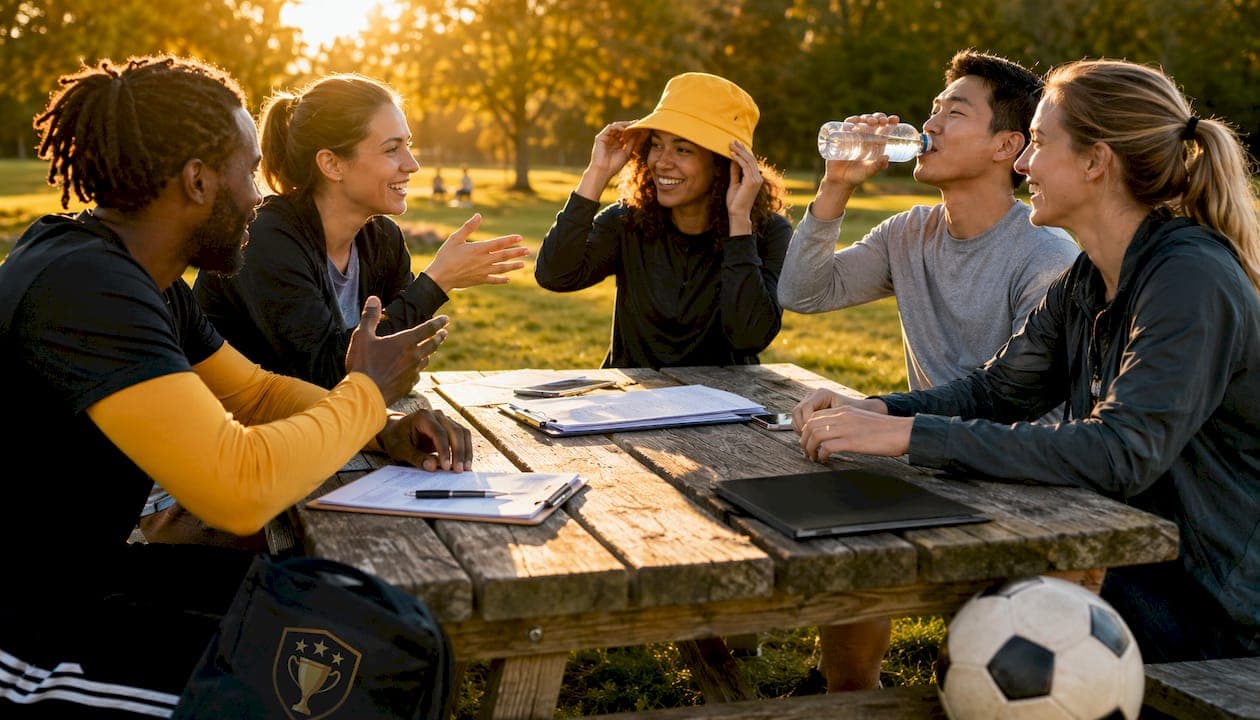
Casual team-based sports games are short, social competitions built around simple formats, lightweight rules, and peer-driven scoring. They run on three things: divided teams, a clear win condition, and a time limit short enough that nobody has to clear their calendar. Think a pickup soccer match at the park, an office bracket pool during March Madness, a four-team round-robin on a Tuesday evening, or a survivor-style pool where your group drafts teams instead of tracking individual player stats. The format is the point. Nobody is chasing a championship ring.
Every casual game shares the same structural skeleton:
- Teams: 2 or more sides, usually 3–12 players each
- Simple rules: one page or less, agreed before play starts
- Short game windows: 20–90 minutes per match
- Basic scoring: win/loss, points per goal, or bracket advancement
- Social enforcement: peer pressure and group norms keep things honest
Table of Contents
- What counts as a casual team-based sports game?
- Which formats work best for casual team play?
- Copy-and-paste rule templates and scoring systems
- Step-by-step organizer checklist
- How to keep casual games low-maintenance and socially engaging
- Safety, balancing teams, and handling disputes
- Running casual games and pools with online tools
- Common organizer mistakes and how to avoid them
- Key Takeaways
- Draftwins makes running a casual team pool simple
- FAQ
What counts as a casual team-based sports game?
Casual formats sit between a backyard pickup game and a formal registered league. No season-long commitment, no paid referees required, and entry fees, when they exist, are typically modest and social rather than commercial. The main categories:
- Pickup games: Self-organized, show-up-and-play. Soccer, basketball, ultimate frisbee.
- Mini-tournaments: 4–16 teams, single day or one evening. Single-elimination or round-robin.
- Bracket pools: March Madness-style. Each participant picks outcomes; points for correct picks.
- Draft/team-pick pools: Participants draft whole teams rather than individual players. Lower maintenance than fantasy leagues because injuries to one player rarely tank your entire entry.
- Scrimmages: Two teams, no standings, just practice-level competition.
Choose casual formats when time is short, skill levels vary widely, or the goal is social bonding over serious competition.
Which formats work best for casual team play?
Choosing the right format depends on how many teams you have and how much time you can spare.
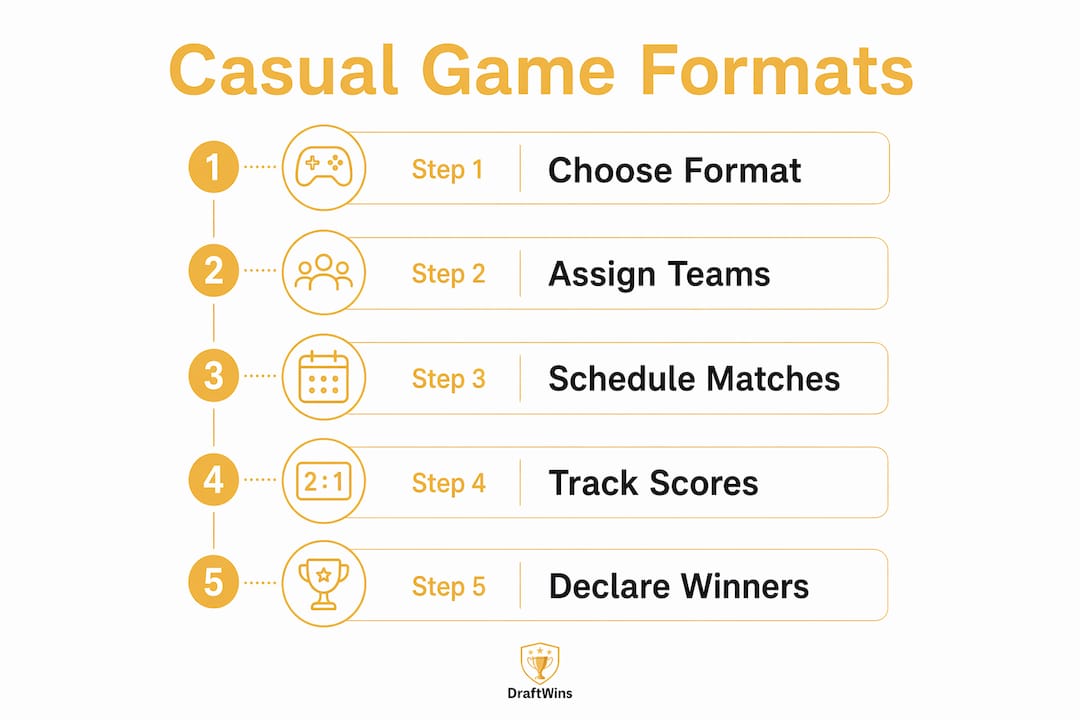
Single-elimination is the fastest option. With 16 teams, you need enough games to determine a single winner quickly. One loss and you're out, which keeps the schedule tight but leaves early losers with nothing to do.
Double-elimination gives every team a second chance, requiring about twice as many games as single-elimination for 16 teams. Fairer, but plan for a longer day.
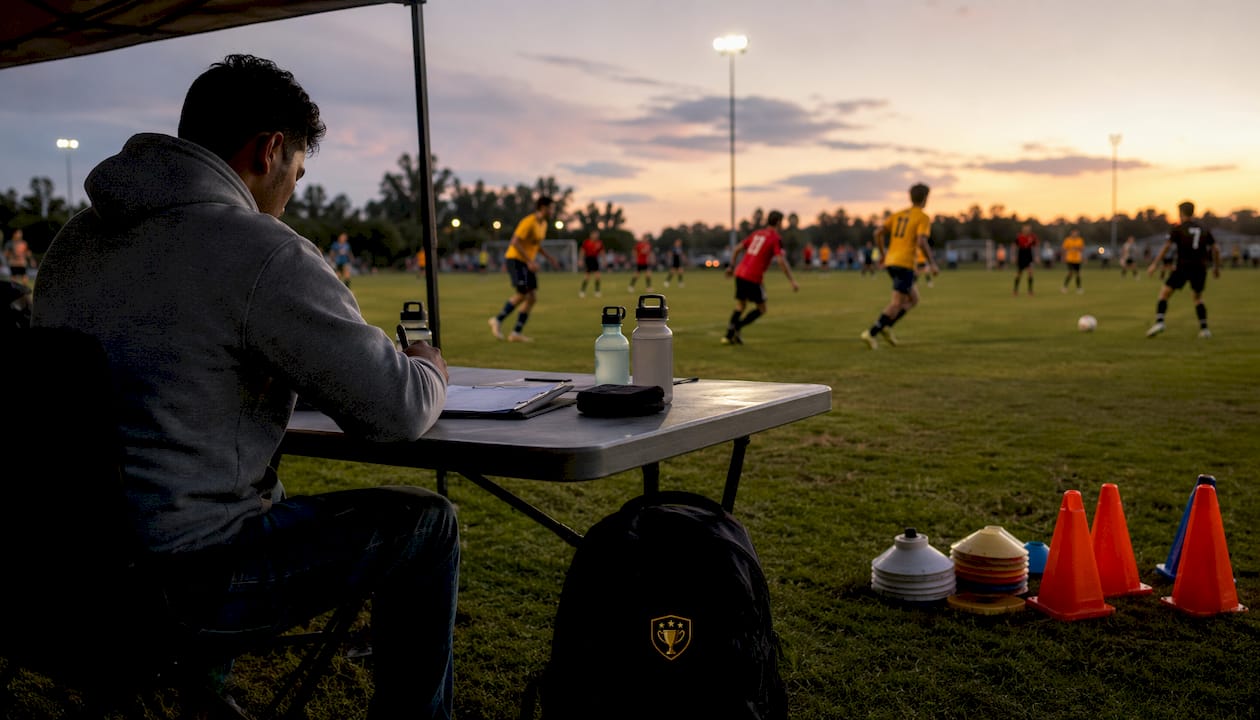
Round-robin guarantees every team plays multiple games, making it ideal for fields of 8 or fewer. An 8-team round-robin allows each team to play multiple games. Great for evenings where everyone wants to stay involved.
Pool play into bracket works for medium fields (8–16 teams). Split into pools of 4, play round-robin within each pool, then the top finishers advance to a single-elimination bracket.
Draft/team-pick pools are the lowest-maintenance option. Participants draft entire sports teams rather than individual players, so lineup management and injury tracking nearly disappear. These work especially well for group sports contests tied to real events like the World Cup or NFL playoffs.
A quick example for 8 teams, single-elimination:
- Game 1: Team A vs. Team B
- Game 2: Team C vs. Team D
- Game 3: Team E vs. Team F
- Game 4: Team G vs. Team H
- Semifinal 1: Winner A/B vs. Winner C/D
- Semifinal 2: Winner E/F vs. Winner G/H
- Final: Semifinal winners
Total: 7 games. On 2 fields with 30-minute matches, that's under 2 hours.
Copy-and-paste rule templates and scoring systems
A universal rule checklist covers most casual sports:
- Match length: Set a fixed time (e.g., 25 minutes) or a race-to target (e.g., first to 3 wins). Race-to-3 formats typically run 20–30 minutes per match.
- Substitutions: Rolling subs or stoppage-only, agreed before the game.
- Fouls/penalties: Keep it simple. One warning, then a free kick or possession change.
- Injury timeout: 2 minutes max; play resumes or the team forfeits the point.
- Tiebreakers (in order): Head-to-head result → point differential → goals/points scored → coin flip.
Dispute clause to publish with your rules: "All disputes are decided by the designated event director. The director's call is final. No retroactive protests after the next game begins."
Publishing a clear tiebreaker ladder up front prevents most arguments before they start. Transparent seeding criteria have been shown to eliminate seeding protests entirely in organized youth club events.
| Sport | Format | Scoring | Tiebreaker |
|---|---|---|---|
| Soccer | Timed (25 min) | 3 pts win, 1 draw, — loss | Goal differential, then goals scored |
| Basketball | Race to target | 1 pt per basket, 2 pts beyond arc | Sudden-death next basket |
| Flag football | 4 quarters, 10 min | 6 pts TD, 1 pt PAT | Point differential |
| Bracket pool | Per round | 1 pt Round 1, 2 pts Round 2, etc. | Total points accumulated |
Bracket pools carry high variance by design. The combinatorial outcome space in bracket-based formats is enormous, which means early upsets can scramble standings fast. Build that unpredictability into your scoring to keep late-round games exciting.
Step-by-step organizer checklist
A well-run casual event follows a simple sequence. Organizing group sports games gets easier when you work backward from game day.
4–8 weeks out:
- Choose format and confirm team count.
- Reserve venue or public space (check local park permit requirements).
- Set entry fee and prize structure.
- Publish one-page rules.
2 weeks to 48 hours out: 5. Confirm rosters and collect emergency contacts. 6. Recruit a non-playing event director and one scorekeeper per field. 7. Build and share the bracket or schedule. 8. Send a reminder with check-in time and location.
Day of: 9. Set up check-in table with roster list and waivers. 10. Post the schedule visibly (whiteboard or printed bracket). 11. Confirm equipment: balls, cones/markers, first-aid kit, water. 12. Brief all team captains on rules and tiebreaker ladder.
Timeline comparison:
| Event type | Teams | Fields | Est. duration |
|---|---|---|---|
| Single-elim evening | 8 | 2 | ~2 hours |
| Round-robin evening | 6 | 2 | under 2 hours |
| Weekend mini-tournament | 16 | 4 | 2 days, ~28–32 games |
Build 15-minute transition slots between matches to prevent cascading delays. A 16-team weekend event on 4 fields typically requires 28–32 games across two days.
Rough cost estimate for a single-day event:
| Item | Estimated cost |
|---|---|
| Field rental | modest entry fees |
| Officiating (volunteer or paid) | modest entry fees |
| Platform/hosting fee | Varies by tool |
For pool-style events, entry fees at casual pool-style events typically cover costs without requiring outside sponsorship.
How to keep casual games low-maintenance and socially engaging
The single biggest organizer mistake is building a format that requires constant attention. Use team-draft formats and automated scoring wherever possible. When participants draft whole teams rather than managing player lineups, the weekly maintenance nearly disappears. Low-maintenance fantasy formats work precisely because they remove the friction that causes people to drop out mid-season.
Social dynamics matter more than most organizers realize. Research applying the Theory of Planned Behavior to casual sports participation finds that subjective norms, meaning what friends and peers are doing, are the single strongest predictor of whether someone joins a casual pool or game. Skill level and personal confidence matter far less. That means your best recruitment tool is a group text from a mutual friend, not a flyer about prize money.
Pro Tip: Send invites through existing social groups (team chats, office Slack channels, family group texts) rather than individual cold messages. Peer visibility drives sign-ups faster than any incentive.
Practical low-effort tactics:
- Fixed short time slots (same day/time each week)
- Digital sign-up with an RSVP deadline to control no-shows
- Auto-generated brackets after registration closes
- Automated scoring updates so participants check standings themselves
- Reminder messages 48 hours and 2 hours before game time
Digital management tools cut no-shows, centralize communication, and keep brackets updated in real time, reducing the volume of logistical questions organizers field.
Safety, balancing teams, and handling disputes
Safety does not require a lengthy protocol. Three basics cover most casual events:
- Pre-event acknowledgment: A simple one-sentence waiver or digital check-in confirmation that participants play at their own risk.
- Equipment check: Proper footwear, no jewelry in contact sports, and a visible first-aid kit on site.
- Serious injury procedure: Stop play immediately, call 911 if needed, designate one person to stay with the injured player.
Heat and hydration matter more than most organizers plan for. Schedule water breaks every 20–25 minutes for outdoor summer events.
Balancing teams keeps games competitive and participants happy:
- Self-rated skill bands (beginner/intermediate/advanced) for blind draws
- Rotating captains who alternate picks in a snake draft
- Seeded pools that separate the strongest teams in early rounds
For dispute resolution, designate a non-playing event director before the event starts. Publish the tiebreaker ladder with the rules. The director's call is final, and that policy needs to be stated before the first game, not during a heated argument.
Permits: Using a public park or recreation facility in the US typically requires a reservation or special-use permit from the local parks department. Requirements vary by city and event size. Check with your municipality at least 4 weeks out.
Running casual games and pools with online tools
Moving sign-ups and bracket management online solves most organizer headaches. The features worth prioritizing:
- Digital sign-up with automatic roster confirmation
- Auto-generated brackets after registration closes
- Automated scoring tied to real game results
- Live leaderboards participants can check anytime
- Private pool access so only invited members can join
- Mobile-friendly web access (no app download required)
Hybrid events combine in-person play with online pool management. Players compete on the field while remote participants follow live standings and leaderboards. This works especially well for sports pool leaderboards tied to professional sports seasons, where your group drafts teams and the real-world results do the scoring automatically.
The core advantage of team-draft platforms over traditional fantasy leagues: no weekly lineup decisions, no waiver wire stress, and no single player injury ruining an entry. Participants draft teams once, then watch the standings update on their own.
Common organizer mistakes and how to avoid them
Most casual events fail for predictable reasons:
- Unclear rules published too late: Post rules at least one week before the event. Participants who read them in advance ask far fewer questions on game day.
- Underestimating game count and time: Use the format math. Single-elim with 12 teams needs 11 games. Add transition time or the schedule collapses.
- Weak communication: Collect phone numbers or emails at sign-up. One group message the night before prevents half your no-shows.
- No plan for no-shows: Build a substitute player list or a bye-round rule before the event, not during it.
- Poor seeding: Random draws in unbalanced pools produce lopsided games that frustrate everyone. Seed by known skill level or prior results when possible.
Red flags that predict a rough event: no designated director, no published tiebreaker policy, and no equipment checklist. Fix all three before game day.
Key Takeaways
Casual team-based sports games work best when the format is simple, rules are published early, and scoring runs automatically so organizers can focus on the game rather than the paperwork.
| Point | Details |
|---|---|
| Pick the right format | Single-elim for speed, round-robin for max play, draft pools for zero weekly maintenance. |
| Publish rules before the event | Post rules at least one week out; include a tiebreaker ladder to prevent disputes. |
| Automate sign-ups and scoring | Digital tools cut no-shows and keep brackets updated without organizer effort. |
| Balance teams deliberately | Use self-rated skill bands or a snake draft to keep games competitive and fun. |
| Use Draftwins for private pools | Draftwins handles team drafts, automated scoring, and live leaderboards so commissioners set it up once and let it run. |
Draftwins makes running a casual team pool simple
Running a casual pool for your office, friend group, or family doesn't have to mean spreadsheets and manual score updates. Draftwins is built specifically for commissioners who want to set up a private team-based pool once and let the platform handle the rest.
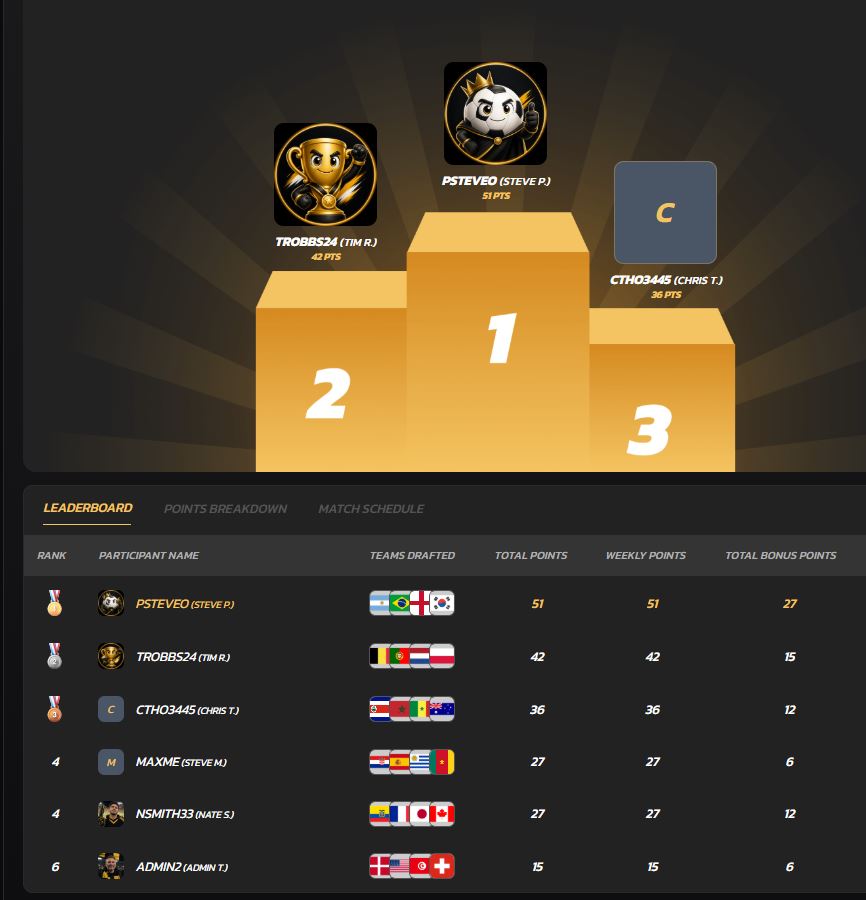
With Draftwins, participants draft whole teams rather than individual players, which removes the lineup management and injury anxiety that makes traditional fantasy leagues exhausting. The platform handles automated scoring, live leaderboards, and private pool access from any browser, no app download needed. Commissioners pay a one-time hosting fee to create the pool; everyone else joins free. Draftwins launches with World Cup pools, followed by NFL and College Football pools.
Ready to run your first pool? Set up your private pool at Draftwins and have it ready to share with your group in minutes.
FAQ
What are casual team-based sports games?
Casual team-based sports games are short, social competitions with simple rules, divided teams, and a clear win condition, designed for fun rather than formal standings or season-long commitments.
How long does a casual sports tournament take?
An 8-team single-elimination event on 2 fields runs in roughly 2 hours with 30-minute matches. A 16-team weekend tournament on 4 fields typically requires 28–32 games across two days.
What is the easiest format for a first-time organizer?
A 4-team round-robin or an 8-team single-elimination bracket. Both require minimal equipment, finish in one evening, and need only one non-playing director to run smoothly.
How does Draftwins reduce organizer workload for casual pools?
Draftwins automates team drafts, scoring, and live leaderboards so commissioners create the pool once and participants track standings on their own, with no weekly lineup management required.
Do I need a permit to run a casual sports game in a public park?
Most US cities require a reservation or special-use permit for organized events in public parks. Check with your local parks department at least 4 weeks before your event date.