
Low-maintenance fantasy sports options are formats designed to deliver the thrill of competition without the weekly grind of managing individual player rosters. Over 60 million people in North America play fantasy sports, yet a large share drop out before the season ends because traditional leagues demand too much time. The good news: a growing category of casual fantasy sports formats cuts that burden dramatically. These no-fuss fantasy leagues focus on team outcomes, quick predictions, and social fun rather than injury reports and waiver wire decisions.
1. What low-maintenance fantasy sports options are available?
The three formats that define easy fantasy sports games are pick'em pools, best ball leagues, and daily prediction grids. Each one removes a different layer of complexity from the traditional fantasy experience.
Pick'em pools are the simplest entry point. You select which teams will win each week, and the person with the most correct picks wins. Pick'em games require as little as 1–5 minutes per week. That time commitment is lower than almost any other structured competition format in sports entertainment.

Best ball leagues take a set-it-and-forget-it approach. You draft a roster once at the start of the season, and the platform automatically scores your best-performing players each week. There are no lineup decisions, no waiver pickups, and no weekly stress. This format suits fans who enjoy the draft experience but want to disappear afterward.
Daily prediction grids are the newest category. These are short, timed micro-puzzles where you predict outcomes for a single game or event. Sessions typically run 1–3 minutes, with countdown timers and limited attempts that make the format feel more like a game than a chore.
- Pick'em pools: Best for groups who want weekly engagement with minimal effort.
- Best ball leagues: Best for fans who love drafting but hate weekly management.
- Daily prediction grids: Best for fans who want a quick daily habit tied to live sports.
Pro Tip: If your group has mixed sports knowledge, pick'em pools level the playing field fastest. Win-loss predictions require no deep stats knowledge, so a casual fan can beat a die-hard on any given week.
2. How team-focused games compare to player-focused fantasy sports for casual groups
Traditional fantasy sports put you in charge of a roster of individual players. You track injuries, manage bye weeks, and make lineup decisions every single week. Casual users strongly prefer team-based pools over player-heavy management because the cognitive load is simply lower.
Team-focused formats shift the question from "which running back should I start?" to "which team will win?" That shift matters for social groups. When the decision is simpler, more people stay engaged longer. Simplified formats encourage group participation and reduce the skill gap between novices and experienced players, which keeps the competition fun for everyone at the table.
Fandom fatigue is a real problem in traditional leagues. Tracking multiple players across multiple positions across a 17-week NFL season burns people out. Focusing on team-based pools reduces that fatigue and keeps the social energy alive. The conversation shifts from "my tight end got injured" to "did your team cover?"
Key advantages of team-focused formats for social groups:
- No injury tracking: Team performance absorbs individual player news automatically.
- Equal footing: Casual fans compete on the same terms as hardcore stat-checkers.
- More conversation: Team outcomes are easier to discuss than individual player stats.
- Faster decisions: Picking a team takes seconds; building a lineup takes minutes.
The social dimension is the real differentiator. Fantasy sports work best when they give friends a reason to talk. Team-based formats create that reason without requiring anyone to become a fantasy expert first.
3. Which platforms and tools offer the best easy fantasy sports games?
The best platforms for hassle-free fantasy options share a short list of features. Look for automated scoring, mobile-friendly interfaces, and formats that require no more than a few minutes of engagement per session. Platforms that force you to download a separate app, create a complex account, or navigate a cluttered dashboard undercut the low-effort promise immediately.
Pick'em, best ball, and prediction microgame platforms have grown significantly because they serve fans who want the social experience without the homework. The best platforms in this category offer live leaderboards so your group can track standings in real time without logging in constantly.
Features worth prioritizing when choosing a platform:
- Automated scoring: The platform calculates results without manual input.
- Live leaderboards: Group standings update automatically after each game.
- Private pool creation: You control who joins and what the rules are.
- Simple setup: New players should be able to join in under two minutes.
- Mobile access: The best platforms work on any phone without a dedicated app download.
Pro Tip: Pay attention to how a platform handles money. Social pools operate peer-to-peer with no house edge, while house-banked pick'em apps carry a different legal and risk profile. For friend groups, a social pool model with a flat hosting fee is the cleanest and most straightforward option.
Draftwins fits this profile directly. It charges a platform hosting fee and does not collect entry fees, hold prize pools, accept wagers, or pay out winnings. That structure keeps the experience social and avoids the regulatory complexity that comes with commercial gambling products.
4. Tips for organizing and enjoying hassle-free fantasy sports with friends
Running a low-effort fantasy competition with your group does not require a commissioner with spreadsheet skills. A few simple practices keep everyone engaged from week one to the final whistle.
-
Choose a weekly reset format. Weekly resets prevent early dropoff by giving every participant a fresh start each week. Someone who falls behind in week three still has a reason to play in week eight. This single design choice does more for group retention than any prize structure.
-
Set a submission deadline and stick to it. Pick a consistent cutoff time, such as one hour before the first game of the week. Communicate it once at the start of the season and let the platform enforce it automatically.
-
Keep scoring simple. Win-loss pick'em pools are more successful in social leagues than complex point-spread or confidence-point systems. Simple scoring means everyone understands the standings at a glance.
-
Add a low-effort reward. A weekly winner gets to pick the group's watch party snack, or the season loser buys the first round. The reward does not need to involve money to create motivation.
-
Use a group chat for standings updates. Post the leaderboard screenshot after each week's games wrap up. This one habit generates more conversation and engagement than any in-app notification.
-
Start with a short season or a single tournament. A World Cup pool or a playoff-only bracket is a lower commitment than a full regular season. It lets new participants test the format before committing to a longer competition.
-
Limit the group to people who will actually play. A pool of 8–12 active participants beats a pool of 30 where half go silent by week two. Quality of engagement matters more than headcount.
5. Format comparison: low-effort fantasy competition types
Different no-fuss fantasy league formats suit different groups. The table below compares the four main categories by the factors that matter most to casual players.
| Format | Time per week | Decision complexity | Social engagement | Best for |
|---|---|---|---|---|
| Pick'em pool | 1–5 minutes | Very low | High | Any group, any sport |
| Best ball league | 0 minutes (after draft) | Low | Medium | Fans who love drafting |
| Daily prediction grid | 1–3 minutes | Low | Medium | Daily sports watchers |
| Team draft pool | 5–10 minutes (draft only) | Low | Very high | Social groups, tournaments |
Pick'em pools win on pure simplicity. Best ball leagues win for fans who want a season-long stake with no weekly work. Daily prediction grids suit fans who want a quick daily habit. Team draft pools, like those offered through Draftwins, deliver the highest social engagement because the draft itself becomes a group event. Drafting teams instead of players removes the injury and lineup anxiety that drives casual fans away from traditional formats.
Habit-forming features like streaks, countdown timers, and short sessions increase retention across all four categories. Platforms that build these mechanics into the experience keep casual players coming back without requiring them to invest more time.
Draftwins makes group fantasy sports simple
Casual fans who want the excitement of competition without the complexity of roster management have a clear option in Draftwins. The platform lets your group draft entire teams instead of individual players, which removes injury tracking, lineup decisions, and waiver wire stress from the equation entirely.
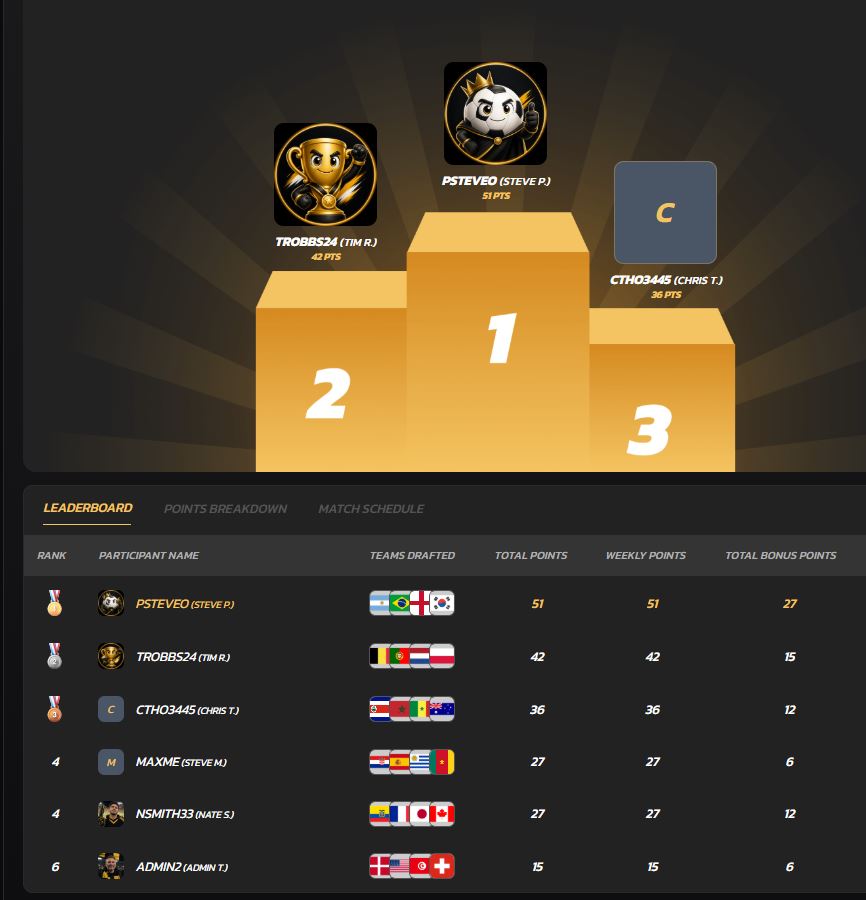
Automated scoring and live leaderboards mean you never have to calculate standings manually. Commissioners can build private pools with custom rules in minutes, and new participants can join without any prior fantasy sports experience. Draftwins launches with World Cup pools, with NFL and College Football pools to follow. If your group wants a low-commitment fantasy experience that actually keeps everyone engaged, Draftwins is built for exactly that.
FAQ
What are low-maintenance fantasy sports options?
Low-maintenance fantasy sports options are formats like pick'em pools, best ball leagues, and team draft pools that require minimal weekly time. They replace complex roster management with simple team-level decisions.
How much time do easy fantasy sports games take per week?
Pick'em pools require as little as 1–5 minutes per week, and best ball leagues require zero time after the initial draft. Daily prediction grids typically take 1–3 minutes per session.
Why do casual groups prefer team-based fantasy formats?
Team-based formats remove injury tracking and lineup management, which are the two biggest sources of burnout in traditional fantasy leagues. They also level the playing field between new and experienced players.
What should I look for in a hassle-free fantasy platform?
Look for automated scoring, live leaderboards, private pool creation, and a simple setup process. Platforms that operate as social pools with a flat hosting fee avoid the legal complexity of house-banked commercial products.
Can a complete beginner join a no-fuss fantasy league?
Yes. Pick'em pools and team draft formats require no prior fantasy experience. The decisions are straightforward enough that a first-time player can compete on equal terms with a seasoned fantasy veteran.
Key takeaways
The best low-maintenance fantasy sports options use team-level decisions, automated scoring, and weekly resets to keep casual fans engaged without the burden of traditional roster management.
| Point | Details |
|---|---|
| Pick'em pools are the simplest format | They require 1–5 minutes per week and no prior fantasy knowledge to compete. |
| Team-based formats reduce burnout | Removing injury tracking and lineup decisions keeps casual players engaged longer. |
| Weekly resets protect group retention | Fresh competition each week gives every participant a reason to keep playing. |
| Simple scoring beats complex systems | Win-loss pick'em formats outperform point-spread systems in social league settings. |
| Platform structure matters | Choose social pool platforms with flat hosting fees to avoid legal and financial complexity. |