
The biggest frustrations casual fantasy players report are variance and bad luck, unexpected injuries, too much time required, inactive league-mates, confusing trades, scoring rules nobody understands, clunky apps, draft mistakes, league drama, and burnout. The single most effective fix: switch to a simplified format or a team-draft pool that removes weekly micromanagement entirely.
Three things you can do right now:
- Reduce your roster size by joining a league with fewer lineup slots
- Enable auto-substitutions so a missed lineup swap doesn't tank your week
- Ask your commissioner to set clear inactivity rules before the season starts
Pro Tip: If you're already dreading the weekly lineup grind before the season even starts, that's your signal to try a different format, not push through.
Table of Contents
- 1. Common fantasy sports frustrations casual players actually report
- Why casual players feel these frustrations more than hardcore players
- Practical fixes that actually reduce the frustration
- Recognizing burnout before it ruins the hobby
- How Draftwins addresses casual-player frustrations by design
- Key Takeaways
- Draftwins pools: less grind, more game-day fun
- FAQ
1. Common fantasy sports frustrations casual players actually report
Most casual players share the same list of complaints. Here's what hurts most, and why it hits harder when you're not obsessing over stats every day.
| Frustration | Share of casual players affected | Source |
|---|---|---|
| Time investment too high | Top barrier for non-players | SSRS research |
| Perceived complexity | Top barrier alongside time | SSRS research |
| Quit due to stress/time/money | 80% of lapsed players cite a single incident as motivation to quit | Kenny Smith research |
| Would return at lower stakes | 38% of former players | Kenny Smith research |
1. Variance and bad luck. You set a perfect lineup, your star scores zero, and you lose by two points. MIT research confirms that skill does matter in fantasy sports, but the week-to-week variance is brutal enough that casual players rarely see that skill pay off before they quit.
2. Injuries. Your first-round pick tears an ACL in Week 2. There's no recovering from that without deep waiver-wire knowledge, which most casual players simply don't have. Injury concerns are one of the fastest ways a promising season falls apart.
3. Time and complexity. Checking waivers, monitoring injury reports, setting lineups before multiple game times — it adds up fast. High-engagement players visit fantasy apps five or more times per week; casual players average fewer than two visits. That gap compounds every single week.
4. Inactive or colluding managers. Nothing deflates a league faster than a manager who stops setting lineups in Week 4 or trades away their best players to a friend. It poisons the competitive balance for everyone else.
5. Bad trades. Casual players often accept lopsided deals without realizing it, or get blocked from fair ones by leagues with no trade review process. Either outcome feels unfair.
6. Scoring and rules confusion. Half-PPR, full-PPR, IDP, keeper rules — the jargon alone is enough to make a new player feel lost. When you don't understand why you scored what you scored, the whole thing feels arbitrary.
7. Platform UX issues. App crashes and late push notifications during lineup-lock windows are a recurring complaint. Missing a lineup change because the app froze is a special kind of frustrating because it's completely outside your control.
8. Draft mistakes. Drafting on name recognition, ignoring positional tiers, and following crowd runs during the draft are among the most common errors casual players make. A bad draft often means a bad season, full stop.
9. League drama and social punishments. Public shame punishments, group-chat arguments over trades, and commissioner favoritism turn a fun hobby into a social minefield. For casual players who joined to have fun with friends, this is often the final straw.
10. Burnout and quitting. Many casual players describe fantasy as feeling like a second job. A study of 50 former players found that 80% could name a single incident that pushed them to quit, and most said they wished they'd quit sooner.
Pro Tip: If your league has more than 10 roster spots per team, ask your commissioner to trim it. Fewer slots means fewer decisions and less weekly stress for everyone.
Why casual players feel these frustrations more than hardcore players
Casual players are structurally disadvantaged in traditional fantasy formats. It's not just about caring less — the mechanics of most leagues actively reward the players who spend the most time, and that's a gap casual players can't close by caring more on Sunday morning.

Research on fantasy sports consumer segments identifies three distinct groups: loyal gamblers, hedonists, and casual players. Loyal gamblers visit platforms five or more times per week. Casual players connect once or twice, spending under 30 minutes per visit. The waiver wire, injury news, and start/sit decisions all reward the player who checks in daily. Casual players are playing a different game at a structural disadvantage.
The skill-vs-luck debate makes this worse psychologically. MIT researchers found a clear skill signal in fantasy outcomes, which means the time and learning curve that build skill create a measurable frustration gap for players who can't invest that time. When you lose, it doesn't feel like bad luck — it feels like you were outworked by someone who treats this as a hobby job.
The psychological toll is real. UX research on fantasy football participation documents how micromanagement and the fear of failure push casual users away from regular engagement. When the hobby stops feeling fun and starts feeling like obligation, most people don't push through — they just quietly stop showing up.
Practical fixes that actually reduce the frustration
The fastest path to a better experience is simpler rules and less roster maintenance. Here's how to get there.
For players:
- Run a 10-minute pre-draft checklist: confirm your top 3 picks at each position, identify two sleepers, and set a hard rule against drafting injured players.
- Set your lineup once per week on a fixed day — Sunday morning works for most NFL formats. Don't check it again until the following week.
- Turn on auto-substitutions for every position your platform supports. A missed swap costs you points; auto-sub is free insurance.
- Apply a conservative trade filter: only accept trades where you're getting the player you'd have drafted over the one you're giving up.
For commissioners:
- Set an inactivity rule before the season: three consecutive weeks of an unset lineup triggers an auto-drop or replacement manager.
- Choose a draft format that favors casual players — snake drafts with autopick enabled are far less stressful than auction formats.
- Enable auto-substitutions league-wide so no one loses points to a bye-week mistake.
- Cap roster size at 15 or fewer players. Simplified formats with fewer lineup decisions keep casual players engaged longer.
- Set a transparent trade review window (48 hours, league vote) so no one feels blindsided.
The simplest setup that works for casual groups: a team-draft pool where each participant drafts NFL or World Cup teams rather than individual players. No weekly lineup changes, no waiver wire, no injury scrambles. Low-maintenance formats like this keep the social competition alive without the grind.
Recognizing burnout before it ruins the hobby

Step back when fantasy feels like an obligation or causes stress that bleeds into your actual life. That's the line.
Warning signs worth taking seriously:
- You feel anxious on Sunday morning before games start
- You're spending more time worrying about your lineup than watching the games
- Financial stress from entry fees is affecting other spending decisions
- You're neglecting work, family, or sleep to manage your team
- You've stopped enjoying the sport itself because of fantasy results
If two or more of those apply, you're past the fun zone. Here's how to step back without losing the social connection:
- Reduce your league count. Drop to one league instead of three. The social payoff stays; the workload drops by two-thirds.
- Lower the stakes. Switch to a free or low-entry-fee format. Research shows 38% of former players would return if stakes were lower.
- Switch formats. Move from a full-roster league to a pick'em or team-draft pool. Same group chat, far less weekly management.
- Set a play window. Give yourself 15 minutes per week maximum. If a decision takes longer than that, go with your gut and move on.
- Take a single-season hiatus. Stay in the league chat, cheer for a friend's team, and rejoin next year if you miss it.
Many former players report relief after quitting — not regret. The hobby should add to your enjoyment of sports, not compete with it.
Pro Tip: Tell your commissioner you're stepping back before you ghost the league. A quick message keeps the friendship intact and gives them time to find a replacement manager.
How Draftwins addresses casual-player frustrations by design
Draftwins removes the top sources of frustration for casual players by eliminating weekly roster micromanagement at the format level. Instead of drafting individual players and managing a lineup every week, participants draft entire teams. When your team wins, you score. No injury scrambles, no waiver wire, no start/sit decisions.
Features that map directly to the frustrations above:
- Team-based drafts replace player rosters, so injuries to individual athletes don't wreck your season
- Automated scoring means you never miss points because of an app glitch or a forgotten lineup change
- Live leaderboards keep the competition social and visible without requiring daily check-ins
- Customizable pool rules let commissioners configure scoring and format to match their group's preferences
- No entry fees collected by Draftwins — commissioners pay a one-time hosting fee; participants join free
Three groups that fit this format well: an office pool where half the participants barely follow football, a friends' Sunday group that wants competition without the weekly homework, and a family World Cup pool where everyone knows the teams but nobody wants to manage a roster.
Draftwins currently supports World Cup pools, with NFL and College Football pools launching next. All pools run on web — no app download required.
Pro Tip: Commissioners: set your pool to the simplest scoring option first. You can always add complexity next season once your group is hooked. Starting simple keeps everyone in through Week 1.
Why team-based drafts reduce player management stress is worth reading before you set up your first pool.
Key Takeaways
Casual players face a structural disadvantage in traditional fantasy formats — simplifying the format or switching to team-draft pools removes most of the friction before it becomes burnout.
| Point | Details |
|---|---|
| Time is the top barrier | SSRS data shows time and complexity are the leading reasons casual players quit or never start. |
| Skill gap is real but fixable | MIT research confirms skill matters, but casual players can't close the gap without format changes that reduce weekly grind. |
| Burnout has clear warning signs | Anxiety, financial stress, and neglecting real-life commitments signal it's time to step back or switch formats. |
| Commissioners hold the most power | Inactivity rules, auto-substitutions, and capped roster sizes protect casual players from the worst frustrations. |
| Draftwins fits casual groups | Team-draft pools with automated scoring and no weekly lineup changes remove the core sources of casual-player frustration. |
Draftwins pools: less grind, more game-day fun
Tired of losing because your star player got hurt in warmups? Draftwins is built for groups that want the competition without the weekly homework.
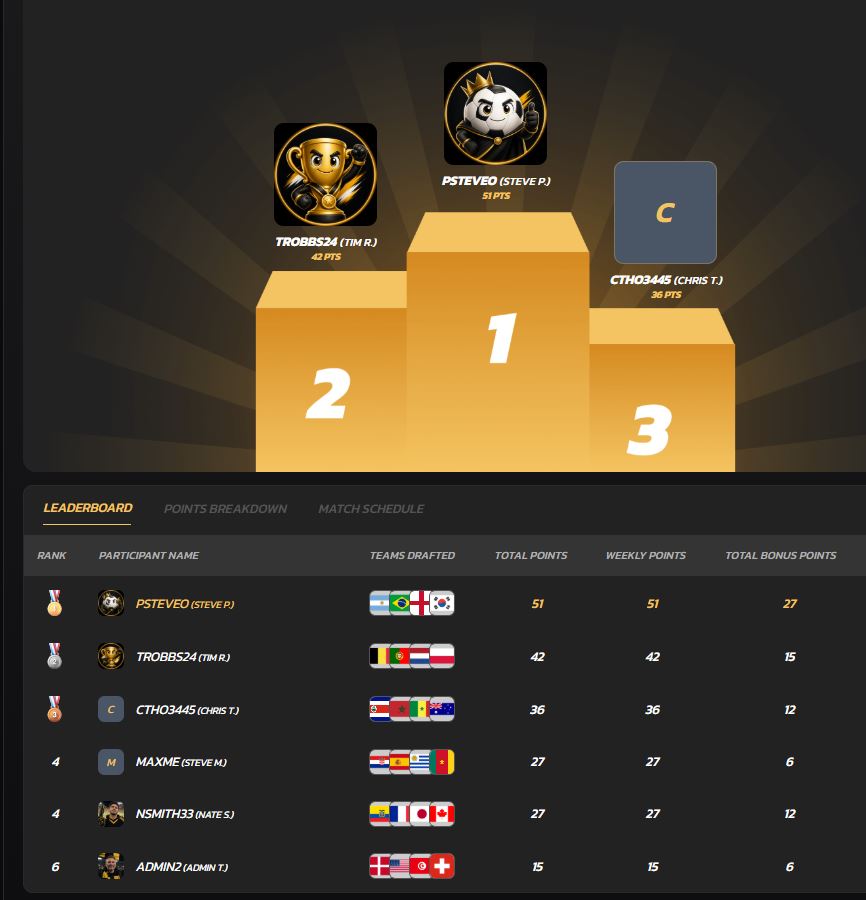
You draft teams, not players. Automated scoring handles the rest. No lineup changes, no waiver wire, no app crashes at kickoff. Commissioners set up a private pool once, participants join free, and everyone stays engaged through the final whistle.
- Team drafts mean one injury never sinks your season
- Automated scoring and live leaderboards keep it social without daily check-ins
- Flexible commissioner controls let you match the format to your group
- Web-based access — no download required
Whether it's an office World Cup pool, a friends' NFL group, or a family bracket, Draftwins keeps the fun without the friction. Browse available pools at Draftwins and set one up in minutes.
FAQ
Is fantasy sports skill or luck?
Both, but skill wins over time. MIT research found a clear skill signal across thousands of fantasy games — players who engage more consistently tend to win more, which is why casual players with limited time are structurally disadvantaged.
What are the most common fantasy football draft mistakes?
Drafting based on last year's stats, ignoring positional tiers, and following crowd runs during the draft are the most frequent errors casual players make. Overloading on "safe" veterans at the expense of upside players is another common trap.
What players should you avoid in fantasy football?
Avoid injury-prone players with no clear backup, players in crowded backfields where carries are unpredictable, and any player whose team has an offensive coordinator change heading into the season. For casual players especially, reliability beats upside.
When should you quit fantasy sports?
When the hobby causes anxiety, financial stress, or starts competing with work and relationships, it's time to step back. Research on former players found most wished they'd quit sooner, and 80% could point to a single incident that motivated them to quit; 38% said they'd return if stakes were lower — a strong case for switching formats before quitting entirely.
What are some alternatives to traditional fantasy leagues for casual players?
Team-draft pools, pick'em contests, and survivor pools all offer the social competition of fantasy sports with far less weekly management. Draftwins runs team-draft pools where participants draft entire teams rather than individual players, removing the injury and lineup-change stress that drives most casual players away.