
Injury concerns ruin fantasy sports by creating unpredictable player availability that directly destroys lineup stability and scoring potential. A single injury report on a Thursday afternoon can collapse a roster you spent hours building. Fantasy output for NFL skill positions drops significantly after ankle injuries, with a statistical significance of p < 0.0001. The injury impact on fantasy goes far beyond a player missing one game. It reshapes valuations, distorts the waiver wire, and tilts league competition in ways most managers never fully account for.
Why injury concerns ruin fantasy player values
Injury designations are the first place fantasy managers lose control. The NFL uses a tiered system: Questionable, Doubtful, Out, and Injured Reserve. Each tag carries a different probability of a player suiting up on game day. Most managers treat these labels as binary, either the player plays or he does not. That assumption is wrong and costly.
A player tagged as Questionable historically plays about 50% of the time. That single fact causes 10–20 spot swings in positional rankings every week. A wide receiver ranked 8th at his position becomes a coin flip, and that uncertainty forces managers to carry backup options they would rather spend on depth elsewhere.
Doubtful players play less than 25% of the time. Out and Injured Reserve designations are near certainties for absence. The problem is that injury news rarely arrives clean. A player listed as Limited in practice on Wednesday can be Full on Friday, or the reverse. That back and forth creates a constant state of roster anxiety.
The smarter approach treats injury status as a probability distribution, not a yes or no answer. A Questionable tag means you plan for both outcomes, not just one.
- Questionable: roughly 50% chance of playing; plan a backup at the position
- Doubtful: less than 25% chance; treat as inactive for lineup purposes
- Out/IR: near certain absence; move immediately on the waiver wire
- Limited practice: signals reduced snap count even if the player suits up
- Full practice: strongest indicator of full participation and normal output
Pro Tip: Check the final injury report released Friday for NFL games. That report is the most predictive of game-day status and should override anything you read earlier in the week.
How injuries statistically damage player output and team performance
The numbers behind injury impact on fantasy are more severe than most managers realize. Johns Hopkins research confirms that skill position output drops sharply after ankle injuries, with results that are statistically significant at p < 0.0001. This is not a small sample quirk. It is a consistent, measurable pattern across the NFL.

Running backs carry the highest injury risk of any fantasy position. Nearly 60% of running backs with 400 or more touches experience either a 20% or greater performance drop or miss significant time after that workload. That means the workhorse back you drafted in the first round is statistically likely to cost you at some point during a full season.
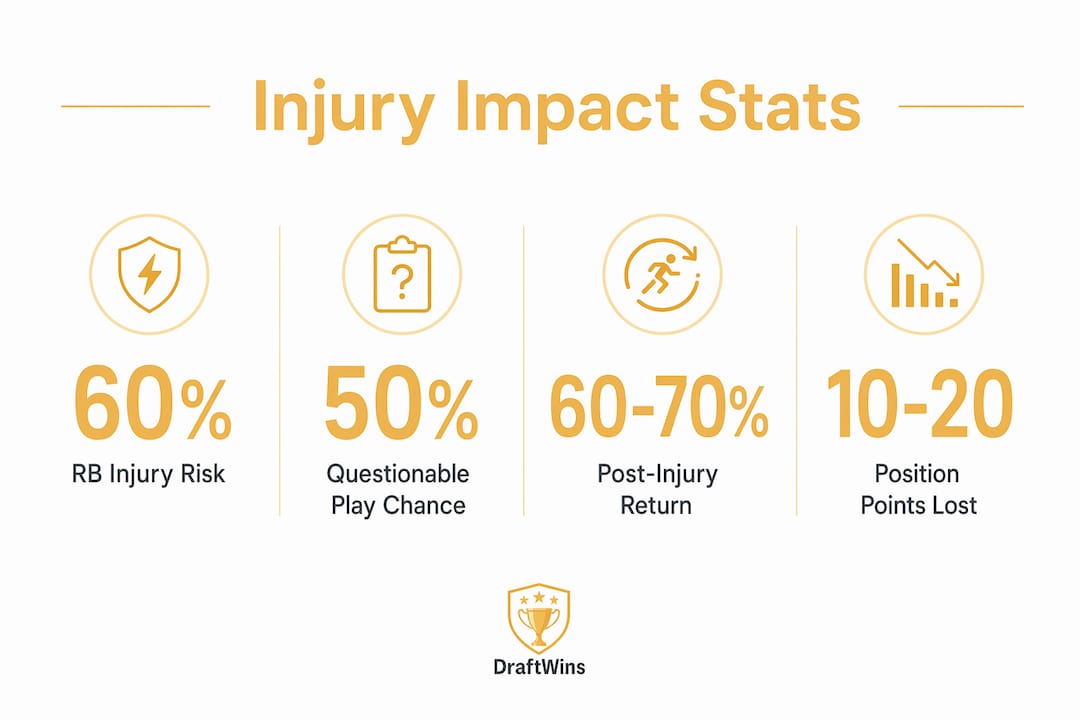
Recovery timelines make the problem worse. Players returning from multi-week injuries typically resume at 60–70% of their pre-injury positional rank. They need 2–3 weeks to return to full form. A running back who was a top-5 option before his injury comes back as a low-end RB2 at best, and managers who start him immediately often pay the price.
The downstream effects on teammates are just as damaging. An injured quarterback reduces receiver and tight end production because passing volume drops with a backup under center. Wide receivers lose target share. Tight ends become afterthoughts. The cascade effect hits the entire offensive unit, and static ranking systems rarely capture it.
| Injury type | Typical fantasy performance impact | Recovery timeline |
|---|---|---|
| Ankle (skill positions) | Significant output decline, statistically confirmed | 2–4 weeks to return to form |
| Soft tissue (hamstring, quad) | High recurrence risk; 20%+ drop likely | 3–6 weeks; chronic risk lingers |
| Concussion protocol | Unpredictable return; full output on return | 1–3 weeks if cleared |
| Quarterback injury | Cascades to all receivers and tight ends | Backup era depresses entire offense |
| Multi-week absence (any) | Returns at 60–70% pre-injury rank | 2–3 weeks ramp-up required |
Pro Tip: For running backs with 350 or more touches in the prior season, draft one round later than their ADP suggests. The injury risk is priced in by the market far less than the data warrants.
How to respond when injury news hits your league
Most fantasy managers overreact to injury news. That overreaction is predictable, and predictable behavior creates opportunity. Injury news causes players to drop 15–30 draft spots and generates roughly 30% value discounts within 24 hours of a report. The market moves faster than the actual injury risk justifies.
The 24–48 hour window after an injury report is the most valuable time to act. Savvy managers use this window to buy undervalued players or sell handcuffs at peak value before the market corrects. Selling a backup running back the night a starter gets hurt often returns more value than holding and waiting.
The key distinction every manager needs to make is between "hurt" and "injured." A player who is hurt plays through discomfort and may even perform normally. A player who is injured has structural damage that affects output, availability, or both. Confusing the two leads to either panic drops or dangerous overconfidence. Context matters more than the injury label itself.
ADP moves of 20 or more spots within 48 hours are frequently mispriced relative to actual injury risk. That mispricing is your edge if you act with information rather than emotion.
Common pitfalls and the right responses:
- Panic dropping a starter: Wait 24 hours before dropping any player with a Questionable tag. The market often overcorrects.
- Ignoring handcuff value: When a starter gets hurt, his backup's trade value spikes immediately. Sell into that spike.
- Starting a player returning from IR on week one back: Expect 60–70% output. Plan accordingly and have a backup ready.
- Chasing injury-inflated backups at full price: Buy before the injury news breaks or wait for the market to settle after 48 hours.
- Treating all soft tissue injuries equally: Chronic soft tissue injuries warrant two-round draft discounts and sustained handcuffing. A first-time hamstring strain is a different risk than a player's third.
Pro Tip: Set a personal rule: never make a trade within two hours of breaking injury news. Let the market panic first, then act when prices are most distorted in your favor.
How injury uncertainty shapes league competition all season
Injuries do not just hurt individual rosters. They reshape the entire competitive structure of a fantasy league. Managers with better injury risk modeling gain a measurable edge in both the draft and in-season trades. Those who rely on static rankings and ignore injury history consistently underperform over a full season.
Roster depth becomes the defining factor in injury-heavy environments. Managers who draft with depth at running back and wide receiver survive the inevitable attrition. Those who load up on upside picks without backup options fall apart by week 6. The draft pick strategy that wins leagues accounts for injury probability at every tier, not just the top rounds.
The cascade effect creates hidden opportunity costs that most managers never track. When a team's starting quarterback goes down, every receiver on that roster loses value. Managers holding those receivers often do not adjust their expectations or trade targets fast enough. The result is a roster that looks healthy on paper but underperforms every week.
League engagement suffers too. Unpredictable weekly lineup changes force managers to spend more time managing rosters than enjoying the competition. For casual players especially, the weekly grind of injury reports and last-minute decisions is a primary reason they disengage mid-season.
| League factor | Effect of injury uncertainty |
|---|---|
| Draft strategy | Injury history forces positional tier adjustments and round discounts |
| Trade market | Injury news creates short-term price distortions that reward fast movers |
| Roster depth | Managers with handcuffs and depth survive; one-dimensional rosters collapse |
| Weekly engagement | Constant lineup uncertainty increases management burden and burnout |
| Season outcomes | Teams with better injury luck outperform talent-equivalent rosters |
Understanding draft position advantage matters more in injury-heavy seasons because early picks on durable players compound in value as the season progresses and attrition thins the field.
Draftwins takes the injury stress out of group competition
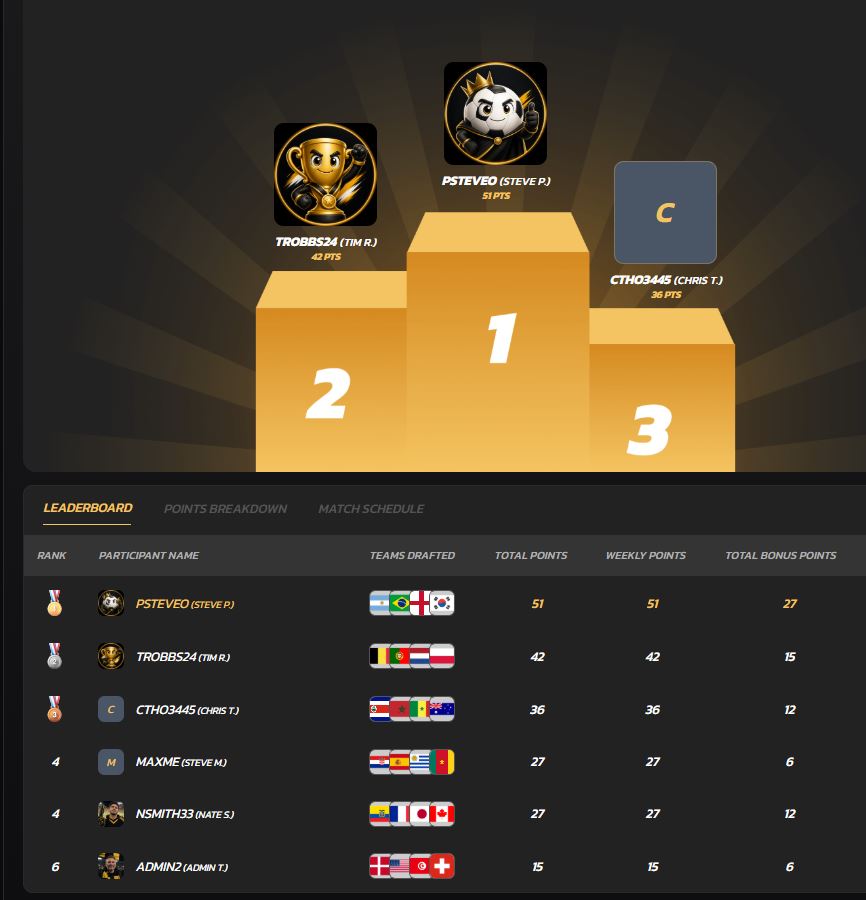
Injury concerns ruin fantasy for millions of players every season, not because injuries are unavoidable, but because traditional formats force you to manage every consequence alone. Draftwins takes a different approach. Instead of drafting individual players and absorbing every injury blow directly, you draft entire teams. That single structural change removes the weekly lineup panic that makes injury management so exhausting.
Draftwins offers automated scoring and live leaderboards so you track competition without rebuilding your roster every Thursday night. Commissioners set the rules, the platform handles the rest. Whether you play World Cup pools now or NFL and College Football pools when they launch, Draftwins keeps the focus on competition, not injury reports. It is the format built for players who want the thrill of the draft without the grind of individual player management.
FAQ
Why do injury concerns ruin fantasy more than any other factor?
Injuries create unpredictable player unavailability that directly reduces scoring output and forces constant roster changes. Unlike matchups or weather, injuries can eliminate a top player entirely with no warning.
What does a Questionable tag actually mean for my lineup?
A Questionable designation means the player has roughly a 50% chance of playing. That uncertainty causes 10–20 spot positional rank swings and requires you to have a backup ready at that position.
How long does it take a player to return to full form after injury?
Players returning from multi-week injuries typically perform at 60–70% of their pre-injury positional rank. Full recovery usually takes 2–3 additional weeks after their return to the lineup.
Should I drop a player immediately after an injury report?
No. Wait at least 24 hours before making roster moves on injured players. The market overreacts in the first 24–48 hours, and premature drops often cost you more than holding through the uncertainty.
How do quarterback injuries affect the rest of my fantasy roster?
A quarterback injury reduces passing volume for the entire offense. Receivers and tight ends on that team lose target share and fantasy points, making them less reliable starters until the starter returns.
Key takeaways
Injury concerns ruin fantasy seasons because they create cascading performance declines, distort player valuations, and force constant roster decisions that most managers are not equipped to handle systematically.
| Point | Details |
|---|---|
| Injury designations carry real probabilities | A Questionable tag means roughly 50% play chance; plan for both outcomes every week. |
| Post-injury output drops are measurable | Returning players perform at 60–70% pre-injury rank for 2–3 weeks after coming back. |
| Market overreaction creates opportunity | Injury news drops ADP by 15–30 spots; the 24–48 hour window rewards informed buyers. |
| Cascade effects hit entire offenses | A quarterback injury depresses receiver and tight end value across the whole roster. |
| Roster depth decides season outcomes | Managers with handcuffs and positional depth survive injury attrition; others do not. |