
Use a weighted round-multiplier system: 1 point per correct group-stage winner, 2 for Round of 32, 4 for Round of 16, 8 for the quarterfinals, 16 for the semifinals, and 32 for picking the champion. It rewards knowledge without punishing casual players, and it scales naturally with the 48-team format's extra Round of 32.
One important decision: how to score the teams that place third and advance from the group stage. Get that settled before kickoff, because changing it mid-tournament will start arguments you can't win.
If the default system doesn't fit your group, two variations are worth knowing:
- Confidence points — participants rank their confidence in each pick, adding strategic depth for expert groups.
- Upset bonus — extra points for correctly picking a lower-ranked team to beat a favorite, which keeps eliminated favorites' fans engaged.
TL;DR:
- Using a weighted round-multiplier system ensures fair and engaging scoring, with 1 point for group winners and up to 32 for the champion, emphasizing knockout-stage knowledge.
- Decide on how to award points for third-place teams and implement FIFA's tiebreaker rules in your scoring setup to prevent disputes over rankings.
- Lock all entries before the tournament or before each group's first match to avoid late changes and preserve scoring fairness throughout the event.
- Keep bonus points for exact scores and upsets small to ensure they add fun without overshadowing skill-based predictions.
- Automate scoring with platforms like DraftWins to manage match results and leaderboard updates, reducing manual effort and errors across the tournament.
Table of Contents
- What Are the Main World Cup Pool Scoring Systems?
- How Should You Score the 48-Team Group Stage?
- How Do Points Add Up Across the Tournament?
- Commissioner Checklist: Rules You Can Publish Today
- How DraftWins Handles World Cup Pool Scoring for You
- How Do You Handle Cancellations or Postponed Matches?
- Do Bonus Points for Exact Scores Change the Game?
- How Do You Keep Scoring Fair From Round One to the Final?
- What Other Scoring Variations Do World Cup Pools Use?
- Which Tools Handle World Cup Pool Scoring Automatically?
- Set Up Your Pool Scoring Without the Spreadsheet Headache
- Key Takeaways
- Sources
- FAQ
What Are the Main World Cup Pool Scoring Systems?
Most world cup pool scoring falls into four camps, and picking the wrong one for your group is the fastest way to kill engagement by the Round of 16.
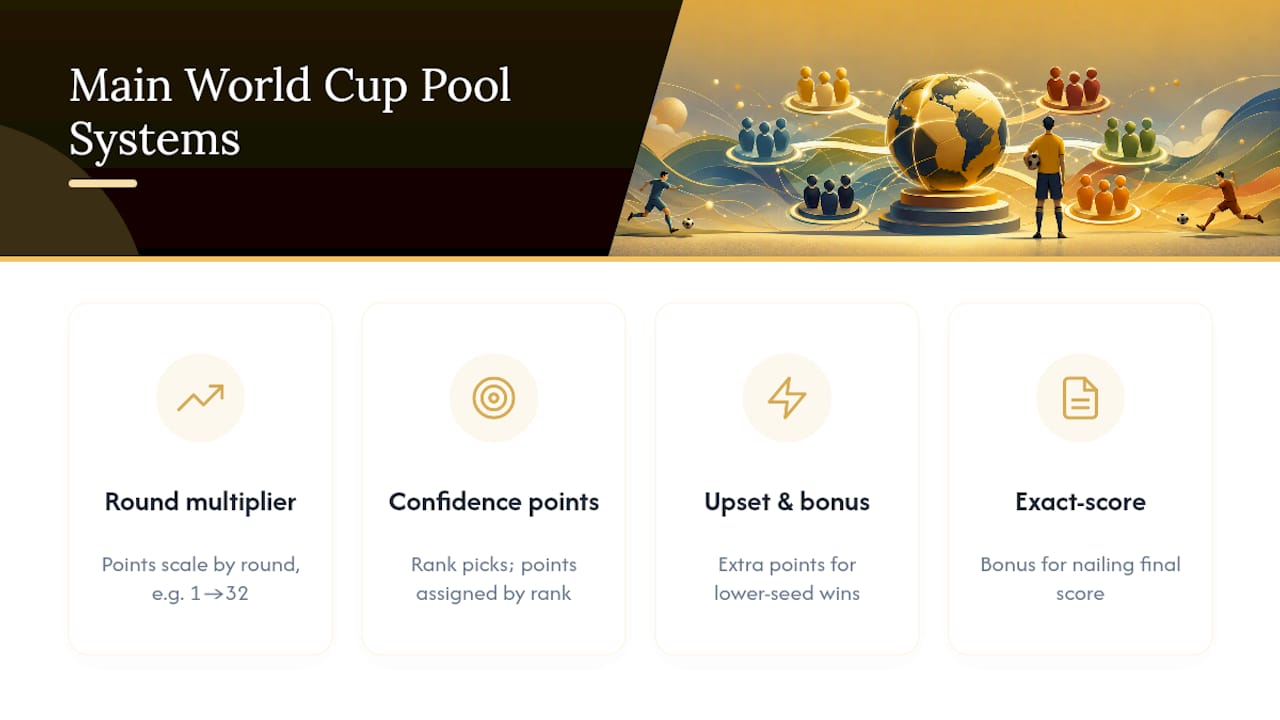
Round-multiplier scoring is the standard. Points double or jump at each knockout stage, so a correct Final pick is worth far more than a correct group-stage guess. A common pattern is 1 group point, 2 for Round of 32, 4 for Round of 16, 8 for quarterfinals, 16 for semifinals, and 32 for the champion. Some commissioners flatten this to 1-2-4-8-16 without a Round of 32 tier for simpler pools. The logic is straightforward: later rounds carry more information and more stakes, so they should carry more weight.
Confidence points ask participants to rank every pick by how sure they are, then assign points based on that rank. It rewards genuine soccer knowledge but takes longer to fill out and confuses first-time players. Save it for small, highly engaged groups who already know the format.
Upset and bonus systems award extra points when a lower-seeded team wins outright, on top of the base scoring. This keeps people invested even after their favorite gets knocked out.
Exact-score variants award bonus points for nailing the final score of a match, not just the winner. It's a fun add-on but rarely works as a standalone system since exact scores are genuinely hard to predict.
Pro Tip: If you're running a pool for coworkers who barely follow soccer, skip confidence points entirely. A simple round-multiplier system with one bonus category is the sweet spot between fairness and fun.
For casual office or family pools, simple round-multiplier scoring wins every time. Reserve confidence points and layered bonuses for groups of die-hard fans who want the extra complexity.
How Should You Score the 48-Team Group Stage?
The 2026 tournament's 12 groups of four create a specific problem prior World Cups didn't have: eight third-place teams advance alongside every group's top two, and your scoring rules need to account for that before the group stage even starts.
Three approaches work, each with a different time-versus-fairness trade-off:
- Full ordering — participants predict the exact 1st, 2nd, 3rd, 4th finish in each group. Highest ceiling for skilled players, but it's a lot to fill out across 12 groups and punishes anyone who guesses one team out of order.
- Top-two only — participants pick which two teams advance from each group, ignoring order. Faster to complete and easier to score, though it ignores the drama of who finishes first versus second.
- Top-two plus best-thirds — participants pick group advancers, then separately predict which of the third-place teams make the cutoff as one of the eight qualifiers. This mirrors the real tournament structure most closely.
For most pools, option B (top-two only) balances speed and fairness. Award 1 point per correct advancer, then a small bonus (1 to 2 points) for correctly flagging a third-place team that advances if you use option C.
Group scoring should mirror FIFA's actual tie-breaking process where possible. FIFA ranks tied teams using head-to-head points, then head-to-head goal difference and goals scored, followed by overall goal difference, goals scored, disciplinary record, and FIFA ranking if ties remain. The same cascade determines the eight best third-placed teams. Build your pool's tiebreaker language around that exact sequence so nobody argues about a technicality in October.
Lock entries before the tournament opens, or at minimum 24 hours before the first match in each group, to prevent last-minute pick changes once lineups leak.
How Do Points Add Up Across the Tournament?
Here's how the recommended 1-2-4-8-16-32 system plays out in practice.
- A player correctly picks 8 of 12 group winners: 8 points.
- That player also nails 12 of 16 Round of 32 winners: 24 points (12 x 2).
- They get 6 of 8 Round of 16 winners correct: 24 points (6 x 4).
- They correctly pick 3 of 4 quarterfinal winners: 24 points (3 x 8).
- They get 1 of 2 semifinal winners right: 16 points.
- They correctly pick the champion: 32 points.
- Running total: 128 points, with the champion pick alone worth 25% of the score.
Now compare that to a pool using upset bonuses. Suppose two players are tied entering the semifinals. One picked a heavy favorite to reach the Final and lost; the other correctly flagged an upset in the quarterfinals, earning a 10-point bonus on top of base points. Bonus points for upsets can create late-tournament drama that keeps a pool interesting through the Final.
Commissioner Checklist: Rules You Can Publish Today
Copy this into your pool's rules page and fill in your point values.
Scoring table:
| Round | Points per correct pick |
|---|---|
| Group stage winner | 1 |
| Round of 32 | 2 |
| Round of 16 | 4 |
| Quarterfinal | 8 |
| Semifinal | 16 |
| Champion | 32 |
Rules to nail down before the tournament:
- Decide and publish your best-third-place-team rule before groups are announced, since waiting until mid-tournament to settle this invites disputes.
- Set your tiebreaker cascade: head-to-head record first, then most correct later-round picks, then earliest correct champion prediction submitted.
- Lock all entries before the opening match, with no edits allowed after kickoff.
- Spell out your dispute process in one sentence: the commissioner's ruling is final once published.
- Consider a "wooden spoon" consolation prize for last place to keep eliminated players checking the leaderboard.
Pro Tip: Splitting prizes among first, second, and third place can keep more participants emotionally invested through the Final.
How DraftWins Handles World Cup Pool Scoring for You
Manually tallying points across 104 matches and 48 teams is where most commissioners burn out. DraftWins runs automated scoring so you never touch a spreadsheet.
- Team-draft format instead of individual player picks, so participants focus on team performance, not injury reports.
- Automated scoring that updates as real results come in, including knockout-round multipliers.
- Customizable rules, so you can set your own point values for group stage, best-thirds, and each knockout round.
- Live leaderboards that update in real time, so nobody's asking "who's winning?" mid-match.
A pool that runs on automated scoring removes the single biggest source of commissioner headaches: manually recalculating standings after every match and defending your math to twelve different group chats.
Pro Tip: Set your scoring rules once, before your group's first match, and let automation handle every recalculation from there. Draft Wins Pools applies your rules consistently across all 104 matches without you touching a spreadsheet.
How Do You Handle Cancellations or Postponed Matches?
Match cancellations are rare in modern World Cups, but weather, safety issues, or logistical problems can still force a postponement, and your pool's rules should say what happens before it does.
The simplest fix: if a match is postponed and replayed, score it normally once it's completed, using the actual result rather than the original schedule. Points post whenever the match is finally played, not on the original date.
If a match is canceled outright and not rescheduled, most pools treat it as a "no contest" for scoring purposes. Nobody gains or loses points for that specific pick, and any downstream picks tied to that match's outcome (like a knockout-round advancer) get similarly voided rather than guessed at. This avoids the mess of retroactively awarding points based on a hypothetical result.
Group-stage cancellations are trickier because they can affect who advances. If FIFA officially resolves a canceled group match through forfeiture or another ruling, your pool's group-stage points should follow that official ruling exactly rather than the commissioner improvising a fix. Publish this rule alongside your lock policy so nobody's surprised in a low-probability scenario.
The upside of automated scoring platforms is they can flag affected picks automatically instead of forcing you to comb through 104 matches by hand looking for one canceled fixture.
Do Bonus Points for Exact Scores Change the Game?
Exact-score bonuses add a small, fun layer to world cup pool scoring, but they shouldn't become your primary scoring mechanism.
A typical implementation: award 3 to 5 bonus points on top of base scoring when a participant predicts the correct final score, not just the winner. Since most matches don't end in the score anyone guesses exactly, this bonus tends to reward a handful of lucky calls rather than consistent skill, which is exactly why it works best as a garnish rather than the main course.
The upside is real: exact-score bonuses give players a reason to think harder about every single match, even the ones with an obvious favorite. A 4-0 blowout becomes interesting again if someone can bank bonus points for calling the exact margin.
The downside is variance. If you weight exact-score bonuses too heavily, you can end up with a leaderboard where the winner got lucky on two matches rather than correctly picking more winners overall.
Other special-achievement bonuses worth considering include correctly picking a shutout, predicting a match that goes to penalties, or flagging the tournament's top scorer in advance. Each adds flavor without restructuring your core scoring system, and none of them should carry more weight than a correct knockout-round pick.
How Do You Keep Scoring Fair From Round One to the Final?
The core tension in world cup pool scoring is this: group-stage picks happen when nobody has real information yet, while knockout picks happen after players have watched a month of soccer. Weighting both stages equally isn't fair to anyone.
Round-multiplier scoring solves most of this automatically, since later rounds are worth more points precisely because they require more informed decisions. But there are a few extra levers worth pulling if your group wants finer balance.
One option is capping how much of the final score any single pick can represent. Some commissioners lower the champion multiplier slightly, or require players to lock in that pick again after the group stage, to reduce the luck factor of an early guess.
Another option is rewarding sustained accuracy across the group stage with a small cumulative bonus, so players who correctly track form through all 12 groups get credit even if a late-round pick misses. This keeps early engagement meaningful instead of treating the group stage as a formality before "real" scoring begins.
The best pool structures strike a balance where a player who dominates the group stage can't coast to victory, but a player who ignores the group stage entirely can't win purely on knockout luck either.
What Other Scoring Variations Do World Cup Pools Use?
Beyond the standard round-multiplier system, a few common variations show up across different pool platforms and office traditions.
Fixed-point systems award the same point value for every correct pick regardless of round. It's the simplest possible option, but it ignores how much harder later-round predictions are to make correctly, so it tends to reward group-stage luck as much as knockout-stage insight.
Golden Goal or top-scorer bonuses give a set number of points for correctly predicting the tournament's top scorer or golden boot winner. It's a nice side bet that runs the entire tournament length and gives people something to track even after their bracket falls apart.
Team-elimination survivor pools work differently altogether. Instead of predicting outcomes, each participant picks a team to advance each round, and picking a team that loses eliminates you. This isn't really "scoring" in the traditional sense, but it's popular among groups who prefer sudden-death stakes over cumulative points.
Hybrid systems, as one practical approach for mixed-skill office groups, layer a single high-value confidence pick (usually the champion) on top of otherwise simple round-multiplier scoring. This rewards the group's most engaged predictors without forcing everyone to rank confidence on all 104 matches.
The variation you choose should match your group's appetite for complexity. A team-draft pool format sidesteps a lot of this decision entirely, since scoring is based on team performance across the tournament rather than match-by-match predictions.
Which Tools Handle World Cup Pool Scoring Automatically?
Manually tracking points across 12 groups and 104 matches is realistic for a small pool of five friends. It becomes a part-time job once you're managing 40 coworkers.
Spreadsheet templates are the most common DIY option. They work, but someone has to manually enter every result, recalculate multipliers, and re-sort the leaderboard after each match day, and one typo means disputed standings. For pools of a dozen people or fewer with a patient commissioner, this can work fine.
Dedicated pool platforms remove that manual step. Automated scoring systems pull real match results and apply your chosen point values instantly, so the leaderboard updates itself without anyone opening a spreadsheet. This matters even more in 2026, since the extra Round of 32 means more matches, more scoring events, and more chances for manual math to go wrong.

When comparing tools, look for three things: whether the platform supports the group-stage and best-third scoring approach you want, whether it lets you customize point values per round instead of forcing a fixed system, and whether the leaderboard updates automatically as results come in. Platforms built specifically around team-based pools also tend to handle the draft and roster side of things, not just the scoring math, which matters if your group wants something more engaging than a static prediction sheet.
Set Up Your Pool Scoring Without the Spreadsheet Headache
If you've read this far, you already know the trade-off: manual scoring gives you full control over every rule, but it also means you're the one recalculating a leaderboard after every match for six weeks straight.
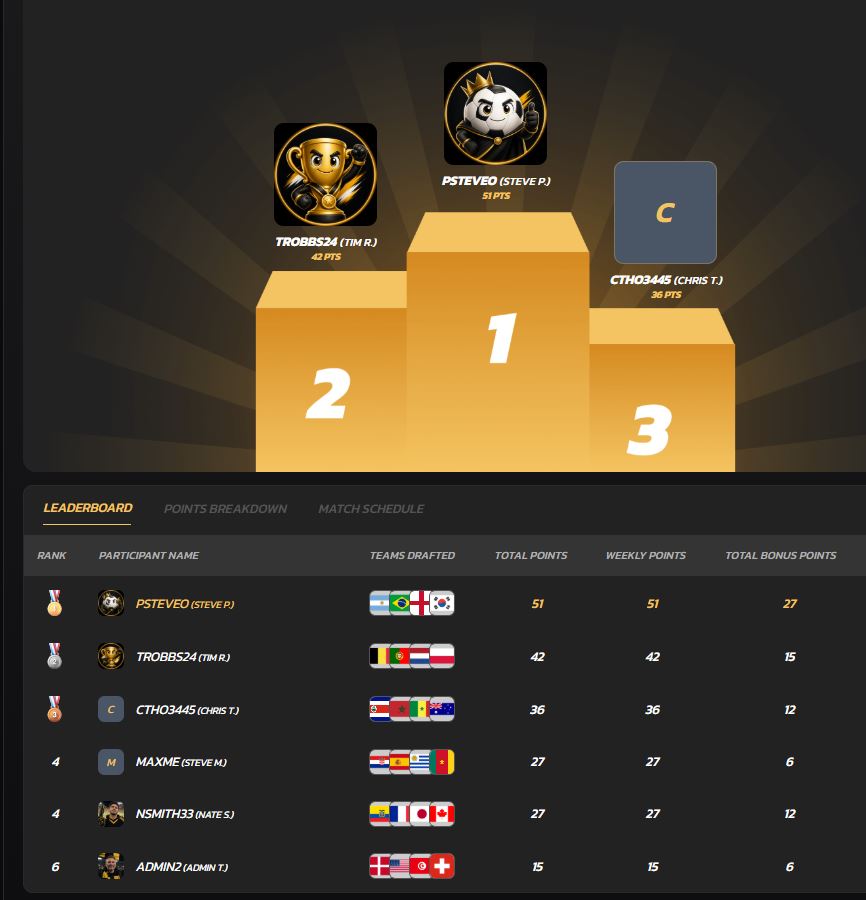
DraftWins takes a different approach built for exactly the scoring system this article recommends. Instead of predicting individual matches, participants draft actual World Cup teams, and DraftWins applies your chosen scoring rules automatically as results come in, including round multipliers, group-stage rules, and any bonus categories you want to add. Commissioners set up custom scoring once during pool creation, then the live leaderboard handles the rest without anyone touching a formula.
DraftWins charges a one-time hosting fee to the commissioner who creates the pool. Participants join for free, and there's no entry fee collection or prize pool management on the platform, so you're free to run your own prize structure exactly as outlined in your rules. Head to DraftWins Pools to set up your 2026 World Cup pool with automated scoring built in from day one.
Key Takeaways
A weighted round-multiplier system, from 1 point in the group stage up to 32 for the champion, gives World Cup pools fair, engaging scoring that rewards knockout-stage knowledge without alienating casual players.
| Point | Details |
|---|---|
| Default scoring system | Use 1-2-4-8-16-32 point multipliers from group stage through champion pick. |
| Decide on third-place teams early | Publish your rule for handling the eight best third-placed qualifiers before groups are announced. |
| Match tiebreakers to FIFA's rules | Use head-to-head record, goal difference, and goals scored in that order, mirroring official tie-breaker logic. |
| Lock entries before kickoff | Close all picks before the tournament starts or before each group's first match. |
| Cap luck-based bonuses | Keep exact-score and upset bonuses to a small share of total points so skill still decides the leaderboard. |
| Automate scoring with DraftWins | DraftWins applies your custom scoring rules automatically across all 104 matches with a live, self-updating leaderboard. |
Sources
- What is the format for the FIFA World Cup 2026 tournament
- How teams qualify for the knockout phase (tie-breakers) — FIFA
FAQ
How Do You Score a World Cup Bracket?
Assign increasing point values to each round, typically 1 point for group-stage picks up to 32 for the champion, then total points as each round's results come in.
How Should Pools Handle the Eight Best Third-Placed Teams in 2026?
Decide before the tournament whether to award points for correctly predicting which third-place teams advance, and apply FIFA's official tie-breaker cascade (head-to-head record, goal difference, goals scored) to resolve any ties in your scoring.
What's the Difference Between Round-Multiplier and Confidence-Point Scoring?
Round-multiplier scoring assigns fixed point values by round, while confidence points let each participant rank how sure they are on every pick, adding strategy but also complexity best suited to expert groups.
When Should Pool Entries Lock?
Most commissioners lock entries before the tournament's opening match or at minimum 24 hours before each group's first game to prevent last-minute pick changes.
Can Automated Platforms Handle Custom Scoring Rules?
Yes. Platforms like DraftWins let commissioners set custom point values per round and automatically update the leaderboard as match results come in, removing manual recalculation entirely.