
What is a custom scoring system and why does it matter?
A custom scoring system is a structured evaluation tool that assigns specific point values to predefined criteria or answer options, then aggregates those points into a single weighted total. The result tells you, clearly and consistently, which option, participant, or response performed best under your chosen standards.
The core elements of any scoring system are:
- Criteria: The dimensions you are evaluating (e.g., Innovation, Presentation, Feasibility)
- Weights: The relative importance of each criterion, typically summing to 100%
- Rating scale: The range judges or respondents use to score each criterion (e.g., 1–5 or 1–10)
- Total score calculation: Multiplying each rating by its weight, then summing across all criteria
What separates a custom system from a generic rubric is intentionality. You decide which criteria matter, how much each one counts, and what the rating scale means at every level. That design work is what makes the output trustworthy rather than arbitrary. Custom scoring applies across competitions, scored surveys, fantasy sports pools, and project prioritization in business settings.
Table of Contents
- How to enable and implement a custom scoring system
- Common types and methods of custom scoring systems
- How to build a custom scoring model step by step
- Where custom scoring systems add real value
- Expert best practices for reliable custom scoring
- How Draftwins uses custom scoring for sports pools
- Key Takeaways
- FAQ
How to enable and implement a custom scoring system
Setting up a scoring system is less about software and more about decisions made before anyone touches a tool. Here is a practical sequence that works across competitions, surveys, and sports pools.
-
Choose your platform or format. Survey tools like QuestionPro let you assign variable points to each answer option, display scores after each question, and route respondents based on their running total. Competition platforms let judges score independently via private links. Fantasy sports platforms like Draftwins let commissioners configure scoring rules before the pool opens.
-
Define your criteria and point values. List every dimension you want to evaluate. Assign a maximum point value or weight to each. A pitch competition might allocate 40 points to Market Opportunity and 20 to Presentation Skills.
-
Configure the scoring interface. Enter your criteria, weights, and scale into your chosen tool. Many platforms support CSV uploads for bulk configuration. Microsoft Dynamics 365 Customer Voice, for example, lets you set a base score, assign weights per question, and assign point values per answer option through its Satisfaction Metrics panel.
-
Communicate the methodology to participants. Publish the criteria, weights, and scale before scoring begins. Transparency in weighting builds acceptance even when participants disagree with results, because the process feels fair and logical.
-
Enable real-time or automated tallying. Automated aggregation removes human arithmetic errors and speeds up results. Live leaderboards let participants track standings without waiting for a manual tally.
Common types and methods of custom scoring systems
Choosing the right scoring method shapes how fair and interpretable your results will be. The three most common approaches each handle ranking and aggregation differently.
-
Raw Score (Weighted Sum Model): Each criterion rating is multiplied by its weight, and the products are summed. This is the most widely used method because everyone on the team can follow the math. Its limitation is that a high score on one criterion can compensate for a low score on another, which is not always appropriate.
-
Borda Count: Judges rank alternatives from best to worst. Each rank position converts to a point value (e.g., first place gets n points, last gets 1). The alternative with the highest total points wins. This method works well when you want to capture consensus across multiple judges without requiring them to agree on absolute scores.
-
Ordinal Consensus: Alternatives are placed by majority agreement into rank positions. This approach is useful when precise numeric scoring feels artificial, such as in creative competitions where judges have strong opinions about relative order but not absolute quality.
Beyond the calculation method, your rating scale matters more than most designers expect. Larger numeric scales like 1–100 tend to produce central tendency bias, where judges cluster scores around the middle. Smaller scales with verbal anchors (e.g., 1 = "Does not meet expectations," 3 = "Meets expectations," 5 = "Exceeds expectations") yield more consistent and discriminating ratings.
For multi-judge setups, score aggregation methods include simple averaging, dropping the highest and lowest scores before averaging (the Olympic gymnastics approach), and weighted criteria where some dimensions count more than others. Pick the aggregation method before the event and tell participants. Changing it after scores are submitted creates legitimate complaints.

How to build a custom scoring model step by step
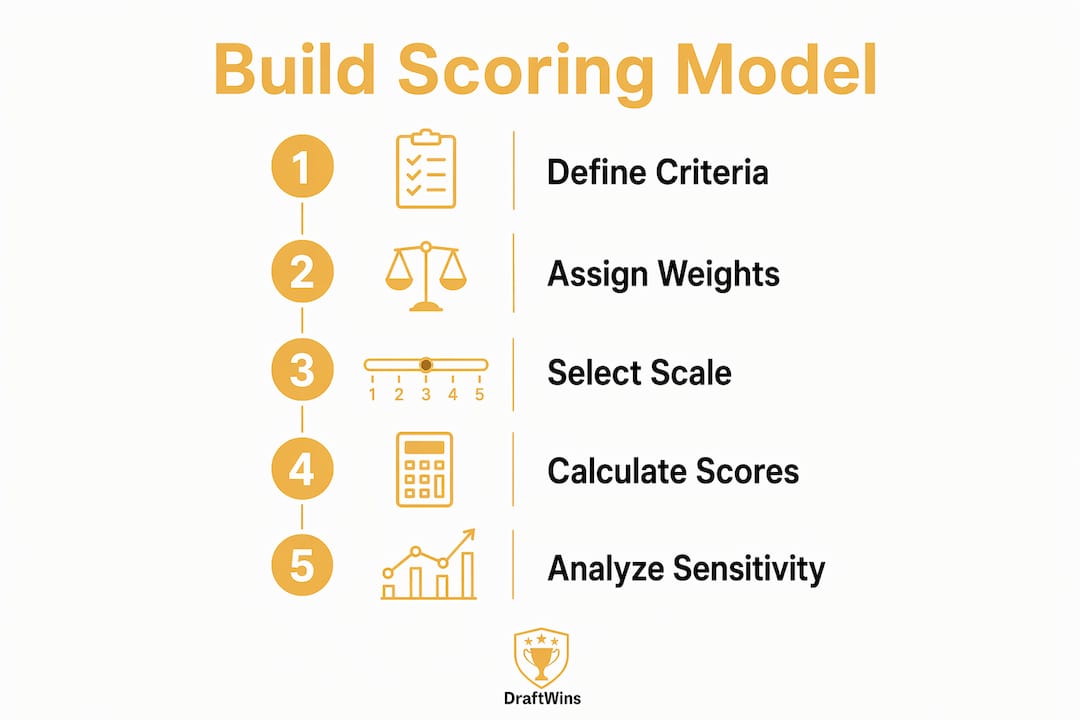
Building a scoring model from scratch takes roughly four focused steps. The sequence matters because changing weights after you have seen ratings introduces unconscious bias toward a preferred outcome.
-
Define your evaluation criteria. Aim for 5–8 independent, precise dimensions. Research on innovation project scoring found that seven factors per dimension should be the maximum; more than that and judges give less attention to each one. Write a brief description for each criterion so every judge interprets it the same way.
-
Assign weights before rating begins. Express weights as percentages summing to 100%. Decide on weights as a group, document them in writing, and declare them fixed. This is the most critical step and the most frequently skipped.
-
Rate each alternative on a consistent scale. Use silent, independent rating before group discussion to prevent anchoring. A 1–5 scale with clear verbal anchors at each level works better than a 1–10 scale in most settings.
-
Calculate weighted totals and normalize where needed. Multiply each rating by its criterion weight and sum across all criteria. When your criteria include metrics with different units (time, money, percentages), normalize the data before weighting to prevent high-magnitude metrics from dominating the final score. Min-max scaling, which maps each metric to a 0–1 range, is the most common approach.
Pro Tip: Run a sensitivity analysis after calculating scores. Shift the weight of your most important criterion up and down by 10 percentage points and check whether the ranking changes. If it does, that weight deserves more discussion before you finalize results.

Where custom scoring systems add real value
Custom scoring applies wherever you need to compare options fairly and explain the outcome to others.
-
Competitions: Judges evaluate participants on defined criteria like Innovation, Feasibility, and Presentation. Weighted scoring ensures that the criteria your organization cares most about drive the result, not whichever criterion a particular judge happens to weight heavily in their head.
-
Scored surveys and assessments: A scored survey assigns variable points to answer options, supports negative scoring for wrong answers, and can branch respondents to different question paths based on their running score. Online quizzes, certification tests, and customer satisfaction assessments all use this format.
-
Fantasy sports pools: Scoring rules determine which team performances translate into points. Commissioners configure rules before the pool opens, and automated systems handle the tallying. Learn more about how draft-based scoring works in fantasy contests.
-
Project and innovation prioritization: Companies use multi-factor scoring to evaluate early-stage projects when full business plans are not yet available. Separating Opportunity scores from Feasibility scores prevents a highly feasible but low-value project from outranking a harder but more valuable one.
Expert best practices for reliable custom scoring
A well-designed system can still produce unreliable results if a few common mistakes slip through.
-
Define verbal anchors for every scale point. Without a clearly defined midpoint or verbal anchor, judges apply their own subjective definitions of "good" and "bad," which undermines consistency across the panel.
-
Keep sub-categories to about seven per dimension. Effective custom scoring in competitions and surveys limits sub-categories to roughly seven factors per dimension to keep ratings meaningful rather than diluted.
-
Hide scores until all judges have submitted. Multi-judge systems that prevent judges from seeing each other's scores until submission reduce conformity bias and produce more honest, independent ratings.
-
Normalize before weighting. When criteria use different units, apply min-max or z-score scaling before multiplying by weights. Skipping this step lets high-magnitude metrics dominate regardless of their assigned weight.
-
Avoid overly wide scales. A 1–100 scale sounds precise but rarely is. Judges cannot reliably distinguish a 67 from a 71. A 1–5 scale with anchors forces clearer distinctions.
Pro Tip: Document your scoring methodology in writing before the event, including criteria definitions, weights, scale anchors, and aggregation method. Share it with all judges and participants. A paper trail prevents disputes and makes the process repeatable.
How Draftwins uses custom scoring for sports pools
Draftwins is built around the idea that scoring a sports pool should be automatic, transparent, and configurable without a spreadsheet. Commissioners set the rules; the platform handles everything else.
-
Customizable scoring rules: Commissioners configure point values and scoring criteria before the pool opens, tailoring the system to their group's preferences rather than accepting a one-size-fits-all format.
-
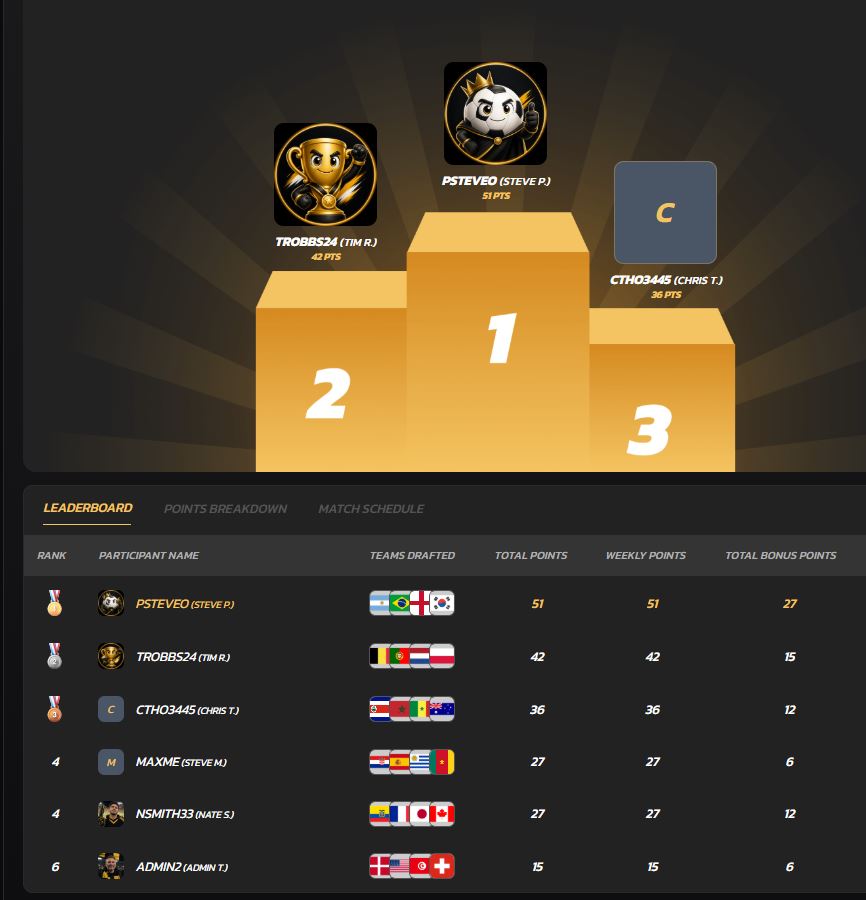
Automated scoring and live leaderboards: Once the competition starts, Draftwins calculates scores automatically and updates standings in real time. Participants track progress without waiting for a manual tally, and the automated scoring system removes arithmetic errors from the equation entirely.
-
Draft teams, not individual players: Participants draft whole teams rather than individual athletes, which eliminates the injury-tracking stress that makes traditional fantasy leagues exhausting for casual players.
-
Private pools with personal rules: Each pool is private and configured by its commissioner, so the scoring reflects what the group actually values. The platform handles scoring rule configuration so commissioners spend their time on competition, not administration.
-
No entry fees or prize pool management: Draftwins charges a platform fee and does not collect entry fees, hold prize pools, or accept wagers. The focus stays on the competition itself.
Ready to run a sports pool with scoring that just works? Start your pool on Draftwins and let the platform handle the math.
Key Takeaways
A custom scoring system produces fair, transparent results only when criteria, weights, and scale anchors are defined before any rating begins.
| Point | Details |
|---|---|
| Define criteria and weights first | Set weights as percentages summing to 100% before anyone rates alternatives, to prevent anchoring bias. |
| Use small scales with verbal anchors | A 1–5 scale with labeled anchors yields more consistent ratings than a wide 1–100 scale. |
| Normalize before weighting | Apply min-max scaling when criteria use different units to prevent high-magnitude metrics from skewing results. |
| Run sensitivity analysis | Shift your top criterion's weight by 10 percentage points and check whether rankings change before finalizing scores. |
| Document and share the methodology | Publish criteria, weights, and aggregation method before the event to build participant trust and make results defensible. |
FAQ
What is a custom score?
A custom score is a weighted total calculated by multiplying each criterion's rating by its assigned weight and summing the results. It gives a single, comparable number that reflects how well an option or participant performed across all defined dimensions.
How does a scoring system work?
A scoring system works by assigning point values to criteria or answer options, rating each alternative against those criteria, and aggregating the weighted points into a final score. The alternative with the highest total score ranks first under the chosen criteria and weights.
What are the different types of scoring?
The three most common types are Raw Score (weighted sum of ratings), Borda Count (rankings converted to points), and Ordinal Consensus (majority placement by rank). Multi-judge setups also vary by aggregation method: simple average, drop-high-low, or weighted criteria.
How do you build a scoring model?
Build a scoring model in four steps: define 5–8 evaluation criteria, assign percentage weights that sum to 100% before rating begins, rate each alternative on a consistent scale with verbal anchors, and calculate weighted totals. Run a sensitivity analysis afterward to confirm the ranking holds under small weight changes.