
A team pick contest with no stats tracking is defined as a group competition where participants select whole teams rather than individual players, with winners determined by team outcomes alone. No player statistics, no injury updates, no waiver wire decisions. This format is the standard approach for casual sports fans who want the fun of competition without the time commitment of a traditional fantasy league. Simple digital play formats attract fans who prefer quick, low-effort engagement over deep stats analysis. Draftwins is built around exactly this idea, letting groups run a team pick contest no stats tracking required, from setup to final leaderboard.
What do you need to run a team pick contest with no stats tracking?
Running a contest without stats tracking requires far fewer tools than most fans expect. The core ingredients are a participant list, a set of matchups to pick from, a simple scoring rule, and a way to collect and display entries. That's it. Avoiding statistical complexity lets contest creators focus on format, engagement, and fair scoring instead of data management.
The essential tools
You need three things to get started:
- A team selection method. Participants pick whole teams to win each matchup, not individual players. This is the core mechanic of every no-stats contest.
- A scoring rule. The most common approach awards one point per correct team pick. Some contests add a bonus point for picking an upset correctly.
- An entry collection system. This can be a shared spreadsheet, a group chat, or a dedicated platform like Draftwins that handles entries and scoring automatically.
A dedicated platform removes the most common pain point: manually tracking who picked what and calculating standings after each round.
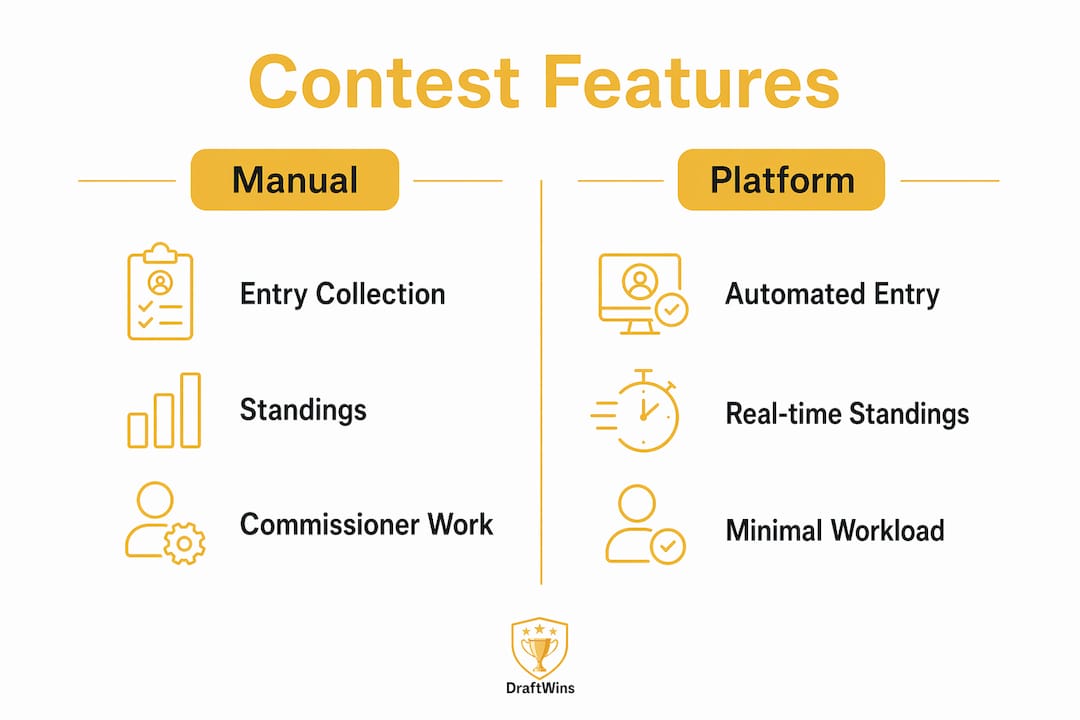
Feature comparison: manual vs. platform-based contests

| Feature | Manual (spreadsheet or chat) | Platform-based (e.g., Draftwins) |
|---|---|---|
| Entry collection | Manual, error-prone | Automated |
| Scoring updates | Manual after each game | Live, automatic |
| Leaderboard visibility | Requires rebuilding | Always visible |
| Tie-breaker handling | Decided ad hoc | Set in advance |
| Setup time | 30+ minutes | Under 10 minutes |
Platform-based contests reduce commissioner workload to near zero after setup. That matters when your goal is fun, not administration.
Pro Tip: Set your entry deadline before the first game of the round locks. Platforms like Draftwins enforce this automatically, but manual contests need a clearly communicated cutoff time posted in the group chat.
How to set up your team pick contest step by step
A well-structured contest takes less than 30 minutes to build from scratch. Follow these steps and your group will be picking teams the same day.
-
Choose your sport and tournament. World Cup group stages, NFL playoff brackets, and college football bowl seasons all work perfectly. Each round produces a clean set of matchups with a clear winner.
-
Define the pick window. Participants must submit their picks before the first game of each round. Pick'em contests lock entries before kickoff, which prevents last-minute changes based on injury news.
-
Set your scoring rule in writing. One point per correct team pick is the simplest rule. Write it down and share it with every participant before the contest opens. Ambiguity causes disputes.
-
Decide on a tie-breaker. A common method is total goals or total points scored in the final game. Publish this rule upfront so no one is surprised at the end.
-
Invite participants and collect entries. Send a single link or form. Draftwins handles this with a private pool invite, so every entry lands in one place automatically.
-
Publish the leaderboard after each round. Community transparency through visible standings significantly increases participant return and engagement. People come back when they can see where they stand.
-
Declare a winner. After the final round, the participant with the most correct team picks wins. Apply the tie-breaker if needed.
Tips for drafting teams instead of players
Drafting teams instead of players removes the single biggest source of fantasy league frustration: individual player injuries. When a star player goes down in a traditional fantasy league, that manager's week is ruined. In a team pick contest, the team still plays and the pick still counts. This makes the format far more resilient and far more fun for casual fans.
Keep the draft pool simple. For a World Cup pool, every participating nation is a valid pick. For an NFL playoff pool, every team in the bracket is available. No research required beyond knowing which teams you like.
Pro Tip: Limit each participant to one entry per contest round. Multiple entries per person create an unfair advantage and dilute the social competition that makes these contests worth playing.
Common mistakes in team pick contests and how to avoid them
The most frequent problem in untracked team selection games is unclear rules. When participants disagree about how a tied game is scored or what happens when a match is postponed, the contest loses credibility fast. Transparent scoring rules, published entry limits, and clear tie-breakers reduce frustration and disputes before they start.
Here are the most common errors and how to prevent them:
- No written rules. Verbal agreements fail. Write every rule in a shared document and link it in the group chat before the first pick deadline.
- Missing tie-breaker rules. Ties happen. Define the tie-breaker before the contest starts, not after it becomes a problem.
- Inconsistent pick deadlines. If the deadline shifts even once, participants lose trust in the process. Set it and hold it.
- No communication after each round. Silence kills engagement. Post results and updated standings within 24 hours of each round ending.
- Allowing late entries. Late picks give an unfair advantage because the participant already knows some results. Lock entries before the first game, no exceptions.
"Emphasizing group visibility, simple rules, and fixed pick deadlines preserves fairness and user enjoyment in no-stat contests. When everyone can see the standings and the rules are clear from day one, the contest runs itself."
Engagement without stats depends entirely on social energy. Post standings publicly, celebrate correct picks, and keep the group chat active between rounds. Social motivation is the key appeal of prediction pools for casual fans, not statistical depth. Give people something to talk about and they will stay engaged through the final round.
Benefits of team pick contests vs. traditional stat-heavy competitions
A no-stats fantasy league format wins on three dimensions: time, cost, and social connection.
Time commitment. A traditional fantasy league requires weekly lineup decisions, waiver wire pickups, trade negotiations, and injury monitoring. A team pick contest requires one decision per round. Casual fans prefer formats that fit into short time frames with minimal complexity. A five-minute pick session beats a two-hour lineup management session every time.
Cost. Traditional sportsbooks maintain a 5–10% house edge, meaning participants lose money over time by design. Social pools and pick-and-win contests have minimal or no house edge. Draftwins charges a platform hosting fee and does not collect entry fees, hold prize pools, accept wagers, or pay out winnings. The contest is about bragging rights, not financial risk.
Social connection. Scoring based on correct team outcomes rather than player performance metrics lowers management time and raises the fun factor. Everyone understands whether a team won or lost. Nobody needs to explain what a PPR scoring system is.
| Factor | Team pick contest (no stats) | Traditional fantasy league |
|---|---|---|
| Time per week | 5–10 minutes | 1–3 hours |
| Knowledge required | Basic team awareness | Deep player stats knowledge |
| Injury impact | Minimal | High |
| Social accessibility | Anyone can join | Requires commitment |
| Cost structure | Platform fee only | Entry fees common |
The sports pool leaderboard format works because it keeps everyone in the game until the final round. In a traditional fantasy league, a bad week can mathematically eliminate a team from contention by week 10. In a team pick contest, one strong round can move a participant from last to first.
Draftwins makes team pick contests simple
Draftwins is built for exactly the kind of contest described in this guide. Participants draft whole teams, not individual players. Scoring is automated. The leaderboard updates live after every game. Commissioners set the rules once and the platform handles everything else.
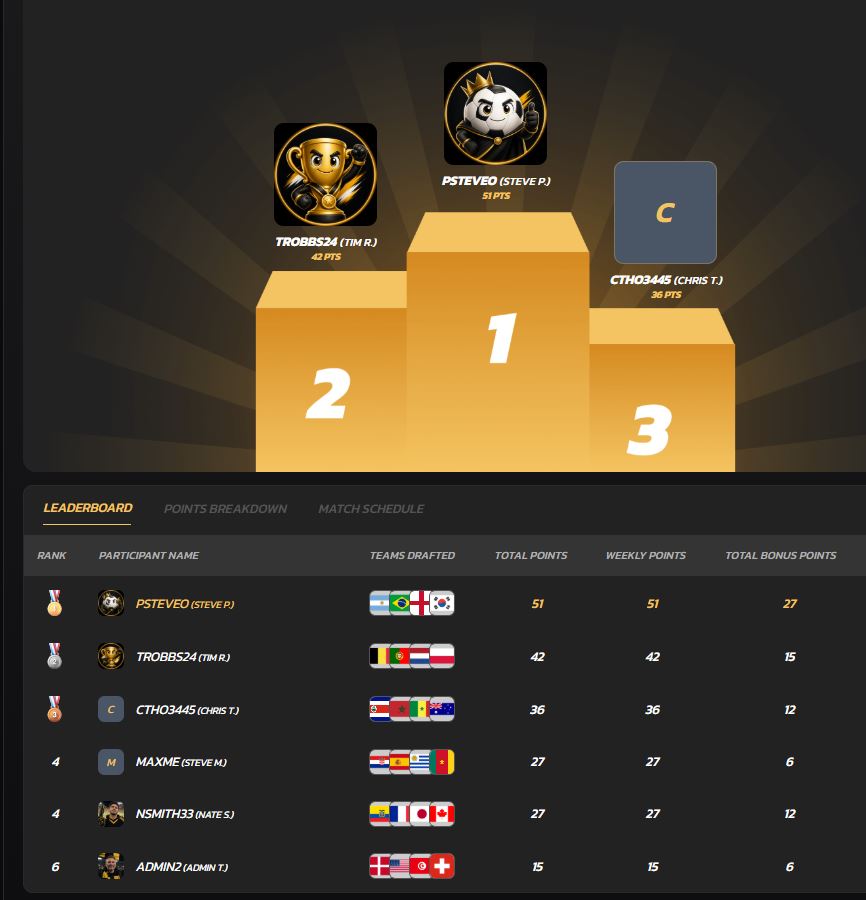
Draftwins launches with World Cup pools, followed by NFL and College Football pools. If your group wants a no-spreadsheet sports pool that runs without manual tracking or stat management, Draftwins is the direct answer. Visit Draftwins to create your private pool, invite your group, and start picking teams today.
Key Takeaways
A team pick contest with no stats tracking is the fastest, most accessible way for casual fans to compete together without the burden of player-level data management.
| Point | Details |
|---|---|
| Define scoring before launch | Publish one clear scoring rule and a tie-breaker before the first pick deadline. |
| Draft teams, not players | Team-based picks remove injury risk and lower the knowledge barrier for all participants. |
| Lock entries before games start | Fixed deadlines prevent late picks and protect contest fairness for every participant. |
| Publish standings after each round | Visible leaderboards drive return engagement and keep social energy high. |
| Use a platform to cut admin work | Automated scoring and live leaderboards eliminate manual tracking entirely. |
FAQ
What is a team pick contest with no stats tracking?
A team pick contest with no stats tracking is a group competition where participants pick whole teams to win matchups, and scoring is based solely on correct team outcomes. No individual player statistics are collected or required.
How do you score a no-stats team pick contest?
The standard method awards one point per correct team pick per round. A tie-breaker rule, such as predicting the total score in the final game, resolves ties at the end of the contest.
Can casual fans run a team pick contest without a platform?
Yes, a shared spreadsheet or group chat works for small groups. A dedicated platform like Draftwins automates entry collection, scoring, and leaderboard updates, which removes the manual work entirely.
Why is a team pick contest better than a traditional fantasy league for casual fans?
Team pick contests require only a few minutes of participation per round and need no knowledge of individual player statistics. Traditional fantasy leagues demand weekly lineup decisions, injury tracking, and trade management, which is a much larger time commitment.
How do you keep participants engaged in a no-stats contest?
Visible picks and group chat significantly increase return engagement in social contests. Post updated standings after every round and celebrate correct picks publicly to keep the group active through the final game.