
A team pick game is a contest where you select teams or predict team outcomes in real sporting events to earn points or win prizes based on how accurate your choices are. This format covers everything from picking a game winner to predicting spreads, totals, and futures. Platforms like PrizePicks and Underdog Sports have made team pick games widely accessible across the NFL, NBA, NHL, MLB, college sports, and soccer. The core appeal is simple: you use your sports knowledge to back teams, and the results play out on the field. No lineup management, no injury tracking, just picks.
How does a team pick game work?
The team pick game explained in its simplest form: you choose a team or outcome, set your entry amount, and wait for the game to decide if you win. The mechanics vary slightly by platform, but the user flow is consistent across the two biggest names in the space.
On PrizePicks, the process starts with selecting a sport and a matchup. You then choose your pick type. PrizePicks team picks cover game winners, over/unders, spreads, and futures like MVP or league champion. Before you can place any picks, the platform requires identity verification and account funding via Visa debit, MasterCard debit, or online banking. That verification step is a legal requirement tied to the platform's operating licenses, not just a formality.

On Underdog Sports, the process is even more direct. You pick a team, select your entry amount anywhere from $1 to $2,000, and submit. The three-step pick process on Underdog is designed for speed and simplicity. There are no complex parlay structures to navigate unless you choose to build one.
What happens after you submit your picks?
Once picks are locked, the game plays out and results are applied automatically. PrizePicks pays winners right after the event ends. You can also opt for an early payout option if market liquidity allows, which means you can cash out before the final result if the market supports it. That feature adds a layer of flexibility that fixed-odds formats do not offer.
Pro Tip: On PrizePicks, the early payout option is only available when there is enough market activity on the other side of your pick. Check the contract price before deciding to sell early, since low liquidity means a worse payout.
What are the common rules in team selection games?
Team selection game rules exist to keep contests fair and prevent any single player from gaining an unfair advantage by concentrating picks on one dominant team or country. These rules apply whether you are playing on a major platform or running a casual pool with friends.
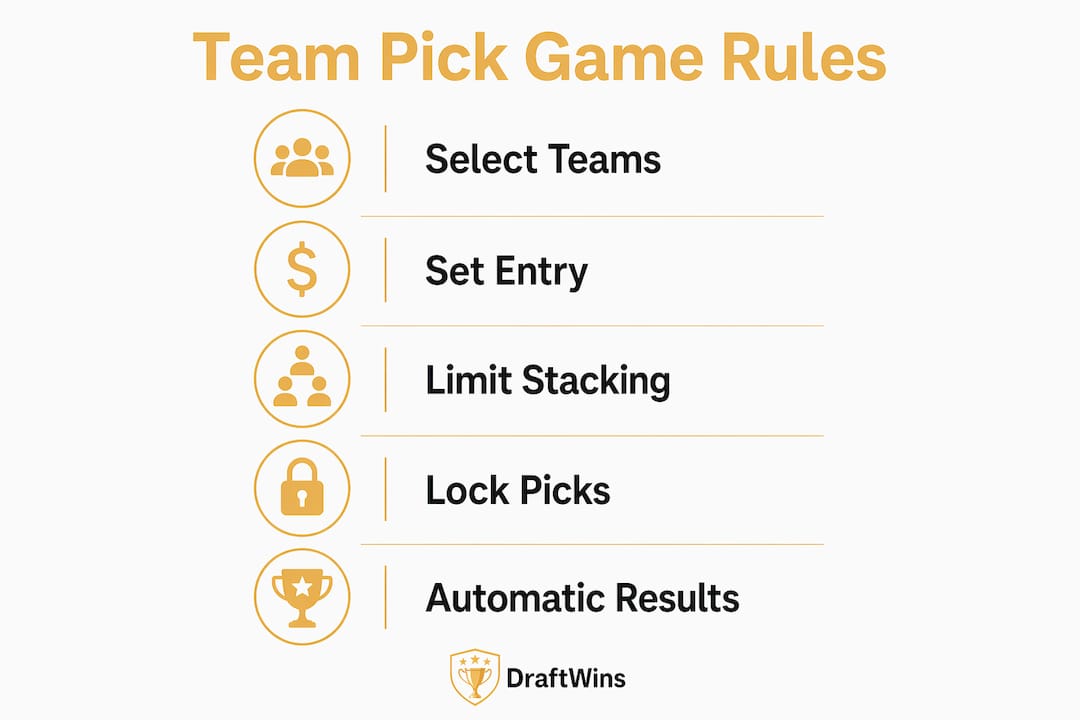
The most concrete example comes from organized fantasy competitions. The IIHF 2026 World Men's Championship fantasy rules cap players at a maximum of 3 selections from the same country or real-world team per GameDay. That rule prevents stacking, which is the practice of loading up on players from one strong team to exploit a favorable matchup. Most well-designed team pick formats include a similar constraint.
Here are the most common rules you will encounter across team pick formats:
- Pick timing windows: Picks open and close at set times. On PrizePicks, contract timing is clearly defined, and picks placed after the window closes are not accepted.
- Team stacking limits: Most platforms cap how many picks from the same team you can include in a single entry.
- Pick type distinctions: Team picks (game outcomes) and culture picks (entertainment or non-sport events) are separate categories on PrizePicks and follow different rules.
- Service fees: Every contract carries a fee applied at purchase and deducted at payout.
- Minimum and maximum entries: Entry amounts are bounded, with Underdog Sports running a $1–$2,000 range per entry.
For casual group games without a platform, fairness comes from a different source. Random assignment tools like team pick generators use algorithms to distribute teams without bias. Combining randomization with transparent scoring rules is the standard practice for keeping informal contests fun and argument-free.
| Rule Type | Purpose | Example |
|---|---|---|
| Stacking limit | Prevents overloading on one team | Max 3 from same team (IIHF 2026) |
| Pick timing window | Ensures picks are placed before games start | Contracts close at tip-off or kickoff |
| Service fee | Platform revenue and contract cost | $0.005–$0.02 per contract |
| Entry range | Controls risk and accessibility | $1–$2,000 per entry (Underdog) |
How do pricing and payout models work?
Pricing in team pick games is not fixed. On PrizePicks, the contract price fluctuates between $0.00 and $1.00 based on how many players are picking each side. The more popular a pick, the higher its price and the lower its payout multiplier. The less popular a pick, the cheaper the contract and the higher the potential return.
This "crowd sets the price" model makes team pick games more strategic than standard fixed-odds formats. You are not just predicting the outcome. You are also reading the market. A pick on a heavy favorite might cost $0.85 per contract, meaning your upside is limited. A pick on an underdog might cost $0.20, with a much larger payout if you are right.
Service fees add a small cost to every transaction. Fees per contract range from $0.005 to $0.02, applied when you buy and deducted when you sell or receive a payout. On small entries, this is negligible. On large entries with many contracts, it adds up and should factor into your expected return.
| Platform | Pricing Model | Entry Range | Payout Timing |
|---|---|---|---|
| PrizePicks | Crowd-driven, fluctuating | Varies by contract price | Instant after event or early payout |
| Underdog Sports | Fixed entry, team-based | $1–$2,000 | After event completion |
| Casual group games | Points-based or prize pool | Set by commissioner | End of tournament or season |
Pro Tip: On PrizePicks, check the contract price before you commit. A pick priced at $0.10 means 90% of the market is on the other side. That could mean the crowd is right, or it could mean you have found real value. Your sports knowledge is the edge.
What strategies help you win at team pick games?
A solid team pick strategy guide starts with one principle: do not just pick favorites. The crowd sets the price on PrizePicks, which means the most popular picks already have their value baked in. Winning consistently requires finding spots where your read on a game differs from the majority.
Here are the most effective approaches:
- Target less popular picks with strong reasoning. If a team is undervalued by the crowd but you know their recent form, home record, or matchup advantage, the lower contract price gives you better upside.
- Avoid stacking from one team. Beyond the rule limits, concentrating all your picks on one team creates single-point-of-failure risk. If that team underperforms, your entire entry collapses.
- Mix pick types. Combining game winners with totals or spreads in a single entry spreads your exposure. A team can lose a game but still cover a spread or hit an over.
- Use randomizers for casual group drafts. For informal pools, random team assignment tools eliminate bias and keep the group focused on fun rather than arguing over fairness.
- Track timing windows carefully. Picks placed close to game time often reflect the most current information, including injury news and lineup changes. Late picks on PrizePicks can be more accurate picks.
Understanding team drafting mechanics also helps you think about team pick games differently from traditional fantasy. You are not managing a roster week to week. You are making discrete predictions with defined outcomes. That simplicity is the format's biggest strength for casual players.
The best practice for casual groups is to combine randomization with clear scoring rules before the contest starts. Agreeing on how points are awarded, what tiebreakers apply, and when picks lock prevents disputes and keeps the game enjoyable from start to finish. For more structured formats, fantasy football alternative drafts offer a useful framework for setting up fair team-based contests without the complexity of traditional leagues.
Pro Tip: If you are new to team pick games, start with game winner picks before moving to spreads or totals. Winners are binary and easy to evaluate. Once you understand how contract prices move, spreads and totals become much more interesting.
Key takeaways
Team pick games reward sports knowledge and market awareness in equal measure, making them more strategic than they first appear.
| Point | Details |
|---|---|
| Core mechanics | You select teams or outcomes, set an entry amount, and win based on correct predictions. |
| Crowd-driven pricing | On PrizePicks, less popular picks cost less and pay more, rewarding independent thinking. |
| Rules prevent stacking | Most formats cap picks from the same team to keep contests fair and competitive. |
| Fees affect returns | Service fees of $0.005–$0.02 per contract apply on PrizePicks and should factor into your entry math. |
| Strategy beats luck | Targeting undervalued picks, mixing pick types, and respecting timing windows improves your results over time. |
Try team pick games without the complexity on Draftwins
If the pricing models and verification steps on major platforms feel like too much for a casual game with friends, Draftwins is built for exactly that situation. Draftwins lets your group draft teams instead of individual players, removing the lineup stress and injury tracking that makes traditional fantasy leagues exhausting.
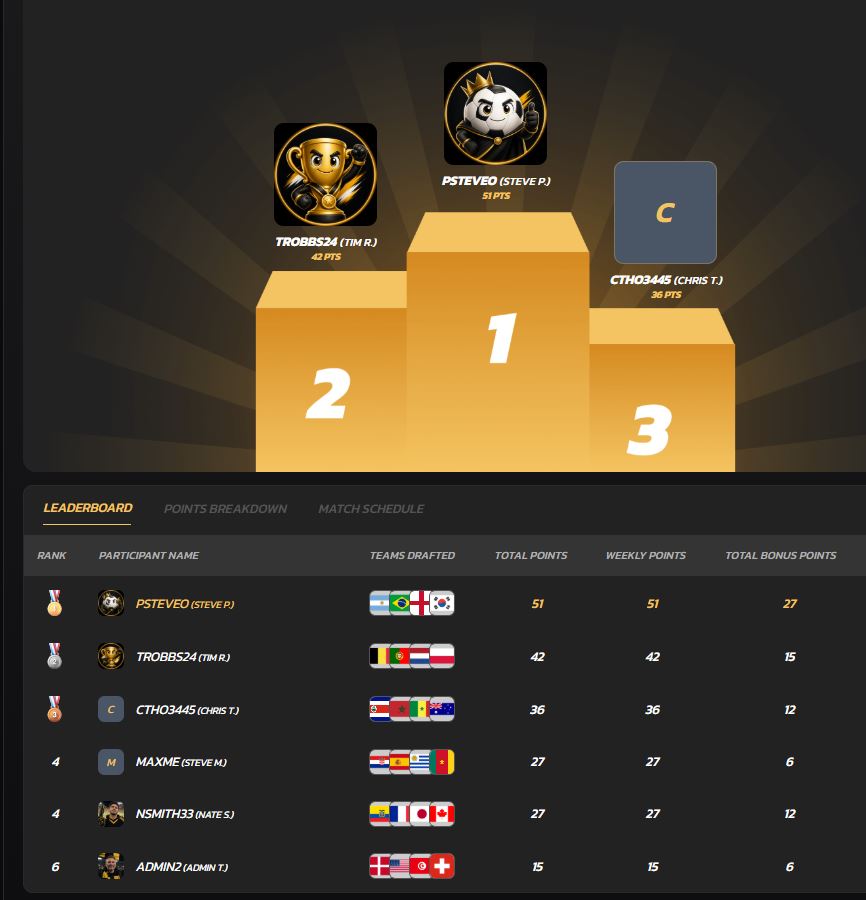
Draftwins automates scoring and runs live leaderboards so you always know where you stand. Commissioners can create private pools with custom rules, making it easy to run a World Cup pool, an NFL contest, or a College Football competition with your own group. There are no entry fees collected or prize pools held by the platform. You just set up the contest, draft your teams, and let the games decide the winner. Start your pool on Draftwins and see how much easier team-based competition can be.
FAQ
What is a team pick game?
A team pick game is a contest where you select teams or predict team outcomes in real sporting events to earn points or prizes. Popular formats include picking game winners, spreads, totals, and futures on platforms like PrizePicks and Underdog Sports.
How do you make picks on PrizePicks?
You select a sport, choose a matchup, pick your outcome type, and fund your entry. PrizePicks requires identity verification and account funding via Visa debit, MasterCard debit, or online banking before picks are accepted.
Why do less popular picks pay more on PrizePicks?
PrizePicks uses a crowd-driven pricing model where contract prices fluctuate based on how many players pick each side. Less popular picks have lower contract prices, which means a higher payout multiplier if they win.
What rules prevent unfair stacking in team pick games?
Most team pick formats limit how many selections you can make from the same team. The IIHF 2026 World Men's Championship fantasy rules, for example, cap players at 3 selections from the same team per GameDay to maintain competitive balance.
Can you play team pick games casually without a betting platform?
Yes. Casual group games use points-based scoring and random team assignment tools to run fair contests without any wagering. Combining a randomizer with agreed-upon scoring rules is the standard approach for informal group play.