For private team-draft pools, the fastest path to a smooth contest is matching your participant count to a "clean division" of the sport's total teams, then setting teams-per-person so your live draft wraps in 90 minutes or less.
Three templates cover most groups:
- Small social pool (4–10 people): 2–4 teams per person, live draft in 60–90 minutes
- Office pool (10–16 people, 12 is the sweet spot): 2–3 teams per person, live draft in 90–120 minutes
- Large group (20+ people): 1–2 teams per person, automated platform draft required
For a 48-team tournament like the World Cup, clean participant counts are 4, 6, 8, 12, 16, and 24 because they divide evenly with zero leftover teams. Pick one of those numbers, lock your cap today, and set a one-week RSVP deadline before you do anything else.
Key Takeaways
The single most important decision in pool size planning is matching your participant count to your sport's team total and keeping your draft under 90–120 minutes for live groups.
| Point | Details |
|---|---|
| Use clean division counts | For 48-team tournaments, participant counts of 4, 6, 8, 12, 16, or 24 leave zero leftover teams. |
| 12 is the standard sweet spot | Footballguys' commissioner guide identifies 12 as the most balanced size for fantasy-style pools. |
| Automate above 16–20 participants | Manual drafts above 20 people cause drop-off; use automated pick windows of 24–72 hours. |
| Publish rules before the draft | Require written acknowledgment of all rules, including tie-breakers and default-pick policy. |
| Draftwins for private team-draft pools | Commissioners pay a one-time hosting fee; participants join free and Draftwins handles automated scoring and live leaderboards. |
Table of Contents
- How should you decide on participant count and total teams?
- What draft format and size keep your pool moving?
- How does pool format change the ideal number of participants?
- When should you schedule the draft and what's the right timeline?
- What rules must every commissioner set before the draft?
- How should entry fees and prizes be handled?
- Draftwins makes running your pool straightforward
- Sources
- FAQ
How should you decide on participant count and total teams?
Start with constraints, not preferences. How long can your group realistically sit for a draft? Is it live or asynchronous? Those two answers narrow your options faster than any formula.
The core math is simple: teams per person = total teams ÷ participants. An 8-person pool with 32 available teams gives each person 4 teams. A 12-person pool with the same 32 teams gives each person roughly 2.67, which means you'll have leftovers to handle.
According to Footballguys' commissioner guide, 12 is the standard size for balance in fantasy-style pools, 8 and 10 work well for smaller groups, and anything above 16 introduces draft and engagement challenges that usually require automation or splitting into conferences. That guidance translates directly to team-draft pools.
When your participant count doesn't divide cleanly into the team total, you have three options: redistribute leftover teams randomly, run a short auction for them, or allow capped multi-entries (one extra team per person until leftovers are gone). Plan for leftovers explicitly rather than deciding on draft night.
Capacity planning research recommends running at 85–90% of your theoretical maximum to absorb drop-outs and last-minute changes. For a pool with a 12-person cap, that means confirming 10–11 committed participants before you finalize the draft order.
Pro Tip: Set a hard participant cap in writing and a one-week RSVP window. Late additions after the draft order is set create resentment and logistical headaches that no rule patch fully fixes.
What draft format and size keep your pool moving?
Draft size (teams per participant) and draft order format are the two levers that control how long your draft takes and how fair it feels.
Teams per participant typically runs 1–4 in team-draft pools. One team per person is fastest and works well for large groups or casual contests where simplicity matters most. Two to three teams per person adds strategy without bloating draft time. Four teams per person is best reserved for small groups of 6 or fewer who want deeper engagement.
On draft order, snake and fixed each have a clear use case:
- Snake draft (order reverses each round) is the default for competitive groups. It self-corrects for pick-position advantage over multiple rounds and feels fair to most participants.
- Fixed order (same order every round) is simpler to explain to casual groups and works fine when teams per person is low (1–2), since pick-position advantage matters less with fewer rounds.
For live draft timing, budget roughly 45–60 seconds per pick for engaged groups, and 90 seconds for casual ones. A 12-person pool with 2 teams each runs 24 total picks. At 60 seconds a pick, that's 24 minutes of actual pick time plus setup and discussion, landing comfortably under 90 minutes total.
- Small pool (4–8 people, 3–4 teams each): 60–90 minutes live
- Office pool (10–16 people, 2–3 teams each): 90–120 minutes live
- Large group (20+ people): switch to an automated platform draft with 24–72 hour pick windows
Pro Tip: For groups above 20, a manual chat-based draft is the single biggest cause of early-season drop-off. Automated platform drafts preserve momentum by handling default picks automatically when someone misses their window, so the draft finishes on schedule regardless of who's paying attention.
How does pool format change the ideal number of participants?
Format is the first decision, and participant count follows from it. Choosing the wrong size for your format is how pools lose engagement by Week 3.
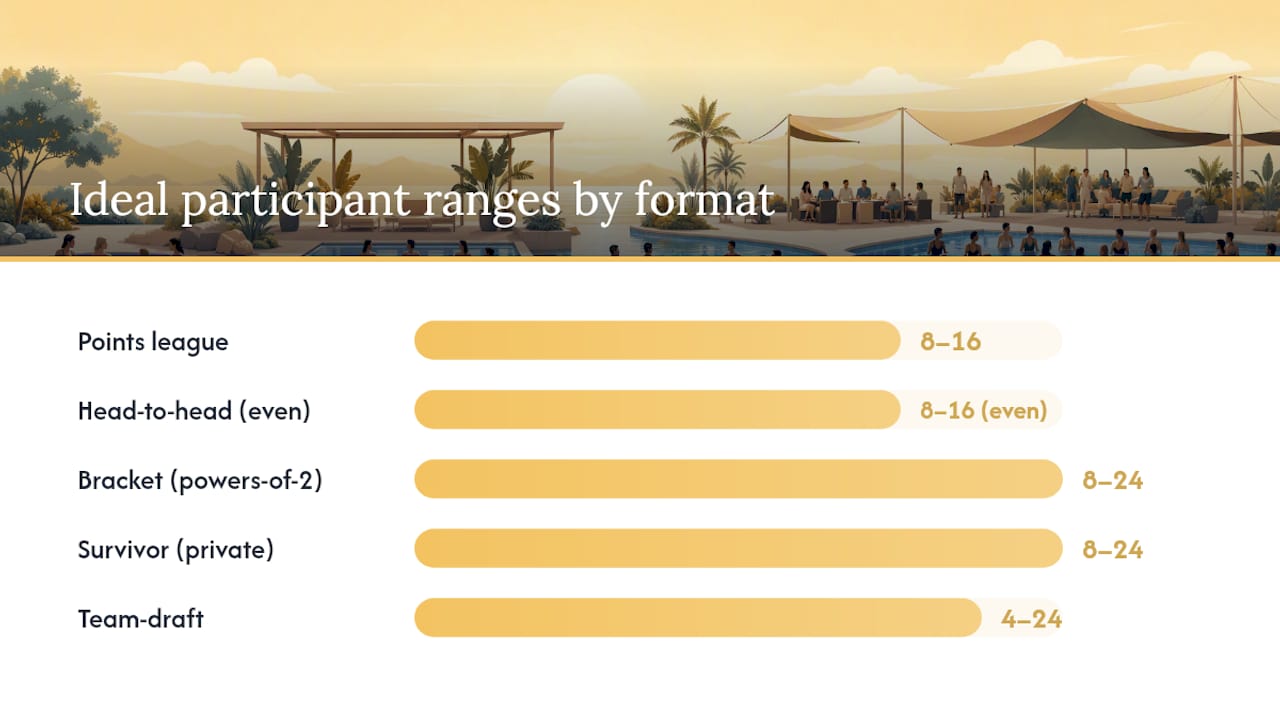
Here's how common formats map to participant ranges:
| Format | Ideal participant range | Key constraint |
|---|---|---|
| Points league | 8–16 | Scoring depth; too many participants dilutes standings drama |
| Head-to-head | 8–16 (even number required) | Needs balanced schedule; odd numbers create byes |
| Bracket | 8–24 (powers of 2 preferred) | Bracket integrity; 16 and 32 are cleanest |
| Survivor | 8–24 (private groups) | Elimination pace; too few and it ends too fast |
| Team-draft | 4–24 | Platform automation needed above 16 |
Team-draft formats reduce lineup-management stress compared to player-level fantasy because participants track team performance, not individual player injuries. That simplicity makes them easier to scale and more accessible to casual participants who'd bounce from a traditional fantasy league.
For head-to-head pools, an even participant count isn't optional. An odd number forces a bye each week, which participants almost universally dislike. If someone drops out mid-season, have a plan: a ghost team (average score) or a forfeiture rule.
Format-specific sizing guidance consistently points to the same principle: pick the format first, then choose a participant cap that preserves competitive balance and keeps your draft under your target time.
When should you schedule the draft and what's the right timeline?
Work backward from your sport's kickoff date. Four weeks is the minimum runway for a well-run pool.
- 4 weeks before kickoff: Open signups, publish the participant cap, and share the rules document for acknowledgment.
- 2–3 weeks before: Confirm RSVPs, collect entry fees if applicable, and finalize draft order.
- 1 week before: Send draft reminders, confirm the platform or draft tool, and set default-pick rules in writing.
- Draft week: Hold the draft, publish rosters publicly, and confirm automated scoring is active.
- Weekly during the season: Send automated standings updates and mid-week reminders for any required picks.
For draft window expectations by pool size:
- Small pool (4–8 people): 60–90 minutes, live preferred
- Office pool (10–16 people): 90–150 minutes, live or slow-draft with 12–24 hour pick windows
- Large group (20+ people): automated 24–72 hour pick windows, no live draft
Confirm default-pick policy before the draft, not during it. If a participant misses their window, does the system auto-pick the highest-ranked available team, or does the pick pass? Both are valid, but the rule must be written down and acknowledged in advance.
What rules must every commissioner set before the draft?
Disputes almost always trace back to a rule that was never written down. Cover these before anyone picks a team:
- Entry cap and max entries per person (one entry is standard; multi-entry rules need explicit caps)
- Draft order method (random draw, reverse standings, commissioner-assigned)
- Pick timer and default-pick policy (what happens on a missed pick)
- Tie-breaker rules (total points scored, head-to-head record, then coin flip if needed)
- Trade approval process (commissioner approval, league vote, or no trades)
- Substitution and inactive-team policy (what happens if a team withdraws from the tournament)
- Mid-season dropout policy (roster transfer to a new participant vs. forfeiture)
- Final dispute resolution (commissioner decision is final, or majority vote)
Sample tie-breaker language: "In the event of a tied final score, the participant with the higher total cumulative points across all weeks wins. If still tied, the participant who drafted first in round one wins."
Publishing rules and requiring acknowledgment before the draft is the single most effective way to prevent disputes. Keep a time-stamped record of all picks and any rule changes made after the draft.
Pro Tip: Screenshot or export your draft results immediately after the draft ends. A public, time-stamped record of every pick is your best protection against "I never picked that team" arguments weeks later.
How should entry fees and prizes be handled?
Common prize splits by pool size:
- Small pools (4–8 people): Winner-takes-all is simple and creates a clear incentive.
- Medium pools (10–16 people): Tiered splits work best. A 60/30/10 split (first, second, third) keeps more participants invested deep into the season.
- Large pools (20+ people): Fixed-percentage payouts or a parimutuel approach where the pot scales with entries.
Collect fees upfront, before the draft. Venmo and PayPal are the standard methods for friend and office pools. Require payment confirmation publicly (a shared spreadsheet or group chat receipt) so there's no ambiguity about who has paid.
Transparency checklist before draft day:
- Publish the total pot size once all fees are collected
- Document the prize split formula in the rules
- Record all payouts with receipts after the season
Draftwins charges a hosting/platform fee paid by the commissioner. Participants join free, and Draftwins does not collect, hold, or distribute entry fees or prize money. That separation keeps the platform fee clean and transparent, separate from whatever prize arrangement your group decides on.
A brief legal note: check your state's rules on money pools before collecting entry fees. Most casual office pools fall outside regulated gambling definitions, but rules vary by jurisdiction.
Draftwins makes running your pool straightforward
Running a pool above 12 people without platform support means you're manually tracking picks, updating standings in a spreadsheet, and chasing people for scores. That's where most pools quietly fall apart.
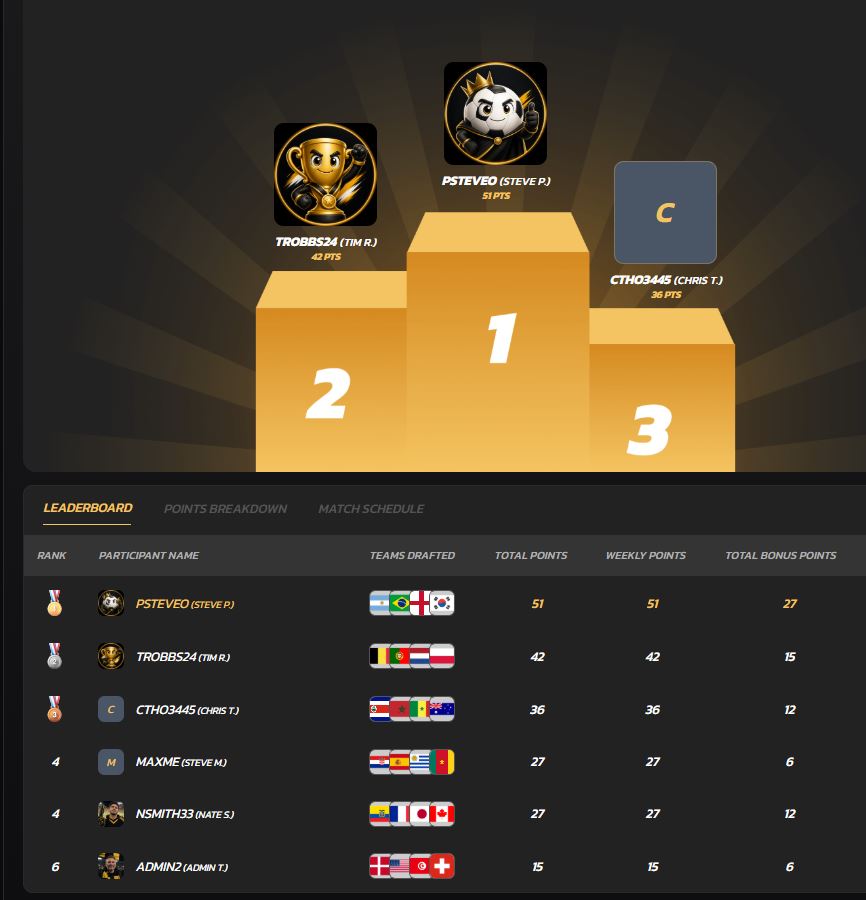
Draftwins is built specifically for private team-draft pools. Commissioners set a participant cap, configure custom scoring rules, and let the platform handle automated drafts, default picks, and live leaderboards. Participants join free; the commissioner pays a one-time hosting fee. Draftwins does not touch entry fees or prize payouts, so your group's money stays exactly where you put it.
Whether you're running a 6-person World Cup pool with friends or a 20-person office NFL pool, create your pool on Draftwins and pick the template that matches your group size to get started today.
Sources
- Myteamkickoff
- How Many Teams Can You Actually Run? – Signature Locker
- Commissioner Guide, Part 3: League Size - Footballguys
FAQ
What is the ideal number of participants for a private sports pool?
For most groups, 8–16 participants hits the best balance of competition and simplicity, with 12 being the most common standard. Pools above 16 typically need platform automation to stay manageable.
How many teams should each participant draft?
Two to three teams per person works for most pools. One team per person suits large or casual groups; four teams per person fits small, competitive groups of 6 or fewer.
What's the difference between snake and fixed draft order?
Snake draft reverses pick order each round, which self-corrects for position advantage and suits competitive groups. Fixed order repeats the same sequence every round and is simpler for casual pools with few rounds.
How does Draftwins handle entry fees and prize payouts?
Draftwins charges commissioners a one-time hosting fee and does not collect, hold, or distribute participant entry fees or prize money. Groups handle their own fee collection and payouts separately.
What should I do if my participant count doesn't divide evenly into the team total?
Plan for leftovers before draft night: redistribute extra teams randomly, run a short auction, or allow capped multi-entries (one extra team per person) until all teams are assigned.