
Yes, a private office pool is legal under U.S. law when it follows three rules: nobody running it takes a cut, the group is closed to coworkers or friends rather than the public, and any platform involved charges a flat hosting fee instead of collecting entry money or holding a prize pool. A provider operating on this model follows these conditions. Stray from those three conditions and you shift from a friendly contest into territory regulators actually watch.
TL;DR:
- A private office pool is legal if organizers do not profit, the group is closed to friends or coworkers, and the platform charges a flat fee instead of taking entry fees.
- Avoid collecting money across state lines, involving employer resources, or advertising publicly to stay within legal boundaries.
- Fix prizes before the draft and prefer non-cash or modest rewards to reduce regulatory scrutiny and maintain compliance.
- Recordkeeping, clear rules, and promoting participant age and social connection are crucial to defend the pool’s legality and handle disputes.
- Office pool winnings are taxable, with amounts over $600 potentially requiring a 1099, and participation is typically restricted to those aged 18 or older.
Table of Contents
- Is an Office Pool Legal? The Federal and State Rules
- How to Set Up a Private, Non-Wager Office Pool
- What Makes an Office Pool Illegal? Red Flags to Avoid
- Commissioner Checklist for Launching a Compliant Pool
- Do You Have to Pay Taxes on Office Pool Winnings?
- Sports Pool vs. Sweepstakes: What's the Legal Difference?
- Can You Get in Legal Trouble for Running an Office Pool?
- How Are Disputes Between Office Pool Participants Resolved?
- Who Can Legally Join an Office Pool?
- Setting Up a Compliant Pool on Draftwins
- Sources
- FAQ
Is an Office Pool Legal? The Federal and State Rules
Gambling law generally rests on three elements: consideration (an entry fee), chance, and a prize. Remove any one of those and most statutes stop applying. That's why a free contest with a fixed prize looks completely different, legally, than a pool where entrants pay in and the organizer skims a percentage off the top.
Every state carves out some version of a "social gambling" exception, and the details vary, but the recurring conditions are consistent: the organizer can't profit, the players need some real social connection (coworkers, friends, family), and there's no advertising to strangers. Attorney-general opinions across multiple states use a similar test, weighing whether the contest rewards skill or pure chance, whether the prize is fixed in advance, and whether the sponsor stays neutral.
Two federal statutes matter here even though they were written long before fantasy drafts and web platforms existed:
- The Interstate Wire Act (18 U.S.C. §1084) targets betting information transmitted across state lines, and it can get implicated even in a non-wager contest if money or wagering communications cross state borders, as Ogletree's analysis of office pools points out.
- 18 U.S.C. §1955, the Illegal Gambling Business Act, targets larger, profit-driven operations, generally ones involving five or more people and substantial revenue, not a 12-person bracket pool in a break room.
State variation is the part most commissioners underestimate. A 2025 American Gaming Association review found that many states restrict pool betting outright unless a specific exception applies, and no two states define "social" the same way. If your pool involves real money changing hands and spans multiple states, a quick conversation with an employment attorney costs far less than guessing wrong.
How to Set Up a Private, Non-Wager Office Pool
Legal theory only helps if it translates into settings you actually configure before draft day. Here's the structure that keeps a pool on the right side of every state's social-gambling exception.
- Lock the guest list. Use invite-only access, single-use invite links, or password protection so the pool stays limited to a defined group of coworkers or friends. Some platforms support password-protected setups built for exactly this.
- Keep money off the platform. Don't route pooled entry funds through the tool you're using to run the draft. If a platform is involved, it should charge you, the commissioner, one flat hosting fee rather than taking a percentage of anything players contribute.
- Fix the prize before anyone joins. A prize that's set in advance and doesn't scale with the number of entrants looks like a sponsored contest, not a wager. Courts have upheld this distinction directly, most notably in State v. American Holiday Ass'n, where a fixed prize from a neutral sponsor was found not to constitute illegal gambling despite an entrance fee.
- Favor non-cash or modest prizes. A $50 gift card draws far less scrutiny than a $5,000 cash pot, and legal analysts note that structuring a contest as a free-to-enter sweepstakes sidesteps most gambling concerns entirely.
- Keep it small and quiet. Don't advertise the pool publicly, don't recruit outside your existing social or work circle, and lock rosters once the draft closes.
Pro Tip: Save a simple written policy, even one paragraph, stating that you don't profit from the pool and explaining where any prize money actually comes from. If anyone ever asks questions, that document does the talking for you.
What Makes an Office Pool Illegal? Red Flags to Avoid
Most pools that get shut down or flagged didn't start out looking like gambling operations. They drifted there through a handful of specific decisions. Watch for these:
- Taking a rake. The single biggest red flag is an organizer collecting entry fees and keeping a percentage for themselves. A flat hosting fee paid to a platform, separate from any prize money, avoids this problem because the fee doesn't move with pool size or payouts, as the AGA's pools legality analysis notes.
- Collecting money across state lines. Venmo or PayPal requests sent to remote coworkers or out-of-state friends increase Wire Act exposure. Keep participation, and any money that changes hands, inside a single state where possible.
- Employer entanglement. If a company's resources, systems, or management pressure get wrapped into the pool, HR risk climbs fast, regardless of the gambling analysis. Ogletree's guidance recommends employers set clear internal policies barring company funds and cross-state solicitation.
- Payment-processor flags. Anti-gambling terms of service and the Unlawful Internet Gambling Enforcement Act can trigger account freezes even when the underlying pool is legally low-risk, according to LegalClarity's review of football pool law.
If any of these creep in, the fix is usually simple: stop collecting money directly, shift to non-cash prizes, or pause and check with HR or counsel before the next round.
Commissioner Checklist for Launching a Compliant Pool
Run through this before you send a single invite.
- Confirm your state's social-gambling exception and check your employer's policy on workplace contests.
- Set the pool to private and require an invite or password to join.
- If using a platform, confirm it charges you a flat hosting fee, not a cut of entries.
- Decide the prize source and amount before anyone signs up.
- Lock the roster and draft once the pool fills.
- Avoid recruiting participants outside your existing state or social circle.
- Keep records of who joined and how the prize was funded.
- Distribute the prize exactly as stated, then share results with participants only.
| Stage | Key action | Why it matters |
|---|---|---|
| Pre-launch | Check state and employer rules | Confirms the social-gambling exception applies |
| Setup | Password-protect and cap the invite list | Keeps the group closed and defensible |
| During | Avoid cross-state money collection | Limits Wire Act exposure |
| Post-event | Keep brief records, share results privately | Documents neutrality if ever questioned |
Do You Have to Pay Taxes on Office Pool Winnings?
Yes. The IRS treats gambling and contest winnings as taxable income regardless of the amount or how casual the pool feels. A $40 pot split among coworkers is technically reportable income for whoever wins it, even though almost nobody files paperwork for amounts that small.
The practical trigger point comes from payers, not players. If a single win reaches $600 or more, the entity issuing the prize may need to issue a Form 1099-MISC. Cash prizes funded and distributed by an individual commissioner rarely hit that reporting threshold, but larger office-wide pools with bigger pots can. Because Draftwins never holds or distributes prize money, that reporting responsibility sits entirely with the commissioner and the people funding the prize, not with the platform.
Winners are legally required to report gambling winnings as "other income" on their tax return whether or not anyone sends a 1099. Losses aren't deductible unless you're itemizing and can document them, which almost never applies to casual office pools. Commissioners should keep a simple record of who won what and where the prize money came from. It's the same documentation habit that helps prove the pool was a fixed-prize contest and not an unlicensed betting operation.
Sports Pool vs. Sweepstakes: What's the Legal Difference?
Not every office contest is judged the same way. Three structures show up constantly, and each carries a different legal profile.
A sports betting pool in the traditional sense involves entry fees, chance, and a prize that scales with how much money comes in. That's the structure most state gambling statutes are actually written to catch, and it's why traditional pay-to-play office pools carry real legal exposure.
A sweepstakes removes the consideration element entirely. Entry is free, and the prize is fixed regardless of how many people join. Courts have consistently upheld this distinction, and State v. American Holiday Ass'n is the case most often cited for it: an entrance fee doesn't automatically make a contest illegal gambling when a neutral sponsor provides a guaranteed prize unrelated to entry volume.
A hosting-fee, team-draft pool, the model Draftwins runs on, sits closer to the sweepstakes end of that spectrum. The platform charges the commissioner a one-time flat fee to set up and run the contest. It never touches entry money, never holds a prize pool, and never pays out winnings. That structural separation is exactly what legal analysts point to when they say intent and structure matter more than the subject matter of the contest itself.
Can You Get in Legal Trouble for Running an Office Pool?
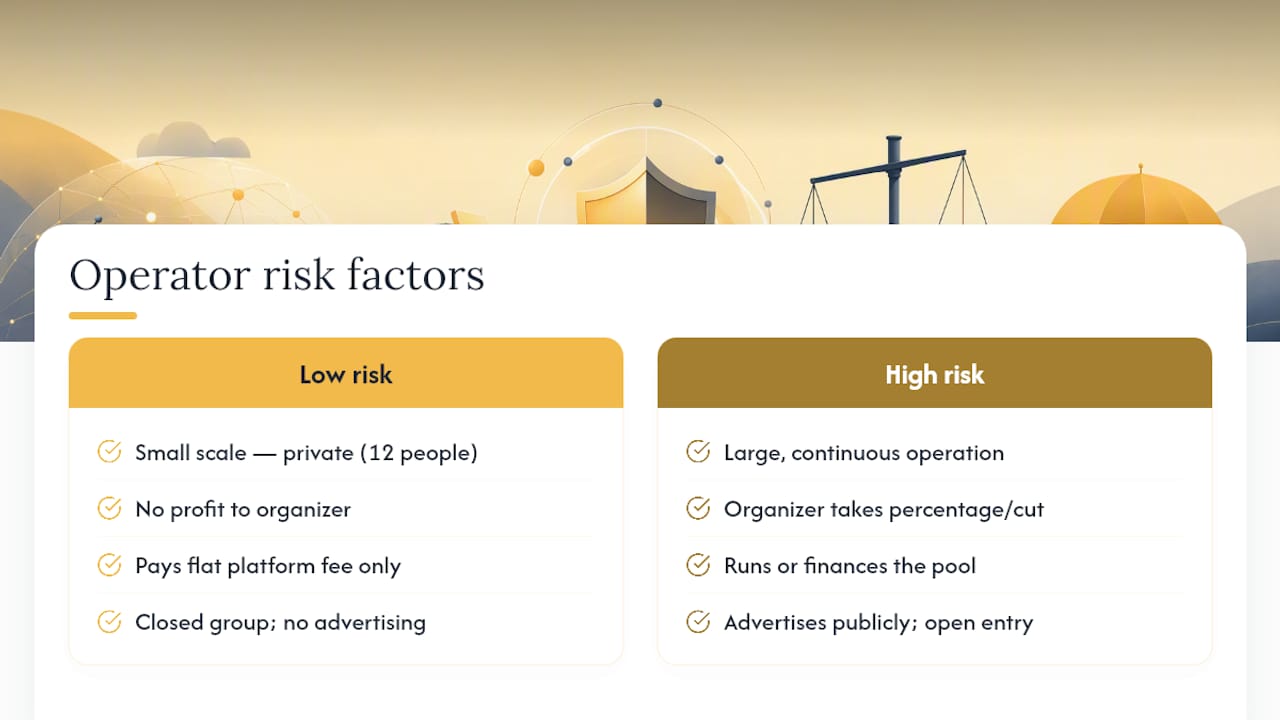
Criminal exposure for office pools exists, but it's concentrated at the operator level, not the casual participant level. Federal law under 18 U.S.C. §1955 targets illegal gambling businesses generally involving five or more people who conduct, finance, manage, or own the operation, with substantial and continuous revenue. A 12-person March Madness bracket in a break room doesn't come close to that threshold.
State-level penalties vary widely. Some states classify small-scale, no-profit social gambling as a low-level misdemeanor that's rarely prosecuted; others treat any organized betting activity, regardless of scale, as a chargeable offense on paper even if enforcement in practice is essentially nonexistent for private, no-rake pools. The AGA's state-by-state analysis is the clearest single reference for seeing how differently states treat this.
The real exposure almost always traces back to one factor: whether the organizer profited. A commissioner who takes a percentage of entry fees, runs a large-scale operation, or advertises publicly starts to resemble a bookmaker in the eyes of a prosecutor. A commissioner who pays a flat fee to a platform, keeps the group closed, and never touches a cut of anyone's money looks like exactly what they are, someone running a private contest among friends. That distinction is why the structural choices in earlier sections aren't just best practices. They're the difference between a hobby and a liability.
How Are Disputes Between Office Pool Participants Resolved?
Office pool disputes almost never end up in court, mostly because the amounts involved rarely justify the cost of litigation. Nearly every disagreement traces back to one of three things: unclear scoring rules, confusion over who actually won a tiebreaker, or disagreement about how a prize should be split.
The fix is prevention, not adjudication. Written rules, agreed to before the draft happens, resolve the overwhelming majority of conflicts before they start. A platform with transparent, automated scoring removes the "he said, she said" element entirely, since results are calculated the same way for everyone and visible in real time on a shared leaderboard.
For the rare dispute that still comes up, most commissioners handle it the same informal way any office disagreement gets handled: the commissioner makes a final call based on the written rules, and that decision stands. Some groups build in a simple appeal step, like a second commissioner or a quick group vote, for genuinely ambiguous situations. What doesn't work is deciding rules after the fact, which is exactly when trust in the pool starts to erode. Locking rules, tiebreakers, and prize splits before anyone drafts a team is the single best dispute-resolution tool available, because it prevents the dispute from having room to exist in the first place.
Who Can Legally Join an Office Pool?
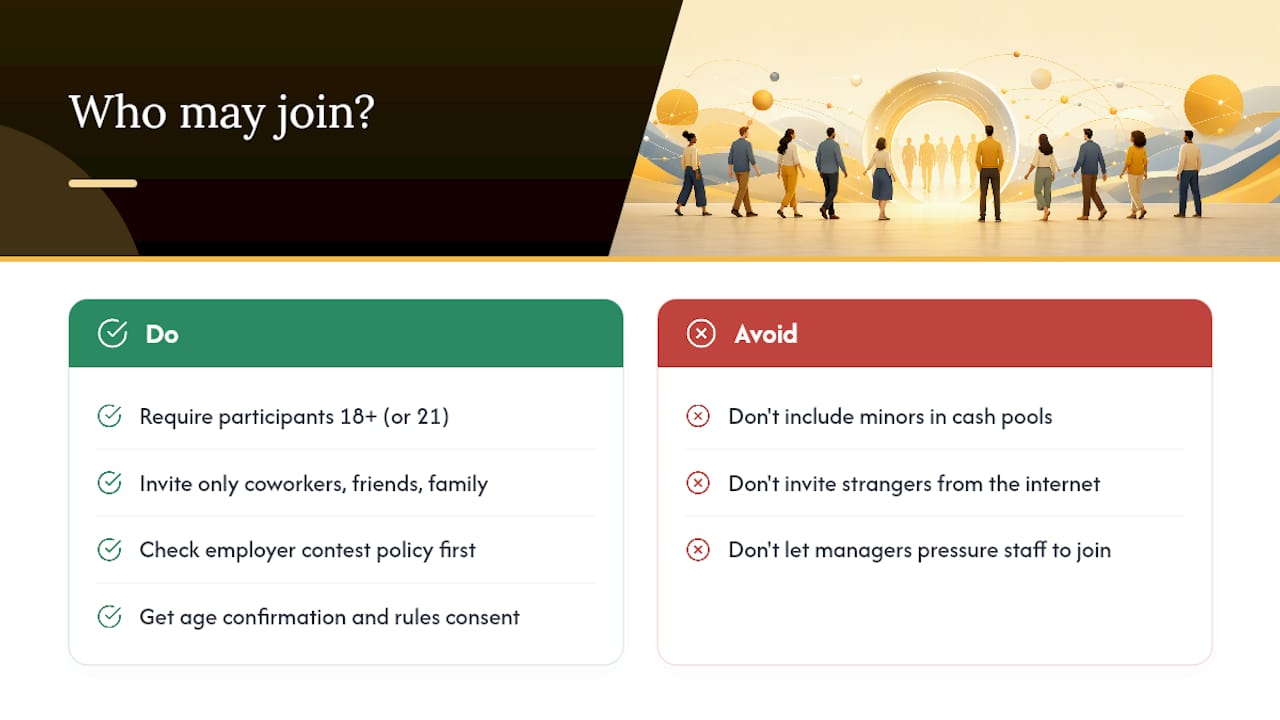
Age matters more than most commissioners assume. Because office pools that involve any money, even modest prizes, fall under the same general framework as other contests involving consideration and chance, most states expect participants to be 18 or older, and a handful set the bar at 21 for anything resembling wagering activity. A commissioner who lets a 16-year-old intern into a cash-prize pool has created a real problem, regardless of how small the stakes are.
Eligibility beyond age is where the "social" requirement in most state exceptions actually does its work. Participants need a genuine connection to the organizer or the group, not a stranger who saw a link online. That's part of why keeping invitations closed to coworkers, friends, or family isn't just good practice, it's often a legal condition for the pool to qualify under a social-gambling exception in the first place.
Company policy adds another layer entirely separate from state law. Some employers bar all workplace contests involving money regardless of legality; others allow them with restrictions, like capping entry amounts or barring managers from organizing pools their direct reports feel pressured to join. Checking that policy before launching a pool takes five minutes and avoids an HR conversation nobody wants to have. Requiring every participant to explicitly confirm their age and acknowledge the rules before joining, something a platform's sign-up flow can enforce automatically, closes most of this gap without any manual policing from the commissioner.
Setting Up a Compliant Pool on Draftwins
Some platforms charge commissioners a single, flat hosting fee to create and run a pool, without collecting entry fees, holding prize pools, accepting wagers, or paying out winnings themselves, which aligns with the structural rules that keep a private pool on the right side of social-gambling exceptions.
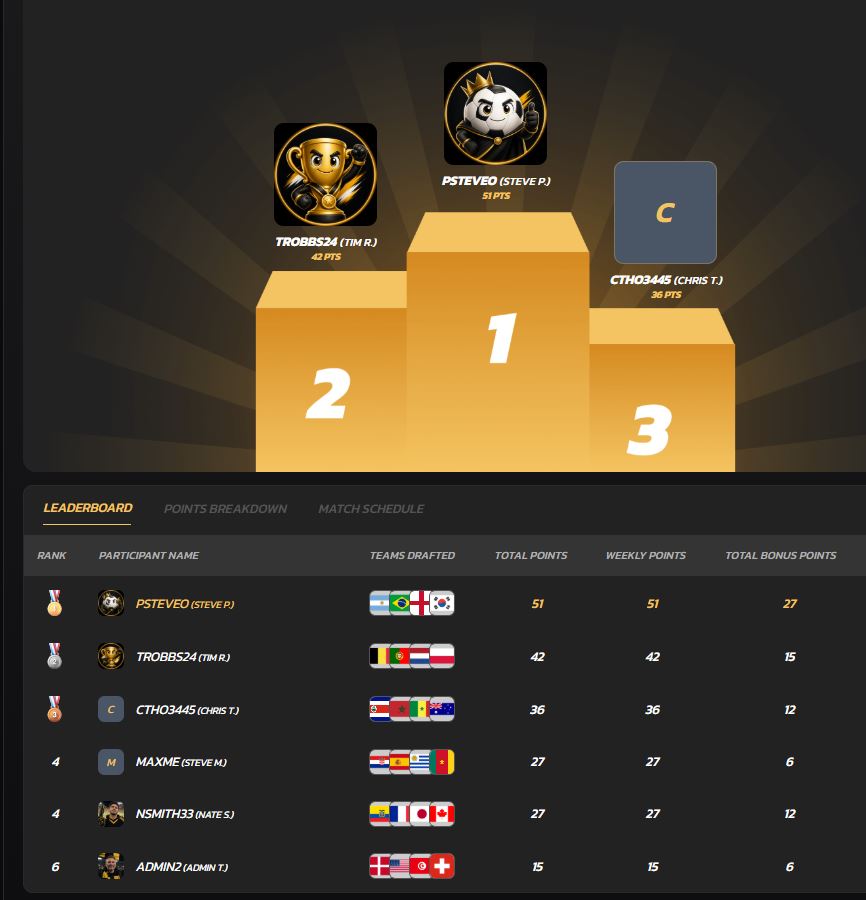
A team's draft format sidesteps a separate headache too: instead of drafting individual players and tracking injuries all season, some commissioners set up private, password-protected pools where groups draft entire teams. Invite-only access, commissioner settings you lock before draft day, automated scoring, and live leaderboards mean disputes over who won rarely come up, because the numbers are transparent to everyone in the group.
Setting one up takes a few configuration decisions: build your invite list first, set the pool to private, define your prize and its source separately from the platform, and lock the draft once your group is full. If you want to see the fee structure before committing, Draftwins pricing lays out the flat hosting cost with no hidden percentage tied to entries. Start by browsing Draftwins pools and building your private, team-draft pool before your next season kicks off.
Sources
For anything beyond a casual, small-stakes pool, read the primary sources rather than relying on secondhand summaries:
- Sports betting in the workplace: ensuring the Super Bowl and March Madness don't cause legal madness and super problems — Offit Kurman
- Super Bowl LIII, legal sports betting in the post-PASPA era: office pools — Ogletree
- Pools legality one-pager — American Gaming Association (AGA)
Check your own state's guidance and talk to counsel before running any pool with significant money involved.
FAQ
Is It Legal to Run an Office Pool for the Super Bowl or March Madness?
Yes, when the group is private, the organizer doesn't profit, and the prize is fixed rather than scaled to the number of entries, most states' social-gambling exceptions apply.
Does Draftwins Collect Entry Fees or Hold Prize Money?
No. Draftwins charges commissioners a single flat hosting fee and never collects entry fees, holds a prize pool, or pays out winnings.
Can I Get in Trouble for Charging a Percentage of Entry Fees?
Yes, taking a cut of entry fees, known as a rake, is the clearest red flag regulators and courts look at when distinguishing a private contest from illegal bookmaking.
Do I Have to Report Office Pool Winnings on My Taxes?
Yes, the IRS treats gambling and contest winnings as taxable income, and prizes of $600 or more may trigger a 1099 from whoever funds and distributes them.
What's the Minimum Age to Join an Office Pool?
Most states expect participants to be at least 18, and some treat anything resembling wagering as requiring participants to be 21.