
Most office pools cost nothing to run, and the paid options usually charge a flat hosting fee or a few dollars per player rather than taking a cut of the prize money. The one thing that changes the math (and the risk) isn't the platform fee at all. It's whether you collect entry fees, because entry-fee pools can trigger state gambling laws unless every dollar collected goes back out to participants or to charity, with zero profit for the organizer.
TL;DR:
- Hosting costs are primarily affected by payment processing fees, which can amount to about 3% of the total collected, significantly reducing the actual prize pool.
- Small in-person pools with cash handle minimal costs but require manual scoring and dispute resolution; paid platforms automate these aspects at a higher expense.
- Charging entry fees triggers legal risks under state and federal gambling laws unless all collected money is returned or donated, and the organizer remains non-profit.
- Collecting entry fees electronically across multiple states increases the likelihood of regulatory scrutiny, especially in larger or remote pools.
- DraftWins offers a legal workaround by providing free pools that do not handle entry fees or prize money, avoiding gambling law considerations altogether.
Table of Contents
- How Much Does an Office Pool Cost to Host?
- Free vs. Paid Hosting: Which One Actually Makes Sense?
- What Legal Risks Come With Charging Entry Fees?
- How Do You Budget and Run a Compliant Pool?
- Does Group Size Change the Cost Per Person?
- What Hidden Costs Catch Office Pool Organizers Off Guard?
- A Lower-Risk Way to Run Your Office Pool
- Sources
- FAQ
How Much Does an Office Pool Cost to Host?
Hosting costs break down into three separate buckets: the platform fee, the payment processing fee, and whatever gets skimmed off the prize pool by the payout structure itself. Confusing these three is why a lot of organizers get blindsided when the final payout is smaller than everyone expected.
Free hosting sites exist and work fine for small pools, but they usually cap the number of players, limit customization, or bury you in ads. Paid hosts charge one of a few ways: a flat fee per pool (common for season-long contests), a per-player fee that scales with your roster size, or occasionally a percentage of the total pot. Easy Office Pools is a good example of a hosting platform that publishes small per-pool or per-player fees rather than hiding costs in fine print, and OfficeFootballPool shows the common pattern of free basic setup with paid upgrades for extra entries or features.
Then there's payment processing. Digital payment tools typically charge around 2.9% plus a small fixed fee per transaction. That doesn't sound like much until you run the numbers on an actual pool.
- 10 players, $20 each: $200 collected, roughly $6 to $8 lost to processing fees depending on how payments are split, leaving about $192 to $194 for the pot.
- 25 players, $20 each: $500 collected, roughly $15 to $18 in fees, leaving around $482 to $485.
- 50 players, $20 each: $1,000 collected, roughly $30 to $35 in fees, leaving about $965 to $970.
Pro Tip: Collect entry money in one lump sum through a single payment link instead of 50 separate transactions. Most processors charge a fixed cents-per-transaction fee on top of the percentage, so fewer transactions means less bleed.
Prize structure changes the effective cost too. A single winner-take-all payout keeps math simple. Splitting by quarter, week, or round means smaller individual payouts but the same total processing fee, so the fee eats a bigger percentage of what each winner actually receives. Donating the pot to charity removes the profit question entirely, which matters a lot more than it sounds once you get to the legal section below.
Free vs. Paid Hosting: Which One Actually Makes Sense?
Free tools work well for a pool run entirely in person, with cash changing hands and a whiteboard tracking scores. There's no cost, no third-party dependency, and no data to worry about. The catch is manual work: you're calculating standings by hand, chasing down who paid, and settling disputes yourself when someone insists they picked the winning team.
Paid hosting earns its cost when your group isn't all in one room. Automated scoring, live leaderboards, and built-in dispute logs remove the guesswork that turns a fun pool into an awkward email thread. The trade-off isn't really cost versus convenience anymore. It's convenience versus legal exposure, since paid hosts differ sharply on whether they touch entry money at all.
- Free options: zero cost, fine for small in-office groups, heavy manual admin.
- Paid hosts that process entry fees: convenient, but the platform is now handling gambling-adjacent money.
- Paid hosts that charge only a hosting fee and never touch entries or payouts: convenient without the same regulatory footprint.
Choose a paid host when participants are remote, the group tops 20 or 25 people, or you simply don't want to be the one fielding "did I get paid" texts for three months.
What Legal Risks Come With Charging Entry Fees?
Gambling laws generally hinge on three elements: consideration (money paid in), chance (an outcome nobody controls), and reward (a payout to winners). An office pool with an entry fee checks all three boxes, which is exactly why it can fall under state gambling statutes even when everyone involved sees it as harmless fun.
Federal law adds another layer once money crosses state lines electronically. The Interstate Wire Act and the Unlawful Internet Gambling Act (UIGEA) can come into play when a pool uses digital transfers across state borders or starts to resemble a business operation rather than a casual office tradition, according to Employers Council. Remote and hybrid teams make this more likely than most organizers realize, simply because "the office pool" now spans five states instead of one floor of a building.
State rules vary widely, and Super Bowl squares and similar pools can be flatly illegal in some states depending on technical details like the number of boards or the price cap per square. Don't assume your state treats this the way a neighboring one does.
Organizers stay inside common social-gambling exceptions by not profiting from the pool and by returning all collected entry fees to participants or directing proceeds to charity, according to the National Law Review.
A practical mitigation checklist:
- Keep the organizer's role strictly non-profit. Every dollar collected goes back out.
- Limit participation to a single state or one local office where possible.
- Keep buy-ins small, since size and interstate scope matter more to enforcement risk than small-dollar stakes.
- Consider noncash prizes, like an extra vacation day, or a company-funded reward instead of pooled cash.
- Put the rules and a voluntary-participation policy in writing before anyone pays a dime.
How Do You Budget and Run a Compliant Pool?
Start with three decisions before you collect a single dollar: confirm what your state allows, decide who can join, and pick how winners get paid. Skipping this step is how organizers end up refunding money mid-season because someone flagged the setup as a legal problem.
- Confirm the legal context. Check your state's rules on social gambling exceptions before charging anything.
- Set participation boundaries. Local office only, or a single state, cuts your federal exposure dramatically.
- Pick a payout method. Decide upfront: single winner, per-round splits, or full donation to charity.
- Write it down. A one-page rules sheet prevents 90% of the disputes that make pools miserable.
Sample budgets for a typical NFL-style season pool:
- Small, 10 players, $10 entry: $100 collected, roughly $3 to $4 in processing fees, plus a $10 flat hosting fee if you use a paid platform. Net pot: around $86 to $87.
- Medium, 25 players, $15 entry: $375 collected, roughly $11 in processing fees, plus a $15 to $25 hosting fee. Net pot: around $330 to $340.
- Charity option, any size: Skip the payout math entirely. Collect a flat suggested donation, send it directly to a charity, and the profit question disappears.
To cut interstate risk, collect cash in person when the group is local, or keep any electronic collection inside a single state's participants. Communicate three things to every participant before they join: the exact rules, how and when payouts happen, and that participation is entirely voluntary with no pressure from management.
Does Group Size Change the Cost Per Person?
Larger pools spread fixed costs across more people, which usually lowers the per-person burden even though the total dollar amount collected goes up. A $25 flat hosting fee split across 10 players costs each person $2.50. Split across 50 players, it's $0.50 each. That part of the math favors bigger groups every time.
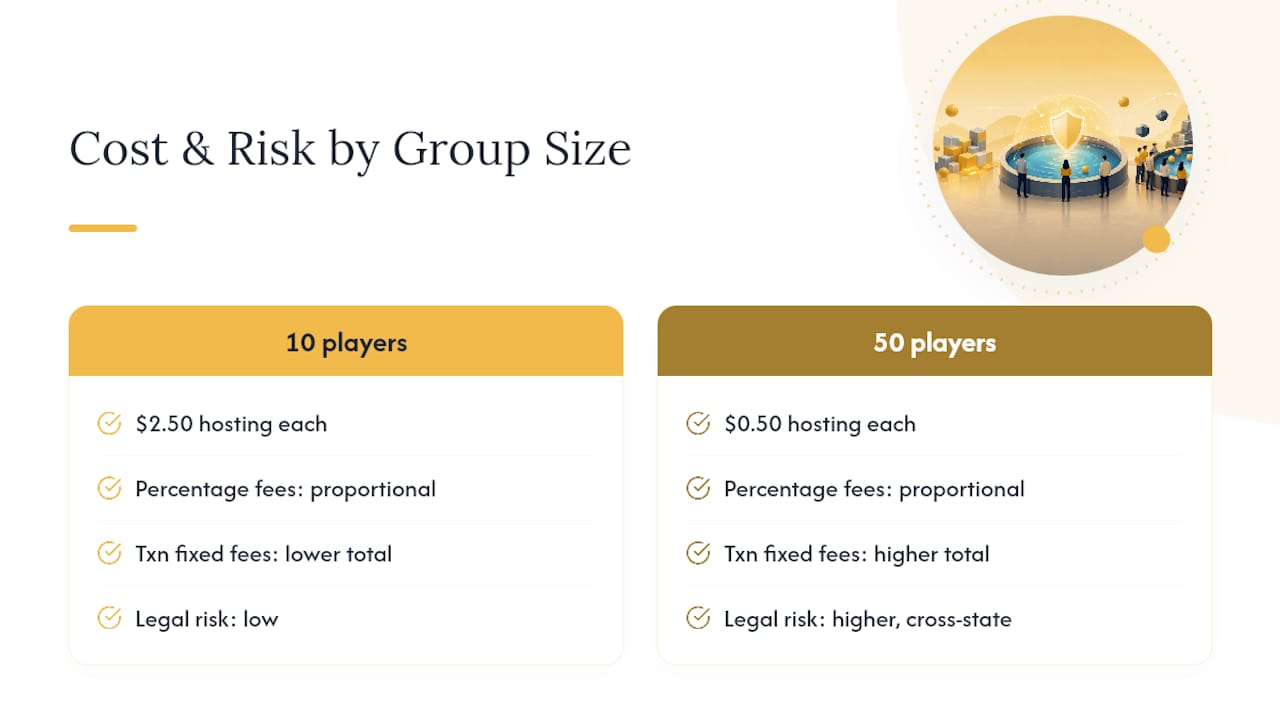
Payment processing fees behave differently. They're mostly percentage-based, so the per-person hit stays roughly proportional to the entry fee regardless of group size, unless the platform charges a flat cents-per-transaction fee on top. In that case, more players means more transactions, which means more fixed fees stacking up in total, even if each one is small.
The bigger shift happens with legal exposure, not dollars. A 10-person pool among coworkers who all sit on the same floor is about as low-risk as this gets. A 50-person pool that pulls in remote employees across six states starts looking less like an office tradition and more like an operation that regulators might actually notice, per Ogletree's compliance guidance. Size doesn't just change your math. It changes your risk profile.
Practically, that means a growing pool should trigger a second look at your rules, not just a bigger spreadsheet. Add more players, but keep the same discipline around who's eligible, how money moves, and who's accountable for it.
What Hidden Costs Catch Office Pool Organizers Off Guard?
The advertised entry fee is rarely the full story. Several costs show up only after the pool is already running, and they're the ones that generate the most frustrated group chats.
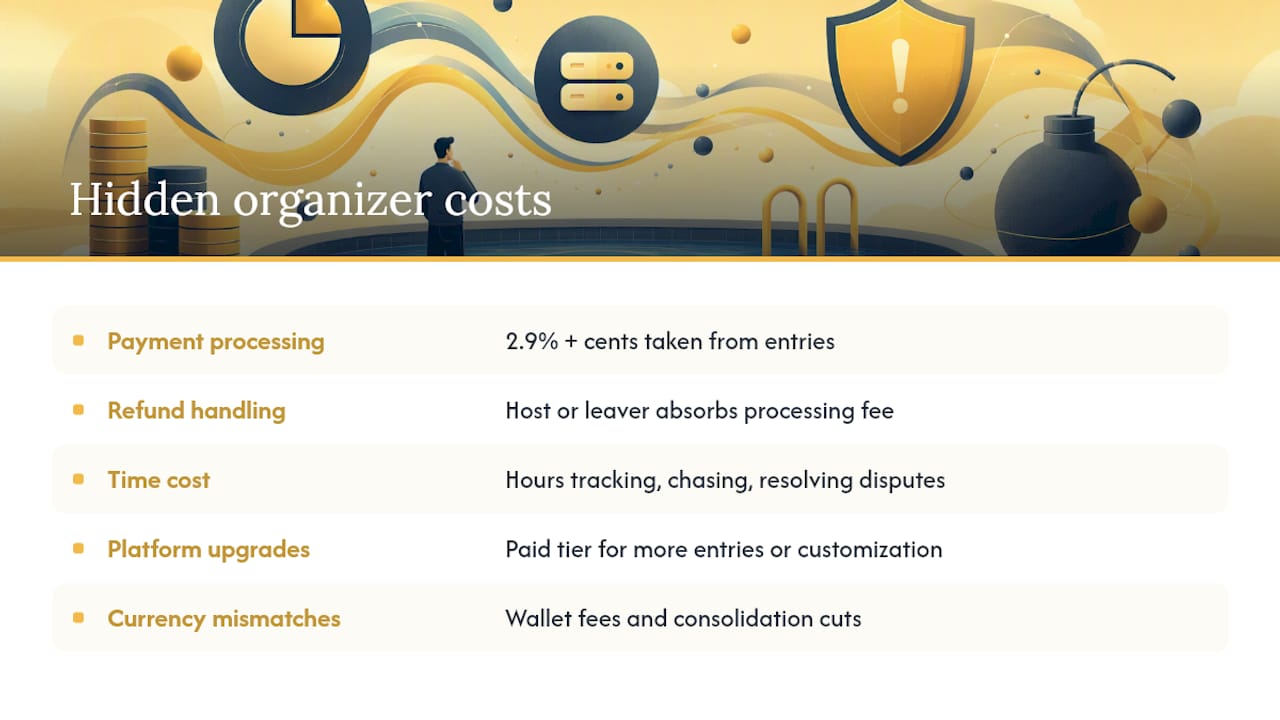
Payment processing fees are the most common surprise, since a $20 entry fee doesn't actually deliver $20 to the pot once a 2.9%-plus-cents fee is deducted. Multiply that across dozens of players and it adds up to a real gap between what was collected and what gets paid out. Refund handling is another one: someone drops out mid-season, and now you're either eating the processing fee on the refund or asking that person to absorb it, which nobody enjoys explaining.
Time is a cost too, even if it never shows up on an invoice. Manually tracking scores, chasing late payments, and settling "who actually won" disputes eats hours that a host with automated scoring and a live leaderboard would have handled instantly. Upgraded features on otherwise-free platforms are another quiet expense. What starts as a free pool often needs a paid tier once you want more than a handful of entries or basic customization.
Currency and payment app mismatches cause smaller headaches, especially when a mixed group uses different digital wallets that each take their own cut before the money consolidates. None of these costs are dramatic on their own. Stacked together, they're usually the difference between the tidy math organizers plan for and the messier total they actually deal with come payout day.
A Lower-Risk Way to Run Your Office Pool
Draftwins charges a one-time hosting fee to set up a private pool and never collects entry fees, holds a prize pool, or pays out winnings, which sidesteps the exact legal gray area this article just walked through. You pay to create the pool. Your group competes for free, and no money ever moves through the platform itself.
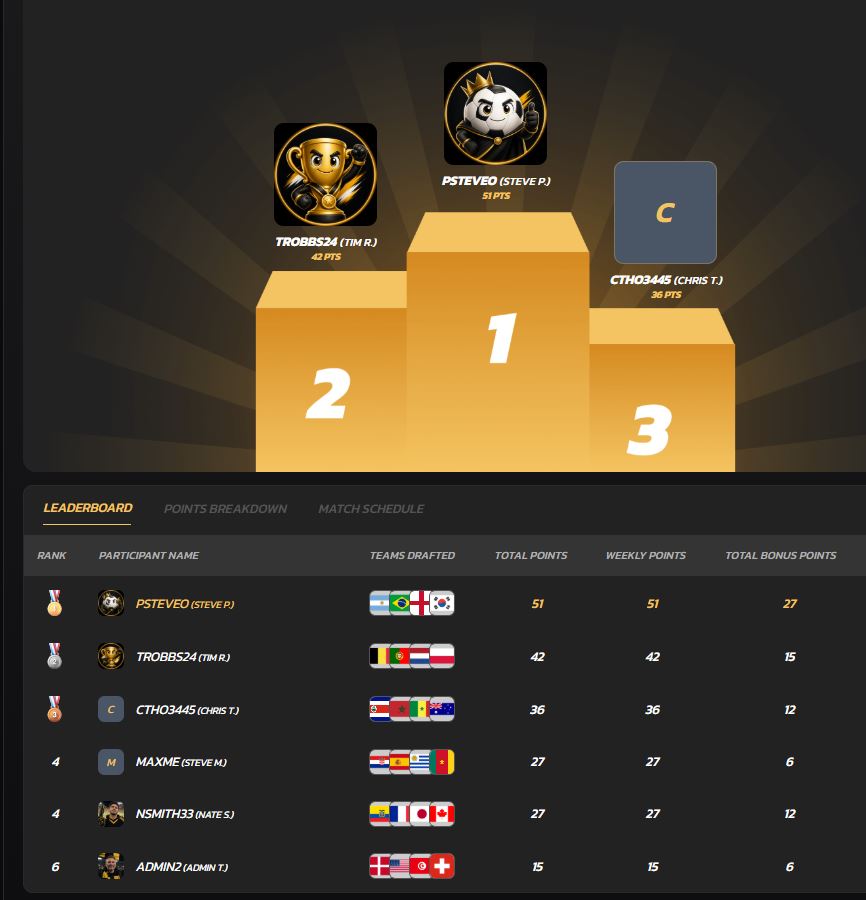
That structure matters more than it sounds, because the platforms that touch entry money are the ones exposed to the consideration-chance-reward test that gets office pools flagged in the first place. Draftwins sidesteps that by design, not by disclaimer. Commissioners still get automated scoring, live leaderboards, and a free draft order generator and randomizer to set up teams fairly, and the draft-team format means nobody's stressing over bye weeks or a star player's ankle injury wrecking their whole bracket.
If your group wants the competitive fun of a season-long pool without the payment-processing math or the legal question mark, check out DraftWins' NFL office pool or browse the full lineup of team-draft sports pools to see which format fits your office best.
Sources
- What issues do Super Bowl squares present in the workplace? | Littler
- Is sports gambling in the workplace a safe bet? | National Law Review
- March Madness bracket pools in the workplace: legal compliance tips | Ogletree
FAQ
Does an office pool cost money to run?
Not necessarily. Many pools run for free using basic spreadsheets or free-tier hosting sites, while paid options typically charge a modest flat hosting fee or a small per-player fee rather than taking a cut of the prize money.
Is an office pool considered gambling?
It can be, legally, if it involves consideration (an entry fee), chance, and a reward, which is why entry-fee pools can trigger state gambling statutes unless the organizer takes no profit and all money goes back to participants or to charity.
How much does it cost to build a commercial swimming pool?
That's a different kind of "pool" entirely, referring to a physical swimming pool rather than a sports contest, and construction costs for commercial pools vary enormously by size, materials, and region, so it falls outside what this guide covers.
What issues come up with in-ground pool sizing and cost, like a 10x20 pool?
Similarly, that question refers to physical swimming pool dimensions and construction pricing, not a sports office pool, so it's not something a sports pool cost guide can answer accurately.
Is DraftWins a safer option for running an office pool?
DraftWins charges only a hosting fee to set up the pool and never collects entry fees, holds prize money, or pays out winnings, which avoids the entry-fee legal question that affects platforms handling pooled cash directly.