
A team-draft NFL pool means each participant drafts entire NFL teams instead of individual players, then scores points based on how those teams perform over the season. The rule set that causes the fewest headaches: 1 point per regular-season win, four teams per player, a snake draft before Week 1, with optional round multipliers or playoff bonuses layered on top once everyone understands the basics. Some platforms build their pools around a similar structure, with automated scoring and live leaderboards so no one has to track wins by hand.
TL;DR:
- Drafting four teams per participant provides a good balance between coverage and simplicity for season-long pools.
- Using a snake draft with a 60-second timer keeps the process fair and efficient, especially in larger groups.
- The simplest scoring model awards one point for each regular-season win, minimizing disputes and ease of auditing.
- Layered bonus points for playoff success can dramatically alter standings, rewarding postseason performance without overshadowing regular-season results.
- Prize money arrangements should be handled privately between participants, with platforms typically charging a one-time fee for hosting, not managing payouts.
Table of Contents
- What Are the Core NFL Pool Rules for Drafting Teams?
- How Should You Score an NFL Draft Pool?
- What Draft Format Should Commissioners Use?
- Commissioner Checklist: Setup, Rules, and Fee Handling
- How Should You Draft and Play Based on the Scoring Rules?
- How Do You Handle Buy-Ins, Refunds, and Late Entries?
- What Privacy and Data Considerations Should Participants Know?
- Where Can You Find Sample Rule Templates for NFL Pools?
- How Does a Team-Draft Pool Differ From Other NFL Pool Formats?
- How Do Participant Pick Deadlines Work in a Team-Draft Pool?
- Running Your Pool Without the Manual Work
- Sources
- FAQ
What Are the Core NFL Pool Rules for Drafting Teams?
Before anyone picks a team, the commissioner has to lock four things: roster size, draft order, timing, and what happens when someone doesn't show up.
Roster size. Most casual pools give each participant 2 to 6 teams. Four is the sweet spot for a season-long pool. It's enough teams that one bad season doesn't sink you, but not so many that half the league ends up on every roster. In a pool where each person drafts several teams, some teams may get drafted multiple times; larger pools often expand to more teams per person to spread coverage further.
Draft order. Two methods dominate: a random draw (names out of a hat, or a random number generator) and a snake draft, where the order reverses each round. In a snake draft with eight players, whoever picks 8th in round one picks 1st in round two, which prevents the same person from getting stuck at the back of every round. This is the format Draftwins' team-based draft tools are built around, since it keeps the draft fair without requiring a commissioner to referee complaints about pick order.
Timing. Schedule the draft before Week 1 kicks off, ideally the weekend before the season starts so byes, injuries, and depth chart news don't scramble everyone's plans mid-draft. Late joiners should either get auto-drafted from remaining teams or assigned reserve picks so they're not locked out entirely.
Announce these details before the draft, not during it:
- Full scoring rules, including any multipliers or bonuses
- Exact draft date and time, plus time allowed per pick
- How ties will be broken
- What happens if a participant misses the draft entirely
Publishing this ahead of time is the single best thing a commissioner can do to avoid mid-season arguments, a point echoed in strategy coverage from FTN Fantasy, which flags unclear rules and deadlines as the most common source of pool disputes.
How Should You Score an NFL Draft Pool?
Three scoring models cover almost every team-draft pool in existence, and each one changes how people draft.
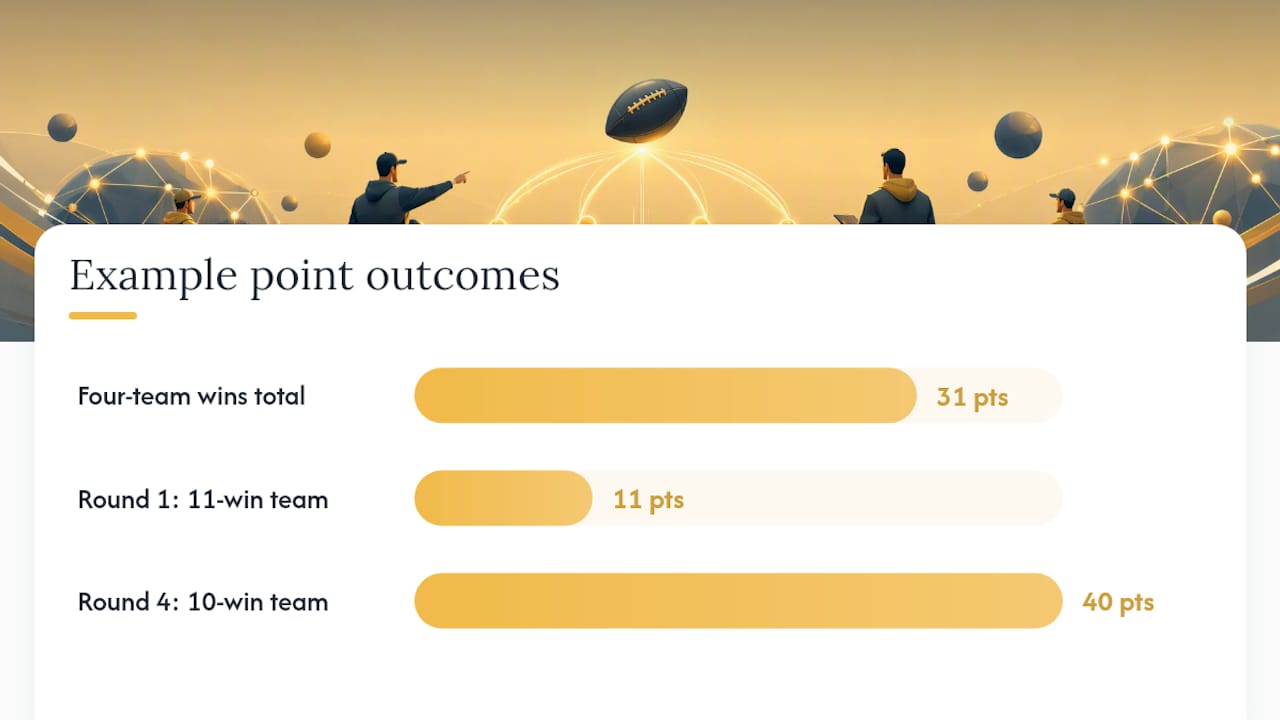
- Simple wins model. Each team earns 1 point per regular-season win. A participant with four teams that finish 11 and 6, 9 and 8, 7 and 10, and 4 and 13 wins ends the year with 31 points total. This model is the easiest to explain, the easiest to audit, and generates the fewest disputes, which is why it's the default on most wins-based pool setups.
- Weighted-win (round multiplier) model. Each team's wins get multiplied by the round it was drafted in. A team taken in Round 1 scores at 1x, while a team taken in Round 4 scores at 4x. Real-world examples like the long-running NFL Family Pool use this exact structure: a 4th-round team that wins 10 games contributes 40 points, more than double what an 11-win Round 1 team would produce at standard weighting. This rewards commissioners who spot sleeper teams late in the draft and punishes anyone who wastes an early pick on a team that underperforms.
- Playoff and bonus points. Layer in extra points for postseason performance: a set amount for making the playoffs, more for a divisional round win, more still for reaching the conference championship or Super Bowl. The Family Pool's bonus structure is a useful template here, since it rewards playoff success without letting one deep postseason run completely erase a full season of regular-season standings.
Statistic to keep in mind: a full NFL season runs 272 regular-season games across 18 weeks, which is why team-draft pools naturally have lower per-pick variance than single-week pick'em contests. One bad Sunday doesn't wreck your standing the way it can in a weekly format.
The tradeoff across all three models is variance versus reward. Wins-only scoring is steady and predictable. Multipliers and playoff bonuses add drama and reward smart late-round drafting, but they also mean a single hot playoff run can flip the final standings in the last two weeks of the season.
What Draft Format Should Commissioners Use?
The snake draft is the standard for a reason: it balances out the advantage of picking early. Whoever gets the first overall pick in round one picks last in round two, so no single person stacks up all the top teams while everyone else fights over leftovers.
Beyond the snake order itself, a few operational defaults keep the draft moving and keep it fair:
- Set a pick timer of 60 to 90 seconds. Anything longer and a 10 or 12 person draft turns into a two-hour ordeal.
- Decide in advance what happens on a missed pick. Auto-pick the best remaining team, or skip and circle back, but pick one method and state it before the draft starts.
- Skip auction-style drafts for casual office or family pools. Auctions where participants bid a fixed budget on teams work fine for experienced fantasy players, but they slow everything down and confuse first-timers.
- Default recommendation for most groups: 4 teams per player, snake draft order, 60-second timer.
Pro Tip: Run a mock draft with two or three friends the week before the real one if half your pool has never drafted teams before. Fifteen minutes of practice saves an hour of confusion on draft night.
Commissioner Checklist: Setup, Rules, and Fee Handling
Running a clean pool comes down to sequencing. Handle these in order and most disputes never happen.
- Before the draft: Finalize your scoring model, set roster size, pick a draft date, and collect participant names and contact info.
- During the season: Publish weekly deadlines, keep a live leaderboard visible to everyone, lock all picks and rosters at kickoff of the first game, and keep a written log of any rule changes or exceptions.
- When disputes come up: Have a published tie-breaker order ready, such as total wins, then head-to-head results among tied teams, then combined playoff wins. Name one person, usually the commissioner, as the final word on close calls, and post that decision publicly so no one hears about it secondhand.
- On fees: Be upfront that a hosting fee for the platform is different from prize money. Some platforms charge commissioners a one-time hosting fee to set up and run the pool. They do not collect entry fees, hold a prize pool, or pay out winnings; any money changing hands between participants is handled directly between them, outside the platform.
That last point trips up a lot of first-time commissioners, since they assume a pool platform functions like an online sportsbook. It doesn't, and being clear about that distinction from day one avoids awkward conversations in Week 12.
How Should You Draft and Play Based on the Scoring Rules?
Your draft strategy should follow directly from whatever scoring model your commissioner picked.
- Wins-only pools: Prioritize teams with stable coaching and forgiving schedules over boom-or-bust rosters. Consistency beats upside when every win counts the same regardless of when it happens.
- Weighted-round pools: Treat your later-round picks as seriously as your first. A 4th-round team multiplied by 4 can outscore a Round 1 team by a wide margin, so hunt for mid-tier teams with real breakout potential rather than just grabbing the biggest name left on the board.
- Heavy playoff-bonus pools: Weight your picks toward teams with realistic playoff odds, even if that means passing on a flashier team that's more likely to finish outside the postseason picture.
Across every format, pay attention to which teams your league mates are grabbing. If your pool includes any spread-based side contests, submitting picks as late as the rules allow lets you react to injury news and last-minute line movement instead of locking in early.
Pro Tip: If your pool uses round multipliers, don't dump your last two picks on whichever teams nobody wanted. A cheap, disciplined defense drafted in Round 4 can quietly outscore a glamour team taken in Round 1.
How Do You Handle Buy-Ins, Refunds, and Late Entries?
Team-draft pools typically separate two very different kinds of money: what participants pay each other for prizes, and what the commissioner pays to run the pool itself. Keeping these distinct from the start prevents most fee-related confusion later in the season.
If your group is running a friendly wager among participants, that arrangement is between the people in the pool. It has nothing to do with the platform hosting the draft and scoring, and commissioners should say so plainly when they announce the rules. Some platforms charge only a one-time hosting fee to the commissioner for creating and running the pool, and do not collect buy-ins, hold funds, or distribute winnings, so any prize money your group decides to put in stays a private matter you settle among yourselves.
Late entries need a clear policy before the draft, not an improvised one after someone texts the group chat asking to join. Decide in advance whether latecomers get auto-drafted from remaining teams, inherit a reserve slot, or simply miss the season. Refund policies work the same way. If someone drops out after the draft, spell out whether their teams get reassigned, retired, or left as a zero-scoring roster. Write the answer down before the situation actually happens; retroactive rulings are where most pool arguments start.
What Privacy and Data Considerations Should Participants Know?
Joining a private team-draft pool usually means sharing a name, an email address, and sometimes a phone number so the commissioner can send draft reminders and score updates. That's a small footprint compared to what many fantasy platforms collect, since team-draft pools don't need detailed personal stats or payment information tied to individual player performance.
Private pools, by design, are visible only to the people invited into them. A pool built on Draftwins doesn't get indexed publicly or shown to strangers browsing the platform; commissioners control who gets an invite and who sees the leaderboard. That matters more than it sounds like it should, especially for office pools where participants would rather not have coworkers outside the group see how much money might be on the line.
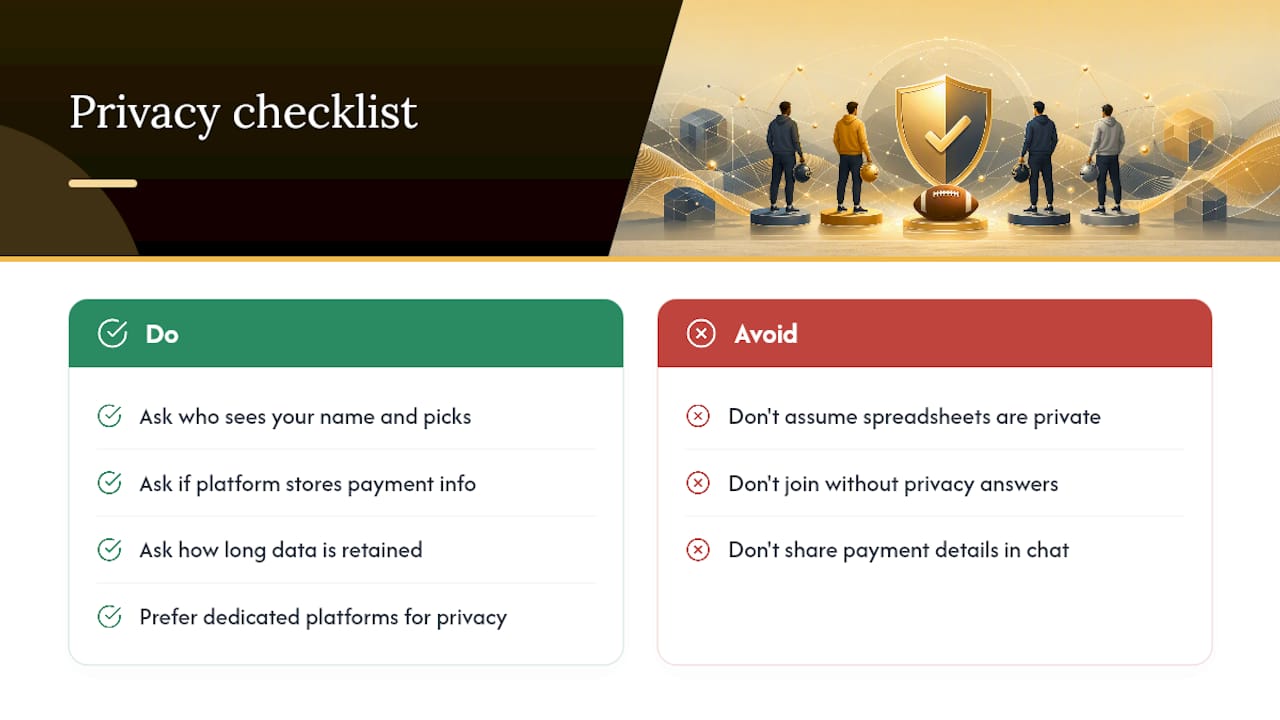
Before joining any pool, participants should know who can see their name and picks, whether the platform stores payment details (it shouldn't, if the platform itself never handles entry fees or payouts), and how long their data sticks around after the season ends. Commissioners running informal pools through spreadsheets and group texts often overlook this entirely, which is one of the quieter advantages of a dedicated platform: the privacy boundaries are built in rather than left to whoever set up the shared document.
Where Can You Find Sample Rule Templates for NFL Pools?
Writing pool rules from scratch is harder than it looks, mostly because commissioners forget to address the edge cases until they actually happen. The fastest way to avoid that is to start from a real template and edit it down to your group's preferences.
The NFL Family Pool rules page is one of the clearest public examples of a team-draft rule document, covering roster limits, round multipliers, and playoff bonus structures in plain language. It's worth reading even if your pool won't use every provision, since it shows what a complete rules document actually needs to cover: draft mechanics, scoring formulas with worked examples, tie-breaker order, and what happens with mid-season roster changes.
A solid template for a casual pool should spell out, in order: how many teams each person drafts, the exact scoring formula with one worked example, the draft date and pick-timer length, the tie-breaker sequence, and who has final say on disputes. Draftwins' scoring guide walks through sample calculations that double as a ready-made template section, so commissioners don't have to build the math from zero. Copy the structure, swap in your group's numbers, and send it out before draft night, not after.
How Does a Team-Draft Pool Differ From Other NFL Pool Formats?
Team-draft pools sit in a different category from most of the other office pool formats people run during football season, and it's worth knowing the difference before you commit a group to one format.
Squares pools assign random number combinations tied to the score at the end of each quarter, with no drafting or ongoing management involved. Pick'em pools have participants pick a straight winner or against the spread every single week, resetting the contest each Sunday. These formats reward short-term luck and require weekly attention from every participant, which is part of why they're popular for single-game watch parties but less satisfying as a season-long commitment.
A team-draft pool works differently. You draft once, before the season starts, and then your teams accumulate points automatically as the season plays out. There's no weekly picking, no risk of forgetting to submit by Sunday morning, and no single bad week wiping out your whole season. That structure is exactly why team-based formats tend to be easier to run for commissioners managing a group of busy friends or coworkers: one setup event replaces an entire season of weekly reminders and manual score tracking.
How Do Participant Pick Deadlines Work in a Team-Draft Pool?
The only real "pick" in a team-draft pool happens once, during the draft itself. After that, rosters lock, and there's nothing further for participants to submit week to week, which is a meaningful contrast to pick'em formats where missing a Tuesday deadline can cost you the whole week.
That single draft-day deadline still needs teeth. Commissioners should set a hard cutoff for when the draft happens and what counts as a valid pick within the allotted time window per turn, whether that's 60 seconds or 90. Anyone who joins after the draft has started should know in advance whether they get auto-assigned remaining teams or have to wait for a reserve slot to open up.
Roster locks matter too. Once the draft ends and the season kicks off, most pools lock rosters permanently, meaning no trading teams mid-season the way fantasy leagues trade players. Some groups allow a short trade window in the first week or two before locking down for good. Whatever you choose, state the lock date clearly, because a participant who assumes they can still swap teams in Week 6 is going to be unhappy to learn otherwise in Week 6.
Running Your Pool Without the Manual Work
Everything covered above, from snake draft order to weighted-win math to tie-breaker logs, is the kind of thing a commissioner ends up tracking in a spreadsheet by Week 3 if they're not careful. Some platforms build all of it into the platform instead: private pools that only your invited group can see, automated scoring that updates as games finish, and live leaderboards so nobody has to ask "wait, who's winning?" in the group chat.
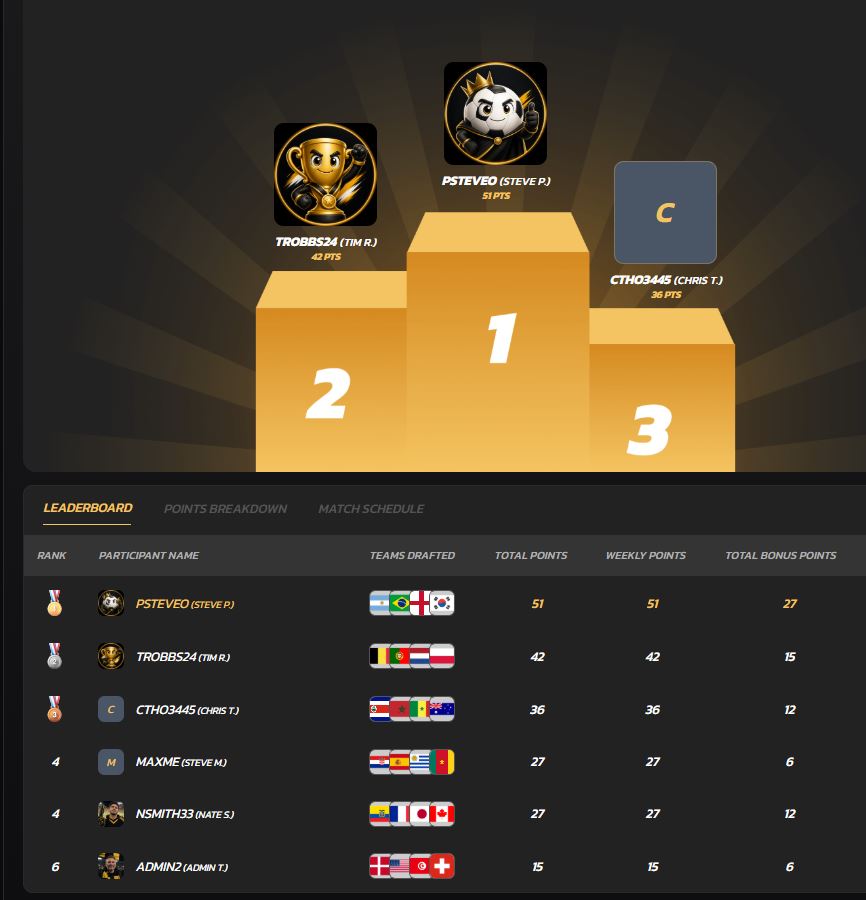
Setting up a pool takes the same rule decisions this guide walked through: roster size, scoring model, draft timing. Draftwins just handles the math and the tracking once you've made those calls, whether you're running a simple wins-only pool or layering in round multipliers and playoff bonuses. And on the money side, the platform may charge commissioners a one-time hosting fee for creating and running the pool. It typically doesn't collect entry fees, hold a prize pool, or manage payouts, so however your group handles buy-ins and winnings stays a private arrangement between participants.
If you're ready to set one up, create a private team-draft pool and use the defaults covered here as your starting point: four teams per player, a snake draft with a 60-second timer, and wins-based scoring with optional multipliers once your group is comfortable with the basics.
Sources
- NFL Pick’em Strategy 2025: Expert tips to win football pool contests — Action Network
- The NFL Family Pool is a Team Draft Pool — NFLFamilyPool
- How to make smarter NFL pool picks & win your league — FTN Fantasy
FAQ
What Is a Team-Draft NFL Pool?
It's a pool format where each participant drafts full NFL teams, rather than individual players, and earns points based on how those teams perform over the season, usually through wins-based scoring.
How Many Teams Should Each Person Draft?
Most season-long pools use 2 to 6 teams per person, with 4 being the most common default because it balances variety against manageable draft length.
What's the Simplest Scoring Method for an NFL Pool?
Award 1 point per regular-season win for each drafted team. It's the easiest model to explain and the least likely to spark disputes, which is why platforms like Draftwins use it as the standard default.
Can You Add Playoff Bonus Points to a Team-Draft Pool?
Yes. Common schemes award extra points for making the playoffs, winning a divisional round game, reaching the conference championship, or winning the Super Bowl, on top of regular-season win totals.
Who Handles Prize Money in a Team-Draft Pool?
Prize money is arranged directly between participants, not through the platform. Draftwins charges commissioners a one-time hosting fee to run the pool and does not collect entry fees or distribute winnings.
What's the Best Draft Order for a Casual Office Pool?
A snake draft, where the pick order reverses each round, is the standard choice because it keeps things fair without requiring the commissioner to referee complaints about who picks first.