
Drafting whole NFL teams instead of individual players cuts your weekly workload down to almost nothing. Instead of juggling a lineup every Sunday, checking injury reports, and swapping bench players, you make one pick at the draft and then just watch how your team performs all season. That's the entire answer to why team-based NFL games are easier: fewer decisions, fewer things that can go wrong, and a scoring system anyone can understand in ten seconds.
Two things make this format hold up week after week. First, a single injured quarterback doesn't tank your whole entry the way it would in a player draft, because you're riding a full roster's worth of talent instead of one name. Second, scoring stays simple, usually just wins, losses, and maybe points differential, so nobody needs a spreadsheet to check the standings. Platforms like DraftWins handle the scoring and leaderboards automatically, which matters for:
- Casual office pools where nobody wants to be the "commissioner who does math all Sunday"
- Friend groups that tried fantasy football once and found it exhausting
- Anyone who wants a set-it-and-forget-it pool that still feels competitive
Key Takeaways
Team-based NFL pools are easier than player drafts because they replace dozens of weekly lineup decisions with one draft-day pick and a scoring system anyone can read at a glance.
| Point | Details |
|---|---|
| One decision, not many | Drafting a whole team removes the weekly lineup management that makes fantasy football exhausting. |
| Injuries matter less | A full roster absorbs individual injuries better than a single fantasy starter would. |
| Setup takes 20 minutes | Choosing pool size, draft order, and scoring rules upfront avoids midseason disputes. |
| Automation kills the busywork | Platforms like DraftWins handle scoring and leaderboards so commissioners don't tally results by hand. |
Table of Contents
- Why Team-Based NFL Games Are Easier Than Fantasy Football
- How to Set Up a Team-Based NFL Pool in Under 20 Minutes
- How Does a Team Draft Actually Work?
- What Happens When Something Goes Wrong Midseason?
- Running Your Pool With DraftWins
- Sources
- FAQ
Why Team-Based NFL Games Are Easier Than Fantasy Football
The math is straightforward. A standard fantasy roster asks you to manage nine or more starting spots, plus a bench, every single week for roughly five months. A team-draft pool asks you to make one choice, once, at the start of the season. That's the whole gap in effort right there.
Here's what that gap actually buys you:
- Fewer weekly decisions. You pick a team at the draft and you're done. No Tuesday-night waiver scramble, no Sunday-morning lineup panic.
- Lower variance from injuries and byes. A backup running back going down doesn't wreck your week the way it does in fantasy, because a full 53-man roster absorbs the hit better than a single fantasy starter.
- Scoring anyone can audit. Win equals a point, loss equals zero. There's no flex-position math or PPR debate to referee.
- Better participation. People who'd never touch a fantasy draft will happily pick a team, because the barrier to entry is basically "know which NFL teams exist."
That last point tracks with what pool-strategy writers have observed for years: simpler pool formats require less time and attention from typical participants, which is exactly why pick'em and survivor-style pools have historically drawn bigger, more casual crowds than season-long fantasy leagues. Academic work on drafting behavior backs this up from a different angle. Research on sequential draft decisions shows that resource availability shifts constantly as a draft unfolds, and that dynamic complexity is the real source of drafter fatigue. Collapse the pool of choices from hundreds of players down to 32 teams, and most of that fatigue disappears.
Pro Tip: If your group has tried fantasy football before and gave up mid-October, that's the strongest signal you're a team-draft crowd. The people who quit fantasy leagues almost never quit because they lost. They quit because managing a roster every week stopped being fun.
How to Set Up a Team-Based NFL Pool in Under 20 Minutes
You don't need a rulebook. You need five decisions, made once, and a group chat.
Before draft day:
- Pick your pool size. Eight to twenty participants works well since there are 32 NFL teams to go around, and 10 to 16 people hits the sweet spot for most office and friend-group pools.
- Decide if entries get one team or multiple. One team per entry keeps things simple; two per entry adds variance without adding weekly work.
- Choose your draft format. A snake draft keeps things fair by reversing order each round; a straight draft is faster but rewards whoever picks first. For a deeper breakdown of which fits your group, a snake draft versus straight draft comparison is worth five minutes.
- Lock in your scoring baseline and a tiebreaker before anyone drafts, not after a dispute pops up.
- Set a communication norm: one group chat, one pinned message with the rules, one person (the commissioner) who has final say on edge cases.
On draft day, in order:
- Confirm your participant list and lock the draft order.
- Run the draft live in the group chat or on a shared call. It takes most groups 15 to 30 minutes for a 12 team pool.
- Post the final rosters somewhere everyone can see them.
- Turn on automated scoring so nobody has to manually tally results each week.
Setup runs about 20 minutes. Weekly maintenance after that should be close to zero if your scoring is automated, which is the entire point of choosing this format over a player-based fantasy league.
How Does a Team Draft Actually Work?
A team draft is exactly what it sounds like: each pick claims one NFL team, not a quarterback or a running back. Once all 32 teams are gone, or once your pool's team allotment runs out, the draft is over and rosters are locked for the rest of the regular season.
That single change removes most of the strategic uncertainty that makes fantasy drafts stressful. Draft decisions in player-based formats involve constantly shifting positional needs, bye-week stacking, and handcuff logic. None of that applies when you're drafting whole franchises. You're not managing a roster. You're picking a side and sticking with it.
Recommended formats:
- 12 team pools with one team per entry. Clean, fast, and every team gets drafted exactly once.
- 8 team pools with two teams per entry. Adds variance for smaller groups without overcomplicating anything.
- 20 team pools with a supplemental pool for undrafted teams. Works for bigger office groups; leftover teams get grouped into a shared entry.
Keep scoring dead simple:
- Win = 1 point, tie = 0.5, loss = 0, tallied across the season.
- Or, if your group wants a bit more texture, total wins plus a small bonus for playoff appearances.
- Avoid stat-level multipliers, yardage bonuses, or anything that requires checking a box score. That's fantasy-football complexity sneaking back in through the side door.
For a copy-ready starting point, this rule snippet covers most groups:
| Point | Details |
|---|---|
| Draft unit | Each pick selects a whole team, not a player, which removes roster management entirely. |
| Scoring | Win/loss/tie tallies avoid the need for stat-based scoring math. |
| Tiebreakers | Set them before the draft, not after a dispute arises midseason. |
| Format | Snake draft for fairness, straight draft for speed. |
What Happens When Something Goes Wrong Midseason?
Pools break down for predictable reasons, and every one of them has a low-effort fix.
- No-shows at draft time. Set an auto-pick rule in advance: if someone misses their slot, the system (or the commissioner) picks the next available team for them. Nobody has to chase down a text.
- Midseason dropouts. Since most commissioners pay a one-time hosting fee rather than collecting entry fees, a dropout doesn't blow up prize logistics. Just freeze their score where it stands or hand the entry to a substitute.
- Fairness complaints. Publish your scoring rules and standings before the season starts, not after week 6 when someone's upset about a tiebreaker. Casual participants tend to underinvest time in optimization, so clear, upfront rules matter more to keeping the group happy than any strategic depth would.
- Rule changes. Never change scoring or rules midseason unless every single participant agrees. Changing rules after teams are drafted is the single fastest way to create a mutiny in your group chat.
Pro Tip: Automate whatever you can before the season starts. Commissioners who manually track scores usually burn 20 to 30 minutes a week doing math that a platform could do instantly, and that's exactly the kind of upkeep this format is supposed to eliminate.
Running Your Pool With DraftWins
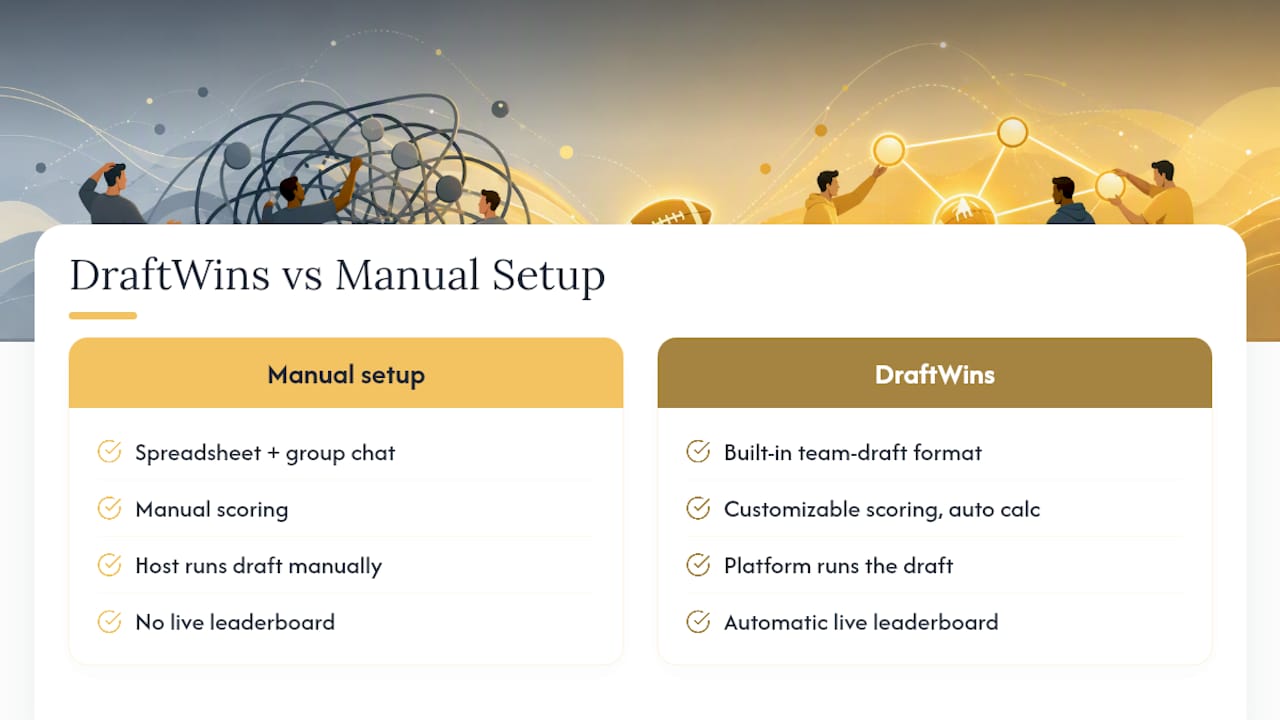
DraftWins builds the team-draft format directly into the platform, so you're not stitching together a spreadsheet and a group chat to make it work. Commissioners set up a private team-draft pool with customizable scoring, and the platform handles the draft, the standings, and the leaderboard automatically.
Here's what that means in practice. You choose your pool size, your scoring rules, and your draft format, and DraftWins runs the live leaderboard from there. No manual score entry, no arguing over who's ahead, no separate app for tracking wins. Participants get a clean view of standings without needing to understand a single scoring formula. That's the appeal for casual drafters who want the fun of a football pool without the fantasy-league grind.
DraftWins charges a one-time hosting fee to the commissioner who creates the pool. There are no entry fees collected, no prize pools held, and no wagers processed on the platform itself. It's built for groups who want a fast, low-maintenance NFL office pool they can set up once and check on for fun every Sunday. If you're ready to try it, start a pool at DraftWins and have your group drafting teams in under 20 minutes.
Sources
- Football Pool Strategy: 3 Factors The Pros Use To Win Notes from the Sports Nerds
- Academic analysis of drafting and roster decision-making (University of Pennsylvania)
- The Overlooked Edge in Sports: Why Football Pools Reward Smart Players - PoolGenius
FAQ
Why are team-based NFL pools easier than fantasy football?
They replace weekly lineup management with a single draft-day pick, and full-roster results absorb individual injuries better than a fantasy starter would.
How many people should join a team-draft NFL pool?
Between 8 and 20 participants works best, since there are 32 NFL teams available to draft across the group.
What's the simplest scoring system for a team-draft pool?
A basic win-loss-tie tally, such as 1 point for a win and 0.5 for a tie, keeps standings easy to explain and audit.
How do I handle ties or postponed games?
Set the rule before the draft: most groups treat postponed or canceled games as a tie for both teams and break standings ties with head-to-head record or point differential.
Does DraftWins charge entry fees or hold prize money?
No. DraftWins charges commissioners a one-time hosting fee to create a pool and does not collect entry fees, hold prize pools, or process wagers.