Automated live scoring for a private sports pool runs on a simple pipeline: match events get ingested from a data feed, a scoring engine converts those events into points based on your league's rules, a leaderboard engine ranks every team, and a delivery layer pushes the update to every screen watching the pool. That's how live score tracking works, start to finish.
Most platforms refresh standings somewhere between a few seconds and roughly 30 seconds after a real-world event happens, depending on whether the underlying data comes through polling or a push feed. A few things commonly get labeled "provisional" instead of final:
- Stats still being confirmed by the data provider (assists, own goal attribution)
- Events under video review that could reverse
- Bonus points that depend on end-of-match totals rather than single plays
A pool platform that flags scores as provisional isn't being cautious for no reason. It's telling you the math is correct given what's known right now, and it might update once the record is complete.
Key Takeaways
Automated live scoring works because it separates raw event data from calculated points, letting platforms correct errors without breaking trust in the leaderboard.
| Point | Details |
|---|---|
| The pipeline has four stages | Events move through ingestion, scoring, leaderboard generation, and delivery before reaching your screen. |
| Update speed depends on data source | Polling typically updates every 15 to 30 seconds, while event-driven feeds push changes with far lower latency. |
| Provisional scores are normal | Stats under review or match-dependent bonuses often display as provisional until final data confirms them. |
| Corrections rely on immutable logs | Platforms reverse and reapply point deltas using the original event record rather than overwriting history. |
| Draftwins runs this pipeline for team-draft pools | Commissioners configure scoring rules once and get automated live leaderboards for a one-time hosting fee. |
Table of Contents
- What Are the Core Layers Behind Live Score Systems?
- Do Live Scores Come from Polling or Push Feeds?
- How Does the Scoring Engine Turn Events Into Points?
- Why Do Scores Change After the Match Ends?
- How Do Leaderboards Stay Fast and Accurate Under Load?
- What Testing Keeps a Live Scoring System Reliable?
- What Should Commissioners Configure Before Kickoff?
- Draftwins Handles the Scoring So You Don't Have To
- Sources
- FAQ
What Are the Core Layers Behind Live Score Systems?
Every reliable live score system splits its work into distinct layers, and that separation is what keeps a scoring bug in one league from ever touching another. The typical stack looks like this:
- Ingestion layer: pulls or receives raw match events from a data provider
- Normalization layer: reshapes those events into a consistent internal format regardless of source
- Scoring engine: applies your league's point rules to normalized events
- Leaderboard engine: aggregates team totals and produces rankings
- Delivery layer: pushes the result to browsers, whether through polling, a live feed, or a socket connection
Multi-league isolation matters more than it sounds like it should. If 50 commissioners are running pools off the same World Cup match, each league needs its own scoring configuration evaluated independently, so a commissioner who awards 6 points for a clean sheet never affects a neighboring pool that awards 4. A single goal event, say a striker scoring in the 78th minute, flows through this exact sequence: ingestion picks it up, normalization tags it with the right match and player IDs, then every affected league's scoring engine evaluates it against that league's own rule set before anything touches a leaderboard.
Do Live Scores Come from Polling or Push Feeds?
The way a platform pulls match data shapes everything downstream, including how fast your leaderboard actually moves. There are two dominant approaches, and understanding scoring engine architecture means understanding both.
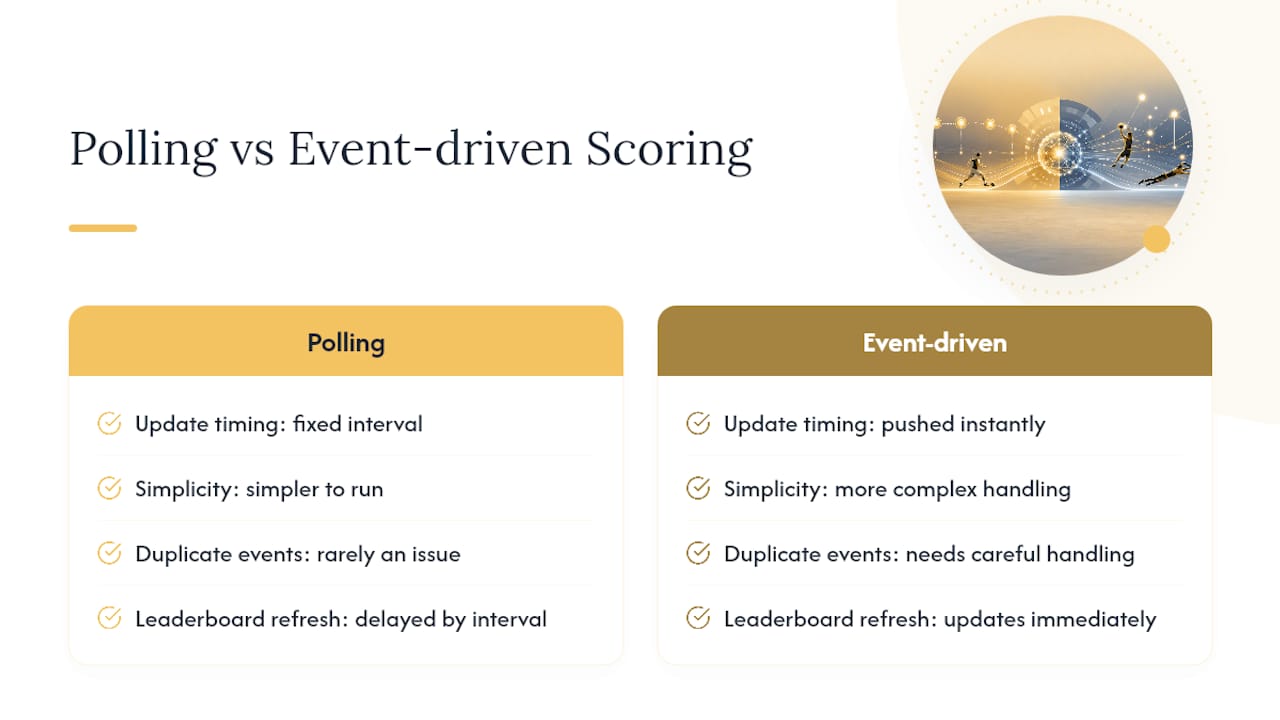
- Polling checks a data source on a fixed interval, often every 15 to 30 seconds. It's simple to build and easy to debug, but it wastes calls when nothing has changed and introduces a built-in lag between the real event and your update.
- Event-driven delivery uses webhooks, WebSockets, or server-sent events (SSE) to push data the moment it happens. Latency drops sharply, but the tradeoff is real: public endpoints need protection, and every incoming event needs idempotency checks so a retried webhook doesn't double-count a goal.
For commissioners, this decision explains why your platform's updates feel instant during some matches and slightly delayed during others. It's rarely a bug. It's an architectural choice.
Pro Tip: If your platform's leaderboard lags by more than a minute during a live match, ask whether it's running on polling. A 30-second poll interval plus processing time can easily produce a 45 to 60 second delay before you see a change.
How Does the Scoring Engine Turn Events Into Points?
A goal doesn't become a point on your leaderboard by magic. It passes through a defined sequence, and skipping any step is where most scoring bugs start.
- Validate the event: confirm the match, team, and player IDs are legitimate and not a duplicate
- Map to the roster: connect the event to whichever drafted team owns that player or club
- Apply scoring rules: check the league's rule set for how that specific event type scores
- Compute base points: calculate the raw point value before any modifiers
- Apply multipliers: layer on captain bonuses or other multipliers as a separate step
- Persist and emit: save the result and send the update downstream
Storing scoring rules as a per-league JSON configuration, rather than hardcoding them, means a commissioner can change point values for defense or adjust captain bonuses without anyone touching code. It's also why scoring rule configuration is worth understanding before your season starts, not after a dispute breaks out.
Not everything scores instantly, either. Bonuses that depend on full match statistics, like a defender's total tackle count, typically get deferred to a post-match calculation pass rather than computed live, which is exactly why those figures show as provisional until the final whistle.

Pro Tip: Applying captain multipliers as a separate post-processing step after base points are calculated makes it far easier to change multiplier rules later without touching the core scoring logic.
Why Do Scores Change After the Match Ends?
Corrections happen because match data itself gets corrected. An own goal gets reassigned, a card gets rescinded, a stat provider fixes an error two hours after full time. The only safe way to handle that is with an immutable event log: a record of every raw event exactly as it arrived, kept separate from the scored totals, so nothing gets overwritten and every change can be traced and reversed.
When a correction lands, the process runs in five steps:
- Locate the original event by its ID
- Reverse the point delta that event originally produced
- Apply the corrected version of the event
- Recalculate every team total affected by that change
- Publish the updated leaderboard
This is also where commissioner policy choices matter. Some pools place a short contest hold after a match ends before declaring results final, giving the correction window time to close. Others simply mark results provisional and communicate that clearly in the pool rules, so nobody is surprised when a leaderboard shifts by a few points the next morning.
How Do Leaderboards Stay Fast and Accurate Under Load?
Leaderboards face a specific problem during a live match: dozens or hundreds of participants refreshing at once, all expecting a ranking that matches what everyone else sees. Writing directly to a live-ranked table while reads are happening invites inconsistency, so most systems generate a full snapshot instead and swap it in atomically once it's ready.
- Snapshot generation: compute the entire ranked leaderboard as one unit, not incremental in-place edits
- Redis caching: store that snapshot in memory with a TTL timed to the scoring window, so the cache expires right as new data would make it stale
- Delivery pattern: clients either poll the cached snapshot, receive lightweight push updates through SSE, or connect via WebSockets when two-way communication is needed
The Redis leaderboard approach is built specifically around this snapshot model, because it guarantees every viewer sees the same version of the leaderboard at the same moment rather than a half-updated mix of old and new data. That consistency is what separates a leaderboard that feels trustworthy from one that quietly confuses people mid-match. For a closer look at how this shapes what you actually see on screen, real-time leaderboard design covers the client side of that same tradeoff.
What Testing Keeps a Live Scoring System Reliable?
Scoring bugs during a live match are expensive in a way that's hard to undo, since a wrong number that gets seen by 40 participants doesn't quietly fix itself. Solid platforms run three categories of tests before they ever trust a rule change in production:
- Unit tests verify each individual scoring rule produces the correct point value in isolation
- Corpus tests replay historical matches, including edge cases like own goals, VAR reversals, and penalty shootouts, to catch regressions before they hit a live pool
- Concurrency tests confirm that leagues running simultaneously stay isolated and don't leak scoring changes into each other
Feed health monitoring and a backup data source matter too, since a live feed can drop mid-match. Heavy recalculation jobs, like reprocessing an entire gameweek after a correction, generally run through background job queues rather than inside a live request, which keeps the site responsive even while a large recalculation is underway.
What Should Commissioners Configure Before Kickoff?
A few decisions made before your pool goes live prevent most of the disputes that show up mid-season.
- Set and save your league's scoring configuration, including point values and how positions are handled for the gameweek.
- Define your captain multiplier rule explicitly, so participants know exactly how it's calculated.
- Decide your policy on provisional versus final scoring, and whether you'll apply a contest hold after matches end.
- Write that policy into your pool rules in plain language before anyone joins.
- Know your platform's expected update cadence so you can recognize normal delay versus an actual problem.
Pro Tip: Screenshot your scoring configuration once it's finalized and pin it in your pool's group chat. It settles more scoring disputes before they start than any explanation after the fact ever will.
If you're setting this up for the first time, a commissioner quick-start guide walks through the initial setup decisions in more detail.
Draftwins Handles the Scoring So You Don't Have To
If you've read this far, you already know how much engineering sits underneath a leaderboard that just works. Draftwins built its platform around exactly this pipeline, tuned specifically for team-draft pools rather than traditional individual-player fantasy formats.
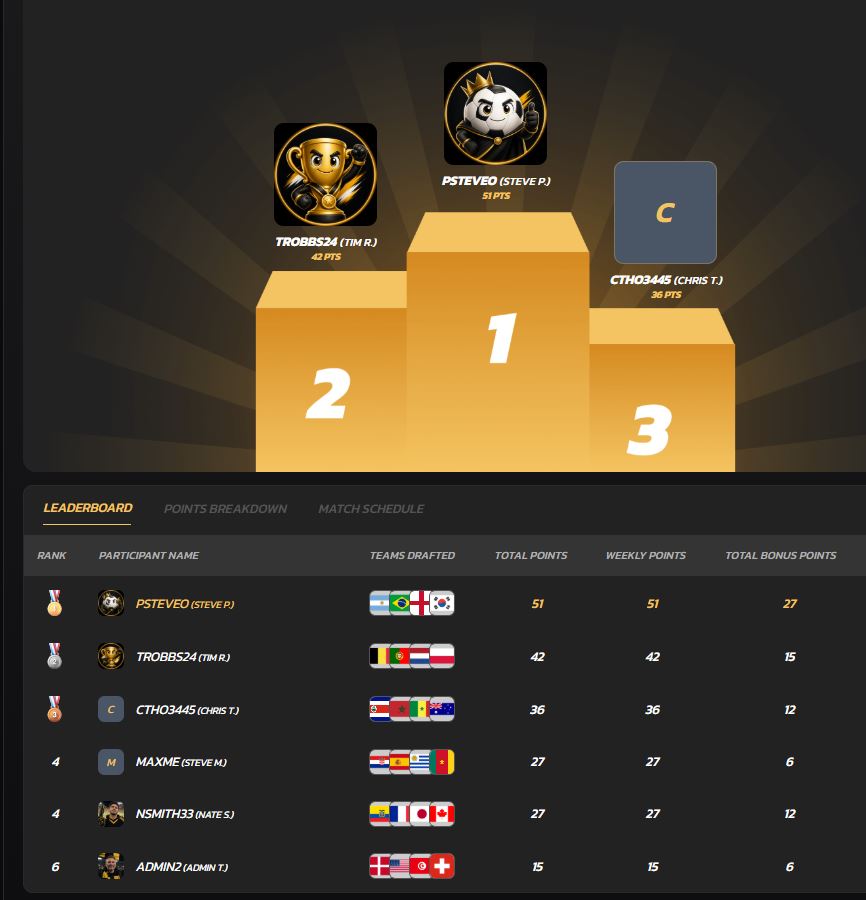
Commissioners get a configurable scoring engine, automated point calculation as matches unfold, and a live leaderboard that updates without anyone touching a spreadsheet. Because participants draft entire teams instead of managing weekly lineups, there's no injury report to check and no bench decision to second-guess, just results tracked automatically as they happen. Draftwins charges a one-time hosting fee to the commissioner who creates the pool. There are no entry fees collected, no prize pools held, and no payouts processed on the platform, so the money side stays entirely between you and your group.
If you're ready to set one up, create a team-draft pool and configure your scoring rules in a few minutes. Commissioners running an office pool for football season can also check the dedicated NFL pool page for format-specific setup options.
Sources
- Redis leaderboards and snapshot strategy
- Fantasy scoring engines: architecture and edge cases - Sportmonks
FAQ
How Often Do Live Scores Update During a Match?
Most platforms update somewhere between every few seconds and every 30 seconds, depending on whether the underlying feed uses polling or event-driven delivery.
Why Did My Pool's Score Change After the Match Ended?
A stat provider corrected an event, such as reassigning an own goal or reversing a card, and the platform reapplied the fix using its immutable event log.
What Does "Provisional" Mean on a Leaderboard?
It means the point total reflects the current known data but could shift slightly once statistics-dependent bonuses or under-review events are finalized.
Can Commissioners Change Scoring Rules Mid-Season?
Yes, on platforms that store scoring rules as a per-league configuration, like Draftwins, commissioners can adjust point values without needing a code change or new deployment.
What's the Difference Between Polling and Event-Driven Scoring?
Polling checks for updates on a fixed interval and is simpler to run, while event-driven delivery pushes changes the instant they happen but requires more careful handling of duplicate events.