
Real-time leaderboards do one thing that no other game mechanic replicates: they tell you exactly where you stand, right now, against everyone else. That immediacy is the whole point. For software engineers building competitive systems, the challenge is not understanding why leaderboards matter. It is building one that stays accurate under 100,000 score updates per second without melting your infrastructure.
The core queries a leaderboard must answer are deceptively simple: return the global top-K players, return a specific player's rank, return the players surrounding a given rank, and do all of it in under 10 milliseconds. Add time-windowed views (daily, weekly, all-time), friend leaderboards, and regional scopes, and you have a system design problem that shows up in interviews at Snap, DoorDash, Lyft, Coinbase, and every major gaming company.
What do real-time leaderboards actually do?
A real-time leaderboard is a continuously updated ranking of players or participants ordered by score. The word "real-time" carries a specific technical meaning here: updates should be visible within 1–2 seconds of a score event, not batched overnight. That constraint shapes every architectural decision downstream.
The core functions a leaderboard serves:
- Rank feedback: Players see their position relative to the field, which drives competitive behavior and time-on-task. Research on leaderboard effects in informal learning environments found that introducing a leaderboard increased time per interaction by about 35%.
- Top-K queries: Return the top 100 or top 1,000 players globally, the most common read path.
- Player rank lookup: Given a user ID, return their exact rank. Critical for personalized display.
- Near-me neighbors: Return the players just above and just below a given rank. This "near-me" view is often more motivating than the global top list.
- Friend leaderboards: Scope the ranking to a player's social graph. Harder to build than it sounds.
- Time-windowed views: Separate rankings for today, this week, and all-time, each with independent score accumulation.
The low-latency requirement (under 10ms for reads) and the consistency trade-off (1–2 seconds of acceptable staleness for global ranks) are the two constraints that define the entire architecture. Everything else flows from those two numbers.
Understanding the scope before you design anything
Before writing a line of code, nail down the workload. Vague requirements produce over-engineered or under-built systems.
Key questions to answer up front:
- User scale: Are you handling 1 million players or 100 million? A Redis Sorted Set for 10 million users fits comfortably in 800MB–1GB of memory. At 100 million, you need partitioning.
- Write throughput: A target of 100,000 score updates per second is a common benchmark for production gaming systems. That number determines whether a single Redis instance suffices or whether you need a cluster.
- Read latency target: Sub-10ms for leaderboard reads is the standard. Anything looser and you can use simpler approaches; anything tighter and you need aggressive caching.
- Consistency tolerance: Global rank staleness of 1–2 seconds is acceptable for most applications. Exact instantaneous consistency at scale is prohibitively expensive.
- Functional scope: Do you need friend leaderboards? Regional scopes? Multiple time windows? Each adds architectural complexity.
- Security requirements: Score submission endpoints need session validation, signed tokens, and anti-cheat checks. Security at data ingress is the foundation of a trustworthy ranking.
Defining these boundaries early prevents the most common system design mistake: building for a scale you do not have while ignoring the security and consistency problems you definitely will.
How the architecture and data model fit together
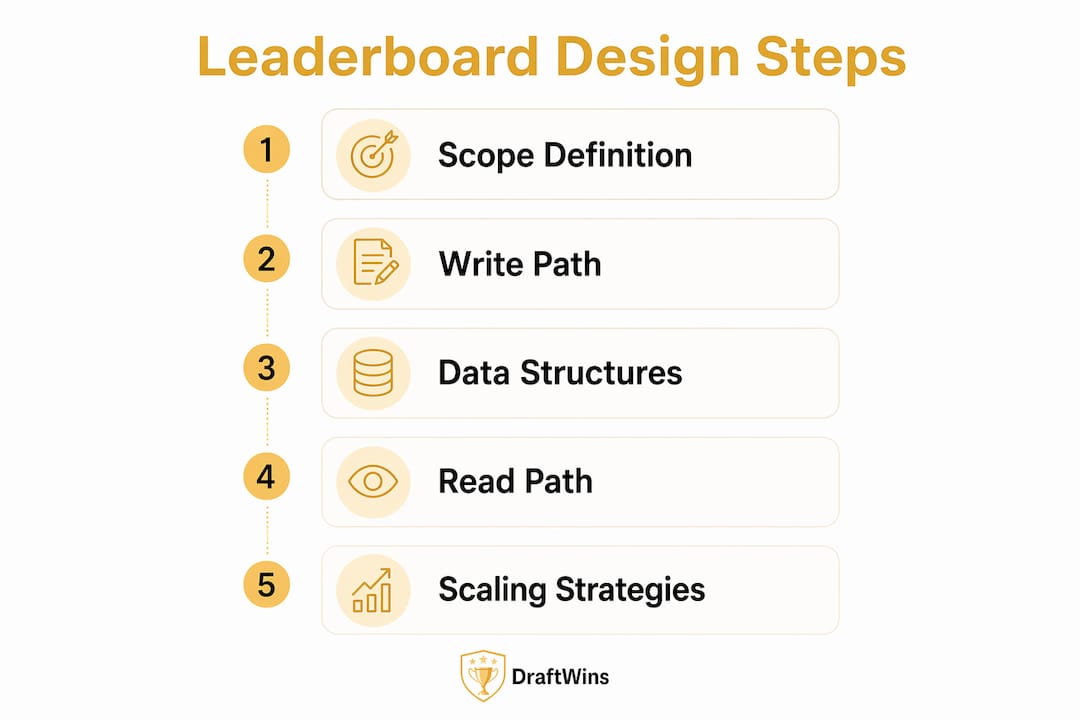
The write path
Score events flow through three layers. First, the score submission API validates the request (session token, anti-cheat check) and writes the event to a durable log. Second, a leaderboard updater service consumes from that log and projects scores into Redis. Third, the read service answers ranking queries directly from Redis.
The durable log is where Redpanda or Apache Kafka lives. Redis is treated as a volatile projection layer. If Redis crashes, you replay the event log and rebuild the sorted sets. This separation is the key architectural insight: Redis gives you speed, Redpanda gives you durability, and you never confuse the two roles.

Redis Sorted Sets: the right data structure
Redis Sorted Sets (ZSET) are the standard data structure for leaderboard ranking. They combine a hash map for O(1) score lookups with a skip list for O(log N) rank operations. The commands you need to know:
| Command | Operation | Complexity |
|---|---|---|
ZADD | Add or update a member's score | O(log N) |
ZINCRBY | Atomically increment a score | O(log N) |
ZREVRANK | Get a member's rank (high to low) | O(log N) |
ZREVRANGE | Get top-K members | O(log N + K) |
ZMSCORE | Get scores for multiple members | O(N) |
The O(log N) characteristic means scaling from 1 million to 100 million entries adds roughly 30 microseconds of latency per operation. That is graceful scaling by any measure.
Time-windowed leaderboards
Maintain separate sorted sets per time window, using date-stamped keys and TTL-based expiration. A daily leaderboard key like leaderboard:daily:20260415 gets a 24-hour TTL set via EXPIRE. Every score event writes to all relevant windows simultaneously: daily, weekly, and global. This approach handles multiple time windows efficiently without complex cleanup logic.
Pro Tip: Set TTLs slightly longer than the window duration (e.g., 25 hours for a daily board) to avoid race conditions at midnight rollover where a late-arriving score event might write to an already-expired key.
The read path
Top-K queries use ZREVRANGE, served entirely from Redis. Player rank uses ZREVRANK. Near-me queries combine ZREVRANK to find position, then ZREVRANGE with an offset to fetch surrounding players. Profile data (display names, avatars) should be hydrated via batched HMGET calls against a Redis hash, not individual lookups per player.
What technical challenges will you actually hit?
High write throughput and hot key contention
At 100,000 writes per second against a single sorted set, you will hit Redis CPU limits before memory limits. The solution is sharding: partition the leaderboard across multiple Redis instances by user ID range or a hash of user ID. Each shard maintains a local top-K. Computing the global top-K means merging the top-K results from each shard, which is cheap (K × number of shards candidates to sort).

Hot key contention is a specific problem at the top of the leaderboard. The top 10 slots get hammered by reads. Cache the top-N results (say, top 1,000) as a serialized list with a short TTL (1–2 seconds). Most read traffic hits the cache, not the sorted set directly.
Race conditions on score updates
The naive approach reads a score, increments it in application code, then writes it back. Under concurrent writes, this loses updates silently. The fix is ZINCRBY, which atomically increments a member's score in a single Redis command with no read-modify-write gap. Never use a read-then-write pattern for score updates.
Pro Tip: Wrap multi-key operations (updating daily, weekly, and global sets in one score event) in a Redis pipeline or Lua script to reduce round-trip overhead and keep the update atomic across all three windows.
Friend leaderboards and the fan-out trap
Friend leaderboards look simple but hide a scaling trap. Pre-materializing a ranked list for every player's friend graph means one score update triggers writes to every friend's materialized view. For a player with 500 friends, that is 500 writes per score event. At scale, this write amplification becomes unsustainable.
The better approach is query-time intersection. When a player requests their friend leaderboard, fetch their friend list, retrieve scores for those user IDs using ZMSCORE, sort in application memory, and cache the result with a short TTL. You trade storage efficiency for on-demand computation, and the math works out far better at large scale.
Durability trade-offs
Redis is fast because it operates primarily in memory. A crash without persistence configured means leaderboard data loss. The practical solution is to treat Redis as a cache rebuilt from the durable event log (Redpanda or Kafka). Redis as a volatile projection layer combined with event sourcing gives you both speed and recoverability. The acceptable data loss window is the lag between the last Kafka offset consumed and the crash, typically under a second.
How to build it: implementation steps
Building a production leaderboard follows a clear sequence. Each layer depends on the one before it.
-
Score submission API. Accept score events over HTTP or WebSocket. Validate the session token, check the score delta against expected game state (anti-cheat), and reject anything that fails. Produce a validated score event to your Redpanda or Kafka topic.
-
Leaderboard updater service. Consume score events from the durable log. For each event, call
ZINCRBYon the daily, weekly, and global sorted sets. Use a Redis pipeline to batch the three writes into one round trip. This service is stateless and horizontally scalable. -
Time window management. On service startup and at window boundaries, create new sorted set keys with appropriate TTLs. The updater writes to whichever keys are currently active. Expired keys are cleaned up automatically by Redis.
-
Read service. Expose endpoints for top-K, player rank, near-me, and friend leaderboard queries. Top-K and rank queries hit Redis directly. Friend leaderboard queries fetch the friend list from a social graph store, then use
ZMSCOREto retrieve scores in bulk. -
Caching layer. Cache the top-1,000 result as a serialized payload with a 1–2 second TTL. This absorbs the vast majority of read traffic for popular leaderboards. Player-specific rank queries are cheap enough to hit Redis directly without a separate cache.
-
Testing and monitoring. Load test the write path at target throughput before launch. Monitor Redis memory usage, command latency (p50, p95, p99), and replication lag. Set alerts on sorted set cardinality growth and TTL expiration rates. Track end-to-end latency from score submission to leaderboard visibility to verify the 1–2 second update window holds under load.
For a practical look at how leaderboard scoring rules translate into user-facing competition design, the principles apply whether you are building a gaming backend or a sports pool platform.
Scaling to millions of players: the trade-offs
Partitioning strategies
For 100 million players, a single Redis instance cannot hold the full sorted set in memory. Two partitioning approaches work in practice. Partition by user ID range: users 0–10M on shard 1, 10M–20M on shard 2, and so on. Partition by score range: a separate shard for each score bucket. User ID partitioning is simpler to implement and avoids hot shards when score distributions are uneven.
Approximate ranking for the long tail
Exact rank computation for a player ranked 500,000th requires knowing how many players have a higher score. Across shards, that means a cross-shard count query, which is expensive. For players outside the top 1,000, approximate ranking is acceptable and far cheaper. Sample a subset of the sorted set, count how many sampled members have a higher score, and extrapolate. The error margin is small enough that players in the long tail do not notice.
Managing write amplification
Each score event writes to three sorted sets (daily, weekly, global). At 100,000 events per second, that is 300,000 Redis write operations per second. With sharding, each shard handles a fraction of that load. Adding more time windows (monthly, seasonal) multiplies write load proportionally. Design the number of active windows deliberately and retire old ones aggressively.
Consistency, availability, and latency
Maintaining perfect instantaneous consistency for global ranks among millions of concurrent users is prohibitively expensive. The practical design accepts eventual consistency: local updates are sub-millisecond, global rank visibility lags by 1–2 seconds. This trade-off is invisible to players in practice. Prioritize availability and partition tolerance over strict consistency for the leaderboard read path.
What research says about leaderboard design and player behavior
The engineering decisions you make have direct behavioral consequences. Understanding those effects helps you build systems that actually serve their purpose.
Localized views outperform global lists
A randomized field experiment found that localized leaderboards showing players their nearby competitors outperformed traditional global top-100 lists in driving user engagement on digital platforms. The mechanism is straightforward: a player ranked 47,832nd has no realistic path to the global top 100, so the global list provides no actionable competitive signal. Showing them the players ranked 47,830th through 47,835th creates a reachable goal.
Stat: After a leaderboard was introduced to a game kiosk in an informal learning environment, consumers spent an extra 60 seconds per interaction, about a 35% increase in time-on-task.
Global leaderboards can backfire
Research consistently shows that global leaderboards have a dual nature. They motivate players who can realistically compete for top positions while demotivating players who perceive the top as unreachable. The same study found that personalized, localized leaderboards improve retention by making competition feel achievable. This is why the near-me query is not a nice feature to have. It is the query that keeps most of your player base engaged.
Personality and domain matter
Survey research found that leaderboard preferences vary significantly by application domain and personality type. Players rated leaderboards highest in fitness applications and lowest in social networking contexts. More extraverted players reported more positive leaderboard experiences regardless of their ranking position. These findings suggest that a one-size-fits-all global leaderboard is rarely the right design choice. Friend-scoped or group-scoped leaderboards serve a broader range of player types.
Redis performance at scale
The O(log N) skip list structure means Redis ZSET operations scale gracefully. Going from 1 million to 100 million entries adds approximately 30 microseconds per operation, a latency increase that stays well within the sub-10ms read target. For systems with over 10 million players, Redis ZSET combined with Kafka for event sourcing is the production-proven architecture.
For a real-world application of these engagement principles, Draftwins uses live leaderboards in its sports pool platform to keep group competitions engaging without the complexity of traditional fantasy league management.
Key Takeaways
Real-time leaderboards require Redis Sorted Sets for sub-10ms ranked queries, a durable event log like Redpanda for crash recovery, and localized views to keep the long tail of players engaged.
| Point | Details |
|---|---|
| Redis ZSET is the core structure | O(log N) operations scale from 1 million to 100 million entries with roughly 30 microseconds of added latency. |
| Use ZINCRBY for atomic updates | Atomic score increments prevent silent data loss from concurrent write race conditions. |
| Accept 1–2 second staleness | Global rank consistency within 1–2 seconds is acceptable and far cheaper than strict real-time consistency. |
| Localized views drive engagement | Showing players their nearby competitors outperforms global top-100 lists for the majority of your player base. |
| Redpanda/Kafka enables durability | Treating Redis as a volatile cache rebuilt from a durable event log gives you both speed and crash recovery. |
FAQ
What data structure powers most real-time leaderboards?
Redis Sorted Sets (ZSET) are the standard. They provide O(log N) rank operations and O(1) score lookups, scaling to hundreds of millions of entries with very low latency.
How do time-windowed leaderboards work technically?
Each time window (daily, weekly, all-time) gets its own sorted set with a date-stamped key. Daily sets use a 24-hour TTL via Redis EXPIRE, and every score event writes to all active windows simultaneously.
Why is ZINCRBY preferred over read-modify-write for score updates?
ZINCRBY atomically increments a member's score in a single Redis command, eliminating the race condition where two concurrent writes both read the same stale score and one increment is silently lost.
How do you handle friend leaderboards without write amplification?
Compute friend ranks on demand at query time using ZMSCORE to fetch scores for the friend list, sort in application memory, and cache the result with a short TTL. Pre-materializing friend views causes exponential write amplification at scale.
What consistency level is realistic for global leaderboards?
Eventual consistency with a 1–2 second visibility window is the practical standard. Strict instantaneous consistency for millions of concurrent players is prohibitively expensive and imperceptible to users in practice.