
A World Cup bracket pool is a prediction contest where participants pick match outcomes across a tournament tree. A draft pool is a team selection contest where participants draft national teams and score points based on how far those teams advance. Both formats create group competition around the FIFA World Cup, but they reward different skills and suit different group types. Knowing the difference between these examples of World Cup bracket vs draft pools helps you choose the format your group will actually enjoy from kickoff to the final.
1. What is a World Cup bracket pool?
A World Cup bracket pool asks participants to predict match results across the tournament structure. Players fill out a bracket before the competition starts, then earn points as their predictions come true. The format is familiar to anyone who has filled out an NCAA March Madness bracket.
Bracket pool formats include four main variations:
- Knockout-only: Participants predict only the round of 16 onward, skipping group stage picks.
- Full-bracket: Every match from group stage through the final is predicted upfront.
- Group-stage pool: Points are awarded only for group stage results, ending before the knockout rounds.
- Pick-em: Participants predict each match week by week rather than all at once.
Scoring uses escalating multipliers to keep the competition alive deep into the tournament. Typical multipliers start at 1 point per correct group stage result and climb to 32 points for correctly predicting the champion. That structure means a participant who trails after the group stage can still win if their late-round picks hold.
Pro Tip: Lock all entries at least 24 hours before the opening match. Late changes create fairness disputes and administrative headaches for the commissioner.
2. What is a World Cup draft pool and how does it work?
A World Cup draft pool replaces prediction with selection. Instead of picking match outcomes, each participant drafts actual national teams and earns points based on those teams' real tournament results. The format borrows mechanics from fantasy sports, specifically the snake draft, where pick order reverses each round so no single participant dominates early selections.

A standard setup involves 12 participants each drafting 4 teams across 4 rounds. Snake draft order and scoring by match wins plus round advancement governs competition. Points increase as teams survive deeper rounds, with quarterfinal and semifinal wins worth significantly more than group stage wins.
Draft pool strategy centers on one concept: correlation. Correlation is the main goal in draft pools. Drafting teams that can advance together without eliminating each other early is the difference between winning and finishing last. If you draft both France and England, and they meet in the quarterfinals, you lose one of your best teams before the scoring gets valuable.
Key drafting principles:
- Prioritize bracket geography: Know which teams are on the same side of the knockout bracket before you pick.
- Balance both halves: Strategic drafters ensure their roster has representation from both bracket halves to maximize scoring potential.
- Target deep-run favorites: France, Spain, England, Brazil, Argentina, Portugal, Germany, and the Netherlands are the teams most likely to reach the final rounds.
- Avoid name recognition traps: Draft pool strategies fail when participants pick names they know without considering bracket geography.
Pro Tip: By your third pick, commit to a bracket-side focus. Spreading picks randomly across the bracket without a plan is the fastest way to eliminate your own teams.
3. Examples comparing World Cup bracket pools vs draft pools
Seeing both formats side by side makes the difference concrete.
Bracket pool example
A 20-person office pool runs a knockout-only bracket for the 2026 World Cup. Each participant predicts every match from the round of 32 through the final before the knockout stage begins. Scoring awards 2 points per correct round of 32 pick, 4 points in the round of 16, 8 in the quarterfinals, 16 in the semifinals, and 32 for the correct champion. After the quarterfinals, the leaderboard shifts dramatically because late-round picks carry so much weight. A participant who correctly predicted Argentina and Spain in the semifinals jumps from 8th place to 2nd overnight.
Draft pool example
A 12-person friend group runs a snake draft the night before the 2026 World Cup group stage begins. With 48 teams in the expanded tournament, each participant drafts 4 teams across 4 snake rounds. The first pick takes Spain. The 12th pick takes two teams in a row (picks 12 and 13 in the snake). By round 3, smart drafters have already checked the bracket to avoid picking Germany and Portugal if those two teams sit on the same side of the knockout draw. Points accumulate across every match win, with round advancement bonuses growing from the quarterfinals onward.
Head-to-head comparison
| Feature | Bracket pool | Draft pool |
|---|---|---|
| Core mechanic | Predict match outcomes | Draft and own national teams |
| Skill required | Tournament knowledge, prediction | Draft strategy, bracket geography |
| Entry timing | Before tournament or knockout stage | Before tournament starts |
| Engagement style | Check results against predictions | Root for your teams to advance |
| Best group size | 8–30 participants | 8–16 participants |
| Complexity level | Low to moderate | Moderate to high |
| Scoring system | Multipliers by round | Points per win and round advancement |
The bracket pool rewards prediction accuracy. The draft pool rewards strategic team selection. Both keep participants engaged across the full tournament, but through different emotional hooks.
4. Which format is better for different groups?
The right format depends on your group's appetite for strategy and the time they want to invest.
Choose a bracket pool when:
- Your group includes casual fans who know the big teams but not the full draw.
- You want a quick setup with minimal explanation required.
- Participants are spread across time zones and cannot coordinate a live draft.
- The group prefers a set-it-and-forget-it experience after the initial picks.
Choose a draft pool when:
- Your group includes sports fans who enjoy strategy and friendly trash talk.
- Participants are willing to spend 30–60 minutes on a live or online draft session.
- The group wants to feel personally invested in specific teams throughout the tournament.
- You want scoring that rewards smart preparation, not just lucky predictions.
Most successful bracket pools are limited to 8–30 participants, use automated scoring with escalating round multipliers, and offer one main prize to maintain friendly competition. Draft pools work best with 8–16 participants, where each person owns a meaningful share of the 48-team field. A pick-em variant works well for groups that want weekly engagement without the upfront commitment of a full bracket or draft. Understanding different draft formats before you commit helps you match the format to your group's actual behavior.
5. Tips for running successful World Cup pools
Good pool management keeps everyone engaged from the group stage through the final.
Use automated scoring. Manual tracking errors are the most common pitfall for commissioners. Automation keeps pools engaging and reduces burnout. A tool that updates scores in real time removes the commissioner from the role of full-time accountant.
Lock entries before the tournament starts. Allowing changes after the draw or after early results are known destroys fairness. Set a hard deadline and communicate it clearly to all participants.
Send regular leaderboard updates. A weekly standings message in your group chat keeps the competition alive. Participants who fall behind early stay engaged when they can see a path back to the top.
Offer one clear prize. A single motivating reward beats a complicated tiered payout. The social competition matters more than the money for most groups. Keep the prize simple so the focus stays on the games.
Encourage strategy talk. A group chat where participants debate picks, celebrate upsets, and argue about bracket geography makes the pool more fun than the prize itself. Friendly banter is the product. The pool is just the structure.
Pro Tip: For draft pools, share the knockout bracket map with all participants before the draft. Many casual fans do not realize that teams on the same bracket half will eventually eliminate each other. A two-minute explanation before the draft prevents frustration later.
Knowing how draft positions are assigned before you start also prevents disputes about fairness in the snake order.
Key takeaways
Draft pools reward bracket geography and correlation strategy, while bracket pools reward prediction accuracy. Choosing the right format for your group determines how engaged everyone stays across the full 39-day tournament.
| Point | Details |
|---|---|
| Bracket pools suit casual groups | Prediction-based format requires less preparation and works for any group size up to 30. |
| Draft pools reward strategy | Snake draft format with correlation focus separates informed drafters from casual pickers. |
| Scoring multipliers matter | Escalating point values from group stage to final keep bracket pools competitive late in the tournament. |
| Correlation is the draft pool key | Avoid drafting teams on the same bracket half to prevent your own teams from eliminating each other. |
| Automation prevents burnout | Automated scoring and live leaderboards keep commissioners focused on fun, not spreadsheets. |
Run your World Cup pool on Draftwins
Draftwins is built for exactly this kind of group competition. The platform supports World Cup draft pools where participants draft national teams instead of individual players, removing the lineup management stress that makes traditional fantasy sports exhausting. Automated scoring and live leaderboards update in real time so you never have to chase down results manually.
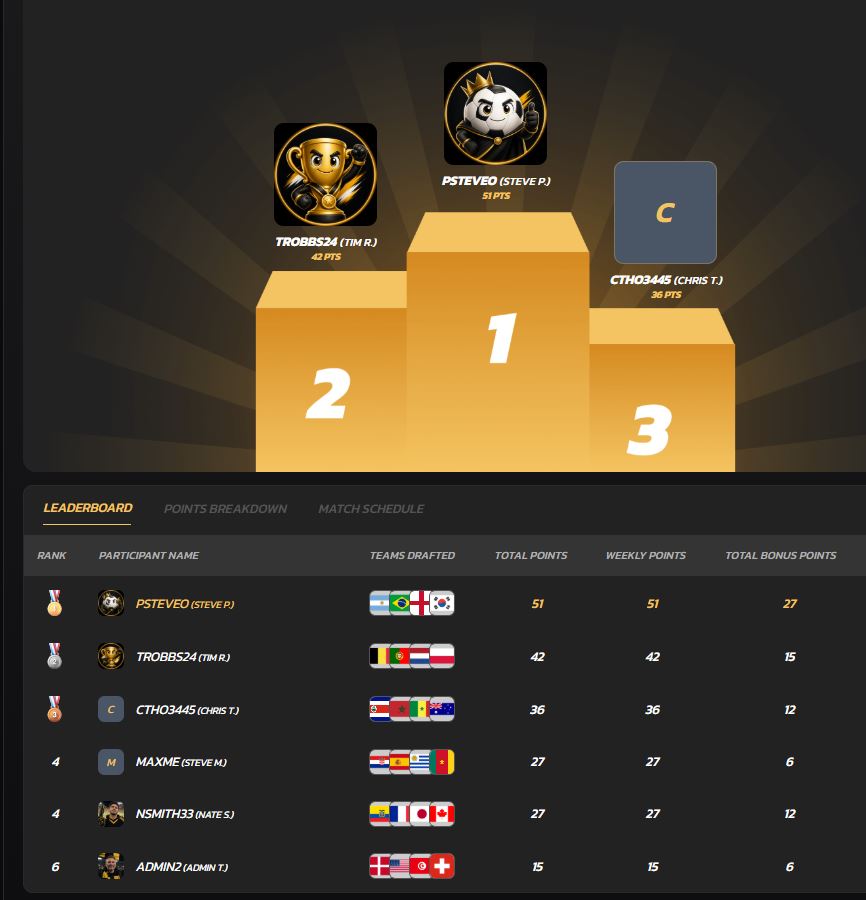
Commissioners can create private pools with custom scoring rules and invite their group in minutes. Draftwins charges a platform hosting fee and does not collect entry fees or hold prize money, keeping the experience clean and social. With the 2026 World Cup approaching, now is the time to set up your pool and get your group locked in before the draw is set.
FAQ
What is the difference between a bracket pool and a draft pool?
A bracket pool asks participants to predict match outcomes before the tournament. A draft pool asks participants to select and own national teams, earning points based on how far those teams advance.
How do World Cup draft pools work?
Participants use a snake draft to select national teams before the tournament starts. Points are awarded for each match win and for advancing through knockout rounds, with higher values in later rounds.
Which World Cup pool format is better for casual fans?
Bracket pools are better for casual fans. They require less preparation, no live draft session, and are familiar to anyone who has filled out a March Madness bracket.
How many teams should each person draft in a World Cup draft pool?
A standard setup has 12 participants each drafting 4 teams. With 48 teams in the 2026 World Cup, that gives every participant a meaningful stake in the tournament field.
Why does bracket geography matter in a draft pool?
Teams on the same side of the knockout bracket will eventually face each other. Drafting multiple teams from the same bracket half means your own picks eliminate each other before the high-value scoring rounds.