
A sports draft is the structured process by which participants select players or teams to build their competitive rosters in fantasy leagues and sports pools. The three foundational formats are the snake draft, auction draft, and linear draft, and each one shapes your strategy in a fundamentally different way. Whether you're joining an ESPN fantasy football league for the first time or setting up a World Cup pool with friends, understanding these types of sports draft formats explained here will determine how you approach every pick. The format you play in is not just a procedural detail. It's the engine driving every decision you make.
1. Types of sports draft formats explained: the big three
The snake, auction, and linear draft are the three formats that define how player selection works across fantasy sports and organized pools. Each format distributes competitive advantage differently, which means the skills you need to win change depending on which one you're playing. Knowing all three before draft day is the single biggest edge most casual players ignore.
These formats appear across platforms like ESPN, Yahoo Fantasy, and Sleeper, and they also influence how real professional leagues like the NFL and NBA structure their own player acquisition systems. The format is not arbitrary. It reflects the competitive philosophy of the league or pool you've joined.

2. What is a snake draft and how does it work
A snake draft uses an alternating pick order that reverses direction at the end of each round, so the manager who picks last in round one picks first in round two. This back-and-forth pattern is where the "snake" name comes from, and it's the most common format in standard fantasy leagues.
The structure creates a built-in equity mechanism. The manager with the first overall pick gets the best player available, but then waits the longest before picking again. Research shows that seats 6 through 12 in snake drafts consistently deliver strong value because of positional runs and tier cliffs at round boundaries. That means the middle of the draft order is often more advantageous than it looks on paper.
Key strategic considerations in a snake draft:
- Tier cliffs matter more than rankings. When a cluster of similar players ends at a round boundary, the manager who grabs the last player in that tier wins the round.
- Positional runs are predictable. If quarterbacks or running backs start flying off the board, you need to decide whether to follow or wait.
- Draft position shapes your entire roster construction. An early pick favors loading up on elite skill positions. A late pick rewards patience and depth.
Pro Tip: Before your snake draft, build a tiered player list rather than a straight ranking. When two players are in the same tier, always take the one at greater risk of being gone before your next pick.
3. What is an auction draft and why it changes everything
An auction draft gives every manager an identical fixed budget, typically $200 in most platforms, and players are acquired through live bidding rather than assigned pick slots. Auction values represent budget share per player, which is a completely different currency from snake draft rankings. The player who goes first is not determined by luck of the draw. Any manager can nominate and win any player.
This format removes positional runs entirely. In a snake draft, a run on wide receivers forces your hand. In an auction, you simply redirect your budget. That flexibility rewards managers who prepare detailed player valuations in advance and stay disciplined under the pressure of live bidding.
Common mistakes in auction drafts:
- Overpaying early. Managers who blow 60% of their budget on two stars often scramble to fill the rest of their roster with $1 bids.
- Ignoring roster construction. Winning an auction requires a plan for how many premium players you want versus how many mid-tier contributors.
- Treating values as fixed. Auction values are dynamic assets, not price tags. If a player you value at $40 goes for $25 because the room is distracted, that's a win.
Auction drafts are especially popular in keeper and dynasty leagues, where the ability to retain players across seasons makes precise valuation even more critical. If you're playing in a format where long-term roster building matters, the auction structure rewards the most prepared manager in the room.
Pro Tip: Enter every auction draft with a pre-set budget breakdown. Decide in advance what percentage of your total budget goes to running backs, wide receivers, and your quarterback. Stick to those percentages unless the market gives you a clear discount.
4. Explaining the linear draft and when it applies
A linear draft maintains the same pick order every single round. The manager who picks first in round one picks first in every subsequent round, with no reversal. This format is rare in season-long fantasy leagues but appears regularly in dynasty startup drafts and mirrors how professional leagues like the NFL historically structured early draft systems.
The fairness argument for linear drafts is weak compared to snake formats. The manager with the first pick holds a compounding advantage across every round. That's why third-round reversal variants were developed to balance pick equity. In a third-round reversal, the snake order flips in round three to redistribute the turn advantage that otherwise concentrates at the top of the board.
Where linear drafts make the most sense:
- Dynasty startup drafts, where the long-term value of early picks is offset by the ongoing nature of roster management across multiple seasons.
- Professional league drafts, where the reverse-order structure (a form of linear drafting) serves a parity function rather than a competitive one.
- Formats with deep player pools, where the advantage of picking first diminishes as the talent gap between early and late picks narrows.
Understanding the linear format matters even if you never play in one, because it clarifies why the snake format was invented in the first place.
5. How professional sports drafts compare to fantasy formats
Professional league drafts are the original model that fantasy sports drafting evolved from, and the differences between them reveal a lot about competitive design. NFL, NBA, and MLB draft systems each use distinct structures built around their league's specific competitive needs.
| League | Draft structure | Primary goal | Fantasy parallel |
|---|---|---|---|
| NFL | Strict reverse order of standings | Competitive parity | Linear draft logic |
| NBA | Lottery system for bottom teams | Discourage tanking | Randomized linear draft |
| MLB | Long-term development tiers | Player pipeline depth | Dynasty draft tiers |
The NFL's strict reverse-order system is the clearest example of a linear draft used for parity. The worst team picks first, every round, to redistribute talent across the league. The NBA lottery introduces randomness to prevent teams from deliberately losing games to secure top picks. MLB drafts operate on a longer development timeline, where the value of a pick is measured in years rather than weeks.
These real-world systems directly shape how fantasy communities think about draft construction. Dynasty leagues, which mirror the long-term roster management of professional teams, borrow heavily from MLB draft logic. Season-long snake leagues reflect the NFL's emphasis on immediate competitive value.
6. Why sports pools use drafts and how to win them
Drafting in sports pools serves a specific function: it creates fair competition and strategic differentiation among participants who all have access to the same player pool. Pool-based contests reward fewer correct picks more generously than fixed-odds formats, which means the social dynamics of who else is picking what directly affects your payout potential.
The winning sports pool draft approach changes based on pool size. Here's how to think about it:
- Small pools (under 20 participants): Conservative picks protect your floor. When fewer people are competing, the risk of being the only one who missed on a contrarian play is too high relative to the upside.
- Large pools (50 or more participants): Contrarian strategies are often the only path to winning. When chalk picks dominate the field, choosing a comparably valued but less popular player maximizes your leverage for differentiation.
- Scoring format awareness: Pools that heavily penalize missed picks demand a higher floor in your selections. Pools that reward upside plays favor aggressive roster construction.
- Tier-based pool logic: In tier-based pools, small pools reward conservative picks while large pools reward aggressive or contrarian approaches. Identify which tier your pool falls into before you make a single selection.
- Leverage versus floor: Every pick in a pool is a trade-off between safety and differentiation. The best drafters consciously decide which picks are floor anchors and which are leverage plays, rather than treating every selection the same way.
The reason sports contests use drafting rather than open selection is precisely this tension between safety and differentiation. Drafting forces scarcity, and scarcity forces strategy.
Key takeaways
The most effective draft format for any sports pool or fantasy league depends on the structure of competition, pool size, and whether the format rewards budget management, pick order strategy, or contrarian differentiation.
| Point | Details |
|---|---|
| Snake draft is most common | Alternating pick order balances advantage across rounds; middle seats often outperform expectations. |
| Auction drafts reward preparation | Budget discipline and dynamic valuation matter more than pick position in auction formats. |
| Linear drafts favor top picks | Fixed order compounds early advantages; third-round reversal variants exist to address this imbalance. |
| Pool size dictates strategy | Small pools reward conservative picks; large pools require contrarian plays to differentiate from the field. |
| Pro leagues shaped fantasy formats | NFL reverse-order, NBA lottery, and MLB development tiers all influenced how fantasy and pool drafts are structured. |
Draft smarter with DraftWins
Understanding draft formats is the foundation. Putting that knowledge into practice with the right platform is what separates a fun experience from a winning one.
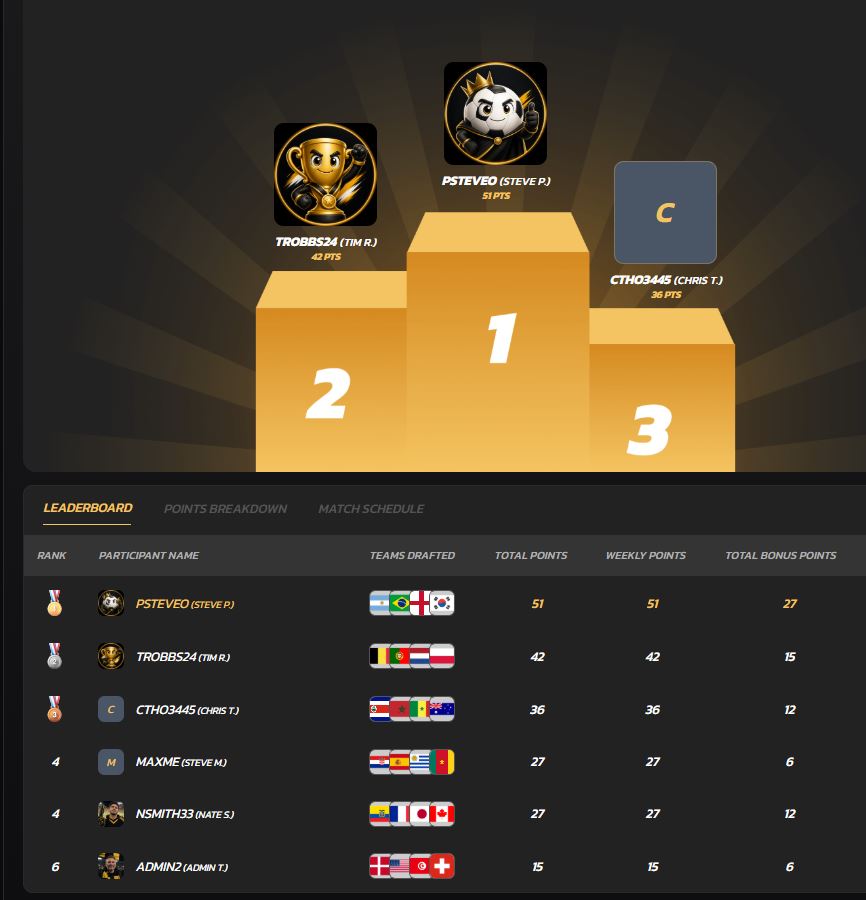
DraftWins is built for exactly this kind of competition. Instead of managing individual players and tracking weekly injuries, DraftWins lets you draft entire teams, which removes the lineup headaches that make traditional fantasy leagues exhausting. With automated scoring and live leaderboards, you always know where you stand without doing the math yourself. Commissioners can set up private pools with custom rules in minutes. DraftWins is launching with World Cup pools and expanding into NFL and College Football pools, so there's a format ready for every sports season. If you're ready to put your draft knowledge to work, start your pool at DraftWins today.
FAQ
What are the main types of sports draft formats?
The three main sports draft formats are the snake draft, auction draft, and linear draft. Snake drafts use a reversing pick order each round, auction drafts use a fixed budget for bidding, and linear drafts maintain the same pick order throughout.
Why do fantasy leagues use snake drafts most often?
Snake drafts are the default in most fantasy platforms because the alternating pick order creates built-in competitive balance without requiring additional rules. Platforms like ESPN and Yahoo Fantasy use snake drafts as their standard format for this reason.
How is an auction draft different from a snake draft?
In an auction draft, every manager has an equal budget and can bid on any player, while a snake draft assigns picks by position in a rotating order. Auction drafts shift the key skill from pick-order timing to budget allocation and player valuation.
When should you use a contrarian draft strategy in a sports pool?
Contrarian strategies work best in large pools where popular picks dominate the field. Choosing comparably valued but less popular players maximizes your differentiation and increases your share of the prize when chalk picks underperform.
What is a third-round reversal draft?
A third-round reversal modifies the standard snake draft by flipping the pick order in round three to reduce the compounding advantage held by managers with top picks. It's a variant designed to improve pick equity across the full draft.