
Draft position assignment is the process by which leagues and fantasy platforms determine the order in which teams or participants select players, using criteria like prior season record, weighted lotteries, or structured randomization. The NFL, NBA, and NHL each use distinct systems designed to protect competitive balance while rewarding rebuilding teams with earlier picks. Understanding how draft positions are assigned matters whether you follow professional sports or manage a fantasy roster, because the slot you hold shapes every selection decision you make.
How draft positions are assigned across major sports leagues
Draft order determination follows one core principle across all major sports: teams that performed worse in the previous season earn earlier picks. This reverse-order logic gives struggling franchises access to top talent, preventing dynasties from compounding advantages indefinitely. The NFL applies this principle most directly, while the NBA and NHL layer in lottery systems to add unpredictability and prevent teams from deliberately losing games to secure better draft slots, a practice known as "tanking."
The three systems differ in meaningful ways. The NFL uses a near-pure reverse-order format for non-playoff teams. The NBA assigns weighted lottery odds to the 14 worst teams. The NHL runs two separate lottery draws with movement restrictions. Each approach reflects the league's philosophy on fairness, competitive balance, and fan engagement.

How the NFL assigns draft slots based on record and playoff round
The NFL draft order is determined by the reverse order of regular-season record, with the team holding the worst record picking first and the Super Bowl champion picking last in every round. Teams that missed the playoffs occupy slots 1 through 20, ranked from worst to best record. Playoff teams fill slots 21 through 32 based on how far they advanced, with first-round exits picking earlier than conference championship losers.
This structure creates a clear, performance-based draft position determination that fans can track in real time as the regular season ends. A team finishing 4-13 picks before a team finishing 7-10, regardless of division or conference. Tiebreakers use strength of schedule, then coin flips when records and schedules are identical.
The system grows more complex through compensatory picks. Teams that lose significant free agents receive additional picks at the end of rounds 3 through 7, with the round determined primarily by the lost player's salary. Losing a top wide receiver might yield a fourth-round compensatory pick, while losing a depth linebacker might generate a sixth-round pick. The NFL awards up to 32 compensatory picks per draft, adding meaningful depth to rosters that lost talent in free agency.
Trades add another layer. Teams routinely exchange future picks, meaning a team's actual draft slot can differ dramatically from its earned position. The Los Angeles Rams, for example, traded away multiple first-round picks to acquire veterans, leaving them without top selections for years.
- Non-playoff teams pick in slots 1-20, ordered worst to best record
- Playoff teams fill slots 21-32 based on round of elimination
- Super Bowl champion picks 32nd in every round
- Compensatory picks extend rounds 3-7 for teams that lost free agents
- Trades can shift any team's slot before or during the draft
Pro Tip: Track compensatory pick projections starting in January using tools like OverTheCap, which models expected awards based on free agent signings and losses before the NFL officially announces them in April.
How the NBA draft lottery determines early pick order
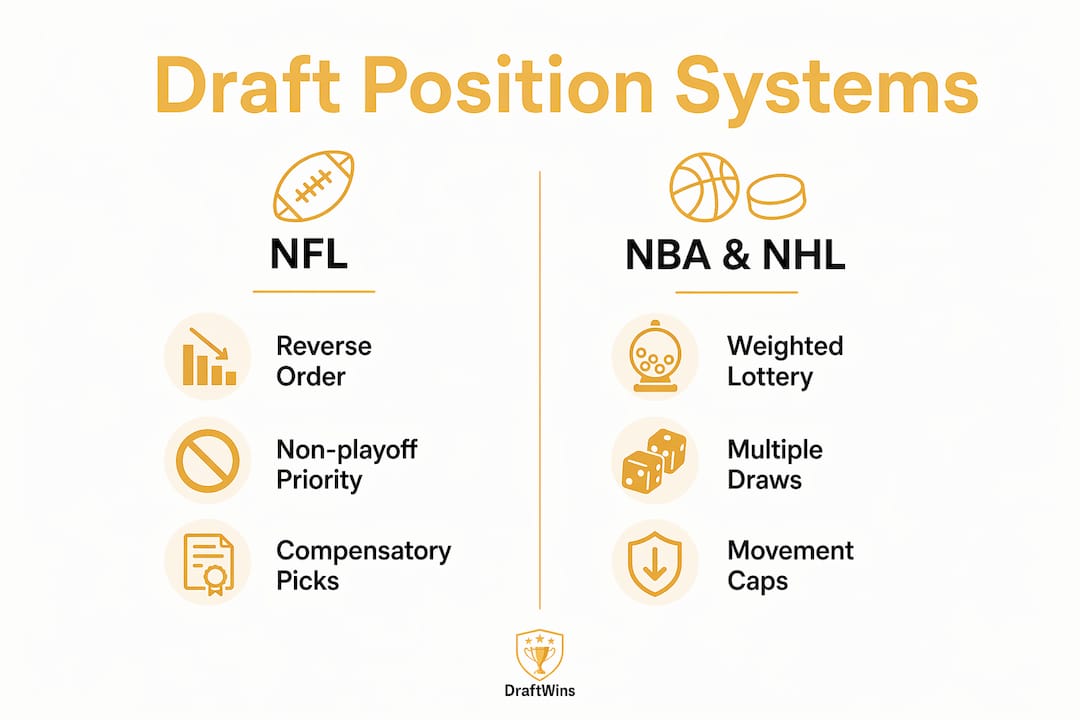
The NBA draft lottery assigns the first 14 picks using 1,000 weighted ping-pong ball combinations distributed among the 14 teams that missed the playoffs, with worse records receiving a larger share of combinations. The team with the worst record holds the highest probability of landing the first pick, but no team is guaranteed any specific slot. Teams ranked 15 through 30 pick in reverse order of regular-season record, with no lottery involved.
The mechanics matter because they directly affect draft position equity. The lottery uses 14 balls numbered 1 through 14 to generate combinations. One combination out of 1,001 possible results is designated as a redraw, leaving exactly 1,000 active combinations. The drawing process includes multiple 10-20 second mixing intervals before each ball is selected, and any unassigned combination drawn triggers an automatic redo. This multi-step process is designed to prevent manipulation and guarantee genuine randomness.
Here is how the lottery draw sequence works:
- All 14 lottery balls are placed in the drum and mixed for at least 20 seconds before the first ball is drawn
- Four balls are drawn to create a combination, which is matched against the assigned team list
- The balls are returned and the process repeats to determine the second pick
- The third and fourth picks are drawn using the same method
- Picks 5 through 14 are then assigned in reverse order of regular-season record among remaining lottery teams
The contrast with the NFL is significant. The NFL's draft position determination is almost entirely predictable by November of the regular season. The NBA's lottery means a team with the worst record has roughly an 14% chance of landing the first pick, not a guarantee. This uncertainty drives trade value calculations and roster decisions throughout the season.
What makes the NHL draft lottery system unique
The NHL draft lottery assigns four-number combinations to non-playoff teams based on their regular-season finish, with the team finishing last receiving 185 combinations, representing an 18.5% chance of winning the first pick. Better-finishing non-playoff teams receive fewer combinations, creating a weighted probability structure similar to the NBA's approach.
What separates the NHL system is its two-draw structure and movement restrictions. Two separate lottery draws determine the first and second overall picks, with each draw conducted independently. A team that wins the first draw is removed from consideration for the second, preventing any single franchise from claiming both top selections.
| NHL lottery rule | How it works |
|---|---|
| Weighted combinations | Last-place team receives 185 of 1,000 combinations (18.5% odds) |
| Two-draw structure | Separate draws determine picks 1 and 2 independently |
| Movement cap | Teams can move up a maximum of 10 spots from their original position |
| Consecutive win restriction | No team can win the lottery more than twice in any five-year span |
| Remaining order | Picks 3 through 16 follow reverse regular-season order after lottery |
The 10-spot movement cap is the NHL's most distinctive rule. A team ranked 12th among non-playoff teams cannot win the first overall pick, because moving from 12th to 1st would require jumping 11 spots. This restriction means only the 11 lowest-ranked non-playoff teams are eligible to win the top pick, regardless of their lottery odds. If a team outside that range draws a winning combination, the result is discarded and redrawn.
Pro Tip: The five-year consecutive win restriction means teams that recently won the lottery carry lower effective odds in subsequent years. Factor this into trade valuations when acquiring picks from teams that won recently.
How draft position equity shapes fantasy sports strategy
Draft position equity in fantasy sports refers to the relative value of each seat in a snake draft, accounting for pick timing, spacing between selections, and positional scarcity. Not all seats are created equal, and understanding the factors affecting draft slots gives you a structural edge before a single player is selected.
The most discussed advantage belongs to turn positions in snake drafts. In a 12-team league, seats 11 and 12 receive back-to-back picks at the end of each round, allowing those managers to secure two players of similar tier quality before anyone else picks again. This consecutive selection window is particularly valuable when a talent tier is running thin and you need to grab two positions before a scarcity cliff hits.
Scarcity cliffs are the single most important concept in fantasy draft strategy. Running back scarcity commonly hits around picks 18-30, meaning managers who wait too long on the position face a sharp drop in available production. The same pattern applies to tight ends, where elite options are concentrated in the first three rounds and the falloff to the next tier is steep. Recognizing where these cliffs exist for a given draft class lets you time your picks to land just above the drop.
"Managers must consider how positional value and elite talent concentration affect their draft strategies more than draft position alone." The implication is clear: your seat number matters less than your awareness of where value concentrates in the player pool.
What influences draft rankings in fantasy contexts goes beyond raw player talent. Draft position equity fluctuates based on how tightly talent is clustered within tiers. When a draft class has a generational outlier at the top, the first overall pick carries outsized value. When the top 20 players are tightly grouped in production, early picks lose their premium and mid-round seats become more competitive.
The ADP deviation concept adds another practical layer. Selecting a player significantly earlier than their average draft position burns pick equity unless scarcity or positional value justifies the reach. If a quarterback is going in round 8 on average and you take him in round 5, you have spent three rounds of value on a position that did not require urgency. Understanding draft pick order and position value helps you avoid these costly deviations while still acting decisively when a tier is about to collapse.
For a deeper look at how different draft formats across sports affect pick value and strategy, the structural differences between auction drafts, snake drafts, and linear drafts each create different equity profiles worth understanding before draft day.
Take your draft strategy further with Draftwins
Understanding how draft order works is the foundation. Applying it in a well-structured contest is where the real competition begins.
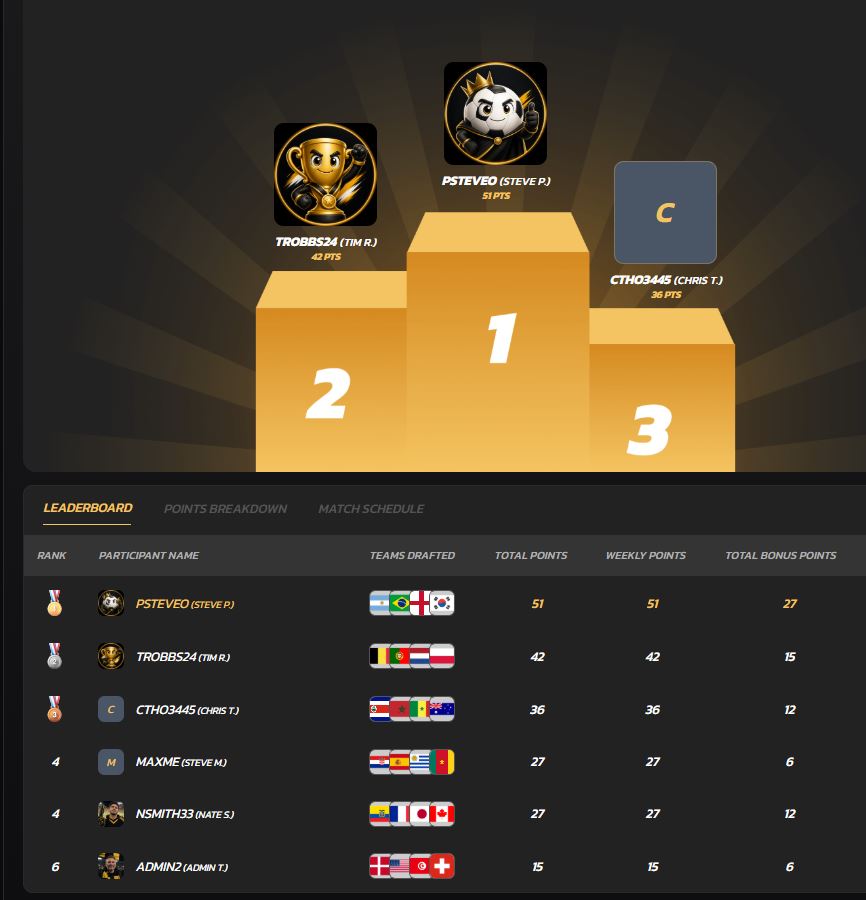
Draftwins is built for sports fans who want the thrill of drafting without the complexity of traditional fantasy leagues. Instead of managing individual player lineups, you draft teams and let automated scoring and live leaderboards handle the rest. Commissioners set up private pools with custom rules, and every participant focuses on competition rather than injury reports. Draftwins launches with World Cup pools, with NFL and College Football pools to follow. If you are ready to put your draft knowledge to work, Draftwins gives you the platform to do it.
FAQ
How are draft positions assigned in the NFL?
The NFL assigns draft positions in reverse order of the prior season's regular-season record, with the worst team picking first. Playoff teams slot in based on their round of elimination, and the Super Bowl champion picks last in every round.
What is the NBA draft lottery and how does it work?
The NBA draft lottery uses 1,000 weighted ping-pong ball combinations to determine the first 14 picks, with worse-record teams receiving more combinations and higher odds. Teams ranked 15 through 30 pick in reverse order of regular-season record without a lottery.
How does the NHL draft lottery differ from the NBA's?
The NHL runs two separate draws to assign the first and second overall picks, with a 10-spot movement cap that limits how far a team can jump. No team can win the lottery more than twice in any five-year span.
What is a scarcity cliff in fantasy drafts?
A scarcity cliff is the point in a draft where viable players at a specific position run out, causing a sharp drop in available production. Running back scarcity commonly hits around picks 18-30, making early selection at premium positions critical.
Does draft seat position matter in fantasy snake drafts?
Yes. Turn positions, specifically seats 11 and 12 in a 12-team league, offer back-to-back picks that allow managers to secure two players from the same talent tier before anyone else selects again.
Key takeaways
Draft position assignment across professional sports and fantasy leagues follows performance-based criteria, weighted lotteries, and structural rules that directly determine which teams and managers access the best available talent.
| Point | Details |
|---|---|
| NFL uses reverse order | Non-playoff teams pick slots 1-20 by worst-to-best record; playoff teams fill 21-32 by elimination round. |
| NBA lottery adds uncertainty | 1,000 weighted combinations give worse teams better odds without guaranteeing top picks. |
| NHL caps upward movement | Teams can move up a maximum of 10 spots, limiting lottery wins to the bottom 11 non-playoff teams. |
| Turn seats hold fantasy value | Seats 11 and 12 in snake drafts deliver back-to-back picks that protect against tier collapses. |
| Scarcity cliffs drive timing | Running back and elite tight end value drops sharply after specific pick ranges, making position timing critical. |