
Team value in a fantasy draft is defined as the measure of how well your entire roster fits together across positions, risk profiles, and scoring potential. It is not simply about picking the highest-projected players. The concept, rooted in Value-Based Drafting (VBD) and Roster Construction Theory, determines whether your picks add up to a winning team or just a collection of names. For casual gamers and FIFA World Cup 2026 fantasy fans alike, understanding why team value matters in a draft is the difference between competing for first place and finishing in the middle of the pack.
Why team value matters in the draft more than individual picks
Team value results from roster construction focused on positional balance, risk profiles, and scoring timelines rather than raw individual projections. Think of your draft like building a stock portfolio. You would not put every dollar into one stock, no matter how promising it looks. The same logic applies here: one elite player cannot carry a roster that bleeds points at every other position.
Casual fantasy players often make the same mistake. They chase the biggest names in early rounds and then scramble to fill positions with whatever is left. The result is a roster with one or two stars and a weak supporting cast. Positional balance and scoring slot availability drive outcomes far more than any single pick, which is why even rosters with strong individual players can underperform when the overall construction is unbalanced.

The practical takeaway is direct: your draft grade is not set by your best pick. It is set by how well every pick fits the whole.
What is value-based drafting and how does it work?
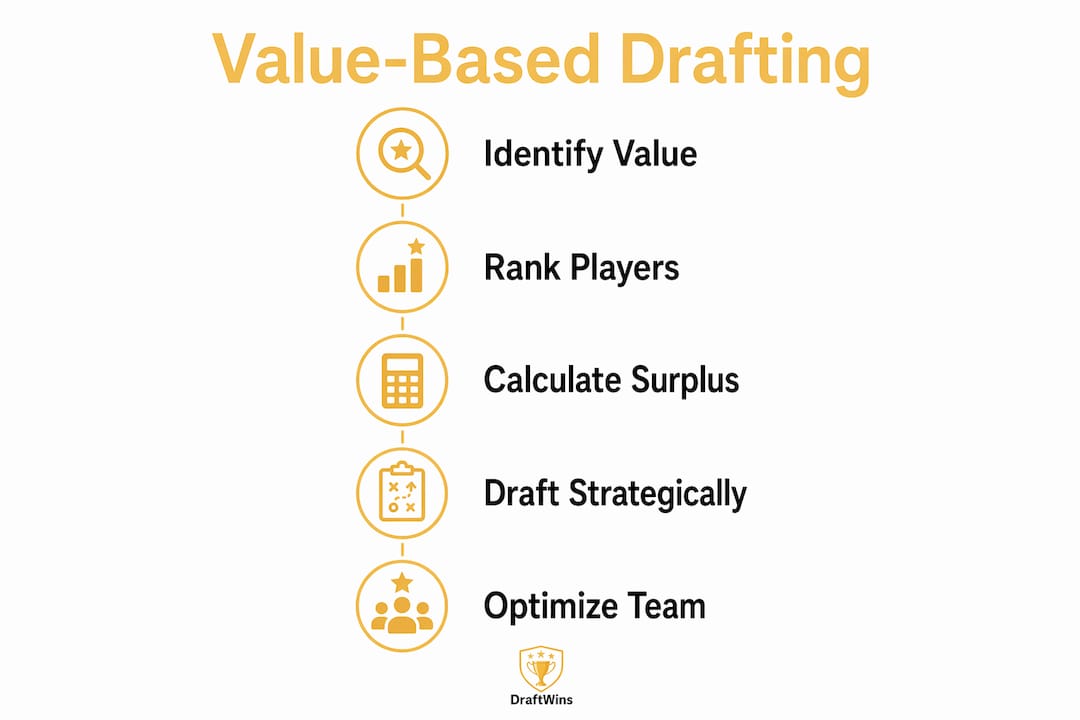
Value-Based Drafting, or VBD, is a framework that turns projections into draft cost decisions by measuring how much surplus value a player provides over a replacement-level baseline for that roster slot. The replacement level is the best player you could pick up for free after the draft ends. Any player you draft should be worth more than that free option. If he is not, you are wasting a pick.
Here is how positional scarcity changes the math. A running back who scores 180 projected points might be worth more than a wide receiver projected at 200 points, if the running back position runs dry after round four while quality wide receivers remain available in round eight. VBD forces you to compare players against what you would get if you did not draft them at all.
- Identify your league's replacement level for each position before the draft starts. This is the projected output of the best undrafted player at that spot.
- Calculate surplus value by subtracting the replacement baseline from each player's projection.
- Rank players by surplus value, not raw points, to build your draft board.
- Adjust for positional scarcity by noting how quickly each position's surplus value drops off as rounds progress.
Pro Tip: Draft boards built on surplus value over replacement level consistently outperform boards built on raw projections. Build yours before draft day, not during it.
Experts treat fantasy drafting as a competitive market problem, where the goal is buying as much surplus value as possible relative to replacement levels. The drafter who understands this framework walks into any draft with a structural advantage over the drafter who simply ranks players by projected points.
How does roster construction theory shape a balanced draft?
Roster Construction Theory treats your draft as a sequence of resource allocation decisions across fixed positions and a fixed number of picks. Each pick you make changes the value of every future pick. That is what makes drafting genuinely strategic rather than just picking the best available player each round.
Four principles define good roster construction:
- Balance floor and ceiling across positions. A roster full of high-upside, high-risk players will boom or bust wildly. Mixing reliable floor players with upside picks creates a more stable scoring base.
- Account for scoring system effects. Half-PPR leagues value running backs differently than full-PPR leagues. Multi-quarterback leagues inflate quarterback value dramatically. Your roster construction must reflect your specific scoring rules, not generic rankings.
- Manage injury risk by position. Running backs carry the highest injury risk in football. Drafting two reliable running backs before loading up at wide receiver is not conservative. It is sound risk management.
- Plan your bench with purpose. A bench full of handcuffs and bye-week fillers is wasted roster space. Each bench spot should serve a specific function: upside stash, injury insurance, or streaming option.
"Draft decisions act like portfolio allocations, optimizing floor and ceiling across positions to avoid scoring gaps." — Roster Construction Value Theory, Draft Value Analytics
A roster lacking depth at high-injury-risk positions is predictably exposed despite some star performers. You can draft the best running back in the league and still lose your season if he gets hurt in week three and you have no viable backup. Roster construction theory prevents that outcome by building redundancy into your draft plan from the start.
The scoring system point deserves extra attention. Drafters who use generic rankings in a full-PPR league are working with the wrong map. Positional value shifts meaningfully between formats, and draft pick strategy must reflect those shifts to maximize team value.
How do draft position and economics affect team value?
Draft order carries real economic weight in professional sports, and the same principle echoes in fantasy drafts. In the NFL, pick #10 earns about 55% of the #1 pick's rookie contract value, while pick #20 earns around 37%. Early picks cost significantly more in cap space, not just in perceived talent. That cost structure shapes how teams allocate resources across the entire roster.
In fantasy drafts, the same dynamic plays out through auction budgets and snake draft positioning. Spending heavily on the first pick in an auction draft leaves less budget for depth. Taking a reach in round two of a snake draft creates a ripple effect through every subsequent round.
| Draft approach | Team value impact |
|---|---|
| Overpaying for one star | Weakens depth at multiple positions |
| Trading down for more picks | Increases roster flexibility and depth |
| Targeting surplus value picks | Maximizes points per draft resource spent |
| Ignoring replacement level | Creates scoring gaps in mid-tier positions |
Research shows draft order is not a strong predictor of long-term player performance beyond early rounds. No relationship was found between draft position and career length or performance for fourth and fifth round NFL players. Teams that traded down showed measurable advantages in roster depth. The implication for fantasy drafters is clear: the best value often sits in the middle rounds, not at the top of the board.
Strategic trading down can yield higher team value by accumulating picks at positions where the talent pool stays deep longer. This is how experienced drafters build rosters that outperform their draft slot.
How do scoring systems and World Cup formats change team value?
The FIFA World Cup 2026 fantasy draft is a strong example of how format rules reshape team value from the ground up. Nation limits, formation constraints, and captaincy multipliers all force drafters to think about roster construction differently than a standard season-long league.
The captain mechanic alone changes the calculus significantly. Fantasy scoring multipliers like captain points doubling can dramatically change expected player value across a tournament. A player from a nation with three group stage matches and a favorable draw is worth more than a player with identical raw scoring potential but a brutal fixture schedule. Repeated access to high-upside captaincy candidates is a drafting priority, not a luxury.
- Prioritize players from nations with favorable fixtures in the early rounds. Fixture difficulty affects scoring potential more than individual talent in short tournament formats.
- Draft multiple captaincy candidates so you have flexibility each matchweek rather than relying on one player.
- Respect nation limits. Stacking too many players from one nation creates a single-point-of-failure risk if that nation exits early.
- Build bench depth for rotation. Maintaining flexibility for bench swaps and formation rotation is vital to avoid being locked into suboptimal starters as the tournament progresses.
- Account for transfer liquidity. Ignoring transfer constraints early forces costly corrections later, reducing your team's overall value at the knockout stage.
Pro Tip: In World Cup fantasy formats, a player from a top nation with three easy group games is often worth more than a global star from a nation likely to exit in the round of 16. Draft the fixture, not just the name.
Roster building under tournament constraints resembles a constrained optimization problem. Flexibility preserved early pays dividends in the knockout rounds, when the field narrows and your transfer options become your most valuable asset.
Draftwins makes team value drafting simple and fun
Draftwins is built for exactly the kind of drafting this article describes. The platform lets you draft teams instead of individual players, removing the lineup management stress that makes traditional fantasy leagues feel like a second job.
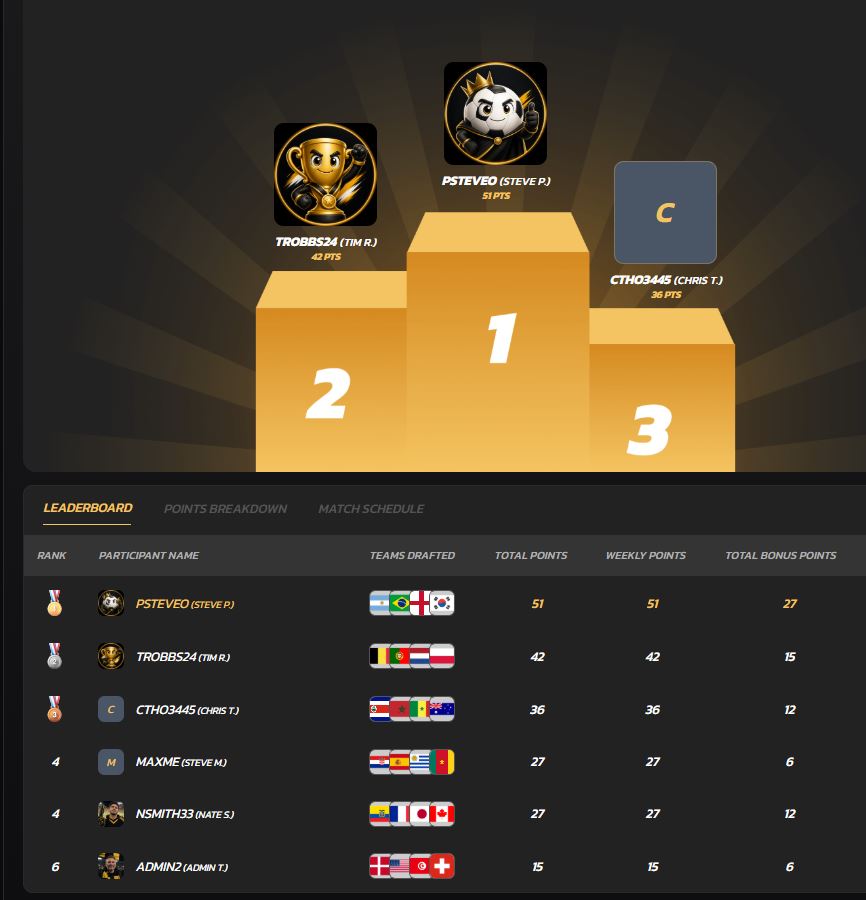
With automated scoring and live leaderboards, Draftwins tracks your team's performance without requiring you to monitor injury reports or waiver wires. Commissioners can create private pools with custom scoring rules, so the format fits your group rather than forcing your group to fit the format. Draftwins is launching with World Cup pools for 2026, followed by NFL and College Football pools. If you want to put roster construction theory into practice without the complexity, Draftwins is the place to start.
FAQ
What is value-based drafting in fantasy sports?
Value-based drafting (VBD) measures a player's surplus value over the best freely available replacement at that position. Drafters use it to build rosters that maximize total scoring output rather than just collecting high-profile names.
Why does positional balance matter in a fantasy draft?
Positional balance prevents scoring gaps that a single star player cannot fix. A roster with elite talent at one position but weak depth elsewhere will consistently underperform a balanced roster across a full season.
How does draft position affect team value in the NFL?
NFL draft position overpromises player potential, particularly beyond the early rounds. Research shows no reliable relationship between draft slot and long-term performance for mid-to-late round picks, making strategic trades down a legitimate path to better roster value.
How do World Cup fantasy formats change drafting strategy?
FIFA World Cup 2026 fantasy drafts require managing nation limits, formation rules, and captaincy multipliers. Fixture difficulty and rotation risk matter as much as individual player quality in a short tournament format.
Can casual gamers benefit from roster construction theory?
Roster construction theory applies at every skill level. Even casual drafters who follow basic principles like balancing floor and ceiling players and avoiding positional gaps will outperform those who simply pick their favorite players.
Key takeaways
Team value in a fantasy draft is determined by positional balance, surplus value over replacement level, and roster-wide risk management, not by the quality of any single pick.
| Point | Details |
|---|---|
| Team value beats individual picks | A balanced roster consistently outscores a star-heavy, unbalanced one across a full season. |
| VBD is the core framework | Draft players based on surplus value over replacement level, not raw projected points. |
| Scoring systems change position value | Adjust your draft board to match your league's specific rules, such as PPR or multi-QB formats. |
| Draft position economics matter | Overpaying early limits depth; trading down often yields better overall team value. |
| Tournament formats add constraints | World Cup fantasy drafts require managing fixtures, nation limits, and captaincy options as primary priorities. |