
Draft position advantage in a pool contest is defined as the structural edge one draft slot holds over others in determining access to top-tier players, positional value, and strategic flexibility. Your slot number is not just a number. It shapes every pick you make, every position you target, and every tier cliff you either exploit or fall into. In a 10-team league, the 4th draft slot produced 50% of the top 20 finishers while the 10th slot produced zero top-10 finishers. That gap is not luck. It is the direct result of positional scarcity, tier cliffs, and pool size effects working together.
How does draft position impact your strategy in pool contests?
Draft position strategy is the practice of adjusting your pick targets and positional priorities based on where you sit in the draft order. The three main positions, early, middle, and late, each carry a distinct risk and reward profile.
Early picks (slots 1–3) give you access to the most elite players available. You lock in a top running back or wide receiver before anyone else can touch them. The tradeoff is a long wait before your next pick in a snake draft, which means positional runs can wipe out entire tiers by the time you pick again.

Middle picks (slots 4–9) offer the most flexibility on paper, but they carry the highest exposure to tier cliffs. Middle draft slots must pre-map tier cliffs to avoid being caught when positional runs clear top talent unpredictably. If you sit at pick 6 and a run on tight ends starts at pick 4, you may miss the entire top tier at that position.
Late picks (slots 10–12) carry a structural advantage that casual players often overlook. Late draft slots pick last in odd rounds but first in even rounds, giving them consecutive picks at the turn. Those back-to-back picks let you react aggressively to positional runs and scarcity cliffs, almost like running a mini-auction within the draft.
Here is how each position breaks down strategically:
- Early slots: Target elite players at scarce positions first. Accept the long wait and plan your second pick before the draft starts.
- Middle slots: Map tier cliffs in advance. Know exactly where the RB, WR, and TE drop-offs occur so you can react before the run starts.
- Late slots: Use the turn to double up on a position that just experienced a run. Two solid picks at the same position in back-to-back rounds can offset the disadvantage of waiting through the first round.
Pro Tip: Before your draft, print or bookmark a tiered ranking sheet organized by position. Mark the scarcity cliffs, the pick ranges where elite players at each position run out. For RBs, that cliff hits around picks 18–24. For WRs, it falls between picks 36–48. Knowing these in advance lets you act before the run, not after.
What role does pool size play in maximizing your draft advantage?
Pool size is the single biggest factor shaping your drafting risk tolerance and overall approach. A 10-person office pool and a 500-entry tournament bracket require completely opposite strategies, even if the draft format is identical.
In small pools of roughly 20 or fewer participants, the best approach is to mirror consensus rankings closely. Safe, high-probability picks keep you competitive because the field is small enough that one contrarian miss can knock you out of contention. Small pools favor safe picks while pools with 500 or more entries reward contrarian strategies that differentiate your entry from the crowd.
Large tournament pools flip this logic entirely. When hundreds of entries all pick the same favorites, those picks carry no leverage. If the favorite wins, everyone who picked them wins too, and you split the prize. Lower-seeded upsets occur roughly 35% of the time in large bracket contests, which means contrarian picks carry real statistical backing, not just wishful thinking.
Draft format also changes how much your slot number matters:
- Snake drafts: Draft position matters most here. The order is fixed, and positional runs hit different slots at different times.
- Best ball formats: Late slots gain extra value because you accumulate players across rounds without managing a weekly lineup.
- Team-based pool drafts (like those on Draftwins): You draft entire teams rather than individual players, which reduces the impact of single-player injury risk and shifts the focus to team-level value and matchup strength.
Pro Tip: Before your draft, identify your pool size and write down one word: "safe" or "contrarian." That single word should guide every borderline pick decision you make. In a 12-person office pool, safe wins more often. In a 200-entry bracket, contrarian is the only path to the top.
How do tier-based and value over replacement strategies work?
Two frameworks separate informed drafters from casual ones: tiering and Value Over Replacement Player, known as VORP. Understanding both will change how you read a draft board.
Tiering means grouping players into clusters of roughly equal value rather than treating every rank as a unique step down. A tier cliff is the gap between two tiers where player quality drops sharply. Scarcity cliffs at key positions appear at predictable pick ranges: RBs between picks 18–24, WRs between picks 36–48, and TEs between picks 24–36. When you see a cliff approaching, you pick before it, not after.
VORP measures how much better a player is compared to the best freely available replacement at that position. Drafting the highest projected scorer is less effective than using a VORP framework that accounts for positional scarcity. A running back projected for 180 points may be worth more than a quarterback projected for 300 points if replacement-level quarterbacks score 280 and replacement-level running backs score only 140.
Here is how to apply both frameworks based on your draft slot:
- Build your tier sheet before the draft. Group players into tiers of 3–5 at each position. Mark the cliffs clearly.
- Identify your slot's exposure window. If you pick 7th in a 12-team league, calculate which tiers will still be available when your pick arrives.
- Use VORP to break ties. When two players from different positions sit at the top of your board, pick the one with higher surplus value over their replacement, not the one with higher raw points.
- React to runs in real time. If a positional run starts two picks before yours, move up your tier cliff pick. Do not wait for the next round.
- Adjust for your pool format. In a team-based pool on a platform like Draftwins, VORP applies to team-level matchup strength rather than individual player stats.
Pro Tip: The most common mistake in middle-slot drafting is ignoring tier cliffs until it is too late. By the time you see three players at one position go in a row, the cliff has already passed. Set a mental trigger: if two players at a scarce position go back-to-back before your pick, move that position to the top of your board immediately.
What are the most common draft position mistakes to avoid?
Most pool contest losses trace back to a handful of repeatable errors. Recognizing them before your draft is worth more than any ranking sheet.
- Assuming early picks always win. Early slots give you elite access, but a poor strategy in rounds 3–6 erases that advantage fast. The draft does not end after pick 1.
- Ignoring positional runs. A run is when multiple managers pick the same position consecutively. Failing to recognize positional runs causes middle-slot managers to miss entire tiers they planned to target.
- Misreading your pool size. Playing a contrarian strategy in a 10-person office pool is a losing move. Avoiding crowd picks only pays off when the pool is large enough that differentiation creates real leverage.
- Overcommitting to a position early. Drafting two running backs in the first three rounds because you fear the scarcity cliff can leave you thin at quarterback or wide receiver by round 5.
- Treating draft order as destiny. Draft order is a tool to control turn dynamics and positional scarcity awareness, not a fixed outcome. Every slot can win with the right preparation.
Pro Tip: Keep a live draft board visible during your draft, whether that is a browser tab, a printed sheet, or a platform's built-in tracker. Cross off players as they go. Seeing the board shrink in real time is the fastest way to spot an incoming positional run before it costs you.
Key takeaways
Draft position advantage in pool contests is determined by your slot's access to elite players, your exposure to tier cliffs, and your ability to match strategy to pool size and format.
| Point | Details |
|---|---|
| Early slots offer elite access | Picks 1–3 secure top players but require planning for the long wait between selections. |
| Late slots gain turn advantage | Back-to-back picks at the turn let late drafters react to positional runs and scarcity cliffs. |
| Pool size drives risk tolerance | Small pools reward safe consensus picks; large pools require contrarian picks to win. |
| VORP beats raw projected points | Pick the player with the highest surplus value over their replacement, not the highest total projection. |
| Tier cliffs decide middle-slot success | Middle pickers must map scarcity cliffs before the draft to avoid missing entire position tiers. |
See your draft position advantage on Draftwins
Knowing your draft slot strategy is one thing. Having a platform built to support it is another.
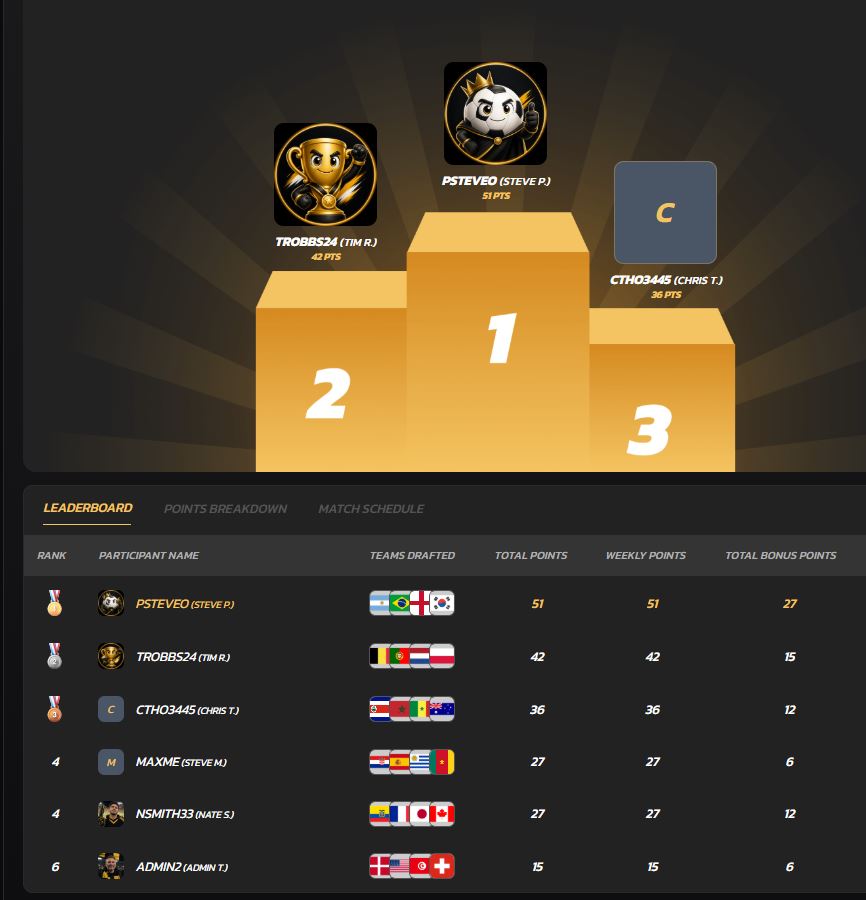
Draftwins is built for sports fans and casual gamers who want the excitement of a group pool without the complexity of traditional fantasy leagues. Instead of managing individual player rosters, you draft entire teams and let automated scoring and live leaderboards do the work. Commissioners can set up private pools with custom rules in minutes, making it perfect for office groups and friend circles. Draftwins launches with World Cup pools, with NFL and College Football pools coming next. If you want to put your draft position strategy to work in a format that actually fits how you play, Draftwins is where to start.
FAQ
What is draft position advantage in a pool contest?
Draft position advantage is the structural edge a specific draft slot provides in terms of access to top players and strategic flexibility. Early slots secure elite players; late slots gain consecutive picks at the turn.
Which draft position is best in a snake draft?
No single slot is universally best. Early slots (1–3) secure elite players, while late slots (10–12) benefit from back-to-back turn picks that allow reactive drafting. Middle slots require the most preparation.
How does pool size change my draft strategy?
Pool size determines whether you should play it safe or go contrarian. Small pools of roughly 20 or fewer entries favor consensus picks, while large pools of 500 or more entries reward contrarian selections that separate your entry from the crowd.
What is a tier cliff and why does it matter?
A tier cliff is a sharp drop in player quality at a position once the top players are gone. In snake drafts, RB scarcity cliffs hit around picks 18–24, making it critical to draft before the cliff rather than after.
How is Draftwins different from traditional fantasy leagues?
Draftwins lets you draft teams instead of individual players, removing the need for weekly lineup management. Automated scoring and live leaderboards track results automatically, making it ideal for casual office or friend group pools.