
Knockout round pool scoring is a system where participants earn points based on how far their drafted teams advance through a single-elimination bracket, with each win or advancement triggering a point award. Unlike round-robin or cumulative league scoring, where every match matters equally, knockout scoring concentrates value on survival: a team that wins in the quarterfinals earns more than one that loses in the round of 16. Only matches in the main bracket typically count; consolation rounds are usually excluded unless the commissioner explicitly opts them in. Platforms like Draftwins automate the whole process, so your leaderboard updates the moment a result is confirmed.
Table of Contents
- How does knockout round pool scoring work?
- What scoring schemes do commissioners actually use?
- Scoring nuances specific to draft-based team pools
- Tie-breakers, cancelled matches, dropouts, and edge cases
- How to set scoring rules: templates commissioners can copy
- Step-by-step worked scoring examples
- Why automated scoring matters for knockout pools
- Key Takeaways
- Draftwins makes running a knockout pool straightforward
- Further reading and authoritative sources
- FAQ
How does knockout round pool scoring work?
A single-elimination bracket pairs teams so that one loss ends their run, and N teams produce exactly N − 1 total matches. Brackets are sized to powers of two: 4, 8, 16, or 32 teams. When entry counts fall between those numbers, top seeds receive byes in the opening round.
How rounds halve the field:
- Round of 16 (16 teams) → 8 winners advance
- Quarterfinals (8 teams) → 4 winners advance
- Semifinals (4 teams) → 2 winners advance
- Final (2 teams) → 1 champion
What typically earns points in a draft-based pool:
- A win in any bracket round
- Advancing to the next round (sometimes scored separately from the win itself)
- Reaching a named stage (quarterfinal, semifinal, final, champion)
- Upset bonus when a lower seed beats a higher seed
What usually does NOT count:
- Third-place or consolation matches (unless the commissioner enables them)
- Bye rounds (no match, no points)
- Forfeits or walkovers, which most platforms treat as byes
In a bracket with multiple rounds, a team that wins successive matches earns points at each stage. A team that loses in an early round earns points only for that one win. That gap is exactly what makes late-round matches feel electric.
What scoring schemes do commissioners actually use?
The most common formulas combine per-win points, per-advance points, stage multipliers, and upset bonuses. Here is how each piece works:
- Per-win: flat points for every match won (e.g., 10 points per win)
- Per-advance: bonus for reaching a specific round (e.g., +20 for reaching the semifinal)
- Stage multiplier: multiply base win points by a round factor (e.g., ×2 in the semifinal, ×3 in the final)
- Upset bonus: extra points when a lower seed eliminates a higher seed (e.g., +5 points)
- Elimination bonus: points awarded to the pool participant whose team eliminates the tournament favorite
- Consolation points: small flat award for teams that reach a third-place match (optional, commissioner-enabled)
A simple total formula: Total = Σ(win points + advance points × stage multiplier + upset bonus)
| Scheme | Win Points | Advance Bonus | Multiplier | Upset Bonus | Best For |
|---|---|---|---|---|---|
| Casual flat | 10 | 0 | ×1 | 0 | First-time pools |
| Balanced | 10 | 10 | ×1.5 | 5 | Mixed groups |
| Competitive | 5 | 20 | ×2 | 10 | Experienced pools |
| Stage-heavy | 0 | — | ×3 | 0 | Drama-focused pools |
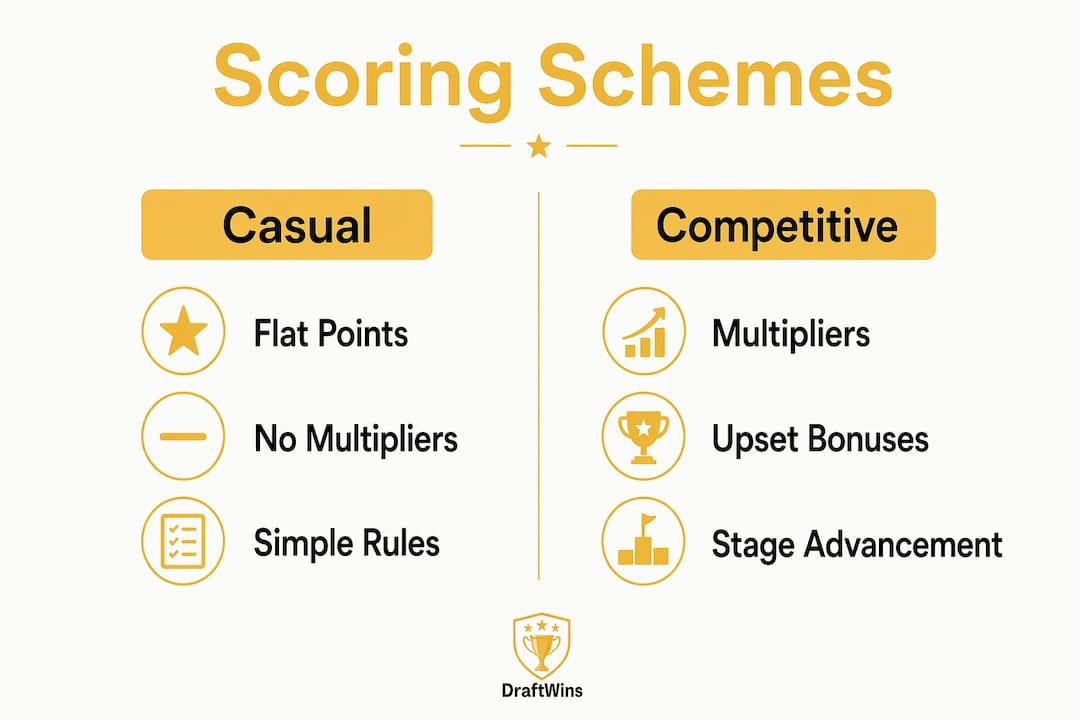
Pro Tip: Multipliers above ×2 in the final can flip the entire leaderboard on one match. That is thrilling for casual groups but frustrating for competitive ones. If your pool skews serious, cap multipliers at ×1.5 and lean on upset bonuses to reward knowledge instead.
Scoring nuances specific to draft-based team pools
When participants draft whole teams rather than individual players, the scoring dynamics shift in a few important ways. A draft-based pool ties each participant's fortunes entirely to their drafted roster, so roster consistency across rounds matters more than in player-based formats. An injury to a star player does not remove the team from the bracket; the team still plays, and points still accrue.
Commissioner configuration checklist before launch:
- Confirm which rounds count toward scoring (main bracket only vs. consolation included)
- Set tiebreaker order explicitly in the platform settings
- Define how byes are handled (zero points, or a nominal advance bonus)
- Decide whether consolation matches award points and at what rate
- Specify the dropout/replacement policy before participants draft
Draftwins supports customizable scoring rules and live leaderboards, so commissioners can dial in stage multipliers and tiebreaker logic before the pool opens rather than patching rules mid-tournament.
Pro Tip: Use a random draw for draft order rather than seeding by perceived skill. It levels the field, reduces complaints about unfair team access, and keeps the pre-tournament energy high.
Tie-breakers, cancelled matches, dropouts, and edge cases
Clear rules here prevent the arguments that kill a pool's social vibe. Set these before anyone drafts a team.
Recommended tiebreaker chain (in order):
- Total pool points (primary standing)
- Head-to-head points between tied participants
- Point differential of drafted teams (points scored minus points allowed)
- Total points scored by drafted teams
- Drawing of lots (coin flip or random number generator)
This ordering mirrors FIFA-style tiebreaker standards widely used as defaults in tournament management.
Edge case rules commissioners can copy directly:
- Cancelled match: "If a scheduled match is cancelled and not rescheduled within the tournament window, both teams advance to the next round on a bye; no points are awarded for the cancelled match."
- Penalty shootout: "A match decided by penalty shootout counts as a win for the advancing team; win points and any applicable multipliers apply."
- Participant dropout: "If a pool participant withdraws after the draft, their drafted teams remain in the bracket and continue earning points; the participant's account is frozen at their last recorded total and excluded from final standings."
- Mid-tournament replacement: "Replacement participants inherit the drafted roster and all points earned to that point; no retroactive adjustments are made."
The dropout freeze approach is the cleanest default. Removing a participant's teams mid-tournament distorts everyone else's scores.
How to set scoring rules: templates commissioners can copy
Tournament management experts recommend matching your format to your group's experience level. Here are three ready-to-use templates.
1. Casual (low barrier) Win points: 10 | Advance bonus: 0 | Multiplier: ×1 | Upset bonus: 0 | Consolation: excluded Rule snippet: "Each participant earns 10 points for every match their drafted team wins in the main bracket. No other bonuses apply."
2. Balanced (mix of engagement and fairness) Win points: 10 | Advance bonus: 10 | Multiplier: ×1.5 in semis, ×2 in final | Upset bonus: 5 | Consolation: excluded Rule snippet: "Participants earn 10 points per win plus a 10-point advance bonus per round reached. Semifinal and final wins carry a ×1.5 and ×2 multiplier respectively. A 5-point upset bonus applies when a lower seed eliminates a higher seed."
3. Competitive (skill-rewarding) Win points: 5 | Advance bonus: 20 | Multiplier: ×2 in semis, ×3 in final | Upset bonus: 10 | Consolation: optional at 5 points per win Rule snippet: "Participants earn 5 points per win plus a 20-point advance bonus per round. Semifinal wins are doubled; final wins are tripled. Upset bonuses of 10 points apply. Consolation wins earn 5 points."
Trade-off summary:
- Casual: lowest barrier, least differentiation late in the tournament
- Balanced: most participants stay engaged through the semifinal
- Competitive: highest skill reward, but late-round multipliers can alienate casual players
For fair scoring configuration across different group types, the Balanced template is the safest default for a first-time pool.
Step-by-step worked scoring examples
Example 1: 8-team bracket, casual flat scoring (10 pts per win)
Team A wins three consecutive matches and earns points for each victory. Total points accumulate accordingly for a participant who drafted Team A.

Team B earns points for their single win before losing in the quarterfinal round.
Example 2: Same bracket, balanced scoring (10 win + 10 advance + multipliers)
Team A quarterfinal win: 10 + 10 = 20 pts. Semifinal win: (10 + 10) × 1.5 = 30 pts. Final win: (10 + 10) × 2 = 40 pts. Total: 90 points.
Team B earns base and advance bonus points for reaching the quarterfinal before losing.
Example 3: Upset-heavy bracket, competitive scoring
Team C beats a higher-seeded team in the quarterfinal and earns points for the win, advance bonus, and upset bonus. They earn advance bonus points for reaching the semifinal before losing.
| Participant | Teams Drafted | Rounds Won | Bonus Points | Total |
|---|---|---|---|---|
| Alex | Team A (champion) | 3 | 40 (advance + multipliers) | 90 |
| Jordan | Team C (QF upset) | 1 | 30 (advance + upset) | — |
| Sam | Team B (QF loss) | 1 | 10 (advance) | 20 |
Verification checklist before trusting automated totals:
- Confirm each win is logged with the correct round designation
- Check that multipliers applied to the right rounds only
- Verify upset bonuses triggered only where seeding data is populated
- Cross-reference at least two participants' totals manually after round one
Why automated scoring matters for knockout pools
Manual scoring in a 16-team bracket across five rounds means tracking roughly 15 matches, applying multipliers, checking upset conditions, and updating standings, all without errors. Automation eliminates that entirely.
Benefits of automated knockout scoring:
- Instant leaderboard updates after each result
- Consistent tiebreaker application with no commissioner judgment calls
- Automatic upset detection when seeding data is loaded
- Audit trail so participants can verify their own totals
Setup checklist for an automated platform:
- Map each bracket round to its point value and multiplier
- Load seeding data before the tournament starts (required for upset bonuses)
- Set tiebreaker order in platform settings, not just in a PDF rule sheet
- Define consolation round inclusion explicitly (on or off)
- Configure bye handling (zero points vs. nominal advance bonus)
Bracket generators fill advancement slots automatically as scores are entered, which removes the most common source of commissioner error. Draftwins handles automated scoring configuration for draft-based team pools, including live leaderboards that update in real time.
Before going live, run a dry-run test:
- Enter two or three simulated results and confirm point totals match your manual calculation
- Trigger an upset scenario and verify the bonus fires correctly
- Check that the tiebreaker logic resolves a tied scenario the way your rules specify
Key Takeaways
Knockout round pool scoring rewards advancement through a single-elimination bracket, and the biggest decisions commissioners make are which rounds count, what multipliers to apply, and how tiebreakers resolve.
| Point | Details |
|---|---|
| Core mechanic | Points are awarded per win, per round advanced, and via multipliers; only main bracket matches count by default. |
| Multipliers change everything | Stage multipliers above ×2 in the final can flip the leaderboard on a single match; cap them for competitive pools. |
| Set tiebreakers before launch | Use the chain: total points → head-to-head → point differential → points scored → drawing of lots. |
| Dropout rule | Freeze the withdrawn participant's score and exclude them from final standings; never remove their teams mid-tournament. |
| Draftwins automates it | Draftwins provides customizable scoring, tiebreaker settings, and live leaderboards for draft-based knockout pools. |
Draftwins makes running a knockout pool straightforward
Running a knockout pool manually is a recipe for spreadsheet errors and mid-tournament rule disputes. Draftwins gives commissioners a platform built specifically for draft-based team pools, where participants pick teams instead of players and the scoring engine handles everything else.
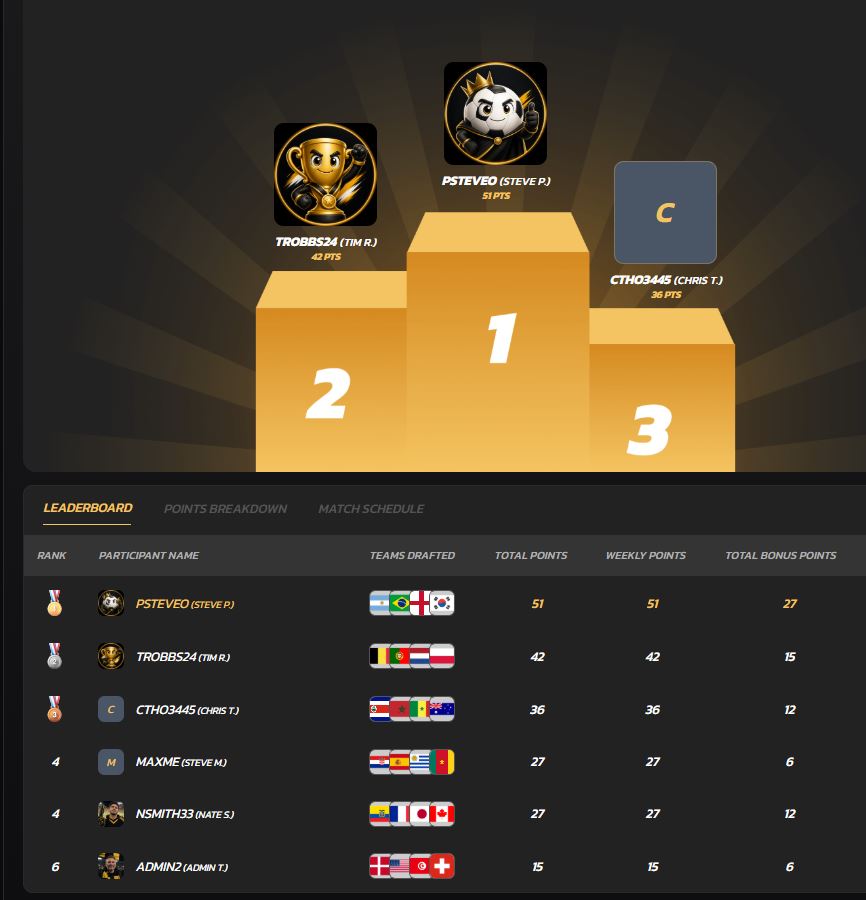
With Draftwins, you configure your scoring scheme once: set win points, advance bonuses, stage multipliers, and tiebreaker order before the pool opens. The platform maps bracket advancement automatically, updates the live leaderboard after every result, and applies upset bonuses without any manual input. Commissioners pay a platform hosting fee; Draftwins does not collect entry fees, hold prize money, or process wagers.
Draftwins is live now with World Cup pools, with NFL and College Football pools coming next. Start your pool and let the bracket do the rest.
Further reading and authoritative sources
These sources back the rules and formats covered above. Consult them when building bracket structures, setting tiebreaker chains, or choosing between pool-play and pure-knockout formats.
- Knockout Tournaments Explained | JustTourney: Covers bracket math, byes, single vs. double elimination, and consolation formats.
- Round-Robin vs Knockout Formats | Pitch Planner: Explains when to use each format and provides FIFA-style tiebreaker ordering.
- Pool Play Tournament Guide | Brakto: Details point differential, standings calculation, and seeding for knockout advancement.
- Group Stage + Knockout | JustTourney: Scoring formula examples including win points, advance bonuses, and upset bonuses.
FAQ
What is knockout round pool scoring?
Knockout round pool scoring awards points to pool participants based on how far their drafted teams advance through a single-elimination bracket, with wins and round advancements each triggering point awards.
How does knockout scoring differ from round-robin scoring?
Round-robin scoring counts every match equally across all participants; knockout scoring concentrates value on survival, so later rounds are worth more and one loss ends a team's scoring contribution.
Which matches count in a knockout pool?
Main bracket matches count by default. Consolation or third-place matches are excluded unless the commissioner explicitly enables them in the pool settings.
What is the recommended tiebreaker order for knockout pools?
The standard chain is: total pool points first, then head-to-head points between tied participants, then point differential of drafted teams, then total points scored, then drawing of lots.
Can Draftwins handle automated knockout scoring?
Yes. Draftwins supports customizable scoring rules, stage multipliers, tiebreaker settings, and live leaderboards for draft-based team pools, updating results automatically as matches are completed.