
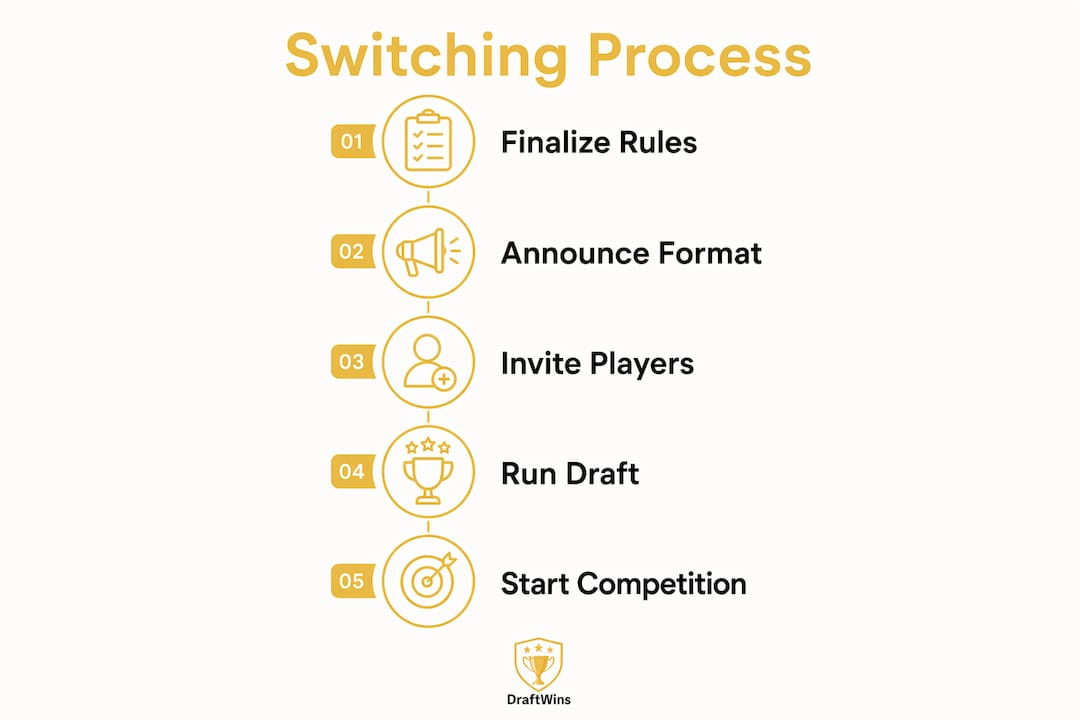
Yes, you can make the switch from fantasy to a team pool in about two weeks. Pick a team-draft format, lock a simple scoring model, schedule a short draft, and host everything on a platform like Draftwins. That's the whole playbook.
Here's the fastest path:
- Choose your format: season-long team draft (8–16 managers), weekly team pick'em (any size), or tournament/World Cup bracket (4–32+ entries)
- Lock three rules before invites go out: roster size, scoring model (wins, goals, or TDs), and your tie-breaker method
- Timeline: two weeks from decision to draft day is realistic for most groups
Team-based pools reward broad sports knowledge over deep player research, which means your group's casual fans can compete on equal footing from day one. Draftwins supports World Cup pools now, with NFL and College Football pools coming next.
Table of Contents
- Why switching from fantasy to team pools keeps your group together
- Which team-pool format fits your group?
- What rules do you need to set before launch?
- How to run the draft: step-by-step
- How to invite and onboard participants
- Pre-launch checklist: 2–4 weeks to draft day
- How Draftwins makes the switch straightforward
- Key Takeaways
- Ready to run your first team-draft pool?
- FAQ
Why switching from fantasy to team pools keeps your group together
The single biggest reason groups make this shift: fewer dropouts. Season-long fantasy leagues bleed managers when weekly lineup decisions pile up alongside real-life schedules. Team pools cut that burden almost entirely.
Pick'em and pool formats demand far less weekly time than season-long roster management, which pulls in casual fans who would otherwise skip the season. You're not monitoring the waiver wire at midnight. You draft your teams once, then watch.
The operational upside for commissioners is just as real. Team formats are modular: when a manager leaves mid-season, a replacement can step in without inheriting a broken roster or a confusing trade history. Long rulebooks and heavy weekly transactions actively discourage new owners from joining, so trimming those elements directly improves retention.
Pro Tip: Start with a roster of 4–6 teams and a scoring model with three categories or fewer. Returning fantasy players adapt faster when the rules fit on a single page.
Which team-pool format fits your group?
The right format depends on one question: how much time do your participants actually have?
Season-long team draft works best for groups of 8–16 who want sustained competition over a full NFL or College Football season. Managers draft 4–8 teams in a snake or straight order, then track those teams' wins all season. Engagement is high, but so is the setup time.
Tournament/World Cup pools are event-driven and self-contained. Everyone drafts or picks teams before the tournament starts, and the bracket does the rest. Group size is flexible (4 to 32+ entries), the time commitment is low, and the social energy spikes around each match. Draftwins launched specifically with World Cup pools for this reason.
Weekly team pick'em is the lowest-friction option. Participants pick winning teams each week with no draft required. Any group size works, and latecomers can join mid-season without disrupting anything. The tradeoff: less strategic depth than a full team draft.
Bracket-style team tournaments split the difference. Participants draft or seed teams into a bracket, and advancement depends on real match outcomes. Great for March Madness-style energy applied to other sports.
A few practical notes on format choice:
- Align prize distribution with format length: weekly prizes suit pick'em; a season-ending pot suits team drafts
- Pools compete peer-to-peer, not against a house, so every dollar in the prize pool comes from participants
- For mixed-schedule groups, short event formats maintain social engagement without large time demands
What rules do you need to set before launch?
Lock these before a single invite goes out. Changing rules after sign-ups open kills trust fast.
Roster size: 4–6 teams for casual groups; up to 8 for competitive season-long drafts.
Scoring model: keep it to three categories maximum. Here's a simple reference:
| Sport | Event | Points |
|---|---|---|
| Soccer/World Cup | Win | 3 |
| Soccer/World Cup | Draw | 1 |
| Soccer/World Cup | Loss | — |
| NFL | Win | 2 |
| NFL | Loss | — |
| NFL | Tie | 1 |
Tie-breaker: point differential is the cleanest option. Head-to-head record works for season-long formats. Coin flip is a last resort, but at least define it in writing.
Substitutions and injuries: in team pools, you're tracking team performance, not individual players, so injury rules are simpler. Decide whether managers can swap a team before the season starts (usually yes) or mid-season (usually no).
Manager replacement policy: write it down now. If a manager drops out, does the commissioner take over their roster, or does a new participant inherit it?
Entry fees for casual pools typically fall in a moderate range suited to casual participation. Keep stakes modest and the structure transparent. Some jurisdictions treat high-stakes informal pools like gambling, so peer-to-peer, clearly documented prize splits are the safest approach.
How to run the draft: step-by-step
A well-run draft takes 30–45 minutes for an 8-team pool and 60–90 minutes for 16 teams. The key is a pick timer and a clear order set before anyone logs in.
- Confirm attendees 48 hours out. Anyone who hasn't confirmed gets a direct message, not just a group reminder.
- Set draft order using a randomizer the day before. Publish it so there are no surprises.
- Brief the group on the format: snake draft (order reverses each round) or straight draft (same order every round). Snake drafts balance early-pick advantages; straight drafts are simpler to explain.
- Start the draft with a 30–60 second pick timer per selection. Automated platforms handle this without a commissioner counting down manually.
- Validate rosters immediately after the draft closes. Check for duplicate picks and confirm every manager's roster is complete.
- Publish the live leaderboard within 24 hours of the first game.
Draft-day roles to assign in advance: one commissioner to manage the platform, one tech-support contact for login issues, and one tie-break adjudicator (usually the commissioner) for disputes.
How to invite and onboard participants
Short invites get read. Long ones get ignored. Your invite needs five things: date and time, expected draft length, two-sentence rule summary, sign-up link, and a link to the one-page rule sheet.
Send reminders on this schedule:
- 2 weeks out: initial invite with sign-up link
- 1 week out: confirmation request
- 48 hours out: draft reminder with platform login instructions
- 2 hours out: final reminder with draft order
- Post-draft: recap email with rosters and leaderboard link
One demo walk-through cuts no-shows dramatically. A 5–10 minute recorded screen share showing how to log in, view the draft board, and read the leaderboard is enough. Pin it in your group chat so anyone can rewatch it. For casual drafters new to team pools, this single resource removes most of the friction.
Pre-launch checklist: 2–4 weeks to draft day
2–4 weeks before:
- Choose your format and finalize all scoring rules
- Create the pool on your hosting platform (Draftwins)
- Open sign-ups and send the initial invite
- Publish the one-page rule sheet
- Schedule the draft date and time
Draft week:
- Confirm all participants and send the 48-hour reminder
- Set and publish the draft order
- Run the draft with a pick timer
- Validate rosters and resolve any disputes immediately
Post-draft:
- Publish the live leaderboard
- Send a recap with rosters and scoring reminders
- Confirm the prize distribution method in writing
For dropouts: if a manager leaves before the season starts, open a replacement spot. Mid-season, the commissioner can manage the orphaned roster or hold a supplementary mini-draft at a natural season break to fill reserve slots.
How Draftwins makes the switch straightforward
Draftwins is built specifically for the team-draft format, which means the platform handles the parts that take commissioner time: automated scoring, live leaderboards, and private pool settings that keep your group's competition separate from the public.
The core workflow:
- Create your pool and select your format (World Cup, NFL, or College Football)
- Set scoring and roster sizes using the customizable rules panel
- Invite participants via a private pool link; they join free
- Run the automated draft with built-in pick timers and order management
- Track results on the live leaderboard without manual score entry
Commissioners pay a one-time hosting fee. Participants join at no cost. Draftwins does not collect entry fees, hold prize pools, or pay out winnings — the prize structure stays entirely between your group. Automated scoring and live leaderboards also cut dispute resolution time, which matters most in the first season when participants are still learning the format.
Key Takeaways
Switching from fantasy to a team pool takes two weeks when you pick the right format, lock simple rules upfront, and use a platform that automates scoring and draft logistics.
| Point | Details |
|---|---|
| Format first | Match format to group size: season draft for 8–16, pick'em or tournament for any size. |
| Simple rules win | Cap scoring at three categories and define the tie-breaker before invites go out. |
| Draft in under 90 minutes | An 8-team draft runs under an hour; larger drafts take proportionally longer with a pick timer. |
| Onboard with one demo | A 5–10 minute recorded walk-through removes most newcomer friction before draft day. |
| Draftwins handles the logistics | Automated scoring, live leaderboards, and private pools let commissioners focus on the group, not the platform. |
Ready to run your first team-draft pool?
If your group has been losing managers to fantasy burnout, the team-pool format solves the right problem. No more weekly lineup stress, no waiver wire chaos, and no 40-page rulebook to hand new participants.
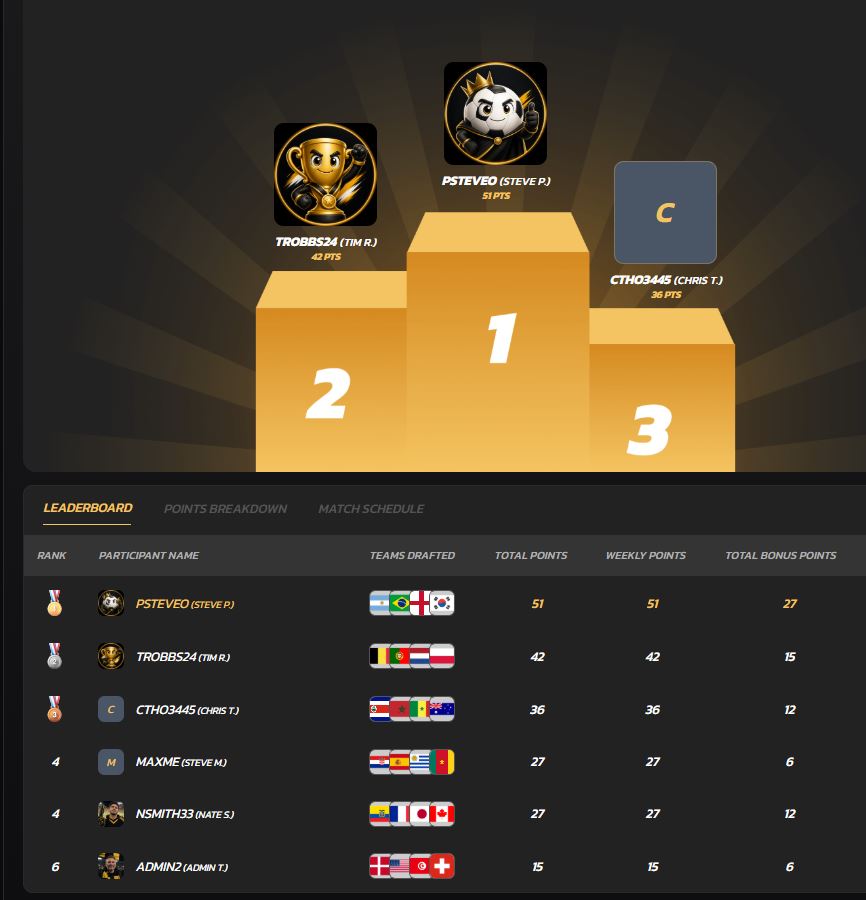
Draftwins is built for exactly this transition. Commissioners pay a single hosting fee to create a private pool with automated drafting, live scoring, and leaderboards. Participants join free. The platform currently supports World Cup pools, with NFL and College Football pools launching next. You get the structure of a competitive league without the overhead that drives people away.
Work through the pre-launch checklist above, then create your pool on Draftwins to get your draft scheduled. First-time commissioners can reach out to the Draftwins support team for a quick walkthrough before draft day.
FAQ
What is the difference between a team pool and fantasy?
In a team pool, you draft entire sports teams and score points based on those teams' real-game results. Fantasy leagues have you draft individual players and track their personal stats week to week.
How long does it take to switch from fantasy to a team pool?
Most groups can complete the switch in a couple of weeks, splitting tasks between rules finalization, sign-ups, and running the draft.
What sports does Draftwins support?
Draftwins launched with World Cup pools and is adding NFL and College Football pools next.
How do I handle a manager who drops out mid-season?
The commissioner can manage the orphaned roster directly or hold a supplementary mini-draft at a natural season break to bring in a replacement with a fresh set of reserve picks.
Do participants pay to join a pool on Draftwins?
No. The commissioner pays a one-time hosting fee to create the pool. Participants join and compete for free.