
The fastest way to run a private group sports pool without lineup headaches is a team-draft format: each participant drafts whole teams instead of individual players, so nobody touches a roster after draft day. Pair that with a platform that handles automated scoring and live leaderboards, and you're done administering the pool before the first match kicks off.
Here's what that looks like in practice:
- No lineup decisions. Once the draft ends, picks are locked. No waiver wire, no injury swaps, no weekly roster shuffles.
- Automated scoring. A platform like Draftwins pulls official league data and updates the leaderboard without you lifting a finger.
- Live leaderboards. Every participant can check standings in real time, which keeps the group chat alive all week.
- Private pools only. Keep the pool closed to your office or friend group, consistent with state gaming commission guidance on low-risk private contests.
Team-draft pools work because they shift attention from individual player performance to team-level outcomes. Injuries to a star quarterback don't knock someone out of contention the way they do in traditional fantasy. The whole group stays engaged through the final whistle.
Table of Contents
- How do you set up a sports pool without player management?
- What draft formats and templates work for World Cup, NFL, and College Football?
- How do you configure automated scoring and verify it before draft day?
- Commissioner timeline and communication templates
- How do you keep participants engaged and handle disputes fairly?
- Platform fees, payouts, and U.S. compliance basics
- What data privacy and security practices should you follow for group pools?
- What are the technical requirements for setting up a pool?
- Legal and fairness considerations for private pools
- Key Takeaways
- Draftwins makes private team-draft pools effortless
- Useful sources
- FAQ
How do you set up a sports pool without player management?
Follow this checklist from idea to first scoring update.
- Decide format and pool size. Groups of medium size work best for team-draft pools. Very small groups make the draft feel thin; very large groups complicate draft logistics.
- Pick your draft style. Snake drafts balance pick value across entries and work well for small groups. Random assignment is faster for casual crowds. Draft format choice should match your group size and engagement goals.
- Set a draft date. Pick a time at least 48 hours before the first match. Evening weekdays work for office groups; weekend mornings for friend circles.
- Create the pool. Use a private-pool platform for groups of 8 or more. For very small groups (under 8), a shared spreadsheet can work, though you'll manage scoring manually.
- Who pays the platform fee? The commissioner pays a one-time hosting fee. Participants join free.
- Configure scoring rules and tiebreakers. Lock picks at kickoff and verify automated scoring settings before you invite anyone.
- Invite participants and collect entry fees upfront. Use Venmo or Zelle with a clear payment memo. Chasing payments after the event is a headache nobody needs.
- Send reminders. A 48-hour reminder and a 2-hour reminder before the draft dramatically cut no-shows.
Pro Tip: If several participants are new to team-draft mechanics, run a 10-minute demo draft the week before. Pick fake teams, show how the leaderboard updates, and answer questions before real money is on the line.
What draft formats and templates work for World Cup, NFL, and College Football?
Three formats cover most private group scenarios, and each trades off simplicity against competitive variance:
- Single-team-per-entry. One team per participant. Simple, fast, and great for casual groups who want a clear winner.
- Multi-team-per-entry. Each entry drafts 2–4 teams. More picks mean more action throughout the event, and one bad team doesn't end someone's run.
- Pooled bucket draft. Teams are grouped by tier or conference, and each entry picks one team from each bucket. Balances the field and prevents one participant from grabbing all the favorites.
| Event | Teams per entry | Draft rounds | Primary scoring drivers |
|---|---|---|---|
| World Cup | 3–4 teams | 3–4 rounds | Goals scored, group-stage wins, knockout advances |
| NFL (season-long) | 2–3 teams | 2–3 rounds | Wins, points scored, yards gained per week |
| College Football | 2–4 teams | 2–4 rounds | Wins, conference record, playoff advances |
Snake vs. random vs. auction: Snake drafts give later picks a compensating early pick in the next round, which most groups find fair. Random assignment suits groups that want speed over strategy. Auction-style team assignment adds excitement for experienced groups but takes longer to run.
For World Cup pools, the expanded 12-group format in 2026 means more group-stage drama and more teams to draft, which makes multi-team entries especially fun. NFL season-long pools reward participants whose teams stay healthy and consistent. College Football pools built around conference matchups keep regional rivalries front and center.
How do you configure automated scoring and verify it before draft day?
Start with the stat categories that matter for your sport:
- World Cup: goals scored, clean sheets, knockout-round wins
- NFL: team wins, points scored, total yards
- College Football: wins, margin of victory, playoff seeding
Map each stat to a point value. A simple World Cup preset might award 3 points per group-stage win, 1 point per goal scored, and 5 points per knockout-round advance. Keep conversions round numbers so participants can calculate their own score mentally.
Automated scoring platforms pull data from official league feeds or API partners. Before draft day, run a short test: create two dummy entries, assign teams manually, and simulate one match result. If the leaderboard updates correctly, you're good. If it doesn't, you have time to fix the configuration rather than explaining a scoring error to 15 annoyed participants.
- Create two test entries with known team assignments.
- Input one completed match result.
- Confirm the leaderboard reflects the correct point totals.
- Screenshot the scoring settings and save them as your audit log.
Pro Tip: Lock scoring rules immediately after the draft and publish a screenshot of your settings in the group chat. When someone questions a score two weeks in, you point to the screenshot instead of relitigating the rules from memory.
Commissioner timeline and communication templates

| Timing | Action | Sample message |
|---|---|---|
| 2 weeks out | Announce pool, open registration | "We're running a [World Cup / NFL] team-draft pool. No lineup management — just draft your teams and watch the leaderboard. Entry fee: $[X]. Reply to join." |
| 1 week out | Collect entry fees | "Send $[X] via Venmo/Zelle to [handle], memo: '[Pool Name] entry.' Deadline: [date]." |
| 48 hours before draft | Confirm draft order, send link | "Draft is [day] at [time]. Here's the pool link: [URL]. Draft order is attached." |
| 2 hours before draft | Final reminder | "Draft starts in 2 hours. Join here: [URL]. Have your team preferences ready." |
| Post-draft | Publish leaderboard | "Picks are locked. Leaderboard is live: [URL]. Good luck!" |
| Event end | Payout message | "Final standings are posted. [Winner] takes the pot. Payout going out via [Venmo/Zelle] today." |
Post-draft, your job is mostly done. Share the leaderboard link once a week, answer the occasional scoring question, and send the final payout message when the event ends.
How do you keep participants engaged and handle disputes fairly?
Engagement in a team-draft pool is mostly self-sustaining because team-level scoring keeps everyone in contention longer than single-outcome formats. A few low-effort tactics help:
- Post the leaderboard link in your group chat every Monday (NFL) or after each match day (World Cup).
- Run a mid-event poll ("Who's your pick to win it all now?") to spark conversation.
- Offer a small mid-event prize for the leader at the halfway point.
For disputes, keep it simple. The commissioner is the final arbiter. Publish your rulebook before the draft and include a tiebreaker hierarchy (total goals scored, then head-to-head team performance, then a coin flip). If someone disputes a score, the audit log screenshot you saved on draft day resolves it in under a minute.
Pro Tip: State your inactive-participant policy upfront: if someone doesn't pay by the deadline, their spot opens to a waitlist. No-shows who paid but didn't draft get assigned teams randomly. Write both rules in the announcement message so there's no ambiguity later.
Platform fees, payouts, and U.S. compliance basics
Draftwins charges the commissioner a one-time hosting fee to create a private pool. Participants join and compete for free. The platform does not collect entry fees, hold prize money, or pay out winnings — that's handled directly between participants.
Keep private pools private. U.S. legal guidance consistently treats small, private sports pools leniently when they stay among friends or coworkers, avoid public promotion, charge no house cut, and cap buy-ins at a casual level. Recommendations include keeping group size limited, avoiding commissions, and collecting entries upfront. If your pool grows large or crosses state lines, check your state gaming commission's rules.
Payment best practices:
- Collect entry fees before the pool opens, not after.
- Use Venmo or Zelle with a clear memo (e.g., "World Cup Pool 2026 entry").
- Keep a simple ledger: participant name, amount paid, date received.
- Pay out winnings promptly after the final standings post.
This article is general information, not legal advice. Confirm your state's rules with your state gaming commission or a qualified attorney if your pool grows beyond a small private group.
What data privacy and security practices should you follow for group pools?
When you run a private pool, you're collecting names, contact info, and sometimes payment details from your group. A few straightforward practices protect everyone:
- Use a platform that stores data on encrypted servers and doesn't sell participant information to third parties.
- Collect only what you need: name, email, and payment confirmation. Skip phone numbers unless you're sending SMS reminders.
- Keep your pool link private. A public link turns a private pool into an open contest, which changes the legal picture.
- If you're managing fees manually, store your ledger in a password-protected file, not a shared Google Sheet with open access.
What are the technical requirements for setting up a pool?
Draftwins is web-based, so no app download is needed. Any modern browser on a phone, tablet, or desktop works. For the draft itself:
- A stable internet connection matters most during the live draft window.
- If you're running a draft party in person, a shared screen (TV or monitor) showing the draft board keeps everyone oriented.
- Common setup issues: participants not receiving invite emails (check spam folders), scoring not updating (verify the sport season is active in platform settings), and draft order not saving (refresh and re-confirm before locking).
If automated scoring isn't updating after a match, the most common cause is a feed delay from the official data source, not a platform error. Wait 15–30 minutes before troubleshooting further.
Legal and fairness considerations for private pools
Private sports pools occupy a gray area in U.S. law that varies by state. The generally accepted safe harbor for private pools includes: no house cut, no public advertising, participation limited to a defined private group, and buy-ins kept at a social level. Operating outside those boundaries, especially charging a rake or opening the pool to strangers, moves the activity into regulated gambling territory.
Fairness inside the pool comes down to three things: transparent rules published before the draft, a random or snake draft order that no one can manipulate, and a single arbiter (the commissioner) whose decisions are final. Participants who know the rules going in rarely dispute outcomes coming out.
Key Takeaways
Team-draft sports pools with automated scoring and a private platform give commissioners the lowest-effort, highest-engagement format available for office and friend groups.
| Point | Details |
|---|---|
| Team-draft removes management | Participants draft whole teams once; no lineup changes, injury swaps, or weekly decisions needed. |
| Automated scoring saves time | Platforms that pull official league data and update leaderboards cut commissioner workload to near zero. |
| Collect fees before the draft | Upfront payment via Venmo or Zelle with a clear memo prevents post-event collection problems. |
| Keep pools private and small | U.S. guidance treats small, private, no-rake pools leniently; public promotion changes the legal picture. |
| Draftwins handles the setup | Commissioners pay one hosting fee, invite participants free, and get automated scoring and live leaderboards out of the box. |
Draftwins makes private team-draft pools effortless
Running a pool where nobody manages lineups sounds simple, but the administrative layer — scoring, leaderboards, rule disputes, draft logistics — adds up fast without the right platform.
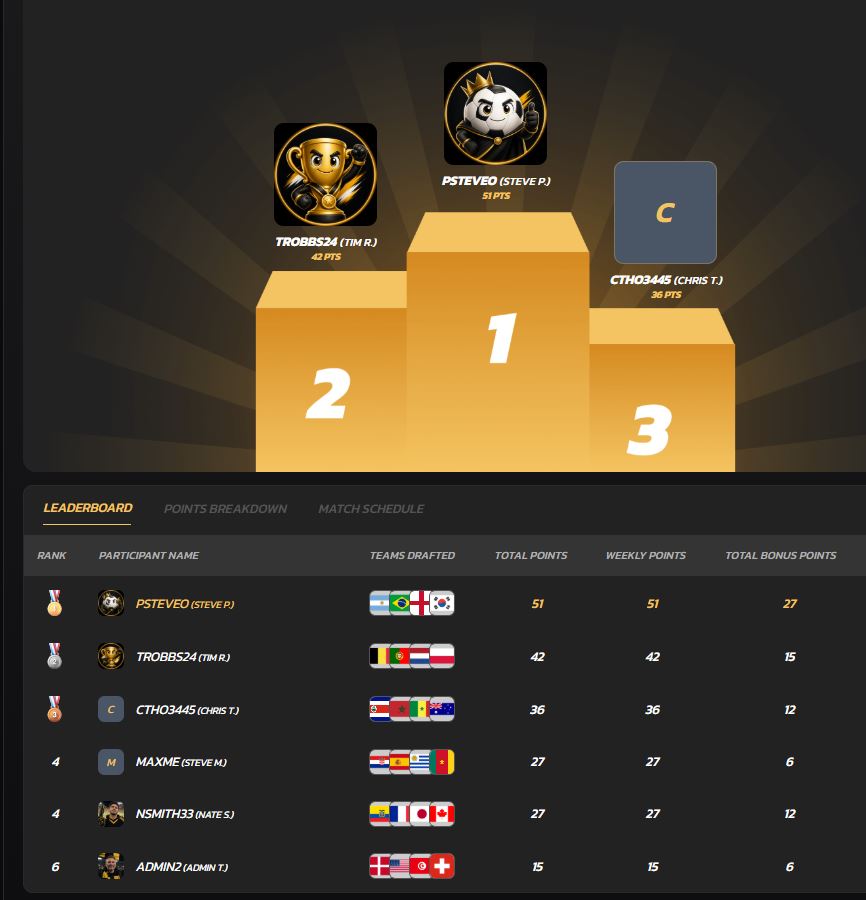
Draftwins was built specifically for this format. Commissioners create a private pool, pay a single hosting fee, and invite participants at no cost to them. The platform handles team drafting, automated scoring from official feeds, and live leaderboard updates throughout the event. You configure your scoring rules once, lock them after the draft, and the platform runs itself.
The flow is straightforward: create your pool on Draftwins Pools, set your draft format and scoring template, invite your group, run the draft, and watch the leaderboard update automatically. Draftwins launches with World Cup pools, with NFL and College Football pools to follow.
Ready to set up your pool? Head to Draftwins Pools and create your first private team-draft pool today.
Useful sources
- Automated Scoring Systems for Sports Pools: 2026 Guide — how automated scoring and leaderboard feeds work
- Team Pool Formats for Sports Fans: 2026 Guide — format presets and when to use each
- How Football Pools Track Standings: 2026 Guide — technical explanation of feed sources and accuracy verification
- No Spreadsheet Sports Pool: Run Yours Effortlessly — practical guide for commissioners moving off manual tracking
- DraftWins Pricing — hosting fee details and commissioner cost scenarios
Save your scoring preset and rulebook before draft day. Participants who receive both documents before the draft ask far fewer questions after it.
FAQ
What does "no player management" mean in a sports pool?
It means participants draft entire teams instead of individual players, so there are no weekly lineup decisions, waiver pickups, or injury adjustments after draft day.
Who pays the platform fee on Draftwins?
The commissioner pays a one-time hosting fee to create the pool. Participants join and compete at no cost.
Is running a private sports pool legal in the United States?
Small, private pools with no house cut and no public promotion are generally treated leniently under U.S. law, but rules vary by state. Check your state gaming commission's guidelines if your pool grows beyond a small private group.
What's the best draft format for a casual office group?
A snake draft with single-team-per-entry entries works well for most casual groups of 8 or more. It's fast, fair, and easy to explain to first-timers.
How does automated scoring work in a team-draft pool?
The platform pulls results from official league data feeds and maps team outcomes to your preset point values, updating the leaderboard automatically after each match or game.