
The fastest way to run a private, paid football pool is to skip the printable grid entirely and set up a team-draft pool on a dedicated platform. Create a private pool on Draftwins, tie the draft date to your payment deadline, and let automated scoring handle the rest. That single decision cuts your admin work from hours to minutes and keeps every participant's trust intact.
Key Takeaways
A private team-draft football pool runs smoothly when the commissioner enforces payment before the draft, uses a platform with automated scoring and audit logs, and documents every rule and fee before the first pick.
| Point | Details |
|---|---|
| Host privately with clear rules | Keep pools invite-only and publish rules, payout formulas, and tie-breakers before the draft. |
| Payment before draft | Require full payment before any participant receives a pick slot; no exceptions. |
| Automated scoring and audit logs | Use a platform that scores automatically and allows a post-draft manual audit within 30 minutes. |
| No house cut without legal review | Taking an admin fee without disclosing it or reviewing state law is the top legal risk for commissioners. |
| Draftwins for commissioner workflow | Draftwins handles automated drafts, live leaderboards, and private pools; commissioners manage fees and payouts off-platform. |
Table of Contents
- What is a team-draft football pool, and how does it work?
- How do you set up a private team-draft football pool step by step?
- What draft formats and rule templates work best for commissioners?
- How does automated scoring work, and what should you set up?
- What are the U.S. legal requirements for paid private football pools?
- How should commissioners handle entry fees and payouts?
- What does a draft-day checklist look like for commissioners?
- Draftwins makes private team-draft pools easier to run
- Sources
- FAQ
What is a team-draft football pool, and how does it work?
A team-draft football pool is a season-long contest where each participant drafts whole NFL (or college football) teams rather than individual players. No lineup swaps, no waiver wire, no injury panic. Your teams play; the platform scores them automatically; a live leaderboard updates after every game. It's the format that casual fans actually finish.
Who pays what. The commissioner pays a one-time platform hosting fee to create the pool. Participants typically join for free on the platform side; entry fees and prize payouts are handled off-platform, between participants, under rules the commissioner sets.
Core features commissioners need:
| Feature | Why it matters |
|---|---|
| Private/invite-only access | Keeps the pool closed to strangers and reduces legal exposure |
| Automated draft engine | Runs the draft on schedule without manual pick entry |
| Customizable scoring rules | Lets you weight wins, playoff rounds, or bonus points |
| Automated scoring feed | Eliminates manual scorekeeping and disputes |
| Live leaderboard | Keeps participants engaged all season |
| Commissioner controls | Lock entries, adjust settings, manage participants |
Setup typically takes under an hour. The draft itself runs 30–60 minutes for groups of 10–14. Ongoing admin is mostly payment reconciliation and answering participant questions, not scorekeeping.
How do you set up a private team-draft football pool step by step?
Follow this sequence from planning through draft day. Skipping steps, especially the payment step, creates problems that last all season.
- Define your pool rules. Write down entry fee, payout formula, scoring method, tie-breaker, and dispute resolution before you touch any platform settings. These become your official rules document.
- Create the pool on your platform. Choose sport (NFL, College Football), draft format, number of teams per participant, and scoring weights.
- Set draft date and payment deadline. The payment deadline must fall before the draft. Commissioner guides are clear: no payment, no draft. Enforce it without exceptions.
- Configure invite controls. Generate a private invite link or enter participant emails. Never make the pool publicly searchable.
- Publish rules to participants. Send the rules document with the invite. Require acknowledgment before the draft.
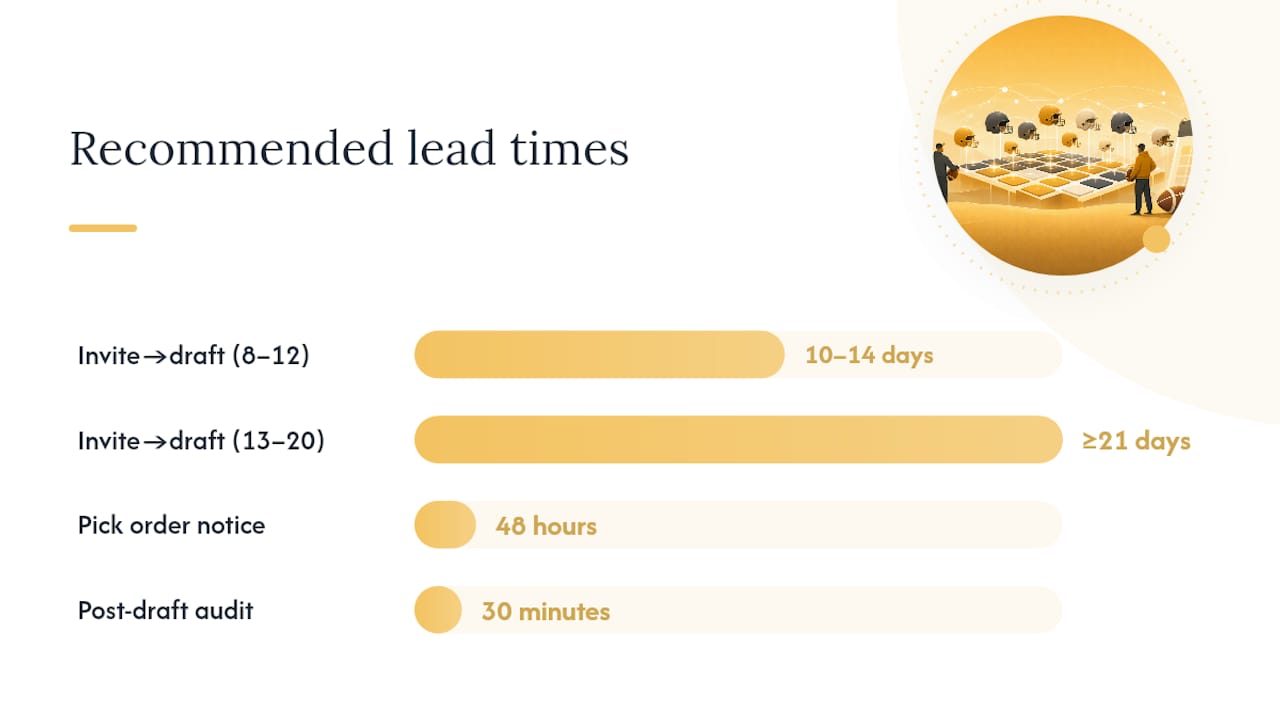
- Confirm draft order and time zone. Announce the pick order at least 48 hours before the draft. Confirm the time zone in writing.
- Lock entries and run the draft. Once the draft starts, entries are frozen. Monitor for connection issues and communicate any delays immediately.
- Run a post-draft audit. Verify picks, scoring settings, and leaderboard within 30 minutes of draft completion.
Timeline guidance: For groups of 8–12, allow 10–14 days from invite to draft day. Groups of 13–20 need at least 21 days to collect payments and confirm rosters without pressure.
Pro Tip: Set a hard rule in writing: anyone who hasn't paid by the payment deadline is removed from the draft order. Announce this before invites go out. It prevents the awkward mid-season "I'll pay you back" conversation and protects every other participant's prize share.
What draft formats and rule templates work best for commissioners?
Three formats cover most private group sizes. Pick the one that matches your headcount and how much engagement you want across the season.
10-team, three-round format
Each participant drafts three teams. Snake order (1–10, then 10–1, then 1–10) is standard. The Ringer's NFL wins pool popularized this structure: it's defensible on fairness grounds because the snake order balances early and late picks across rounds. If a participant later questions draft equity, a documented snake order is your best answer.
12-team, two-round format
Each participant drafts two teams. Works well for groups where some participants are casual fans who don't want to track three teams all season. Scoring tends to be tighter, which keeps the leaderboard competitive into December. See sample draft orders and format breakdowns for a ready-to-use template.
League-style with keeper options
Participants keep one team from the prior season and draft the rest fresh. Adds a strategy layer that rewards returning participants. Best for groups that have run the pool at least one year and want more depth.
Rule template essentials (paste these into your rules document):
- Eligibility: Participants must pay the entry fee in full before the draft to receive a pick slot.
- Scoring source of truth: Official NFL game results as reported by [platform name]. In the event of a data discrepancy, the commissioner's documented record is final pending platform correction.
- Tie-breaker: Total regular-season wins; if still tied, total points scored by drafted teams.
- Postponement policy: If a scheduled game is postponed, it scores when played. Cancelled games score zero.
- Dispute resolution: Disputes must be submitted in writing within 48 hours of the disputed score update.
How does automated scoring work, and what should you set up?
Automated scoring pulls official game results through a data feed and applies your configured point weights without any manual entry. The leaderboard updates after each game resolves. For commissioners, this means no Sunday-night scorekeeping and no "you miscounted my wins" arguments.
Common scoring options:
- Wins only: One point per regular-season win. Simple, easy to explain, lowest engagement late in the season for participants out of contention.
- Wins plus playoff points: Regular-season wins plus weighted points for each playoff round won. Keeps more participants engaged through January.
- Weighted round scoring: Playoff wins worth two or three times a regular-season win. Rewards participants who drafted teams with Super Bowl potential.
- Bonus points: Points for division titles, conference championships, or specific performance thresholds. Adds complexity; use only if your group wants it.
The scoring mechanics behind NFL draft pools show how each method affects season-long incentives. Wins-plus-playoff is the most common choice for private groups because it balances simplicity with late-season stakes.
Operational note: State your scoring source of truth in the rules before the draft. If the platform's feed is delayed or corrected after the fact, you need a documented fallback. Keep a simple spreadsheet backup for the first two weeks until you've confirmed the feed is stable.
What are the U.S. legal requirements for paid private football pools?
Most states allow small, private, social pools when there's no organizer cut and participants share a genuine social relationship. But state laws vary significantly: the same pool structure that's fine in one state may be restricted in another, and the legal tests for chance versus skill differ by jurisdiction.
Practical safeguards every commissioner should follow:
| Action | Why it reduces risk |
|---|---|
| Keep the pool private and invite-only | Public pools attract regulatory scrutiny |
| Cap pool size | Smaller groups fit more easily within social-gambling exceptions |
| No organizer cut | Taking a house fee without legal review is the fastest way to cross a legal line |
| Document all rules and fees | Written records protect you if a dispute escalates |
| Require payment before draft | Eliminates ambiguity about who is a confirmed participant |
| Separate pool funds from personal accounts | Clean bookkeeping reduces tax and legal exposure |
Practical guides for office pools recommend keeping buy-ins modest and avoiding any public advertising. Team-draft pools may have a stronger skill-classification argument than random-assignment formats, but that distinction doesn't override state law.
When to consult a lawyer: If you're running a recurring high-value pool, accepting participants across state lines, or planning to take an admin fee, get a legal opinion before you collect money.
Pro Tip: If you want to charge an admin fee to cover your time, disclose it explicitly in the rules as a line item separate from the prize pool. Undisclosed fees are the most common source of participant disputes and the most common legal red flag.
This article provides general information, not legal or tax advice. Confirm your pool's compliance with a qualified attorney familiar with your state's gambling statutes.
How should commissioners handle entry fees and payouts?
The cleanest model: collect entry fees off-platform through a dedicated payment method, keep pool funds in a separate account, and pay winners within a stated number of business days after the season ends.
Payment collection options:
- Venmo or Zelle (personal): Fast and familiar, but mixes personal and pool funds unless you use a dedicated account. Requires manual reconciliation.
- Escrow/payment services: Platforms designed for group money collection remove the commissioner from acting as the bank, which reduces trust friction significantly. Participants pay the service directly; the commissioner never holds funds personally.
- Platform hosting-fee model: Draftwins charges the commissioner a hosting fee and does not collect participant entry fees or handle payouts. Participants pay each other off-platform per the commissioner's rules.
Best practices:
- Publish the payout formula before the draft. "Winner takes all" and "top-three split" are the most common structures; state exact percentages.
- Provide a payment receipt to every participant within 24 hours of collection.
- Reconcile total collected against total prize pool before the draft. Any discrepancy is easier to fix before the season than after.
- Document everything: payout formulas, receipts, and any corrections. These records are your defense if a dispute arises.
- For payouts over IRS reporting thresholds, consult a tax professional about your documentation obligations.
What does a draft-day checklist look like for commissioners?
Before the draft
- Confirm all payments received and recorded.
- Lock the entry list and publish the final draft order.
- Send participants the rules, tie-breaker, and draft room link at least two hours before start time.
- Test the draft room yourself: confirm scoring settings, pick order, and time zone display.
During the draft
- Monitor for connection issues. Have a backup contact method (group text or email) ready.
- Communicate any unexpected delays immediately. Don't let participants sit in silence.
- Note any manual corrections made during the draft in writing.
After the draft
- Run a manual audit within 30 minutes of draft completion. Check picks, scoring configuration, and leaderboard accuracy.
- Publish finalized rosters and the opening leaderboard to all participants.
- Reconcile payments and confirm the prize pool total.
- Announce the payout schedule: when winners will be paid and by what method.
Pro Tip: Assign a co-commissioner before draft day. Give them access to the platform settings and a copy of the rules. If you lose your connection mid-draft, the pool keeps running.
Draftwins makes private team-draft pools easier to run
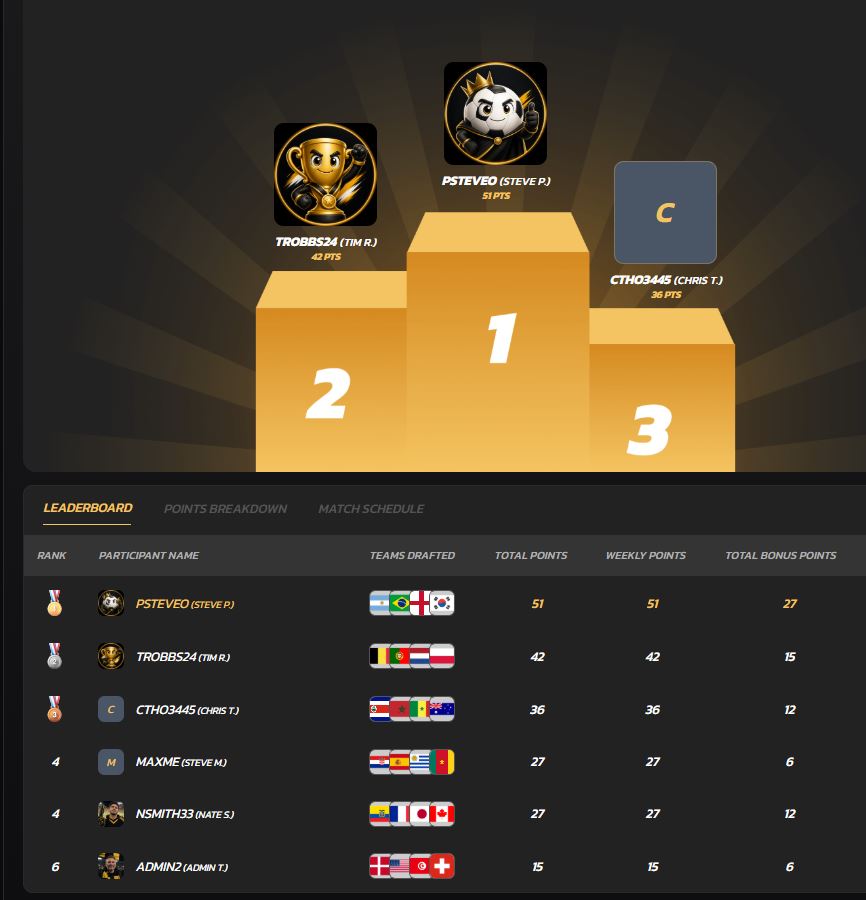
Running a paid private pool means you're responsible for the experience from invite to payout. Draftwins is built for exactly that workload. Private invite controls keep your pool closed. The automated draft engine runs on schedule without manual pick entry. Scoring updates automatically from official results, and the live leaderboard keeps participants checking in all season. Draftwins supports NFL, College Football, and World Cup pools, so one platform covers your full calendar.
The business model matters here. Draftwins charges the commissioner a one-time platform hosting fee. It does not collect participant entry fees, hold prize money, or process payouts. That means you're never asking participants to trust a third party with their money, and you're never the bank either.
Create your private pool on Draftwins and schedule your draft today.
Sources
Draftwins resources:
- Are football pools legal? What the law says | LegalClarity
- Fantasy League Commissioner Guide: How to Run a League the Right Way | LeagueSafe
- Commissioner draft-day checklist | DraftDay Authority
- Paid Pools & Bracket Contests: Rules, Taxes, Trust
- How to Run an Office Betting Pool Legally: Stay Compliant, Keep It Fun 2026
External references:
When in doubt about your pool's legal status or tax obligations, consult a licensed attorney or CPA in your state.
This article is general information, not a substitute for advice from a qualified lawyer. Consult a qualified legal professional about your own circumstances before acting on anything here.
FAQ
What are football squares in the context of team-draft pools?
In team-draft pools, "football squares" refers to private group contests where participants draft whole NFL or college football teams and compete on season-long scoring, not the printable 10x10 grid game. The format runs on a dedicated platform with automated scoring and live leaderboards.
How do you collect entry fees for a private football pool?
Collect fees off-platform through a dedicated Venmo, Zelle, or escrow account before the draft. Require full payment before assigning any pick slot, and provide receipts to every participant within 24 hours.

What is the best draft format for a 10-person football pool?
A 10-team, three-round snake draft is the most common and defensible format. Each participant drafts three teams; the snake order (1–10, 10–1, 1–10) balances early and late picks across all three rounds.
Does Draftwins handle entry fees and prize payouts?
No. Draftwins charges the commissioner a platform hosting fee and does not collect participant entry fees, hold prize money, or process payouts. Commissioners handle money off-platform under their own rules.
Is it legal to run a paid private football pool in the United States?
Many states allow small, private, social pools with no organizer cut, but laws vary by state. Keep the pool invite-only, cap the size, disclose all fees, and consult a licensed attorney if you're running a high-value or recurring pool.