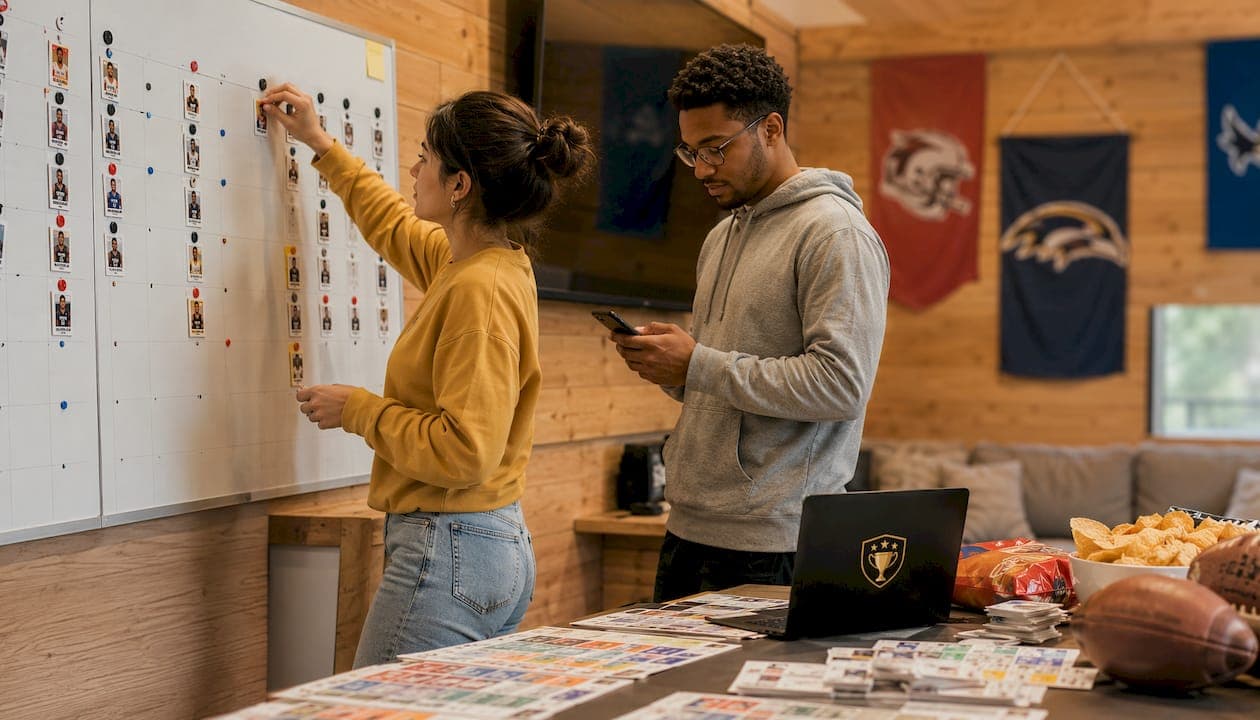
A well-run fraternity sports draft competition setup comes down to three things: clear logistics, the right tools, and enough social energy to make it feel like an event rather than a chore. Get those right and the draft becomes the highlight of your semester. Miss any one of them and you spend the night answering "wait, who was just picked?" for the fifteenth time.
Here is what a successful setup looks like at a glance:
- Send real invitations with a hard RSVP deadline at least five days out, using a tool like Google Forms or Evite so you get a firm headcount for food, seating, and draft supplies
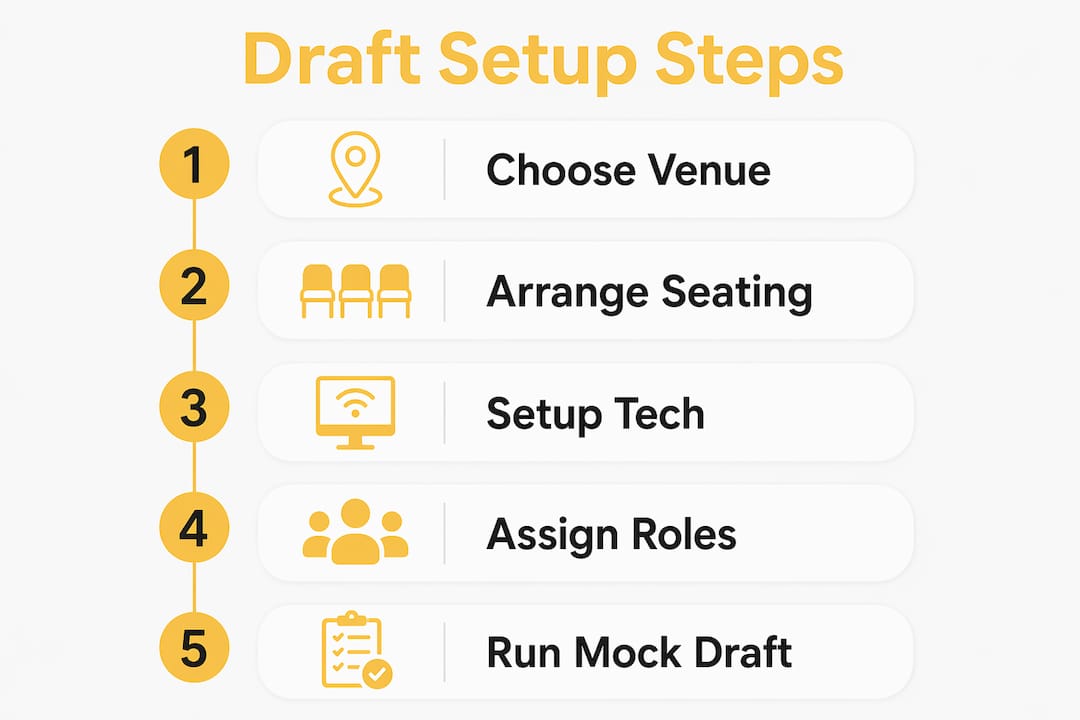
- Choose a venue that fits your group size, offers adequate seating with individual table space, and lets everyone see the draft board without craning their neck
- Build your draft toolkit before the day: a large physical draft board, a visible timer, printed cheat sheets, extra markers, and a backup digital platform for hybrid participants
- Plan food and drinks for 2–3 hours of grazing, leaning on low-mess finger foods and offering both alcoholic and non-alcoholic options
- Set draft timing rules in advance, including pick timer length, draft order method, and auto-pick policy for no-shows
- Assign roles before the first pick: a commissioner to enforce rules and manage the board, and an MC to announce picks and keep the energy up
- Create atmosphere with decorations, a draft order game, and a post-draft social window so the event feels complete
How to choose the right location for your group draft party
The venue shapes everything else about your fraternity sports draft competition setup. A cramped room with bad sightlines kills the vibe before the first pick is announced.
Your three realistic options are a chapter house or private home, a sports bar with a reserved room, and a rented community or clubhouse space. Home setups work well for groups of 8–12 and keep costs low, though you trade energy for comfort. A sports bar private room delivers big screens and built-in atmosphere, but expect slower service during pick windows and unreliable Wi-Fi. Rented spaces give you full control over layout and noise, which matters when you have 16 guys arguing over a pick.
Whatever you choose, prioritize these factors:
- Sightlines to the draft board from every seat, not just the front row
- Individual table space per participant for a laptop or phone, a drink, and printed notes. Seating should prioritize flat workspace over communal dining to reduce pick confusion and disputes
- Noise level that lets participants hear picks announced clearly without shouting
- Reliable Wi-Fi plus a mobile hotspot as backup, especially for hybrid setups
- Proximity that maximizes attendance, because the whole point is getting everyone in the same room
A circular or U-shaped seating arrangement works best. It keeps the commissioner near the board and gives every participant a clear line of sight to both the draft board and each other.
What draft board and technology setup do you actually need?
The physical draft board is the centerpiece of any live college draft competition. It makes picks visible to the whole room, creates genuine excitement when names go up, and prevents the endless "who did we take in round four?" arguments.
Your core setup checklist:
- Large wall-mounted draft board with player or team labels, sized for your league (8, 10, or 12 teams are standard configurations)
- Draft clock or visible timer set to 60–90 seconds per pick for snake formats; auction formats need 3–5 minutes per pick to accommodate bidding
- Randomized draft order determined before draft night, not on the fly
- Extra markers and backup stickers because someone will always drop the only working marker mid-round
- Printed cheat sheets for every participant as a fallback when platforms go down or mobile data gets spotty with a dozen people hammering the same app
- Digital platform or app for tracking rosters, especially if any participants are joining remotely
- Extension cords and power strips if participants bring laptops or tablets
For hybrid setups, position a dedicated laptop or tablet showing the draft interface where the room can see it. Assign one person to verbally call picks and alert remote participants when they are on the clock. Without that role, remote participants consistently feel like they are watching events that already happened, which kills their engagement fast.
Pro Tip: Run a mock draft in the same platform and communication setup you plan to use for the real event. It is a technical rehearsal as much as a strategy session, and discovering that three members have never used your chosen app before the actual draft night is a preventable disaster.

What food and drinks should you plan for a draft party?
Food planning for a fraternity sports event is simpler than most organizers make it. The goal is fuel, not a dinner party. Participants need to eat between picks without monopolizing table space or requiring utensils.
The best draft party food holds up for hours, requires minimal cleanup, and covers every type of eater in the room:
- Wings, sliders, nachos, and pretzel bites as the core spread
- Chips, dip, and a veggie or fruit tray for lighter options and dietary variety
- Mocktails, soda, and water alongside any alcoholic options so everyone has something
- Enough quantity to graze for 2–3 hours without running out mid-draft
A few practical logistics worth locking in early:
- Use an RSVP count to estimate quantities accurately. Formal RSVP tools with firm deadlines give you the headcount you need to avoid over- or under-ordering
- Set up a dedicated drink station away from the draft board area to reduce traffic and spills near equipment
- Decide on BYOB vs. provided drinks before the invites go out, since it affects both your budget and participant expectations
- Stock napkins, trash bags, and paper plates in accessible spots so cleanup does not pile up at the end
If you are hosting at a venue that provides food service, confirm order timing in advance. Waiting on a food order during round three is a draft-killer.
How do you manage draft timing, order, and communication?
Timing is where most fraternity sports league drafts fall apart. A pick timer that nobody enforces turns a two-hour draft into a four-hour endurance test.
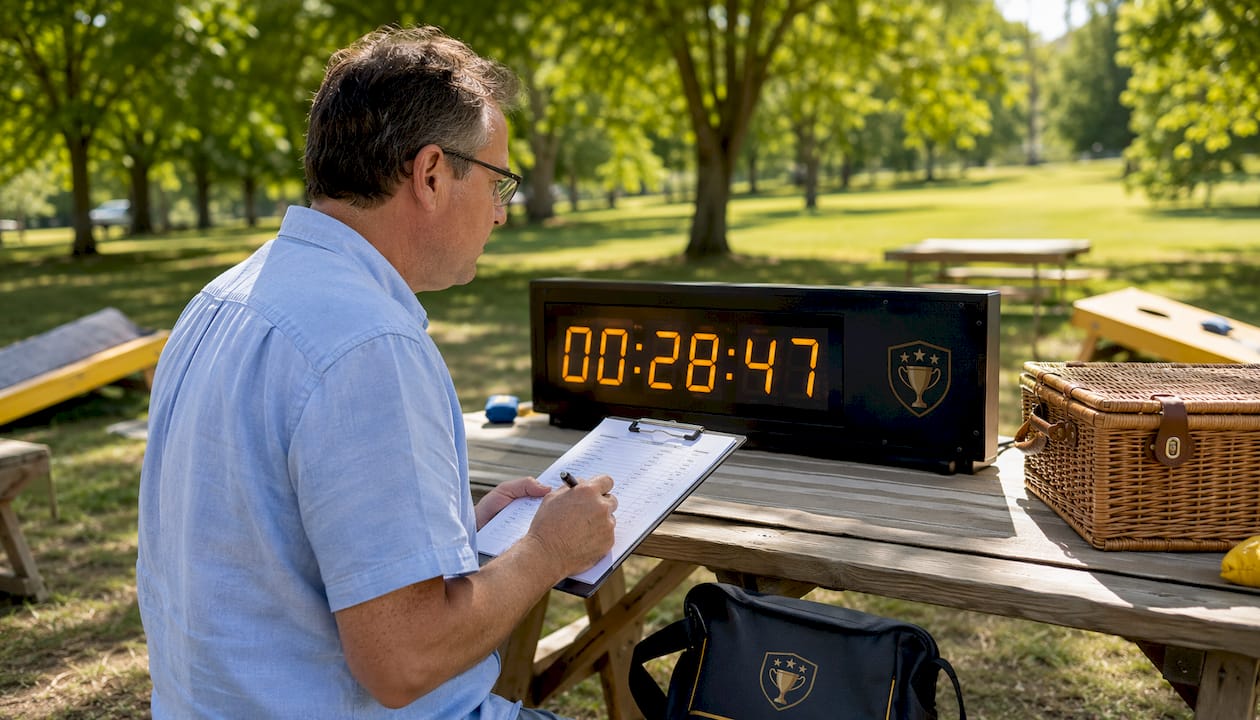
Set a 90-second timer for snake drafts and announce it clearly before the first pick. Warn participants at 15 seconds remaining. Have a defined auto-pick policy for anyone who times out, and communicate it in writing before draft day, not in the moment when someone is already frustrated.
Key communication protocols to establish in advance:
- Draft order method: randomize it before the event using a game (more on that below) rather than a digital randomizer, which feels anticlimactic
- Snake vs. linear format: confirm this in writing so nobody is surprised when their second-round pick comes later than expected
- No-show policy: clear pre-announced auto-pick or penalty rules preserve draft pace and prevent the resentment that builds when one absent participant stalls the whole room
- Trade rules during the draft: decide whether trades are allowed, how they are processed, and whether commissioner approval is required
The commissioner runs the board and enforces rules. The MC announces picks, calls the clock, and keeps the room engaged. Those are two distinct jobs, and combining them on one person usually means one of them gets done poorly. Splitting the roles keeps the draft moving and the energy up.
For hybrid drafts, assign a dedicated remote liaison in the room whose only job is to verbalize picks and engage remote participants. The "silent room" effect is real: without ambient noise and direct acknowledgment, remote participants drift off and miss their picks.
How do you create a genuinely fun draft atmosphere?
The draft order game is the single highest-return investment you can make in your event's atmosphere. Replace the randomizer app with something that creates a winner, a loser, and a story. Cornhole brackets, beer pong tournaments, NFL trivia rounds, or a closest-guess challenge on a preseason stat all work. The game itself lasts 20 minutes; the trash talk lasts the whole season.
Other atmosphere elements worth building in:
- League decorations: team pennants, custom banners, or table signs with each participant's team name add visual identity to the room
- Commissioner welcome speech and a recap of last season's champion and last-place finisher before picks start
- Color commentator role: assign your loudest, most opinionated member to roast every pick in real time. You do not need a professional, just someone the room enjoys listening to for two hours
- Scheduled breaks: build a 10-minute break into the timeline around the midpoint of the draft so participants can refuel and socialize without disrupting pick flow
- Photo opportunities: designate a photographer or set up a spot for group shots. A draft that is not documented did not happen, as far as social media is concerned
The MC's role goes beyond announcing picks. A good MC reads the room, calls out the clock with urgency, and actively prevents the draft from devolving into ten people silently staring at their phones. That social pressure is what keeps the event feeling like a shared experience.
How Draftwins makes fraternity draft competitions easier to run
Traditional fantasy leagues ask a lot of organizers: lineup management, injury tracking, waiver wire decisions, and scoring disputes that drag on for days. Draftwins takes a different approach by letting participants draft whole teams instead of individual players, which removes most of that complexity in one move.
Here is what that means practically for a fraternity sports events organizer:
- No lineup stress: participants draft teams, not players, so there is no weekly scramble to swap injured starters or chase waiver pickups
- Automated scoring and live leaderboards: Draftwins tracks results and updates standings automatically, so the competition stays visible and competitive without manual scorekeeping
- Private pools with custom rules: commissioners create a private pool tailored to their group's preferred scoring format and rules, which means the setup reflects your fraternity's culture rather than a generic template
- Fast launch: the setup process is built to get a pool running quickly, which matters when you are coordinating a group of busy college students
- World Cup pools launching first, followed by NFL and College Football pools, so there are multiple entry points depending on your group's sports calendar
Draftwins charges a platform hosting fee and does not collect entry fees, hold prize pools, accept wagers, or pay out winnings. Prize arrangements stay entirely between participants.
Pro Tip: Use Draftwins' private pool feature to create a league-specific name and custom scoring rules before your draft party. Having the pool live and visible on a shared screen during the event adds a layer of real-time excitement that a whiteboard cannot replicate.
How should you design rules and a scoring system?
Rules set before draft day prevent disputes during it. The commissioner should distribute a one-page rules document to every participant at least 48 hours before the event, covering scoring format, roster size, trade policies, and tiebreaker procedures.
For scoring, decide between standard, points-per-reception (PPR), or a team-based format like Draftwins uses. Each format rewards different strategies, so the choice shapes how competitive and engaged your group stays across the season. PPR formats tend to generate more weekly variation in scores, which keeps standings tighter longer. Team-based formats reduce the individual player knowledge barrier, making them friendlier for mixed-experience groups.
A few rules worth specifying explicitly:
- Scoring categories and point values for every relevant outcome
- Tiebreaker procedure for identical scores, whether that is a coin flip, a head-to-head record, or a designated stat category
- Waiver and trade deadlines so participants know when roster moves are locked
- Dispute resolution process: the commissioner has final say, and that authority needs to be stated in writing before anyone challenges a ruling
Keep the rulebook short. A two-page document that covers the essentials gets read. A ten-page document gets ignored, and then everyone argues about the rules they never read.
What prize structure actually motivates participants?
A prize structure works when it creates stakes at both ends of the standings. Rewarding only the winner leaves most of the group disengaged by midseason. Adding a last-place consequence, often called a "toilet bowl" penalty, keeps everyone invested even when playoff contention is out of reach.
Practical prize and incentive options:
- Championship trophy or belt: a physical award that travels with the winner and gets displayed publicly carries more social weight than a cash payout. Customized trophies with the league name and year become artifacts that outlast the season
- Last-place penalty: a public forfeit, a predetermined task, or a "loser trophy" that the last-place finisher has to display until the next season
- Weekly or mid-season prizes: small awards for highest weekly score or a midseason standings leader keep engagement up between the draft and the playoffs
- Buy-in pool: if participants contribute a buy-in, use a tool like LeagueSafe to collect and hold funds transparently. Note that Draftwins does not hold or distribute prize money; that arrangement stays between participants
The best prizes combine social visibility with a little embarrassment risk. A trophy someone has to display in their room motivates more than a $20 Venmo transfer.
What should you do after the draft ends?
The draft is not over when the last pick is announced. Budget 30–45 minutes after the final pick for a structured post-draft session, and treat it as part of the event rather than an afterthought.
Post-draft activities worth scheduling:
- Roster review: give every participant time to confirm their selections are correct before the platform locks
- Trade talk window: the 30 minutes after a draft is the peak moment for trade interest, when everyone can see what they got and what they wish they had
- Commissioner wrap-up: confirm league settings, waiver order, scoring rules, and the communication channel the group will use during the season
- Power rankings reveal: a quick commissioner or MC read of the post-draft power rankings generates immediate debate and extends the social energy of the event
- Group photo: get everyone together before they leave
Follow-up communication matters as much as the event itself. Send a recap message within 24 hours that includes final rosters, the league schedule, waiver rules, and any trade that was agreed to during the post-draft window. A group chat or Discord server dedicated to the league keeps communication organized across the season. Participants who feel connected to the group between weeks stay more engaged, make better decisions, and show up for next year's draft.
Key Takeaways
A successful fraternity sports draft competition setup requires deliberate coordination of venue, timing, roles, and communication before the first pick is ever announced.
| Point | Details |
|---|---|
| Assign roles before draft day | A commissioner manages rules and the board; an MC announces picks and keeps energy high. |
| Use a firm pick timer | Set 60–90 seconds per pick for snake drafts and communicate the auto-pick policy in writing beforehand. |
| Prioritize individual table space | Every participant needs flat workspace for a device and notes, not just a seat. |
| Plan food for 2–3 hours of grazing | Low-mess finger foods with non-alcoholic options keep everyone fueled without distracting from picks. |
| Budget some time post-draft for review and socializing | Use the time for roster review, trade talk, and locking in league settings before everyone leaves. |
FAQ
How do you make a draft party more fun?
Replace the digital randomizer with a live game like cornhole, beer pong, or an NFL trivia bracket to determine draft order. Assign an MC and a color commentator to keep energy up throughout the event.
How do you structure a fraternity sports draft?
Use a snake draft format with a 60–90 second pick timer, a randomized draft order set before the event, and a commissioner to enforce rules. Distribute a written rules document to all participants at least 48 hours in advance.
What food works best for a draft party?
Wings, sliders, nachos, pretzel bites, and a veggie tray are the standard spread because they require no utensils and hold up for 2–3 hours. Always include mocktail and non-alcoholic drink options alongside whatever else you serve.
How do you handle no-shows during a live draft?
Announce a clear auto-pick or penalty policy before draft day so the rule is not a surprise when someone goes missing. Most commissioners default to the platform's ADP-based auto-pick queue, which keeps the draft moving without manual intervention.
Can remote participants join a live fraternity draft?
Yes. Set up a video call via Zoom or Google Meet, point a camera at the physical draft board, and assign one in-person member as a remote liaison to verbally call picks and alert remote participants when they are on the clock.