
The simplest way to run a season-long football pool is to draft whole teams instead of players, use one clear scoring rule, and let software handle the leaderboard. Skip lineup management, skip trade drama, skip the weekly babysitting fantasy football demands. Pick your teams once in a 30 to 60 minute draft, then track results all season.
Here's the minimum launch checklist:
- Publish rules (scoring, fees, payout, tie-breakers) before Week 1, following the same logic in this commissioner guide
- Collect entry fees before kickoff, ideally 48 hours ahead per standard pool payment practice
- Schedule a single draft session, 30 to 60 minutes, with a fixed pick order
- Turn on automated scoring and a live leaderboard so nobody has to tally points by hand
A platform like DraftWins handles that last step natively. Commissioners typically spend under an hour on setup and draft day, then a few minutes a week checking standings. Participants spend even less. That's the whole time commitment.
Key Takeaways
A low-maintenance football season pool works when you draft teams instead of players, lock one scoring rule, and automate the leaderboard before Week 1 kicks off.
| Point | Details |
|---|---|
| Publish rules early | Post scoring, fees, payout, and tie-breakers before the draft to prevent mid-season disputes. |
| Collect fees upfront | Set a firm deadline, ideally 48 hours before kickoff, to avoid late-payment friction. |
| Balance your draft order | Use a custom order instead of a straight snake when projected team wins are uneven. |
| Keep scoring simple | One rule, like total points scored, is easier to track and explain than layered formulas. |
| Automate with DraftWins | DraftWins runs the draft, scoring, and leaderboard for team-draft pools, cutting commissioner bookkeeping to nearly zero. |
Table of Contents
- What Rules to Publish Before Week 1
- How Do You Run a Fast, Fair Team Draft?
- What's the Simplest Way to Score a Team Pool?
- How Should You Structure Payouts and Fees?
- What Should a Commissioner Automate?
- How Do You Keep Casual Players Engaged All Season?
- What Belongs in Your Rule Sheet Template?
- Launch a Team-Draft Pool With DraftWins
- Sources
- FAQ
What Rules to Publish Before Week 1
Every dispute that wrecks a pool traces back to a rule nobody wrote down. The fix is a short, locked rule sheet posted before anyone picks a team.
Publish these seven items, in this order:
- Scoring method — how weekly and season points get calculated
- Roster and team count — how many teams each person drafts, how many total teams are in play
- Entry fee and deadline — the dollar amount and the exact cutoff time
- Payout structure — who gets paid, and how much
- Tie-breakers — the order of tie-breaking rules, listed from most to least specific
- Draft date, time, and order — when it happens and who picks first
- No-show policy — what happens if someone misses the draft or stops paying attention mid-season
Write each rule as one plain sentence. "Weekly winner is the team with the most total points; ties go to whichever team scored more in the late game" beats a paragraph of hedging. For fees, collecting everything before the season starts and setting a firm deadline, commonly 48 hours before the first kickoff, heads off the awkward "I'll Venmo you later" problem entirely.
Post the rules somewhere permanent: a group text pinned message, a shared doc, or a locked page inside your pool platform. Then, ask every participant to reply with a thumbs-up or a one-word confirmation. That reply is your proof everyone agreed to the same terms.
How Do You Run a Fast, Fair Team Draft?
A team draft doesn't need to feel like a fantasy war room. Most groups finish in under an hour once the order is set and everyone knows the rules going in.
Standard snake order works fine for small, casual groups where team strength is roughly balanced. Pick order reverses each round, so whoever picks first in round one picks last in round two.
Custom balanced order solves a problem snake drafts don't: projected wins across NFL teams aren't distributed evenly. A handful of teams are projected for 11 or more wins, a big cluster sits in the middle, and several are projected for four or fewer. Math-based draft order calculations show that a custom order, built to spread strong, middling, and weak teams evenly across participants, can shrink the standard deviation of projected wins from around 1.49 down to nearly 0.01 in a six-person pool. That's the difference between one lucky drafter running away with the season and a genuinely competitive field.
Roster size matters too. Two or three teams per drafter, with 8 to 10 total participants, keeps the pool easy to track without diluting anyone's rooting interest. Fewer teams per person means less to check on Sunday.
A clean draft script looks like this:
- Confirm attendance and pick order 24 hours ahead
- Set a 60 to 90 second clock per pick
- Have each drafter type or say their pick, then a co-host confirms it out loud
- Auto-skip and auto-pick the next available team for no-shows after two skipped turns
- Post the final roster grid the moment the last pick locks in
Pro Tip: If your group has a wide spread in team strength, run the custom balanced order instead of a straight snake. For a six to ten person pool, alternate one strong, one middle, and one weak team per drafter's slot rather than assigning by raw pick number.
What's the Simplest Way to Score a Team Pool?
Pick one scoring method and stick with it all season. The two easiest options are total points scored or wins plus point differential. Total points is the more forgiving choice for casual groups, since it doesn't punish a team for grinding out a 13 to 10 win.
Here's what a simple weekly scoring table looks like for a three-team roster:
Season scoring is just the sum of every weekly total. No multipliers, no bonus categories, nothing that requires a spreadsheet formula more complicated than SUM.
Tie-breakers need to be specific enough that they never require a group vote mid-season. A workable order:
- Weekly ties: highest single-team score in that week's late game
- Season ties: head-to-head record between the tied drafters' teams, if applicable
- Still tied: total season points scored by all drafted teams combined
- Final fallback: a coin flip, recorded and announced publicly
Print the tie-breaker order in the same document as your scoring rule and treat it as non-negotiable once the season starts. Changing a tie-breaker after a tie actually happens is how pools implode.
How Should You Structure Payouts and Fees?
Three payout structures cover almost every casual pool. Winner-take-all suits small groups of six or fewer, where a split payout feels too thin to matter. Top-three splits, commonly 60/30/10, reward consistency across a bigger field. Weekly prizes plus a season-end split keeps interest alive for people who fall out of season contention early.
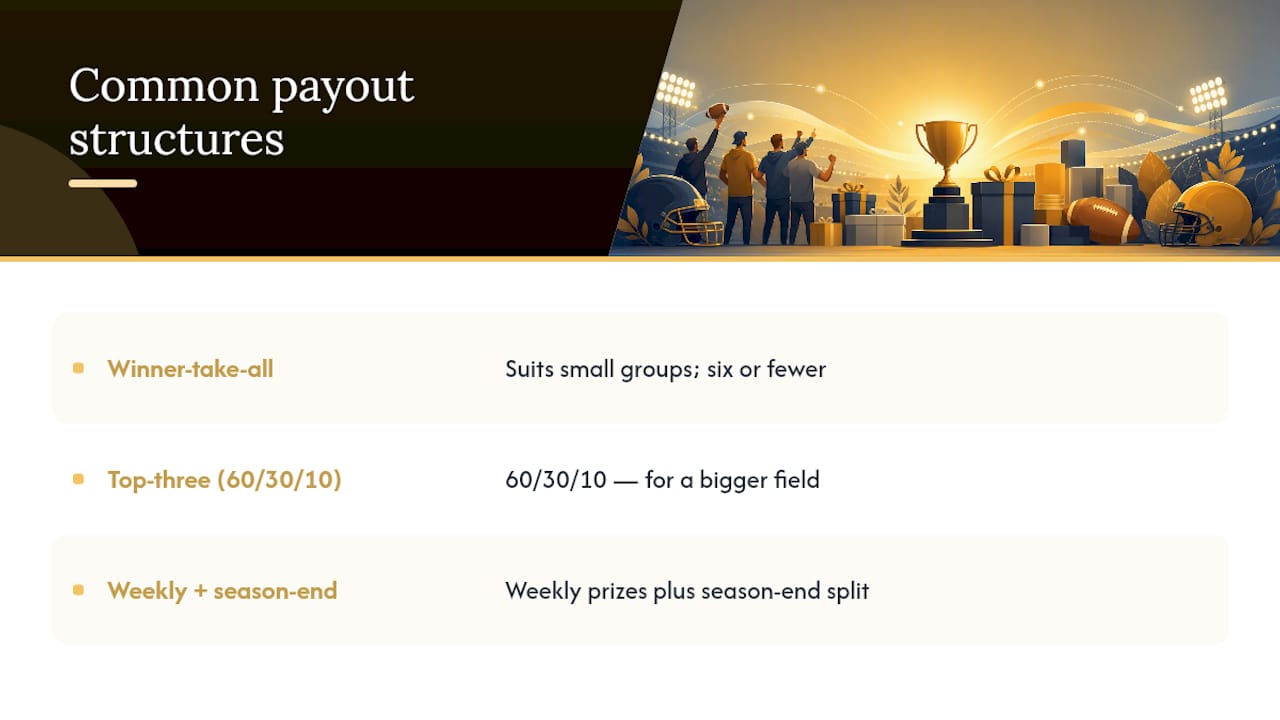
For a small pool with typical entry fees, a 60/30/10 split pays accordingly to reward the top three finishers. State the platform or hosting fee separately from the payout pool so nobody confuses the two. If cash handling feels risky or awkward, a dedicated payment or escrow service removes that friction, and locking in every entry fee before the season starts, following the same standard used for March Madness pools, prevents the "I'll pay you after Week 3" situation that quietly kills trust in a pool.
What Should a Commissioner Automate?
Manual bookkeeping is the single biggest reason commissioners burn out by Week 8. Automate these five tasks and most of that workload disappears:
- Weekly and season scoring calculations
- Live leaderboard updates
- Payment tracking against your entry-fee deadline
- Pick confirmations during the draft
- Weekly result summaries sent to the group
Commissioners running these manually often lose 30 to 60 minutes a week just tallying scores and answering "wait, who's winning?" texts. Automated standings cut that time close to zero and remove the human-error disputes that come with hand-typed math. DraftWins builds this in from setup: automated team drafts, live scoring, and a public leaderboard your group can check without asking you for an update.
What still needs a human: settling genuine disputes, enforcing the no-show policy you published, and confirming payouts actually land in the right hands. Automation handles the math. You handle the judgment calls.
How Do You Keep Casual Players Engaged All Season?
A pool dies from silence, not from bad scoring rules. The fix is a handful of low-effort touches spread across the season rather than one big push in Week 1.

Weekly, an automated standings post with a one-line highlight, "Team A's drafter jumps to first after a 34-point week," keeps the group checking in. Small weekly side prizes, even $5, give people a reason to care about a single Sunday even if their season total is sunk.
Mid-season, call out milestones (a drafter's teams crossing 500 combined points, a surprise last-place-to-third climb) and consider a small surprise prize to reignite anyone who's checked out. By the final week, run a quick payout window, announce final standings clearly, and open sign-ups for next season while the excitement is still fresh.
Pro Tip: Set default picks for inactive participants so one disengaged player doesn't tank the group's momentum, and announce weekly winners publicly, not just the season champion, so more people stay invested longer.
What Belongs in Your Rule Sheet Template?
Copy this structure into a group message or shared doc and fill in your specifics:
- Pool name and commissioner contact info
- Entry fee amount and payment deadline (recommend 48 hours before kickoff)
- Draft date, time, and pick order method
- Roster format (teams per drafter, total teams in the pool)
- Scoring method (one sentence, no ambiguity)
- Tie-breaker order (weekly and season, listed top to bottom)
- Prize distribution (dollar amounts or percentages per placement)
- No-show and default policy
Mark any mid-season changes clearly, though ideally you avoid changes entirely once the pool is locked. Post the final version, then require every participant to reply with a confirmation. Keep those replies as your record of who agreed to what.
Launch a Team-Draft Pool With DraftWins
Everything above, the rules, the draft, the scoring, the leaderboard, is exactly what DraftWins is built to handle without a spreadsheet in sight. Commissioners draft whole teams instead of juggling weekly lineups, set custom scoring rules once, and let automated scoring and a live leaderboard do the rest of the work all season.
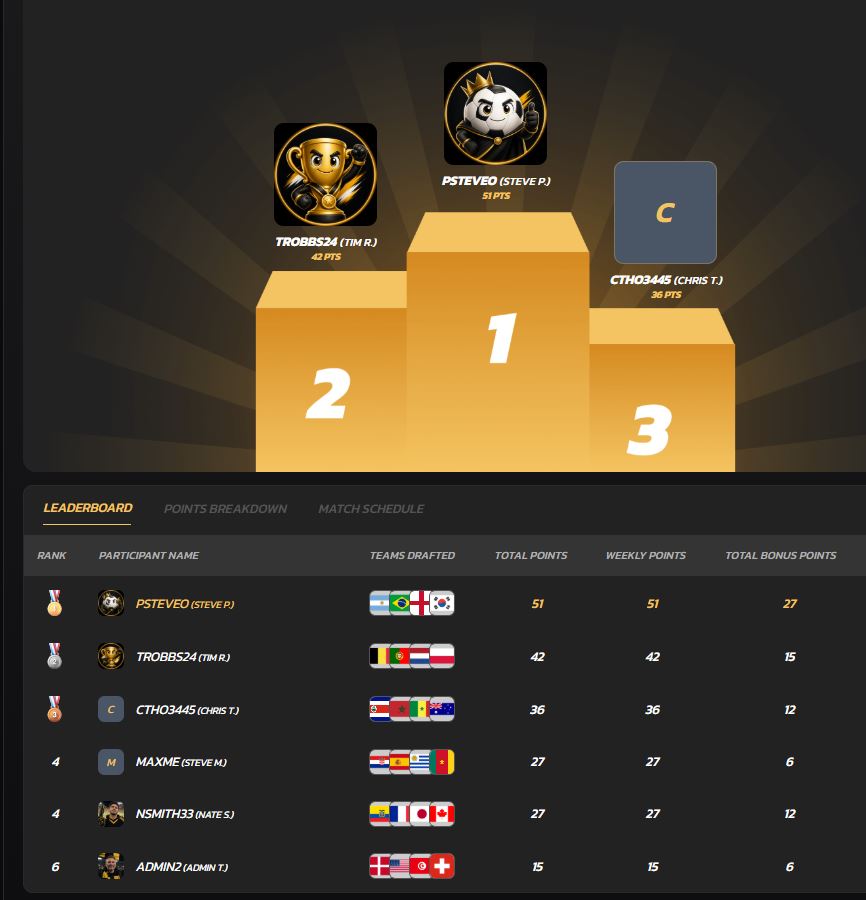
Setup takes minutes, not an evening. You create a private team-draft pool, invite your group, pick your draft time, and the platform handles scoring and standings automatically from kickoff on. DraftWins charges a one-time platform fee to host the pool. It doesn't collect entry fees, hold a prize pool, or handle payouts, so your group still manages its own money the way it always has, just without the manual math. If you're running an NFL pool this season, start building your pool and have your rules and draft locked in before Week 1.
Sources
- Fantasy football commissioner guide
- How to run a March Madness pool
- Collecting fees for fantasy leagues
FAQ
What is a team-draft football pool?
It's a season-long pool where participants draft entire NFL teams instead of individual players, then earn points based on how those teams perform each week.
How long does a team draft take?
A well-run draft with 8 to 10 participants and a 60 to 90 second pick clock typically finishes in 30 to 60 minutes.
What's the easiest scoring method for a casual pool?
Total points scored by your drafted teams each week is the simplest method, since it requires no bonus categories or formulas beyond basic addition.
When should entry fees be collected?
Collect all entry fees before the season starts, with a firm deadline commonly set 48 hours before the first kickoff, to avoid late-payment disputes.
Does DraftWins handle payouts or hold entry fees?
No. DraftWins charges a one-time platform fee to host the pool but does not collect entry fees, hold a prize pool, or process payouts, so groups manage their own money separately.